Objectives
1. Explain theelements of a fire
2. Differentiate classification of the
basic fuel to fire.
3. Explain the types of fire
extinguishers.
4. Distinguish between the different
fire extinguishers.
5. Demonstrate how to extinguish a
fire.
6. Explain the guidelines regarding
fighting a fire.
What is afire?
Combustion or burning, in which
substances combine chemically with
oxygen from the air and typically give out
bright light, heat, and smoke.
Elements of afire
The Fire Triangle
• The Fire Triangle is a simple model used to
understand the ingredients necessary for most
fires.
• Triangle illustrates a fire requires three elements:
Heat - to reach ignition temperature
Fuel - or combustible material to feed the fire
Oxygen - to sustain combustion
Together, they produce the Chemical Reaction
that is Fire.
• The fire is prevented or extinguished by removing
anyone of the three elements. Keep fuel and
ignition sources separate.
• A fire naturally occurs when the elements are
combined in the right mixture.
Fuel Classifications
• Firesare classified according to the type of fire
that is burning. Basically what type of material
is on fire, i.e. paper, grease, electrical
equipment etc.
• It’s very important to understand the four
different fire or fuel source classifications.
Understanding this will allow you to correctly
use the right fire extinguisher.
• If you were to use the wrong type of fire
extinguisher on the wrong class of fire, you may
or may not be able to control or even extinguish
the fire.
9.
Fuel Classifications
• wood
•cloth
• paper
• rubber
• many plastics
• gasoline
• oil
• grease
• tar
• oil-based paint
• flammable
gases
• energized
electrical
equipment
• computer
• TV
• radio
A Trash Wood Paper B Liquids Grease
C Electrical Equipment K Cooking Media
• vegetable oil
• animal oil
• fats
• cooking
equipment
K
10.
Fuel Classifications
• Mostfire extinguishers will have a picture label telling
you which types of fires the extinguisher is designed
to fight.
• For example, a simple water extinguisher might have
a label like this:
Which means it should only be used for Class A fires.
11.
Types of FireExtinguishers
• Different types of fire extinguishers are designed to
fight different classes of fires.
• The three most common types of fire extinguishers
are:
1. Water (Class A)
2. Carbon Dioxide (CO2) (Class BC)
3. Dry Chemical (Class ABC, BC, DC)
** Wet Chemical (Class K)
12.
Types of FireExtinguishers
PRESSURIZED WATER
A Trash Wood Paper
B Liquids Grease
C Electrical Equipment
A Trash Wood Paper
B Liquids Grease
C Electrical Equipment
• Class “A” fires only.
• 2.5 gal. water at 150-175 psi (up to 1
minute discharge time).
• Has pressure gauge to allow visual
capacity check.
• 30-40 ft. maximum effective range.
• Extinguishes by cooling burning
material below the ignition point.
Taking away the heat element from the
fire.
13.
Types of FireExtinguishers
A Trash Wood Paper
B Liquids Grease
C Electrical Equipment
A Trash Wood Paper
B Liquids Grease
C Electrical Equipment
CARBON DIOXIDE (CO2)
• Class “B” or “C” fires.
• 2.5-100 lb. of CO2 gas at 150-200 psi (8-
30 seconds discharge time).
• Has NO pressure gauge--capacity
verified by weight.
• 3-8 ft. maximum effective range.
• Extinguishes by smothering burning
materials. Displaces oxygen.
• Effectiveness decreases as temperature
of burning material increases.
14.
Types of FireExtinguishers
MULITPURPOSE DRY CHEMICAL
A Trash Wood Paper
B Liquids Grease
C Electrical Equipment
A Trash Wood Paper
B Liquids Grease
C Electrical Equipment
• Class “A”, “B”, or “C” fires. On campus
mostly Class ABC.
• 2.5-20 lb. dry chemical (ammonium
phosphate) pressurized to 50-200 psi by
nitrogen gas (8-25 seconds discharge
time).
• Has pressure gauge to allow visual
capacity check.
• 5-20 ft. maximum effective range.
• Extinguishes by smothering burning
materials. This separates the fuel from
the oxygen in the air.
15.
Types of FireExtinguishers
WET CHEMICAL
K Cooking Media
• Class “K” fires.
• 1.5 gal. of stored pressure PRX
wet chemical extinguishing agent
(40 sec. discharge time).
• 10-12 ft. maximum effective
range.
• Extinguishes by cooling and
forming a foam blanket to prevent
the fire from reigniting.
16.
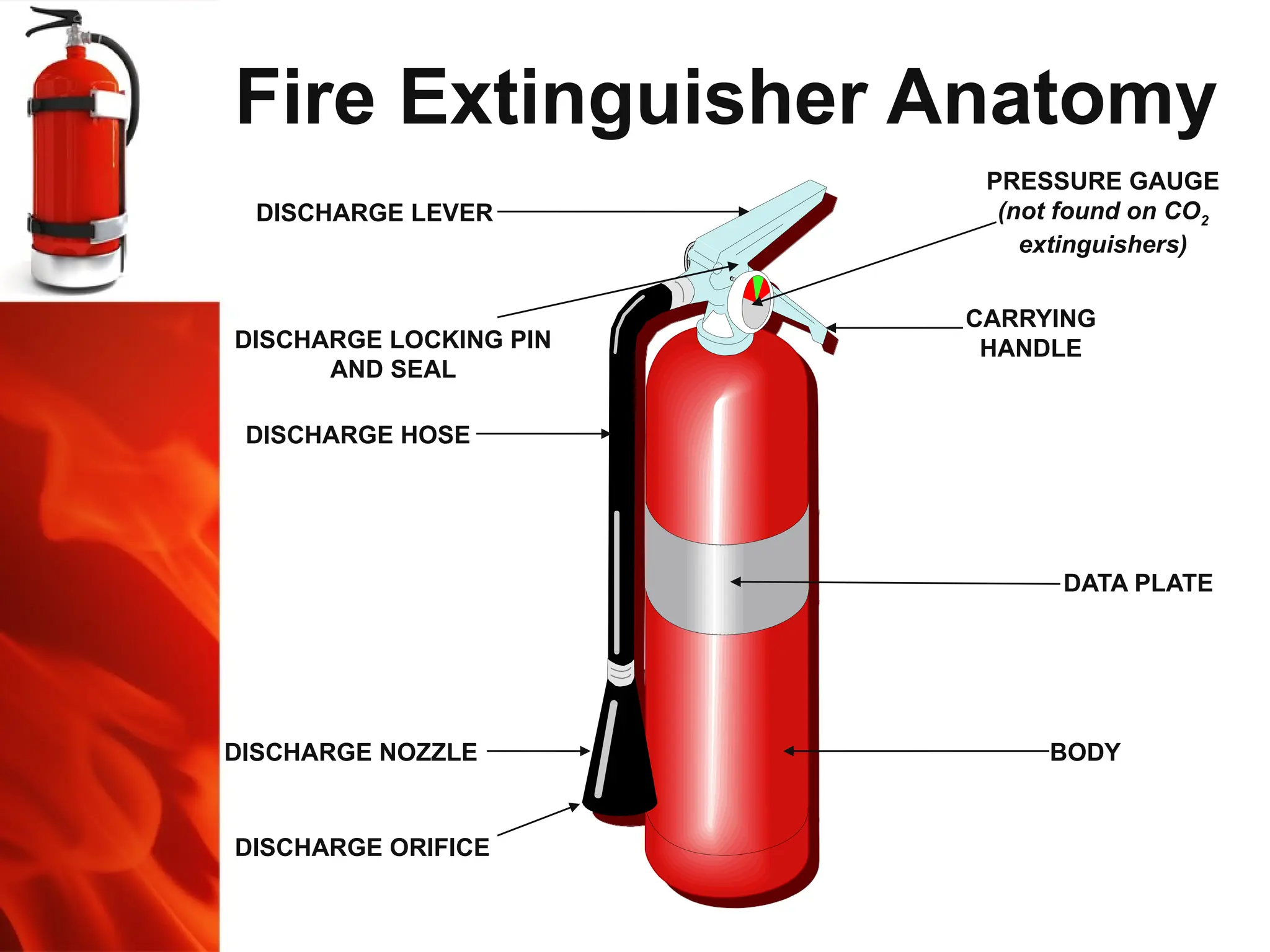
Fire Extinguisher Anatomy
DATAPLATE
PRESSURE GAUGE
(not found on CO2
extinguishers)
BODY
DISCHARGE LEVER
DISCHARGE LOCKING PIN
AND SEAL
DISCHARGE HOSE
DISCHARGE NOZZLE
DISCHARGE ORIFICE
CARRYING
HANDLE
17.
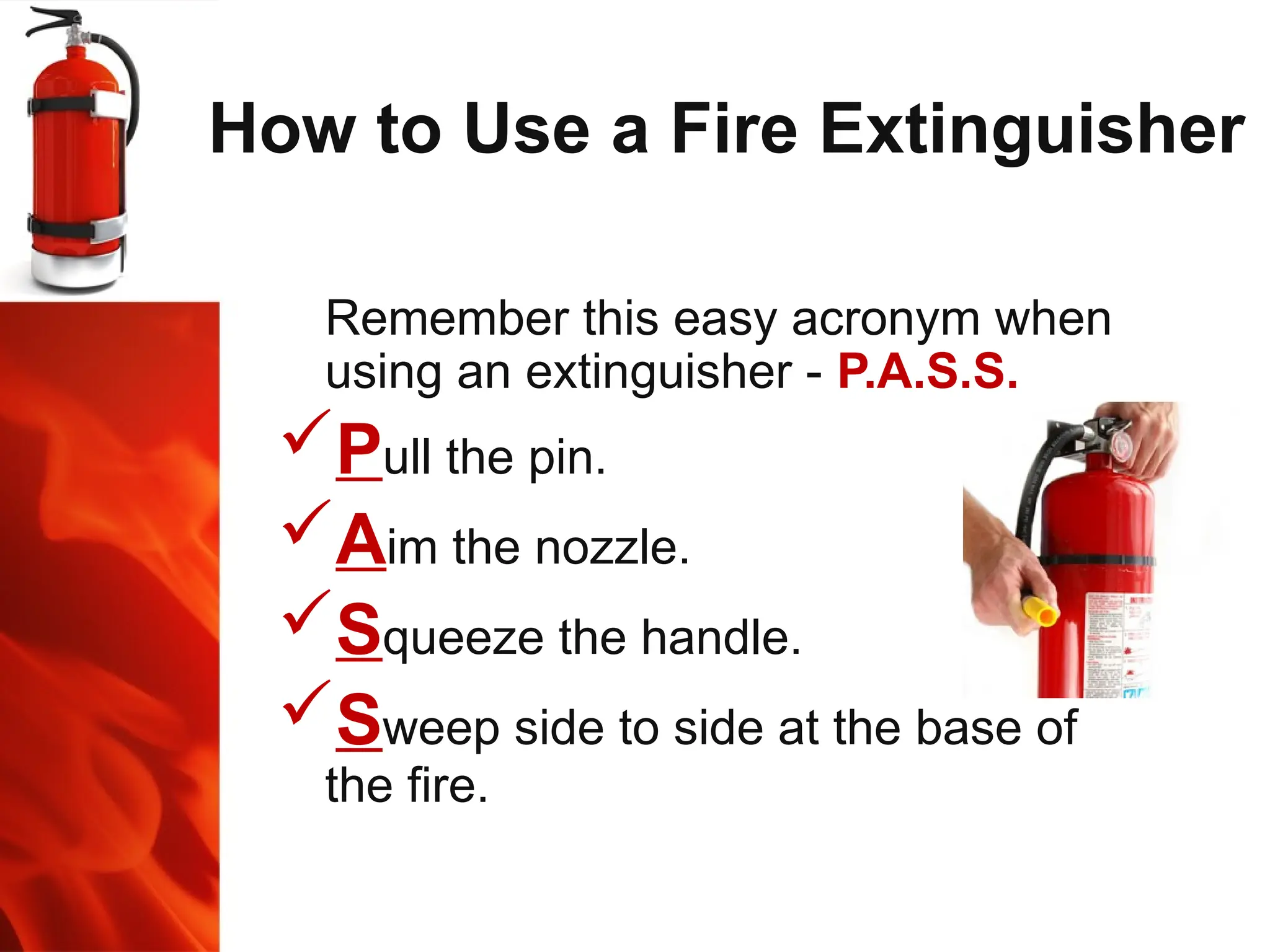
How to Usea Fire Extinguisher
Remember this easy acronym when
using an extinguisher - P.A.S.S.
Pull the pin.
Aim the nozzle.
Squeeze the handle.
Sweep side to side at the base of
the fire.
18.
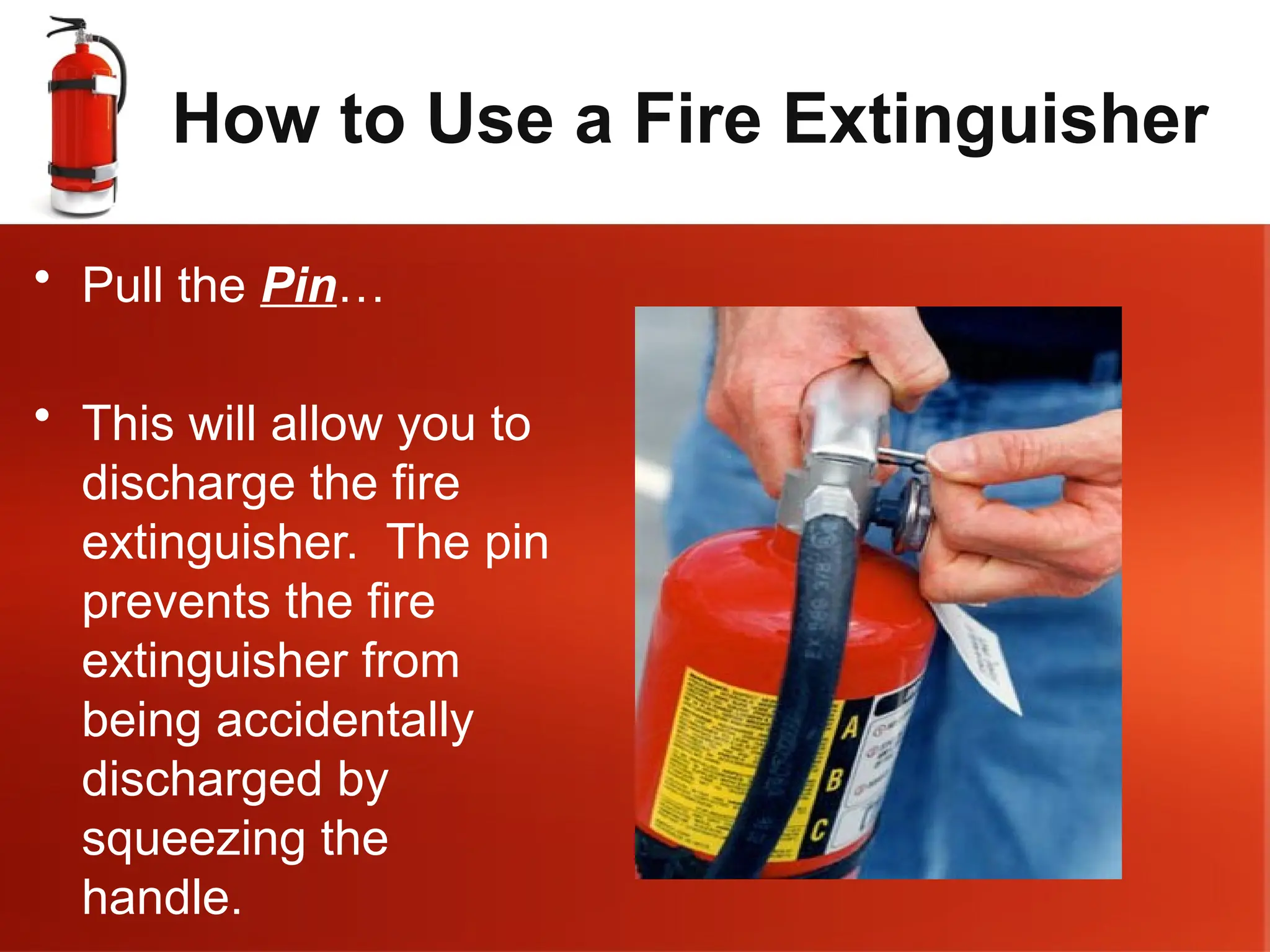
How to Usea Fire Extinguisher
• Pull the Pin…
• This will allow you to
discharge the fire
extinguisher. The pin
prevents the fire
extinguisher from
being accidentally
discharged by
squeezing the
handle.
19.
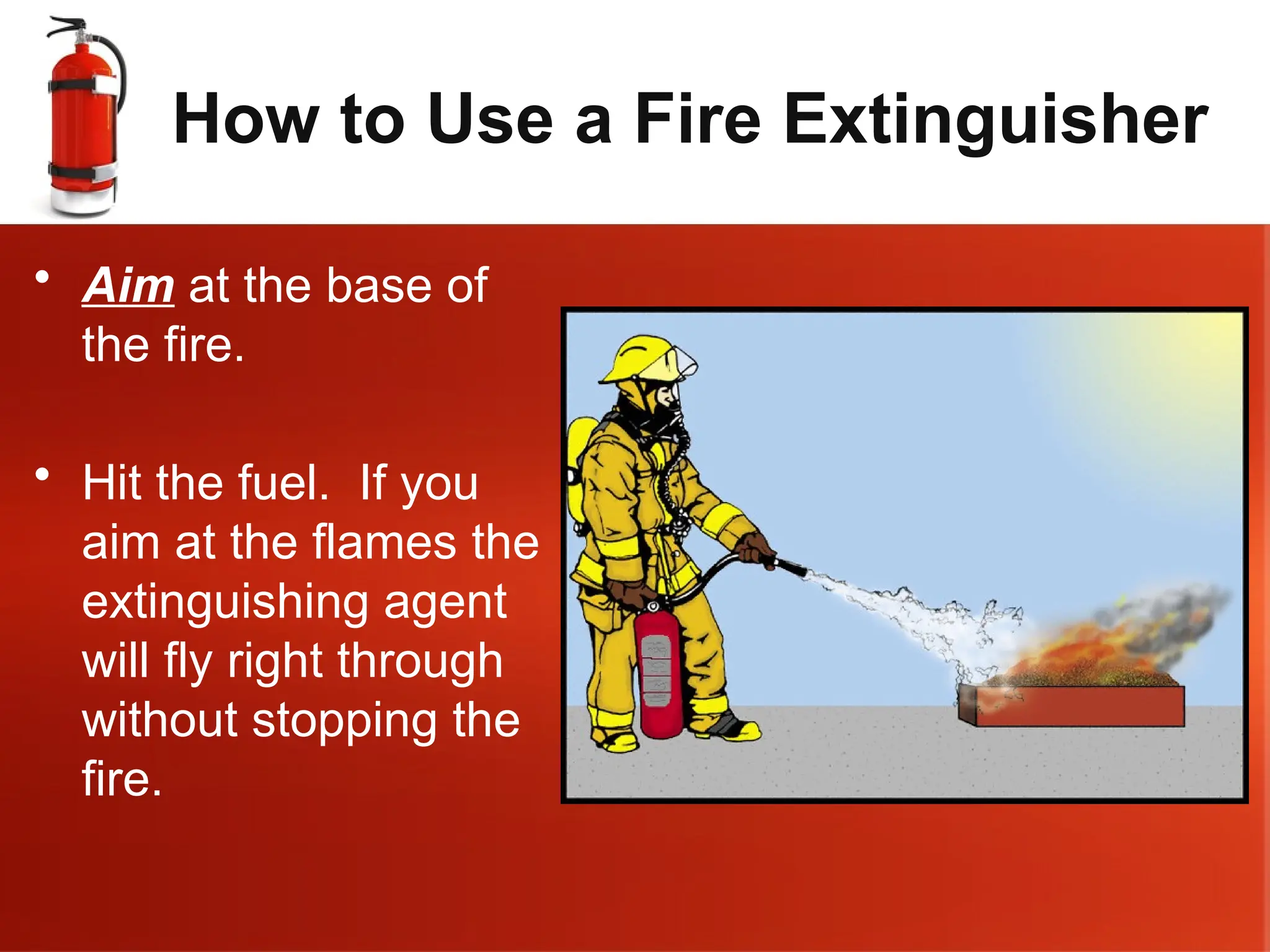
How to Usea Fire Extinguisher
• Aim at the base of
the fire.
• Hit the fuel. If you
aim at the flames the
extinguishing agent
will fly right through
without stopping the
fire.
20.
How to Usea Fire Extinguisher
• Squeeze the top
handle.
• Squeezing the
handle opens a valve
that releases the
pressurized
extinguishing agent
from the fire
extinguisher.
21.
How to Usea Fire Extinguisher
• Sweep from side to side.
(until the fire is completely
out)
• Start using the fire
extinguisher from a safe
distance (6-8 feet) then slowly
move forward if possible.
• Once the fire is out, keep an
eye on the area in case it
reignites.
22.
Guidelines for FightingFires
Fires can be very dangerous and you should always be certain that you will
not endanger yourself or others when attempting to put out a fire.
For this reason, when a fire is discovered…
1. Assist any person in immediate danger to safety, if it can be
accomplished without risk to yourself. Don’t put yourself in danger too.
2. Call 911 or activate the building fire alarm. The fire alarm will notify
the fire department and other building occupants.
If the fire is small (and Only after having done these 2 things), you may
attempt to use an extinguisher to put it out.
23.
Guidelines for FightingFires
Before deciding to fight the fire, keep these things in mind:
1. Know what is burning! If you don’t know what’s burning, you won’t know what kind
of fire extinguisher to use
2. Even if you have an ABC fire extinguisher, there may be something in the fire that is
going to explode or produce toxic fumes.
Chances are you will know what’s burning, or at least have a pretty good idea, but if you
don’t, let the fire department handle it.
3. Is the fire spreading rapidly beyond the point where it started? The time to use a fire
extinguisher is at the beginning stages of the fire
4. If the fire is already spreading quickly, it is best to simply evacuate the building.
As you evacuate the building, close the door (if there is one) behind you as you leave.
24.
Guidelines for FightingFires
• The final rule is to always position yourself with an exit or
means of escape at your back before you attempt to use a
fire extinguisher to put out a fire.
• In case the extinguisher malfunctions, or something
unexpected happens, you need to be able to get out quickly.
You don’t want to become trapped.