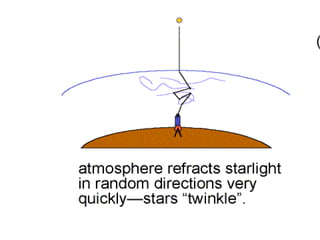
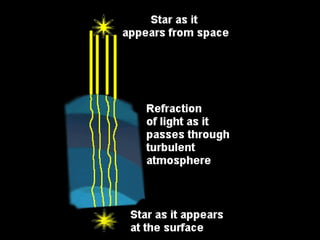
Planets
do not
twinkle
because
they are
closer
and not
a single
point of
light.
We only see the visible range.
But stars give off energy in all the wavelengths!
Using light to discover information
about the universe.


There are two kinds:
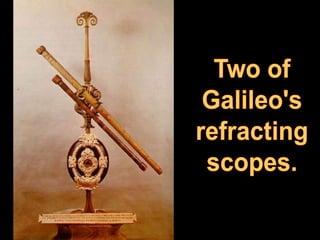
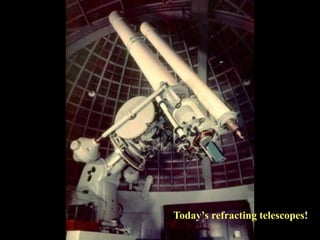
Uses lens to collect the light.
Today’s refracting telescopes!
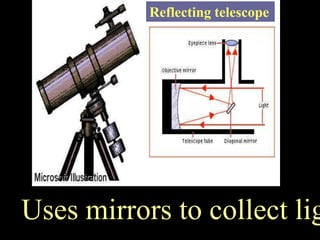
Reflecting telescope
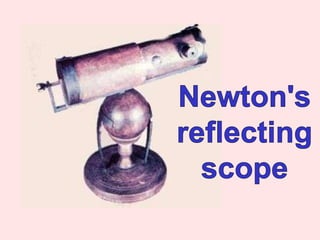
            Reflecting scope


Uses mirrors to collect lig
Spotting scope - A small
refractor to line up the
big scope.


                             Eyepiece for viewing
                           Today’s reflector
Mount Palomar
Observatory                 Hale Telescope
                            Inside Mt. Palomar Observatory
 Large telescopes are put in observatories to
 protect them.
Other scopes at Palomar
   Look across the mountain tops!
1. Mountain tops above atmospheric haze.
 Reduces the twinkle effect and distortion.

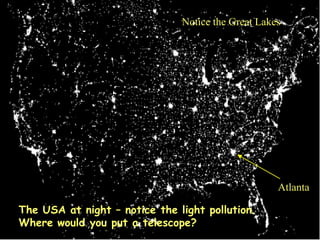
2. Far from city lights ( light pollution).

           3. If our atmosphere blocks the
           wavelength needed to study, then
           the scope goes into orbit!
Notice which wavelengths are blocked!
Notice the Great Lakes


                                                    Atlanta

The USA at night – notice the light pollution.
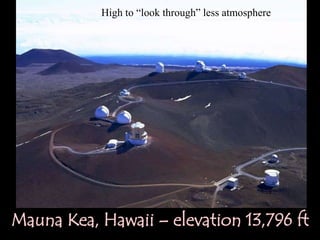
Where would you put a telescope?
High to “look through” less atmosphere


Mauna Kea, Hawaii – elevation 13,796 ft
Multi-mirror reflector in Hawaii
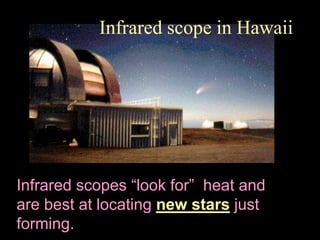
Infrared scope in Hawaii


Infrared scopes “look for” heat and
are best at locating new stars just
forming.
COBE -
                             An Infrared
                             scope that
                             is in orbit.
                             Infrared = heat

                               It has located very
                               important data
                               about the formation
                               of the universe.

Cosmic Background Explorer
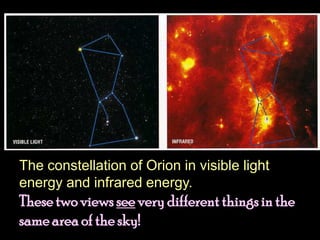
The constellation of Orion in visible light
energy and infrared energy.
These two views see very different things in the
same area of the sky!
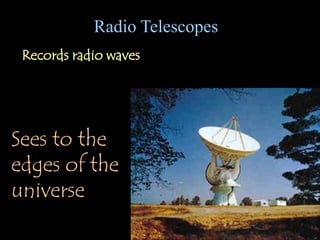
Radio Telescopes
 Records radio waves


Sees to the
edges of the
universe
VLA
                                            New
                                            Mexico

Very Large Array uses multiple radio telescopes.
VLA from above.
They work as a unit
kind of like a fly’s eye.
Largest radio scope in the world in the top of an
extinct volcano! Puerto Rico
Records UV radiation.
Astronomers use this wave
length mostly to look at
and track what the sun is
doing.
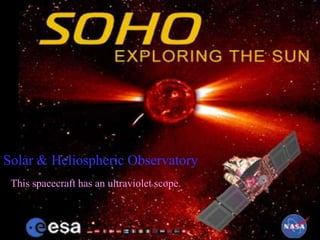
Solar & Heliospheric Observatory
 This spacecraft has an ultraviolet scope.
The sun in
different UV
wavelengths.
Records x ray emissions from
objects in “deep” space
    Best for “looking” for black holes,
    dying stars, and other strange
    objects.

    Must be above the atmosphere!
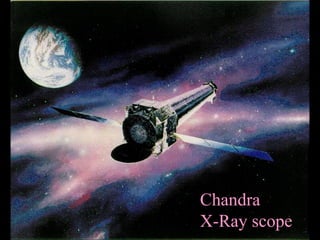
Chandra
X-Ray scope
X Rays from two
Black holes in one
Galaxy.
Due to their high energy content,
Gamma rays are able to cause serious damage
when absorbed by living cells.
Gamma rays are also able to penetrate dense materials.
Aren’t we glad our atmosphere blocks them!


These telescopes are looking for high
energy events: black holes, neutron
stars and quasars.
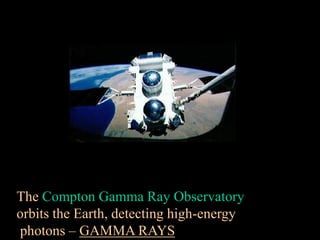
The Compton Gamma Ray Observatory
orbits the Earth, detecting high-energy
photons – GAMMA RAYS
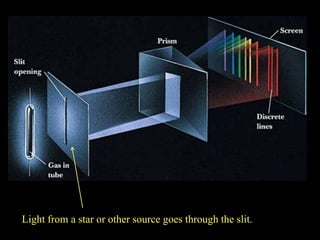
Takes light from stars and
analyzes it.
Light from a star or other source goes through the slit.
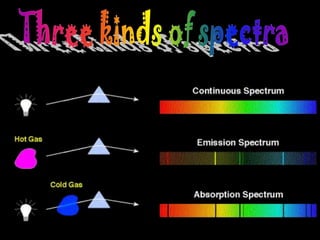
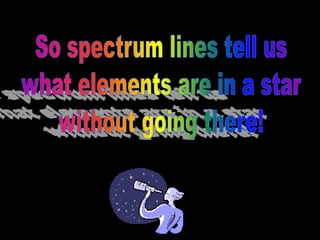
Every element has
a different set of
spectrum lines.


         Much like people
         having different
         fingerprints.
Emission spectrum


   Krypton’s spectrum


Neon’s spectrum
Notice that emission and absorption are the same.
Telescopes & astronomy andie

Telescopes & astronomy andie