By –
Naveen Sihag
B.Tech
BLACK HOLE
BLACK HOLES: WHAT ARE
            THEY?
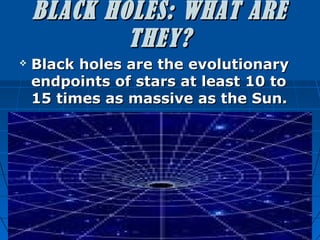
   Black holes are the evolutionary
    endpoints of stars at least 10 to
    15 times as massive as the Sun.
Facts and figures
   Black holes are objects so dense that not even
    light can escape their gravity , and since nothing
    can travel faster than light, nothing can escape
    from inside a black hole.
   For example, if our Sun is magically crushed until
    it becomes about 1 mile in size, it would become
    a black hole, but the Earth would remain in its
    same orbit.
   Even back in Isaac Newton's time, scientists
    speculated that such objects could exist.
FORMATION OF BLACK
            HOLE
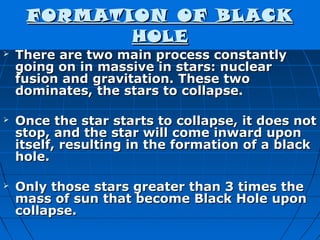
   There are two main process constantly
    going on in massive in stars: nuclear
    fusion and gravitation. These two
    dominates, the stars to collapse.

   Once the star starts to collapse, it does not
    stop, and the star will come inward upon
    itself, resulting in the formation of a black
    hole.

   Only those stars greater than 3 times the
    mass of sun that become Black Hole upon
    collapse.
IF WE CAN’T SEE THEM, THEN HOW DO WE
               KNOW THEY ARE THERE?
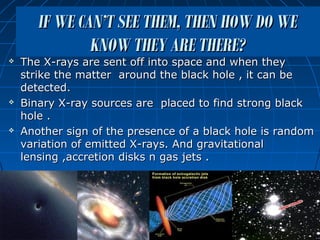
   The X-rays are sent off into space and when they
    strike the matter around the black hole , it can be
    detected.
   Binary X-ray sources are placed to find strong black
    hole .
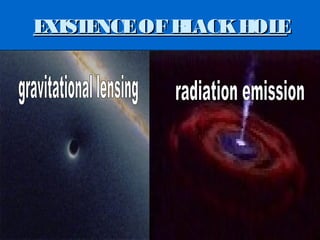
   Another sign of the presence of a black hole is random
    variation of emitted X-rays. And gravitational
    lensing ,accretion disks n gas jets .
EXIST NCE OF B ACK H E
     E        L     OL
SIZE OF A BLACK HOLE
continue……………
   Black hole weigh about as much as a star . It
    would be aprox 10 times mass of sun .
   More massive , more space it would require .
    The size and mass have a simple relationship,
    which is independent of rotation. According to
    this mass/size criterion then, black holes are
    commonly classified as :
   Supermassive black hole
   Inter-mediate mass black hole
   Stellar-mass black hole

    Micro black hole
HOW BIG IS A BLACK
         HOLE?
   Black holes weigh about as much as a massive
    star. A typical mass for such a black hole would
    be about 10 times the mass of the sun.
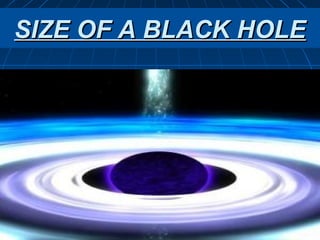
   The more massive a black hole is, the more
    space it takes up. A typical 10-solar-mass black
    hole would have a radius of 30 kilometers, and
    a million-solar-mass black hole at the center of
    a galaxy would have a radius of 3 million
    kilometers.
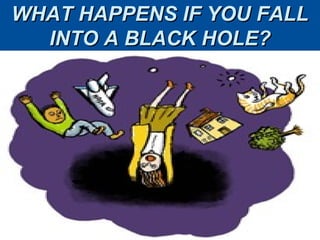
WHAT HAPPENS IF YOU FALL
  INTO A BLACK HOLE?
FALLING INTO A BLACK
            HOLE
   A black hole is a place where the force of gravity is so
    powerful that you would need to be travel at a speed faster
    than the speed of light to escape its pull. Since nothing in
    the universe is faster than the speed of light, nothing that
    falls into a black hole can ever escape.

   The pulling force would increase as you moved toward the
    center, creating what's called a "tidal force" on your body.

   If you fell into a large enough black hole, no one outside
    would be able to see you, but you'd have a view of them.
    Meanwhile, the gravitational pull would bend the light
    weirdly and distort your last moments of vision.
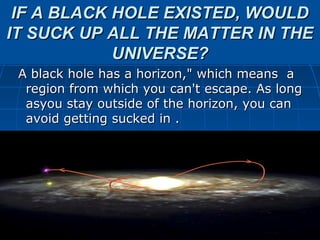
IF A BLACK HOLE EXISTED, WOULD
IT SUCK UP ALL THE MATTER IN THE
            UNIVERSE?
 A black hole has a horizon," which means a
  region from which you can't escape. As long
  asyou stay outside of the horizon, you can
  avoid getting sucked in .
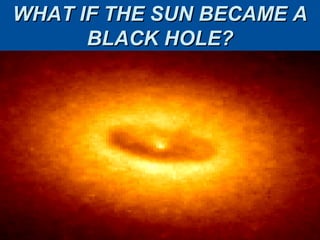
WHAT IF THE SUN BECAME A
      BLACK HOLE?
SUN AS A BLACK HOLE
   Only stars that weigh considerably more
    than the Sun end their lives as black holes.
    The Sun is going to stay roughly the way it
    is for another five billion years or so.

    If the Sun *did* become a black hole for
    some reason? The main effect is that it
    would get very dark and very cold around
    here. The Earth and the other planets would
    not get sucked into the black hole; they
    would keep on orbiting in exactly the same
    paths they follow right now.
BLACK HOLE HUBBLE
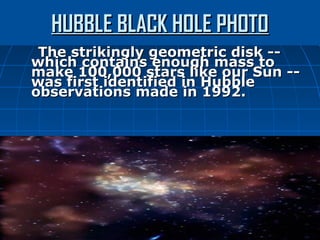
HUBBLE BLACK HOLE PHOTO
 The strikingly geometric disk --
which contains enough mass to
make 100,000 stars like our Sun --
was first identified in Hubble
observations made in 1992.
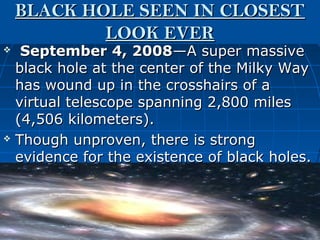
BLACK HOLE SEEN IN CLOSEST
            LOOK EVER
  September 4, 2008—A super massive
  black hole at the center of the Milky Way
  has wound up in the crosshairs of a
  virtual telescope spanning 2,800 miles
  (4,506 kilometers).
 Though unproven, there is strong

  evidence for the existence of black holes.
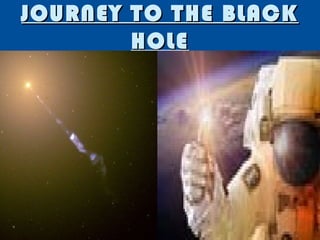
JOURNEY TO THE BLACK
        HOLE
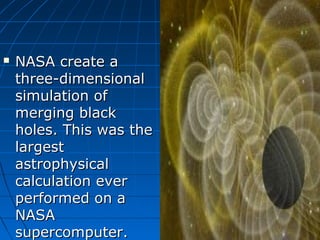
   NASA create a
    three-dimensional
    simulation of
    merging black
    holes. This was the
    largest
    astrophysical
    calculation ever
    performed on a
    NASA
    supercomputer.
THANK

Black holes

  • 1.
  • 2.
  • 3.
    BLACK HOLES: WHATARE THEY?  Black holes are the evolutionary endpoints of stars at least 10 to 15 times as massive as the Sun.
  • 4.
    Facts and figures  Black holes are objects so dense that not even light can escape their gravity , and since nothing can travel faster than light, nothing can escape from inside a black hole.  For example, if our Sun is magically crushed until it becomes about 1 mile in size, it would become a black hole, but the Earth would remain in its same orbit.  Even back in Isaac Newton's time, scientists speculated that such objects could exist.
  • 5.
    FORMATION OF BLACK HOLE  There are two main process constantly going on in massive in stars: nuclear fusion and gravitation. These two dominates, the stars to collapse.  Once the star starts to collapse, it does not stop, and the star will come inward upon itself, resulting in the formation of a black hole.  Only those stars greater than 3 times the mass of sun that become Black Hole upon collapse.
  • 6.
    IF WE CAN’TSEE THEM, THEN HOW DO WE KNOW THEY ARE THERE?  The X-rays are sent off into space and when they strike the matter around the black hole , it can be detected.  Binary X-ray sources are placed to find strong black hole .  Another sign of the presence of a black hole is random variation of emitted X-rays. And gravitational lensing ,accretion disks n gas jets .
  • 7.
    EXIST NCE OFB ACK H E E L OL
  • 8.
    SIZE OF ABLACK HOLE
  • 9.
    continue……………  Black hole weigh about as much as a star . It would be aprox 10 times mass of sun .  More massive , more space it would require .  The size and mass have a simple relationship, which is independent of rotation. According to this mass/size criterion then, black holes are commonly classified as :  Supermassive black hole  Inter-mediate mass black hole  Stellar-mass black hole  Micro black hole
  • 10.
    HOW BIG ISA BLACK HOLE?  Black holes weigh about as much as a massive star. A typical mass for such a black hole would be about 10 times the mass of the sun.  The more massive a black hole is, the more space it takes up. A typical 10-solar-mass black hole would have a radius of 30 kilometers, and a million-solar-mass black hole at the center of a galaxy would have a radius of 3 million kilometers.
  • 11.
    WHAT HAPPENS IFYOU FALL INTO A BLACK HOLE?
  • 12.
    FALLING INTO ABLACK HOLE  A black hole is a place where the force of gravity is so powerful that you would need to be travel at a speed faster than the speed of light to escape its pull. Since nothing in the universe is faster than the speed of light, nothing that falls into a black hole can ever escape.  The pulling force would increase as you moved toward the center, creating what's called a "tidal force" on your body.  If you fell into a large enough black hole, no one outside would be able to see you, but you'd have a view of them. Meanwhile, the gravitational pull would bend the light weirdly and distort your last moments of vision.
  • 13.
    IF A BLACKHOLE EXISTED, WOULD IT SUCK UP ALL THE MATTER IN THE UNIVERSE? A black hole has a horizon," which means a region from which you can't escape. As long asyou stay outside of the horizon, you can avoid getting sucked in .
  • 14.
    WHAT IF THESUN BECAME A BLACK HOLE?
  • 15.
    SUN AS ABLACK HOLE  Only stars that weigh considerably more than the Sun end their lives as black holes. The Sun is going to stay roughly the way it is for another five billion years or so.  If the Sun *did* become a black hole for some reason? The main effect is that it would get very dark and very cold around here. The Earth and the other planets would not get sucked into the black hole; they would keep on orbiting in exactly the same paths they follow right now.
  • 16.
  • 17.
    HUBBLE BLACK HOLEPHOTO The strikingly geometric disk -- which contains enough mass to make 100,000 stars like our Sun -- was first identified in Hubble observations made in 1992.
  • 18.
    BLACK HOLE SEENIN CLOSEST LOOK EVER  September 4, 2008—A super massive black hole at the center of the Milky Way has wound up in the crosshairs of a virtual telescope spanning 2,800 miles (4,506 kilometers).  Though unproven, there is strong evidence for the existence of black holes.
  • 19.
    JOURNEY TO THEBLACK HOLE
  • 20.
    NASA create a three-dimensional simulation of merging black holes. This was the largest astrophysical calculation ever performed on a NASA supercomputer.
  • 21.