Effective Fingerprint
Recognition
Approach Based on
Double Fingerprint
Thumb
By
NEERAJ BAGHEL
M.TECH CS (2017-19)
CONTENTS
Introduction of biometric system.
Fingerprint working.
Fingerprint recognition.
Discrete wavelet transform.
Data collection.
Implemented approach.
Results and discussion.
Conclusions.
References.
INTRODUCTION
Biometric is a technology which deals with unique bio
elements of an individual.
It is used to verify an individual by its own bio elements
saved in system.
Unique bio elements is of two types.
Physical elements
Behavioral elements
Physical elements include fingerprint, hand geometry,
IRIS, DNA.
Behavioral elements include voice, gestures, postures,
style, habits.
Today's worlds mostly use fingerprints for identification
of an individual.
Next is voice where most of research has been done
and it continues.
Fingerprint Working
Firstly hardware store the fingerprint of an individual
into a database.
When system has to check creditability of an individual
it takes fingerprint of that individual and match it
from its database.
If it is matched then that individual is authorized else it
will not authorized.
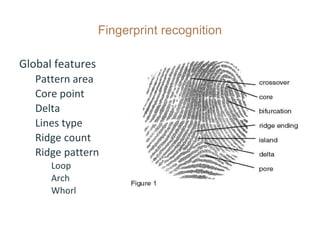
Fingerprint recognition
Global features
Pattern area
Core point
Delta
Lines type
Ridge count
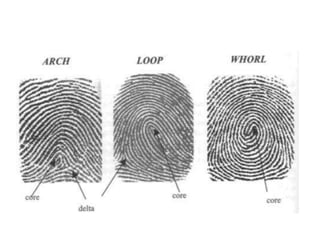
Ridge pattern
Loop
Arch
Whorl
DISCRETE WAVELET TRANSFORM
Discrete wavelet transform (DWT) is a common technique
for feature extraction, edge detection and object
recognition processes.
DWT is used as a good method for fingerprint recognition
because it obtains an effective rate of frequency
components.
In this method we decompose image into multi-resolution.
Each band is a combination of low pass filter (LPF) and
high pass filter (HPF) applied for rows and columns.
DATA COLLECTION
There are several ways to collect fingerprint data
we applied stamp ink to collect data from individuals.
We have take 5 left and 5 right thump prints.
The data was collected from 93 people in university of
human development.
IMPLEMENTED APPROACH
This approach work on traditional data in which
really have many problems.
The data may have lost or may have some noise
during the traditional store.
This approach consist of many steps as follows.
Fingerprint Acquisition:-collect data and convert into digital images.
Fingerprint Preprocessing:-apply simple low pass filter as a noise removal from images and resize to equal size
Converting color into gray scale images: This step deals with
the generating of gray scale images.
Fingerprint Enhancement: Image enhancement via histogram
equalization technique.
Fingerprint Feature Extraction: This step offers a specific
method to extract the features. Three levels of 2D-DWT
are implemented.
Hybrid of Features: Implemented method applied mixing of
features (left and right thumb) to generate a hybrid
method.
Decision Making: Online compare the sored data and the
incoming data to reach the correct decision for the
RESULTS AND DISCUSSION
According to the implemented approach there are many
operation required to implement this algorithm.
Isolate each fingerprint image from the overall image and
enhance this fingerprint image.
The enhancement operation is implemented via histogram
equalization technique.
The histogram of both images before and after enhancement
that there are a big improvement of the enhanced image.
On the other hand the enhancement in the improved image, in
which the histogram gives near smooth curve.
CONCLUSIONS
This work concentrated on the fingerprint recognition
approach by hybridizing features generated from
different fingerprints of the same individual.
Applying the correlation technique leads to a high
relation similarity of fingerprints.
The obtained results indicated that there is a good
benefit in applying this approach in addition that
achieve a big advantage of processing time
REFERENCE
Muzhir Shaban Al-Ani- MIEEE, Tishko N. Muhamad,
Hersh A. Muhamad, Ayub A. Nuri, Effective
Fingerprint Recognition Approach Based on Double
Fingerprint Thumb, ieee Conference: 26-27 April
2017
D. Maltoni, D. Maio, A. K. Jain, S. Prabhakar, Handbook
of Fingerprint Recognition, 2nd Edition, Springer-
Verlag, 2009
S. Prabhakar, S. Pankanti, A. K. Jain, "Biometric
Recognition: Security and Privacy Concerns", IEEE
A. K. Jain, L. Hong, and Y. Kulkarni, “A multimodal
biometric system using fingerprint, face and
speech", Second International Conference on
AVBPA, (Washington D.C., USA), pp. 182-187,
March 1999.
R. Subban, P. Mankame, D., “A Study of Biometric
Approach Using Fingerprint Recognition “, Lecture
Notes on Software Engineering, Vol. 1, No. 2,
2013.

Fingerprint recognition

  • 1.
    Effective Fingerprint Recognition Approach Basedon Double Fingerprint Thumb By NEERAJ BAGHEL M.TECH CS (2017-19)
  • 2.
    CONTENTS Introduction of biometricsystem. Fingerprint working. Fingerprint recognition. Discrete wavelet transform. Data collection. Implemented approach. Results and discussion. Conclusions. References.
  • 3.
    INTRODUCTION Biometric is atechnology which deals with unique bio elements of an individual. It is used to verify an individual by its own bio elements saved in system. Unique bio elements is of two types. Physical elements Behavioral elements Physical elements include fingerprint, hand geometry, IRIS, DNA.
  • 4.
    Behavioral elements includevoice, gestures, postures, style, habits. Today's worlds mostly use fingerprints for identification of an individual. Next is voice where most of research has been done and it continues.
  • 5.
    Fingerprint Working Firstly hardwarestore the fingerprint of an individual into a database. When system has to check creditability of an individual it takes fingerprint of that individual and match it from its database. If it is matched then that individual is authorized else it will not authorized.
  • 6.
    Fingerprint recognition Global features Patternarea Core point Delta Lines type Ridge count Ridge pattern Loop Arch Whorl
  • 8.
    DISCRETE WAVELET TRANSFORM Discretewavelet transform (DWT) is a common technique for feature extraction, edge detection and object recognition processes. DWT is used as a good method for fingerprint recognition because it obtains an effective rate of frequency components. In this method we decompose image into multi-resolution. Each band is a combination of low pass filter (LPF) and high pass filter (HPF) applied for rows and columns.
  • 9.
    DATA COLLECTION There areseveral ways to collect fingerprint data we applied stamp ink to collect data from individuals. We have take 5 left and 5 right thump prints. The data was collected from 93 people in university of human development.
  • 10.
    IMPLEMENTED APPROACH This approachwork on traditional data in which really have many problems. The data may have lost or may have some noise during the traditional store. This approach consist of many steps as follows. Fingerprint Acquisition:-collect data and convert into digital images. Fingerprint Preprocessing:-apply simple low pass filter as a noise removal from images and resize to equal size
  • 11.
    Converting color intogray scale images: This step deals with the generating of gray scale images. Fingerprint Enhancement: Image enhancement via histogram equalization technique. Fingerprint Feature Extraction: This step offers a specific method to extract the features. Three levels of 2D-DWT are implemented. Hybrid of Features: Implemented method applied mixing of features (left and right thumb) to generate a hybrid method. Decision Making: Online compare the sored data and the incoming data to reach the correct decision for the
  • 12.
    RESULTS AND DISCUSSION Accordingto the implemented approach there are many operation required to implement this algorithm. Isolate each fingerprint image from the overall image and enhance this fingerprint image. The enhancement operation is implemented via histogram equalization technique. The histogram of both images before and after enhancement that there are a big improvement of the enhanced image. On the other hand the enhancement in the improved image, in which the histogram gives near smooth curve.
  • 13.
    CONCLUSIONS This work concentratedon the fingerprint recognition approach by hybridizing features generated from different fingerprints of the same individual. Applying the correlation technique leads to a high relation similarity of fingerprints. The obtained results indicated that there is a good benefit in applying this approach in addition that achieve a big advantage of processing time
  • 14.
    REFERENCE Muzhir Shaban Al-Ani-MIEEE, Tishko N. Muhamad, Hersh A. Muhamad, Ayub A. Nuri, Effective Fingerprint Recognition Approach Based on Double Fingerprint Thumb, ieee Conference: 26-27 April 2017 D. Maltoni, D. Maio, A. K. Jain, S. Prabhakar, Handbook of Fingerprint Recognition, 2nd Edition, Springer- Verlag, 2009 S. Prabhakar, S. Pankanti, A. K. Jain, "Biometric Recognition: Security and Privacy Concerns", IEEE
  • 15.
    A. K. Jain,L. Hong, and Y. Kulkarni, “A multimodal biometric system using fingerprint, face and speech", Second International Conference on AVBPA, (Washington D.C., USA), pp. 182-187, March 1999. R. Subban, P. Mankame, D., “A Study of Biometric Approach Using Fingerprint Recognition “, Lecture Notes on Software Engineering, Vol. 1, No. 2, 2013.