TVSum: Summarizing Web Videos Using Titles
PRESENTED BY:
NEERAJ BAGHEL
M.TECH CSE II YR
2015 IEEE Conference on Computer Vision and Pattern Recognition
At Hynes Convention Center in Boston, Massachusetts.
Yale Song, Jordi Vallmitjana, Amanda Stent, Alejandro Jaimes
Yahoo Labs, New York
1
OUTLINE
• INTRODUCTION
• OBSTACLES IN VIDEO SUMMARIZATION
• DATASET
• TVSum Framework
• TVSum50 Benchmark Dataset
• EXPERIMENTAL RESULTS
• CONCLUSION
• REFERENCES
2
1/23
INTRODUCTION
Video
• Video data is a great asset for information extraction and
knowledge discovery.
• Due to its size an variability, it is extremely hard for users to
monitor.
video summarization
• Intelligent video summarization algorithms allow us to
quickly browse a lengthy video by capturing the essence
and removing redundant information.
3
1/23
OBSTACLES IN VIDEO SUMMARIZATI
ON
• Which part of a video is important
• Images irrelevant to video content
• Author present TVSum, an unsupervised video
summarization framework that uses title-based image
search results to find visually important shots
• Author developed a novel co-archetypal analysis technique
that learns canonical visual concepts shared between
video and images
4
1/23
DATASET
 Author introduce a new benchmark dataset, TVSum50, that
contains 50 videos and their shot-level importance scores
annotated via crowd sourcing.
 Experimental results on two datasets, SumMe and
TVSum50,
5
1/23
TVSum50 Benchmark Dataset
 Title-based video summarization is a relatively
unexplored domain; there is no publicly available dataset
suitable for our purpose.
 Author therefore collected a new dataset,TVSum50, that
contains 50 videos and their shot-level importance scores
obtained via crowdsourcing.
6
1/23
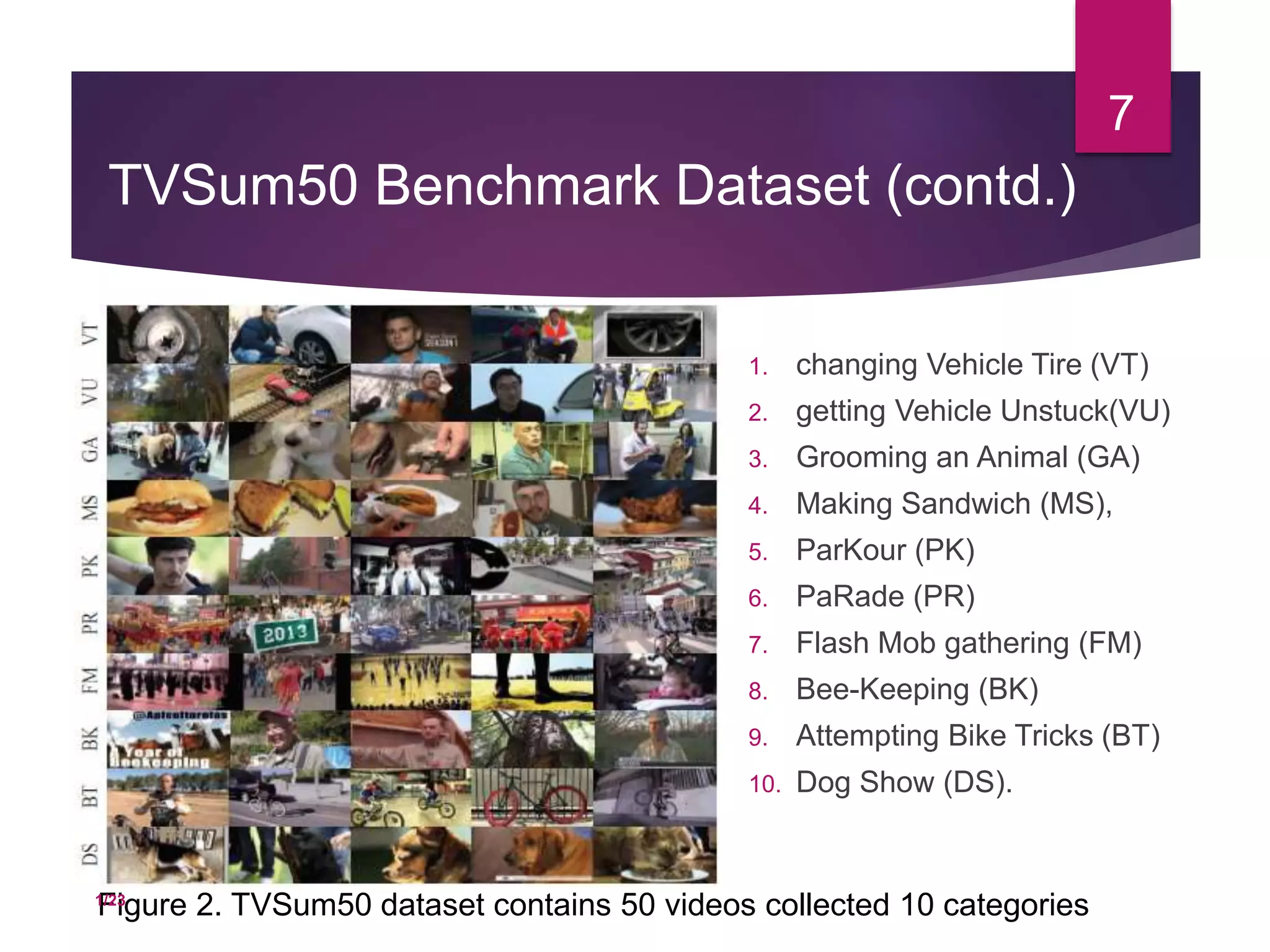
1. changing Vehicle Tire (VT)
2. getting Vehicle Unstuck(VU)
3. Grooming an Animal (GA)
4. Making Sandwich (MS),
5. ParKour (PK)
6. PaRade (PR)
7. Flash Mob gathering (FM)
8. Bee-Keeping (BK)
9. Attempting Bike Tricks (BT)
10. Dog Show (DS).
7
Figure 2. TVSum50 dataset contains 50 videos collected 10 categories
TVSum50 Benchmark Dataset (contd.)
1/23
Video Data Collection
 Author selected 10 categories from the TRECVid
Multimedia Event Detection (MED) task and collected 50
videos (5 per category) from YouTube using the category
name as a search query term.
 From the search results, we chose videos using the
following criteria:
(i) under the Creative Commons license;
(ii) duration is 2 to 10 minutes.
(iii)contains more than a single shot.
(iv) its title is descriptive of the visual topic in the video.
8
1/23
Web Image Data Collection
 In order to learn canonical visual concepts from a video
title.
 Author need a sufficiently diverse set of images [15].
Unfortunately,the title itself can sometimes be too specific
as a query term [29].
9
1/23
Figure 3. Chronological bias in shot importance labeling.
Shown here is the video “Statue of Liberty” from the SumMe
dataset [20].(a) from the SumMe dataset, (b) collected by
us using our annotation interface.
10
1/23
TVSum Framework
This framework consists of four modules:
 Shot segmentation.
 canonical visual concept learning
 shot importance scoring
 summary generation
11
1/23
Shot Segmentation
 Shot segmentation is a crucial step in video
summarizationfor maintaining visual coherence within
each shot, which in turn affects the overall quality of a
summary
12
1/23
Canonical Visual Concept
Learning
 Author define canonical visual concepts as the patterns
shared between video X and its title-based image search
results Y, and represent them as a set of p latent
variables Z = [z1, ・ ・ ・ , zp] ∈ Rd×p, where p ≪ d (in
this experiments,p=200 and d=1,640).
13
1/23
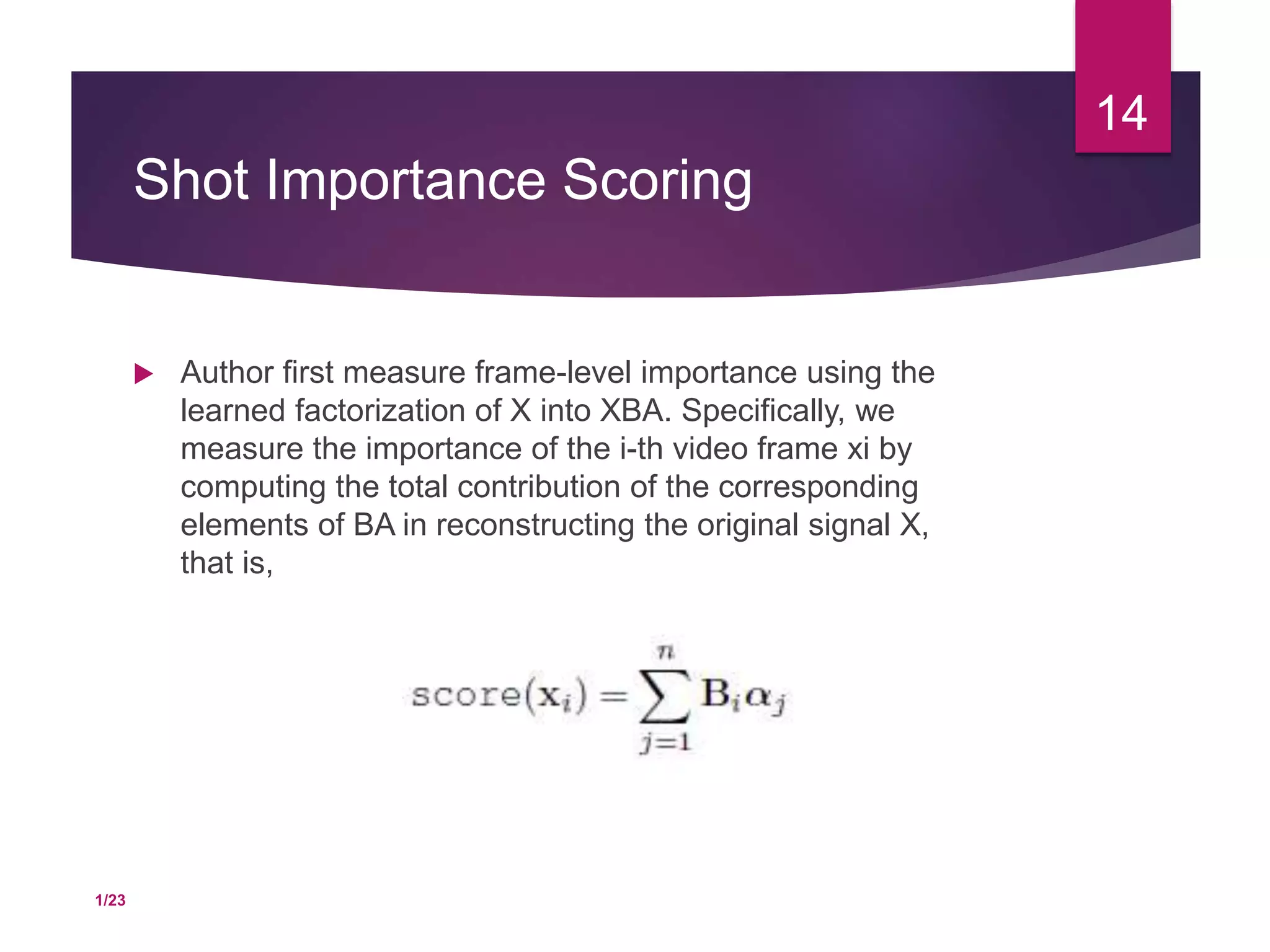
Shot Importance Scoring
 Author first measure frame-level importance using the
learned factorization of X into XBA. Specifically, we
measure the importance of the i-th video frame xi by
computing the total contribution of the corresponding
elements of BA in reconstructing the original signal X,
that is,
14
1/23
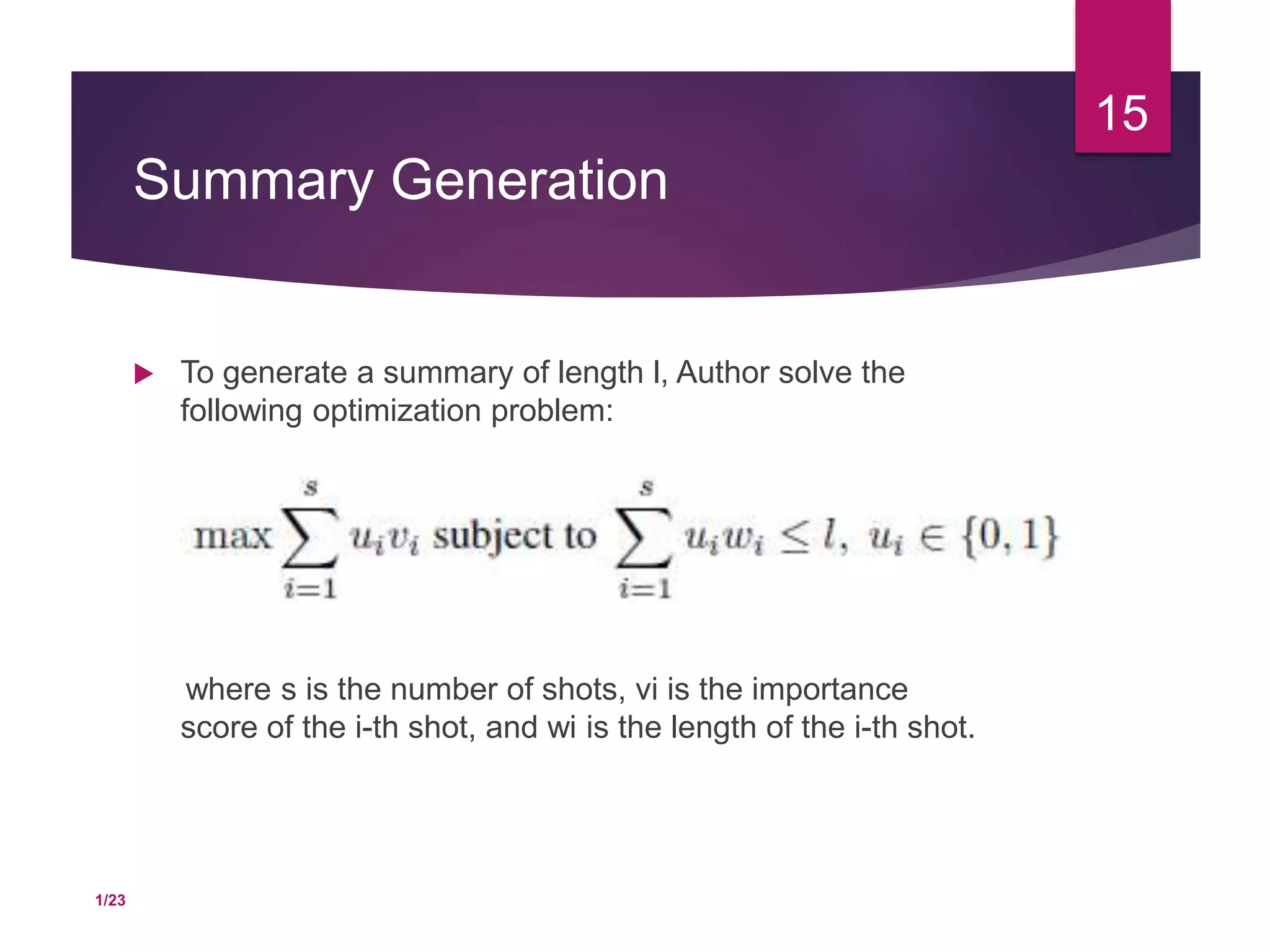
Summary Generation
 To generate a summary of length l, Author solve the
following optimization problem:
where s is the number of shots, vi is the importance
score of the i-th shot, and wi is the length of the i-th shot.
15
1/23
Baseline Models
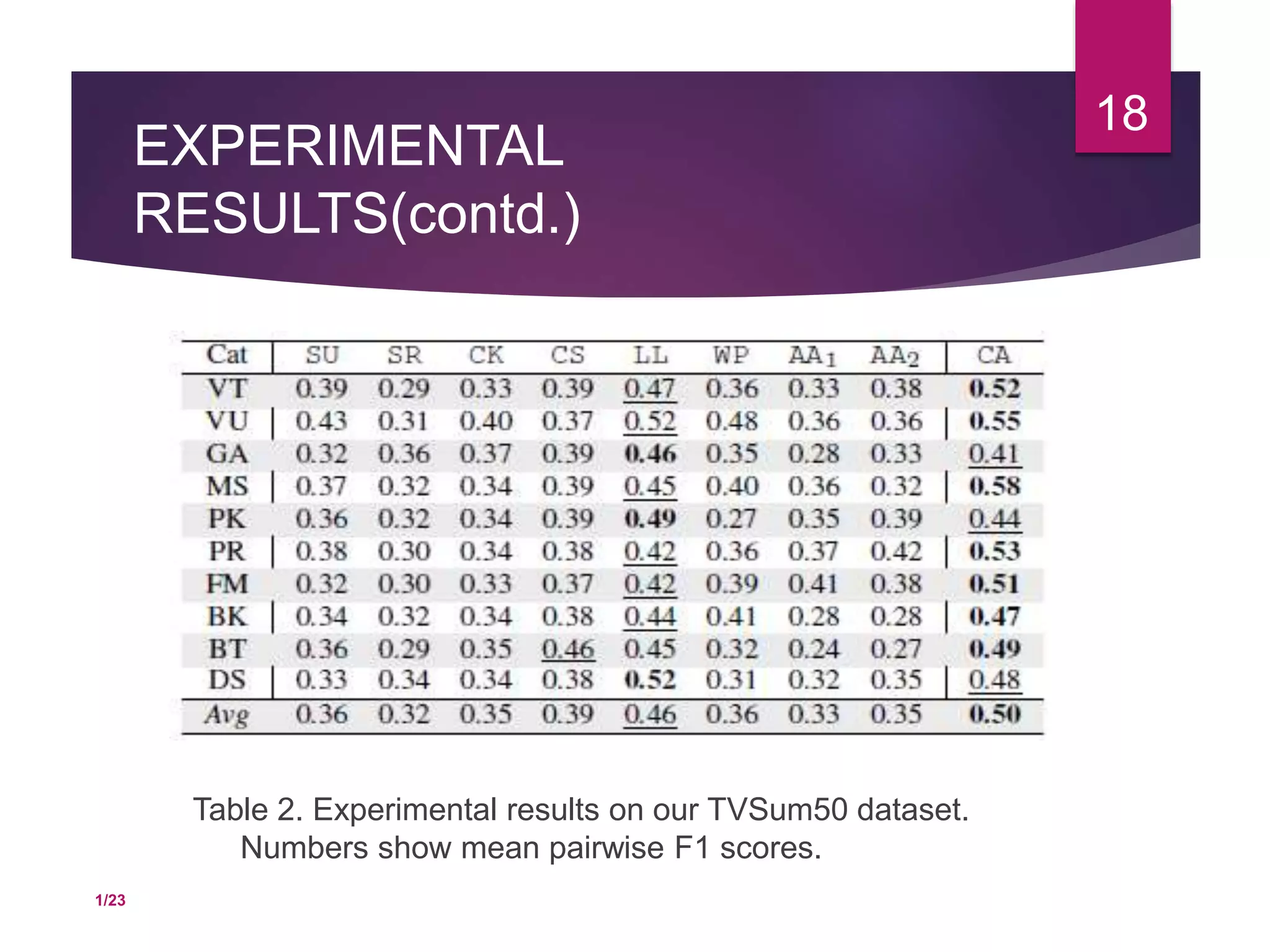
Auhtor compared our summarization approach to 8
baselines covering a variety of different methods:-
 Sampling (SU and SR): A summary is generated by selecting
shots either uniformly (SU) or shots either randomly (SR) such
that the summary length is within the length budget l.
 Clustering (CK and CS): Author tested two clustering
approaches: k-means (CK) and spectral clustering (CS).
16
1/23
Baseline Models
 LiveLight (LL): summary is generated by removing redundant
shots over time, measuring redundancy using a dictionary of shots
updated online. we selected shots with the highest reconstruction
errors that fit in the length budget l.
 Web Image Prior [25] (WP): As in [25], Author defined
100.positive and 1 negative classes, using images from other
videos in the same dataset as negative examples.
 Archetypal Analysis [11] (AA1 and AA2): Author include two
versions of archetypal analysis: one that learns archetypes from
video data only (AA1), and another that uses a combination of
video and image data (AA2).
17
1/23
EXPERIMENTAL
RESULTS(contd.)
18
1/23
Table 2. Experimental results on our TVSum50 dataset.
Numbers show mean pairwise F1 scores.
CONCLUSIONS
 Auhtor presented TVSum, an unsupervised video
summarization framework that uses the video title
to find visually important shots.
19
1/23
REFERENCES
 [1] M. Basseville, I. V. Nikiforov, et al. Detection of abrupt changes:theory and application, volume
104. Prentice Hall Englewood Cliffs,1993. 2, 3
 [2] A. Beck and M. Teboulle. A fast iterative shrinkage-thresholding algorithm for linear inverse
problems. SIAM Journal on Imaging Sciences, 2(1), 2009. 3
 [3] V. Berger. Selection bias and covariate imbalances in randomized clinical trials, volume 66.
John Wiley & Sons, 2007. 6
 [4] K. Bleakley and J.-P. Vert. The group fused lasso for multiple change-point detection. arXiv
preprint arXiv:1106.4199, 2011. 2,3
 [5] A. Borji and L. Itti. State-of-the-art in visual attention modeling. PAMI, 35(1), 2013. 2
 [6] A. Bosch, A. Zisserman, and X. Mu˜noz. Image classification using random forests and ferns.
In ICCV, 2007. 7
 [7] A. Bosch, A. Zisserman, and X. Mu˜noz. Representing shape with a spatial pyramid kernel. In
CIVR, 2007. 7
 [8] C. Carpineto and G. Romano. A survey of automatic query expansion in information retrieval.
ACM CSUR, 44(1), 2012. 5
 [9] F. Chen and C. De Vleeschouwer. Formulating team-sport video summarization as a resource
allocation problem. CSVT, 21. 2
20
1/23
REFERENCES (contd.)
 [10] J. Chen, Y. Cui, G. Ye, D. Liu, and S.-F. Chang. Event-driven semantic concept discovery by
exploiting weakly tagged internet images. In ICMR, page 1, 2014. 2
 [11] Y. Chen, J. Mairal, and Z. Harchaoui. Fast and robust archetypal analysis for representation
learning. In CVPR, 2014.
 [12] Y. Cong, J. Yuan, and J. Luo. Towards scalable summarization of consumer videos via
sparse dictionary selection. IEEE Multimedia,14(1), 2012.
 [13] A. Cutler and L. Breiman. Archetypal analysis. Technometrics, 36(4), 1994.
 [14] S. K. Divvala, A. Farhadi, and C. Guestrin. Learning everything about anything: Webly-
supervised visual concept learning. In CVPR,2014. 8
 [15] L. Duan, D. Xu, and S.-F. Chang. Exploiting web images for event recognition in consumer
videos: A multiple source domain adaptation approach. In CVPR, 2012. 4
 [16] N. Ejaz, I. Mehmood, and S. Wook Baik. Efficient visual attention based framework for
extracting key frames from videos. Signal Processing: Image Communication, 28(1), 2013. 2, 7,
8
 [17] A. Ekin, A. M. Tekalp, and R. Mehrotra. Automatic soccer video analysis and summarization.
Image Processing, IEEE Transactions on, 12(7), 2003. 2
21
1/23
REFERENCES (contd.)
 [18] S. Feng, Z. Lei, D. Yi, and S. Z. Li. Online content-aware video condensation. In CVPR, 2012.
2
 [19] S. Fidler, A. Sharma, and R. Urtasun. A sentence is worth a thousand pixels. In CVPR, 2013.
2
 [20] M. Gygli, H. Grabner, H. Riemenschneider, and L. V. Gool. Creating summaries from user
videos. In ECCV, 2014. 2, 4, 5, 6, 7, 8
 [21] M. Gygli, H. Grabner, H. Riemenschneider, F. Nater, and L. V. Gool. The interestingness of
images. In ICCV, 2013. 2
 [22] Z. Harchaoui and C. L´ evy-Leduc. Multiple change-point estimation with a total variation
penalty. Journal of the American Statistical Association, 105(492), 2010. 3
 [23] G. Hripcsak and A. S. Rothschild. Agreement, the f-measure, and reliability in information
retrieval. JAMIA, 12(3), 2005. 6
 [24] Y. Jia, J. T. Abbott, J. Austerweil, T. Griffiths, and T. Darrell. Visual concept learning:
Combining machine vision and bayesian generalization on concept hierarchies. In NIPS, 2013. 8
 [25] A. Khosla, R. Hamid, C. Lin, and N. Sundaresan. Large-scale video summarization using
web-image priors. In CVPR, 2013.
22
1/23
REFERENCES (contd.)
 [26] G. Kim, L. Sigal, and E. P. Xing. Joint summarization of large-scale collections of web
images and videos for storyline reconstruction. In CVPR, 2014. 2
 [27] Y. J. Lee, J. Ghosh, and K. Grauman. Discovering important people and objects for
egocentric video summarization. In CVPR, 2012. 2,
 [28] L. Li, K. Zhou, G.-R. Xue, H. Zha, and Y. Yu. Video summarization via transferrable
structured learning. In WWW, 2011. 1
 [29] D. Lin, S. Fidler, C. Kong, and R. Urtasun. Visual semantic search: Retrieving videos via
complex textual queries. In CVPR, 2014. 2, 4,8
 [30] D. Liu, G. Hua, and T. Chen. A hierarchical visual model for video object summarization.
PAMI, 32(12), 2010. 2
 [31] X. Liu, Y. Mu, B. Lang, and S.-F. Chang. Mixed image-keyword query adaptive hashing over
multilabel images. TOMCCAP, 10(2),2014. 2
 [32] Z. Lu and K. Grauman. Story-driven summarization for egocentric video. In CVPR, 2013. 2,
5, 6
 [33] Y.-F. Ma, L. Lu, H.-J. Zhang, and M. Li. A user attention model for video summarization. In
ACM MM, 2002. 2
23
1/23
24

TVSum: Summarizing Web Videos Using Titles

  • 1.
    TVSum: Summarizing WebVideos Using Titles PRESENTED BY: NEERAJ BAGHEL M.TECH CSE II YR 2015 IEEE Conference on Computer Vision and Pattern Recognition At Hynes Convention Center in Boston, Massachusetts. Yale Song, Jordi Vallmitjana, Amanda Stent, Alejandro Jaimes Yahoo Labs, New York 1
  • 2.
    OUTLINE • INTRODUCTION • OBSTACLESIN VIDEO SUMMARIZATION • DATASET • TVSum Framework • TVSum50 Benchmark Dataset • EXPERIMENTAL RESULTS • CONCLUSION • REFERENCES 2 1/23
  • 3.
    INTRODUCTION Video • Video datais a great asset for information extraction and knowledge discovery. • Due to its size an variability, it is extremely hard for users to monitor. video summarization • Intelligent video summarization algorithms allow us to quickly browse a lengthy video by capturing the essence and removing redundant information. 3 1/23
  • 4.
    OBSTACLES IN VIDEOSUMMARIZATI ON • Which part of a video is important • Images irrelevant to video content • Author present TVSum, an unsupervised video summarization framework that uses title-based image search results to find visually important shots • Author developed a novel co-archetypal analysis technique that learns canonical visual concepts shared between video and images 4 1/23
  • 5.
    DATASET  Author introducea new benchmark dataset, TVSum50, that contains 50 videos and their shot-level importance scores annotated via crowd sourcing.  Experimental results on two datasets, SumMe and TVSum50, 5 1/23
  • 6.
    TVSum50 Benchmark Dataset Title-based video summarization is a relatively unexplored domain; there is no publicly available dataset suitable for our purpose.  Author therefore collected a new dataset,TVSum50, that contains 50 videos and their shot-level importance scores obtained via crowdsourcing. 6 1/23
  • 7.
    1. changing VehicleTire (VT) 2. getting Vehicle Unstuck(VU) 3. Grooming an Animal (GA) 4. Making Sandwich (MS), 5. ParKour (PK) 6. PaRade (PR) 7. Flash Mob gathering (FM) 8. Bee-Keeping (BK) 9. Attempting Bike Tricks (BT) 10. Dog Show (DS). 7 Figure 2. TVSum50 dataset contains 50 videos collected 10 categories TVSum50 Benchmark Dataset (contd.) 1/23
  • 8.
    Video Data Collection Author selected 10 categories from the TRECVid Multimedia Event Detection (MED) task and collected 50 videos (5 per category) from YouTube using the category name as a search query term.  From the search results, we chose videos using the following criteria: (i) under the Creative Commons license; (ii) duration is 2 to 10 minutes. (iii)contains more than a single shot. (iv) its title is descriptive of the visual topic in the video. 8 1/23
  • 9.
    Web Image DataCollection  In order to learn canonical visual concepts from a video title.  Author need a sufficiently diverse set of images [15]. Unfortunately,the title itself can sometimes be too specific as a query term [29]. 9 1/23
  • 10.
    Figure 3. Chronologicalbias in shot importance labeling. Shown here is the video “Statue of Liberty” from the SumMe dataset [20].(a) from the SumMe dataset, (b) collected by us using our annotation interface. 10 1/23
  • 11.
    TVSum Framework This frameworkconsists of four modules:  Shot segmentation.  canonical visual concept learning  shot importance scoring  summary generation 11 1/23
  • 12.
    Shot Segmentation  Shotsegmentation is a crucial step in video summarizationfor maintaining visual coherence within each shot, which in turn affects the overall quality of a summary 12 1/23
  • 13.
    Canonical Visual Concept Learning Author define canonical visual concepts as the patterns shared between video X and its title-based image search results Y, and represent them as a set of p latent variables Z = [z1, ・ ・ ・ , zp] ∈ Rd×p, where p ≪ d (in this experiments,p=200 and d=1,640). 13 1/23
  • 14.
    Shot Importance Scoring Author first measure frame-level importance using the learned factorization of X into XBA. Specifically, we measure the importance of the i-th video frame xi by computing the total contribution of the corresponding elements of BA in reconstructing the original signal X, that is, 14 1/23
  • 15.
    Summary Generation  Togenerate a summary of length l, Author solve the following optimization problem: where s is the number of shots, vi is the importance score of the i-th shot, and wi is the length of the i-th shot. 15 1/23
  • 16.
    Baseline Models Auhtor comparedour summarization approach to 8 baselines covering a variety of different methods:-  Sampling (SU and SR): A summary is generated by selecting shots either uniformly (SU) or shots either randomly (SR) such that the summary length is within the length budget l.  Clustering (CK and CS): Author tested two clustering approaches: k-means (CK) and spectral clustering (CS). 16 1/23
  • 17.
    Baseline Models  LiveLight(LL): summary is generated by removing redundant shots over time, measuring redundancy using a dictionary of shots updated online. we selected shots with the highest reconstruction errors that fit in the length budget l.  Web Image Prior [25] (WP): As in [25], Author defined 100.positive and 1 negative classes, using images from other videos in the same dataset as negative examples.  Archetypal Analysis [11] (AA1 and AA2): Author include two versions of archetypal analysis: one that learns archetypes from video data only (AA1), and another that uses a combination of video and image data (AA2). 17 1/23
  • 18.
    EXPERIMENTAL RESULTS(contd.) 18 1/23 Table 2. Experimentalresults on our TVSum50 dataset. Numbers show mean pairwise F1 scores.
  • 19.
    CONCLUSIONS  Auhtor presentedTVSum, an unsupervised video summarization framework that uses the video title to find visually important shots. 19 1/23
  • 20.
    REFERENCES  [1] M.Basseville, I. V. Nikiforov, et al. Detection of abrupt changes:theory and application, volume 104. Prentice Hall Englewood Cliffs,1993. 2, 3  [2] A. Beck and M. Teboulle. A fast iterative shrinkage-thresholding algorithm for linear inverse problems. SIAM Journal on Imaging Sciences, 2(1), 2009. 3  [3] V. Berger. Selection bias and covariate imbalances in randomized clinical trials, volume 66. John Wiley & Sons, 2007. 6  [4] K. Bleakley and J.-P. Vert. The group fused lasso for multiple change-point detection. arXiv preprint arXiv:1106.4199, 2011. 2,3  [5] A. Borji and L. Itti. State-of-the-art in visual attention modeling. PAMI, 35(1), 2013. 2  [6] A. Bosch, A. Zisserman, and X. Mu˜noz. Image classification using random forests and ferns. In ICCV, 2007. 7  [7] A. Bosch, A. Zisserman, and X. Mu˜noz. Representing shape with a spatial pyramid kernel. In CIVR, 2007. 7  [8] C. Carpineto and G. Romano. A survey of automatic query expansion in information retrieval. ACM CSUR, 44(1), 2012. 5  [9] F. Chen and C. De Vleeschouwer. Formulating team-sport video summarization as a resource allocation problem. CSVT, 21. 2 20 1/23
  • 21.
    REFERENCES (contd.)  [10]J. Chen, Y. Cui, G. Ye, D. Liu, and S.-F. Chang. Event-driven semantic concept discovery by exploiting weakly tagged internet images. In ICMR, page 1, 2014. 2  [11] Y. Chen, J. Mairal, and Z. Harchaoui. Fast and robust archetypal analysis for representation learning. In CVPR, 2014.  [12] Y. Cong, J. Yuan, and J. Luo. Towards scalable summarization of consumer videos via sparse dictionary selection. IEEE Multimedia,14(1), 2012.  [13] A. Cutler and L. Breiman. Archetypal analysis. Technometrics, 36(4), 1994.  [14] S. K. Divvala, A. Farhadi, and C. Guestrin. Learning everything about anything: Webly- supervised visual concept learning. In CVPR,2014. 8  [15] L. Duan, D. Xu, and S.-F. Chang. Exploiting web images for event recognition in consumer videos: A multiple source domain adaptation approach. In CVPR, 2012. 4  [16] N. Ejaz, I. Mehmood, and S. Wook Baik. Efficient visual attention based framework for extracting key frames from videos. Signal Processing: Image Communication, 28(1), 2013. 2, 7, 8  [17] A. Ekin, A. M. Tekalp, and R. Mehrotra. Automatic soccer video analysis and summarization. Image Processing, IEEE Transactions on, 12(7), 2003. 2 21 1/23
  • 22.
    REFERENCES (contd.)  [18]S. Feng, Z. Lei, D. Yi, and S. Z. Li. Online content-aware video condensation. In CVPR, 2012. 2  [19] S. Fidler, A. Sharma, and R. Urtasun. A sentence is worth a thousand pixels. In CVPR, 2013. 2  [20] M. Gygli, H. Grabner, H. Riemenschneider, and L. V. Gool. Creating summaries from user videos. In ECCV, 2014. 2, 4, 5, 6, 7, 8  [21] M. Gygli, H. Grabner, H. Riemenschneider, F. Nater, and L. V. Gool. The interestingness of images. In ICCV, 2013. 2  [22] Z. Harchaoui and C. L´ evy-Leduc. Multiple change-point estimation with a total variation penalty. Journal of the American Statistical Association, 105(492), 2010. 3  [23] G. Hripcsak and A. S. Rothschild. Agreement, the f-measure, and reliability in information retrieval. JAMIA, 12(3), 2005. 6  [24] Y. Jia, J. T. Abbott, J. Austerweil, T. Griffiths, and T. Darrell. Visual concept learning: Combining machine vision and bayesian generalization on concept hierarchies. In NIPS, 2013. 8  [25] A. Khosla, R. Hamid, C. Lin, and N. Sundaresan. Large-scale video summarization using web-image priors. In CVPR, 2013. 22 1/23
  • 23.
    REFERENCES (contd.)  [26]G. Kim, L. Sigal, and E. P. Xing. Joint summarization of large-scale collections of web images and videos for storyline reconstruction. In CVPR, 2014. 2  [27] Y. J. Lee, J. Ghosh, and K. Grauman. Discovering important people and objects for egocentric video summarization. In CVPR, 2012. 2,  [28] L. Li, K. Zhou, G.-R. Xue, H. Zha, and Y. Yu. Video summarization via transferrable structured learning. In WWW, 2011. 1  [29] D. Lin, S. Fidler, C. Kong, and R. Urtasun. Visual semantic search: Retrieving videos via complex textual queries. In CVPR, 2014. 2, 4,8  [30] D. Liu, G. Hua, and T. Chen. A hierarchical visual model for video object summarization. PAMI, 32(12), 2010. 2  [31] X. Liu, Y. Mu, B. Lang, and S.-F. Chang. Mixed image-keyword query adaptive hashing over multilabel images. TOMCCAP, 10(2),2014. 2  [32] Z. Lu and K. Grauman. Story-driven summarization for egocentric video. In CVPR, 2013. 2, 5, 6  [33] Y.-F. Ma, L. Lu, H.-J. Zhang, and M. Li. A user attention model for video summarization. In ACM MM, 2002. 2 23 1/23
  • 24.