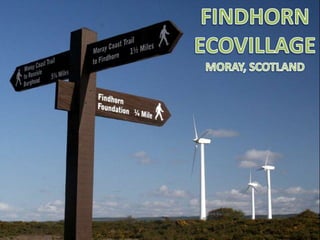
Situated in northern Scotland, Findhorn Ecovillage was founded in the 1960s and has since grown to over 500 residents living in 65 eco-buildings. The community aims to demonstrate sustainable development through ecological housing, renewable energy systems, organic food production, and sustainable economics. Notable achievements include producing more electricity than needed through four community-owned wind turbines, an ecologically engineered sewage treatment plant, and establishing their own local currency. Findhorn has received several awards for its pioneering work in sustainable living.
All About the vernacular Architecture Of Karnataka. The design of the Houses with interiors and the architecture style followed in the different types of houses of Karnataka ,i.e. Gutthu Houses and Anymane houses of Karnataka. The presentation belongs and solely based on the works of the case study dine by the students of Architecture of Poornima University
About the climate and architecture of Kerala & different types of vernacular houses in Kerala-Ekashala, Nalukettu, Kuttikettu
Building Materials used in Kerala
Roofs and Fenestration in Kerala Houses.
The vernacular architecture of Kerala includes a lot of new techniques and good use of local available materials
Club Mahindra Ashtamudi Resort in Kerala was recently awarded with PLATINUM certification under IGBC Green Resorts Rating. The project has adopted Vernacular architectural elements and reflects the characteristics of the local environment, culture and materials.
Few of the key green measures in this project include:
- Integrated BMS
- Lighting Power Density (LPD) is 50% lower than ECBC baselines
- CFC and HCFC free HVAC systems
- E-vehicles for movement within premises
- Organic garden
- Solar panels
- Wastewater treatment
- Sensor operated water faucets and lights
- Minimization of Food Wastage
- Zero Waste sent to landfill
- Use of bio-degradable laundry bags
Mahindra Holiday & Resorts India Limited (MHRIL) is an IGBC Founding member. IGBC appreciates the holistic sustainability initiatives undertaken by MHRIL. IGBC would continue to handhold multiple Club Mahindra resorts across the country to become GREEN.
Indian Green Building Council (IGBC) has launched the Green Resorts Rating to address the need for sustainable development in the hospitality sector. This rating creates a win-win-win situation for all the stakeholders of a resort – Guest, Owner and Society.
For further information on IGBC Green Resorts certification, please refer this link: https://bit.ly/2LN2wvA
All About the vernacular Architecture Of Karnataka. The design of the Houses with interiors and the architecture style followed in the different types of houses of Karnataka ,i.e. Gutthu Houses and Anymane houses of Karnataka. The presentation belongs and solely based on the works of the case study dine by the students of Architecture of Poornima University
About the climate and architecture of Kerala & different types of vernacular houses in Kerala-Ekashala, Nalukettu, Kuttikettu
Building Materials used in Kerala
Roofs and Fenestration in Kerala Houses.
The vernacular architecture of Kerala includes a lot of new techniques and good use of local available materials
Club Mahindra Ashtamudi Resort in Kerala was recently awarded with PLATINUM certification under IGBC Green Resorts Rating. The project has adopted Vernacular architectural elements and reflects the characteristics of the local environment, culture and materials.
Few of the key green measures in this project include:
- Integrated BMS
- Lighting Power Density (LPD) is 50% lower than ECBC baselines
- CFC and HCFC free HVAC systems
- E-vehicles for movement within premises
- Organic garden
- Solar panels
- Wastewater treatment
- Sensor operated water faucets and lights
- Minimization of Food Wastage
- Zero Waste sent to landfill
- Use of bio-degradable laundry bags
Mahindra Holiday & Resorts India Limited (MHRIL) is an IGBC Founding member. IGBC appreciates the holistic sustainability initiatives undertaken by MHRIL. IGBC would continue to handhold multiple Club Mahindra resorts across the country to become GREEN.
Indian Green Building Council (IGBC) has launched the Green Resorts Rating to address the need for sustainable development in the hospitality sector. This rating creates a win-win-win situation for all the stakeholders of a resort – Guest, Owner and Society.
For further information on IGBC Green Resorts certification, please refer this link: https://bit.ly/2LN2wvA
A Self Sustainable Community (Human Settlement) comprising all the activity to a range of Human Scale within the neighborhood interdependent to government or policies.
Vernacular architecture case study with examplesVISHAKA BOTHRA
case study on vernacular architecture, examples of vernacular architecture, literature case study of vernacular architecture, examples of vernacular architecture of India, Maharashtra, Nanded, Aurangabad, complete case study on vernacular architecture
hello! find the details about composite climate and aurabindo ashramam here. If u want best architecture and interior services, click on https://jakkan.com/ and contact them. They give best services.
study of famous housing projects by architect Charles Correa.
1. BELAPUR Housing
2. Kanchanjunga Apartments
3. Tarapur housing
Authors- Richa, Parveen n Aarti
DUAYEE VOCATIONAL SCHOOL PRELIMINARY RESEARCH TOWARDS BUILDING A MODEL SUSTAINABLE VILLAGE | Sustainable Village Model Preliminary Research | Ecosa Institute | Summer 2010
Model Sustainable Village
Project Description
Ecosa has been asked by Peter Gbelia, the Executive Director of the Empowerment Society, to create a master plan for a sustainable intervention in the village of Duayee in Liberia, Africa. This plan is intended to develop a model approach to sustaining the culture, environment, and economy of the Liberian people.
The village we will be working with is Duayee located near the Yah river. The goal is to create Local Economic Development (LED) by designing a system where more food is produced (improved agro-techniques, seeds, irrigation, fertilizers, fish farm, swamp rice), the surplus can be sold at market creating economic growth, and revenue invested back into human capital and community infrastructure.
This is a challenging project in as much as it is based in a non-western culture and needs to respond to needs that are very different to US expectations. Prior to the start of this design, each participant was required to read the report and proposal provided by the Empowerment Project and the Millennium Development Report. The goal of this project was to research alternative development patterns, materials, social and economic systems to create an integrated design that includes all elements of sustainability from materials to permaculture, energy to food supplies. ECOSA is proposing a vocational school as the best way to illustrate, educate about, and build a truly sustainable village. Through the vocational school, Duayee will be able to educate its population and create a skilled work force by allowing every project in the village to be a learning experience that will expand upon the village's knowledge and skill sets. Download the final Duayee Vocational School Proposal, and download the preliminary Research Presentation on Liberia.
For more info check out the project at the ECOSA Institute here: http://www.ecosainstitute.org/projects/model-sustainable-village.html
or copy & paste this URL to catch a glimpse of the final project:
http://www.ecosainstitute.org/index.php?option=com_docman&task=doc_download&gid=71&Itemid=
Justin Hawes is one of the founding members of the Event Greening, CEO of Scan Display and a Patron of the Sustainable Tourism Partnership Programme. Justin led the The South African Climate Change Response Expo (CCR Expo), which was hosted by the Department of Environmental Affairs, and held alongside COP17. The CCR Expo received the UFI 2013 Sustainable Development Award for the Best innovative environmental initiative. The purpose of the event was to raise awareness, provide an educational platform and showcase South African innovations around climate change. The event obviously had to be a green event.
A Self Sustainable Community (Human Settlement) comprising all the activity to a range of Human Scale within the neighborhood interdependent to government or policies.
Vernacular architecture case study with examplesVISHAKA BOTHRA
case study on vernacular architecture, examples of vernacular architecture, literature case study of vernacular architecture, examples of vernacular architecture of India, Maharashtra, Nanded, Aurangabad, complete case study on vernacular architecture
hello! find the details about composite climate and aurabindo ashramam here. If u want best architecture and interior services, click on https://jakkan.com/ and contact them. They give best services.
study of famous housing projects by architect Charles Correa.
1. BELAPUR Housing
2. Kanchanjunga Apartments
3. Tarapur housing
Authors- Richa, Parveen n Aarti
DUAYEE VOCATIONAL SCHOOL PRELIMINARY RESEARCH TOWARDS BUILDING A MODEL SUSTAINABLE VILLAGE | Sustainable Village Model Preliminary Research | Ecosa Institute | Summer 2010
Model Sustainable Village
Project Description
Ecosa has been asked by Peter Gbelia, the Executive Director of the Empowerment Society, to create a master plan for a sustainable intervention in the village of Duayee in Liberia, Africa. This plan is intended to develop a model approach to sustaining the culture, environment, and economy of the Liberian people.
The village we will be working with is Duayee located near the Yah river. The goal is to create Local Economic Development (LED) by designing a system where more food is produced (improved agro-techniques, seeds, irrigation, fertilizers, fish farm, swamp rice), the surplus can be sold at market creating economic growth, and revenue invested back into human capital and community infrastructure.
This is a challenging project in as much as it is based in a non-western culture and needs to respond to needs that are very different to US expectations. Prior to the start of this design, each participant was required to read the report and proposal provided by the Empowerment Project and the Millennium Development Report. The goal of this project was to research alternative development patterns, materials, social and economic systems to create an integrated design that includes all elements of sustainability from materials to permaculture, energy to food supplies. ECOSA is proposing a vocational school as the best way to illustrate, educate about, and build a truly sustainable village. Through the vocational school, Duayee will be able to educate its population and create a skilled work force by allowing every project in the village to be a learning experience that will expand upon the village's knowledge and skill sets. Download the final Duayee Vocational School Proposal, and download the preliminary Research Presentation on Liberia.
For more info check out the project at the ECOSA Institute here: http://www.ecosainstitute.org/projects/model-sustainable-village.html
or copy & paste this URL to catch a glimpse of the final project:
http://www.ecosainstitute.org/index.php?option=com_docman&task=doc_download&gid=71&Itemid=
Justin Hawes is one of the founding members of the Event Greening, CEO of Scan Display and a Patron of the Sustainable Tourism Partnership Programme. Justin led the The South African Climate Change Response Expo (CCR Expo), which was hosted by the Department of Environmental Affairs, and held alongside COP17. The CCR Expo received the UFI 2013 Sustainable Development Award for the Best innovative environmental initiative. The purpose of the event was to raise awareness, provide an educational platform and showcase South African innovations around climate change. The event obviously had to be a green event.
Hotel Sustainable Practices of Finca Exotica Ecolodge, Costa RicaFlorie Thielin
Discover the sustainable practices of Finca Exotica Ecolodge located on the Osa Peninsula, next to Corcovado National Park in Costa Rica.
As part of her Hospitality Tour through Latin America, Florie collected the best responsible practices implemented by Finca Exotica for Hopineo.org
A Self Sustainable Community (Human Settlement) comprising all the activity to a range of Human Scale within the neighborhood interdependent to government or policies.
Reasonable Supplements to Traditional Farming
Touches on why traditional farming alone will not sustain us in the future and what some solutions are - such as hydroponics, vertical farming, and aquaponics.
Welcome to WIPAC Monthly the magazine brought to you by the LinkedIn Group Water Industry Process Automation & Control.
In this month's edition, along with this month's industry news to celebrate the 13 years since the group was created we have articles including
A case study of the used of Advanced Process Control at the Wastewater Treatment works at Lleida in Spain
A look back on an article on smart wastewater networks in order to see how the industry has measured up in the interim around the adoption of Digital Transformation in the Water Industry.
Sachpazis:Terzaghi Bearing Capacity Estimation in simple terms with Calculati...Dr.Costas Sachpazis
Terzaghi's soil bearing capacity theory, developed by Karl Terzaghi, is a fundamental principle in geotechnical engineering used to determine the bearing capacity of shallow foundations. This theory provides a method to calculate the ultimate bearing capacity of soil, which is the maximum load per unit area that the soil can support without undergoing shear failure. The Calculation HTML Code included.
Final project report on grocery store management system..pdfKamal Acharya
In today’s fast-changing business environment, it’s extremely important to be able to respond to client needs in the most effective and timely manner. If your customers wish to see your business online and have instant access to your products or services.
Online Grocery Store is an e-commerce website, which retails various grocery products. This project allows viewing various products available enables registered users to purchase desired products instantly using Paytm, UPI payment processor (Instant Pay) and also can place order by using Cash on Delivery (Pay Later) option. This project provides an easy access to Administrators and Managers to view orders placed using Pay Later and Instant Pay options.
In order to develop an e-commerce website, a number of Technologies must be studied and understood. These include multi-tiered architecture, server and client-side scripting techniques, implementation technologies, programming language (such as PHP, HTML, CSS, JavaScript) and MySQL relational databases. This is a project with the objective to develop a basic website where a consumer is provided with a shopping cart website and also to know about the technologies used to develop such a website.
This document will discuss each of the underlying technologies to create and implement an e- commerce website.
Immunizing Image Classifiers Against Localized Adversary Attacksgerogepatton
This paper addresses the vulnerability of deep learning models, particularly convolutional neural networks
(CNN)s, to adversarial attacks and presents a proactive training technique designed to counter them. We
introduce a novel volumization algorithm, which transforms 2D images into 3D volumetric representations.
When combined with 3D convolution and deep curriculum learning optimization (CLO), itsignificantly improves
the immunity of models against localized universal attacks by up to 40%. We evaluate our proposed approach
using contemporary CNN architectures and the modified Canadian Institute for Advanced Research (CIFAR-10
and CIFAR-100) and ImageNet Large Scale Visual Recognition Challenge (ILSVRC12) datasets, showcasing
accuracy improvements over previous techniques. The results indicate that the combination of the volumetric
input and curriculum learning holds significant promise for mitigating adversarial attacks without necessitating
adversary training.
Cosmetic shop management system project report.pdfKamal Acharya
Buying new cosmetic products is difficult. It can even be scary for those who have sensitive skin and are prone to skin trouble. The information needed to alleviate this problem is on the back of each product, but it's thought to interpret those ingredient lists unless you have a background in chemistry.
Instead of buying and hoping for the best, we can use data science to help us predict which products may be good fits for us. It includes various function programs to do the above mentioned tasks.
Data file handling has been effectively used in the program.
The automated cosmetic shop management system should deal with the automation of general workflow and administration process of the shop. The main processes of the system focus on customer's request where the system is able to search the most appropriate products and deliver it to the customers. It should help the employees to quickly identify the list of cosmetic product that have reached the minimum quantity and also keep a track of expired date for each cosmetic product. It should help the employees to find the rack number in which the product is placed.It is also Faster and more efficient way.
Fundamentals of Electric Drives and its applications.pptx
Findhorn ecovillage - Sustainable Ecovillage
1.
2. Situated in the north of Scotland, about 40 km east of city of Inverness, on the southern
shores of Moray Firth.
3.
4. • Demonstrate a sustainable development in environmental, social, and economic
terms
• It is a synthesis of the very best of current thinking on sustainable human
settlements
• Within the eco-village, sustainable values are expressed in the built environment with-
AIM :
1. ecological houses
2. innovative use of building materials such as
local stone and straw bales
3. beauty in the architecture and gardens
4. applied technology in the Living Machine
sewage treatment facility
5. electricity-generating wind turbines
6. Sustainable values are also expressed in the
community's social, economic and
educational initiatives
5. HISTORY: 1960s
Peter CaddyEileen Caddy Dorothy Maclean
•17 Nov 1962: Peter & Eileen
Caddy and Dorothy Maclean, now
unemployed, arrived at Findhorn
Caravan Park
6. HISTORY: 1960s
•Little money so started a garden
•Dorothy contacted the intelligence of
nature - the devas
•Huge vegetables
•Soil Association could find no logical
explanation
•As the news spread, people started
coming
•Community started developing around the
three founders
•New pre fabricated houses started to
develop in the community
8. HISTORY: 1970s
• Findhorn Foundation, a charitable trust
• Eileen received guidance to start giving
the community guidance
•Construction began on Universal Hall
•Cluny purchased
•Game of Transformation created
•Custodianship of Isle of Erraid
9. HISTORY: 1980s
•Caravan Park purchased
•First wind turbine
•Community began to grow around the
Foundation
•Steiner School began
•Nature sanctuary built
•Recycled whisky barrel houses
10. HISTORY: 1990s
•New Findhorn Association (NFA) to hold
diversity of organisations, businesses and
charities
•Ecohousing on Field
•Affiliation with UN: (NGO) status
•Living Machine completed
•Ecovillage Training began
11. The 21st Century
•65 ecobuildings, 500 residents
•3 more wind turbines
•Findhorn College established
•Eco: local monetary system
•Ecological Footprint Study
•Car Pool formed
•Biomass boiler
•Moray Art Centre opened
•5000 visitors every year
•Own bank & currency
13. •Innovative 'breathing wall' construction
allowing a controlled exchange of air & vapour,
and eliminating the need for a conventional
vapour barrier
•Collection and recycling of rainwater for
garden use
•Shared facilities (laundry, kitchens, lounges)
avoiding unnecessary duplication
Ecological Buildings
•Use of passive solar features through
orientation and window layout
•Solar panels for domestic hot water heating
•A district heating system using a gas
condensing boiler for highest fuel efficiency
•Super efficient insulation
•Low-energy light bulbs used in buildings
•Cellulose insulation (made from recycled
paper)
•Non-toxic organic paints and wood
preservatives throughout the buildings
•Locally grown and harvested timber from
managed forests
•Local stone for skirting, patios and
pathways
14. Renewable Energy Systems
•Homes and community buildings incorporate
solar panels for hot water heating
•passive solar radiation to reduce building
heating needs, such as south-facing windows
and conservatories and minimal wall
openings on north walls
•Four community-owned wind turbines -
750kW, supply more than 100% of the
community's electricity needs
15. Ecological Sewage Treatment
•Ecologically engineered sewage treatment
plant
•Sewage arrives in a greenhouse containing a
series of tanks
•Diverse communities of bacteria, algae,
micro-organisms, numerous species of
plants and trees, snails, and fish interact as
whole ecologies in these tanks and bio-filters
•The resulting water is pure enough to
discharge directly into the sea or to be
recycled
•Uses no chemicals, and has a relatively
inexpensive capital cost attached
16. Organic Food Production
•Organic cheese, eggs and meat are
produced for the community and bioregional
consumers
•Community Supported Agriculture scheme
called Earth-Share, based on organic and
biodynamic farming methods, was
established to increase our use of local produce
as well as to enhance the quality of our food
•vegetables requirements of the entire
community
17. Sustainable Economics
Social Design
•60 different businesses and initiatives, providing a model of a vibrant, living local economy
•Developed their own currency, major source of income is through workshops
•360 individual members and 32 organisation members of the NFA
20. Awards
•In September 1995- awarded the 'We the Peoples 50 Communities' by United Nations as part
of the 50th Anniversary
•1998 UN-Habitat Best Practice Award
•2001- Gold Award for Green Tourism - Scottish Tourist Board
•2002- Best Workshop and Retreat Centre Award from Kindred Spirit
•2006- UN: CIFAL (Centre for training local authorities in sustainable development)
•2007 - Lowest Ecological footprint recorded in the industrial world