Greenbelt Three Sisters Demonstration
 Gardens & Urban Foodshed Project
            August 2011
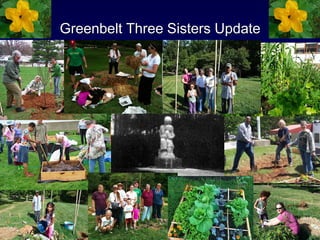
Greenbelt Three Sisters Update
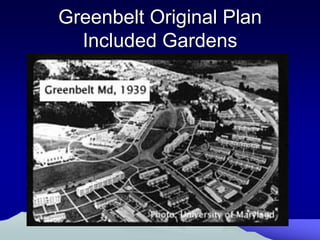
Greenbelt Original Plan
  Included Gardens
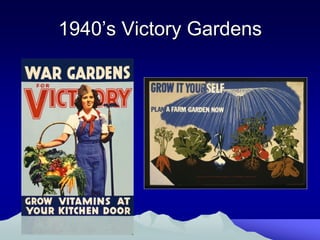
1940’s Victory Gardens
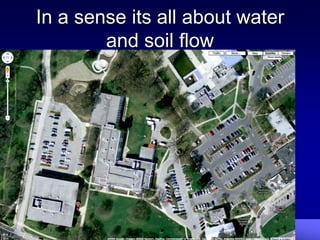
In a sense its all about water
        and soil flow
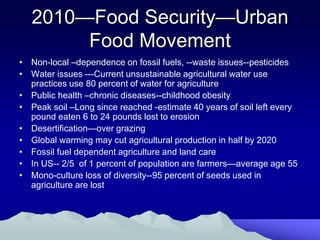
2010—Food Security—Urban
        Food Movement
• Non-local –dependence on fossil fuels, --waste issues--pesticides
• Water issues ---Current unsustainable agricultural water use
  practices use 80 percent of water for agriculture
• Public health –chronic diseases--childhood obesity
• Peak soil –Long since reached -estimate 40 years of soil left every
  pound eaten 6 to 24 pounds lost to erosion
• Desertification—over grazing
• Global warming may cut agricultural production in half by 2020
• Fossil fuel dependent agriculture and land care
• In US-- 2/5 of 1 percent of population are farmers—average age 55
• Mono-culture loss of diversity--95 percent of seeds used in
  agriculture are lost
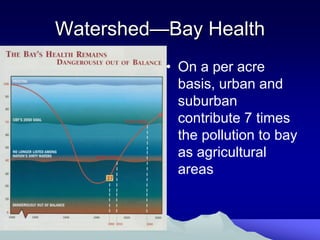
Watershed—Bay Health
          • On a per acre
            basis, urban and
            suburban
            contribute 7 times
            the pollution to bay
            as agricultural
            areas
Grew out of Green Aces Pesticide
       and Land Care Report
        Recommendations
The City and partners engage in a strong public
education campaign designed to inform residents of
Bay friendly and Organic Land Care, and to provide
interested citizens with knowledge of alternatives to
pesticide use. Outreach and education tools include:
household brochures, workshops, Greenbelt
Recreation Department courses, and experimental
community demonstration gardens
Four Equal Interrelated Goals
• Provide additional gardening opportunity
  for urban dwellers—participate in food
  production
• Promote Bay Friendly edible and native
  plant landscaping—help run off to Bay
  issues
• Promote community and co-learning in
  different areas of Greenbelt
• Educational, Scientific and Artistic and
  creative expression
Principles
• Inclusive—multi-age and ethnicity—
  handicapped access
• Organic –Bay Friendly practices
• Use of unused space now in grass
• Provide for sustainability of gardens–on-
  going infrastructure
• Incorporate education and art—creative
  expression; On-going life long co-learning
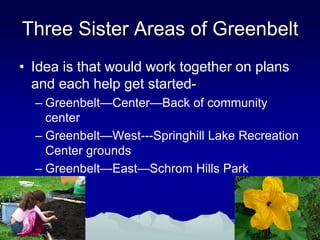
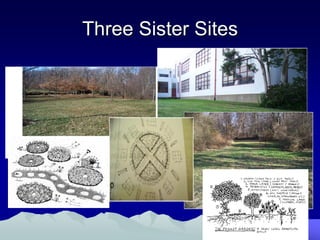
Three Sister Areas of Greenbelt
• Idea is that would work together on plans
  and each help get started-
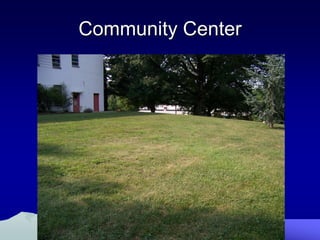
  – Greenbelt—Center—Back of community
    center
  – Greenbelt—West---Springhill Lake Recreation
    Center grounds
  – Greenbelt—East—Schrom Hills Park
Three Sister Sites
Community Center
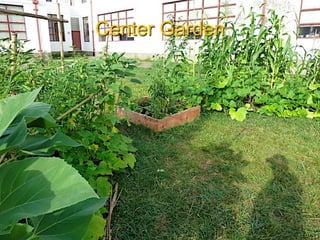
Center Garden
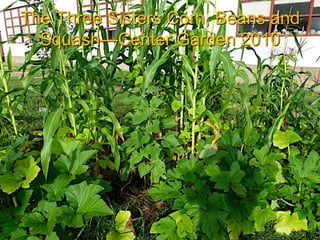
The Three Sisters Corn, Beans and
  Squash—Center Garden 2010
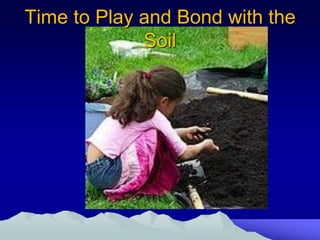
Time to Play and Bond with the
             Soil
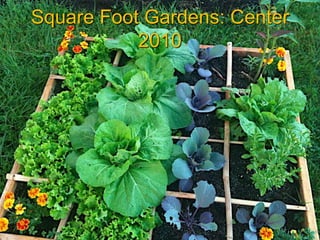
Square Foot Gardens: Center
           2010
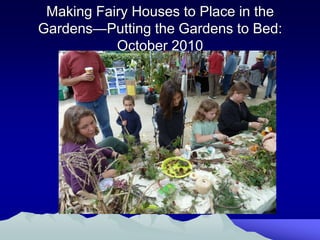
Making Fairy Houses to Place in the
Gardens—Putting the Gardens to Bed:
           October 2010
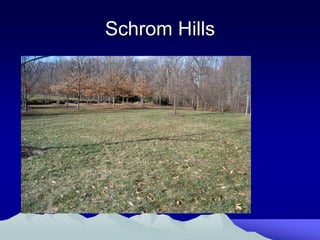
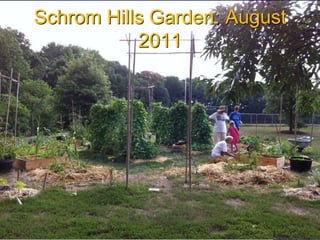
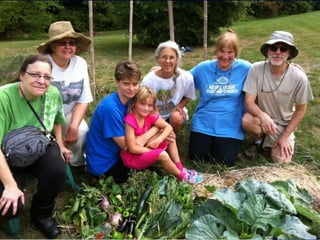
Schrom Hills
Schrom Hills Garden: August
           2011
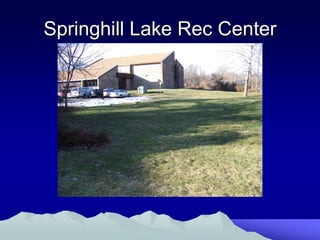
Springhill Lake Rec Center
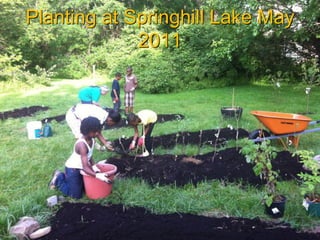
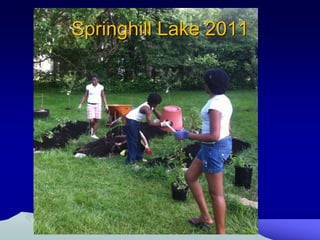
Planting at Springhill Lake May
             2011
Springhill Lake 2011
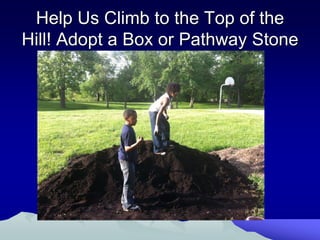
Help Us Climb to the Top of the
Hill! Adopt a Box or Pathway Stone
Adopt a Garden Box and Pathway
 Project at Springhill Lake Garden!
• Site and soil conditions (storm run-off
  area) indicate that we need to garden at
  Springhill Lake site in deep raised bed
  containers.
• Design for circle of 16—boxes that are
  about 4 by 8 feet and two feet deep &
  eco-art stepping stone pathways.
There are many ways to
contribute—Do one or all three!
1) Donate funds for materials and soil
 to help build a box or for eco-art
 pathway stones.
2) Participate in workshops to build the
 boxes and eco-art stepping stones.
3) Plant and maintain a box working
 with the CHEARS Chesapeake
 Conservation Corp volunteer.
Raising Funds to Support and Sustain
  the Gardens --Suggested Donation
• We’re asking individuals and groups to give
  support in donating to this project. All names
  of contributors of any amount will be
  acknowledged on boxes and stones
• $100 donation needed to support a box
  (materials, soil, initial plants—(folks may make
  whole or partial support donation—any amount
  appreciated)
• $25 donation for pathway stone
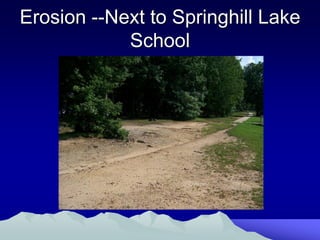
Erosion --Next to Springhill Lake
            School
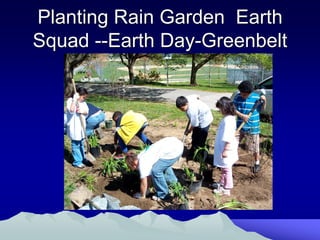
Planting Rain Garden Earth
Squad --Earth Day-Greenbelt
Public Works Supportive with
           Conditions
• Small manageable—          • Design help from city has
  limited area                 and is being given—work
• Must be aesthetically        closely
  pleasing                   • City not responsible for
• City agrees to allow use     vandalism; Accept may
  of water from near by        loose; near community
  buildings                    centers help
• Volunteers must            • Chears agrees to be
  implement and sustain        responsible for any
  gardens; Plan to hold        needed restoration
  workshops to implement
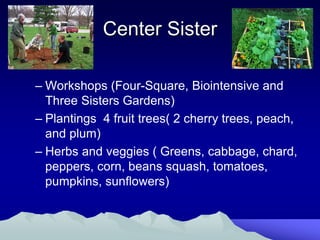
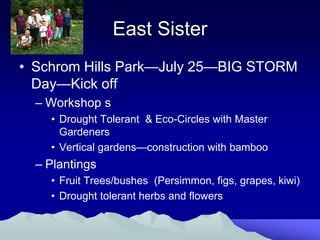
Center Sister

– Workshops (Four-Square, Biointensive and
  Three Sisters Gardens)
– Plantings 4 fruit trees( 2 cherry trees, peach,
  and plum)
– Herbs and veggies ( Greens, cabbage, chard,
  peppers, corn, beans squash, tomatoes,
  pumpkins, sunflowers)
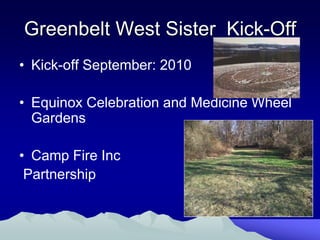
East Sister
• Schrom Hills Park—July 25—BIG STORM
  Day—Kick off
  – Workshop s
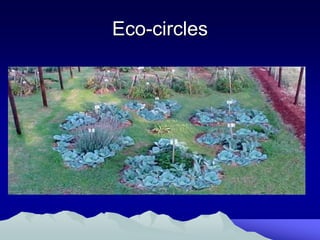
    • Drought Tolerant & Eco-Circles with Master
      Gardeners
    • Vertical gardens—construction with bamboo
  – Plantings
    • Fruit Trees/bushes (Persimmon, figs, grapes, kiwi)
    • Drought tolerant herbs and flowers
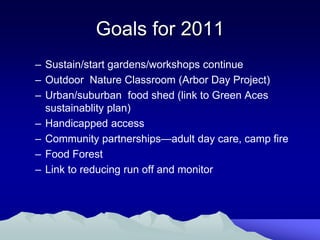
Greenbelt West Sister Kick-Off
• Kick-off September: 2010

• Equinox Celebration and Medicine Wheel
  Gardens

• Camp Fire Inc
 Partnership
Goals for 2011
– Sustain/start gardens/workshops continue
– Outdoor Nature Classroom (Arbor Day Project)
– Urban/suburban food shed (link to Green Aces
  sustainablity plan)
– Handicapped access
– Community partnerships—adult day care, camp fire
– Food Forest
– Link to reducing run off and monitor
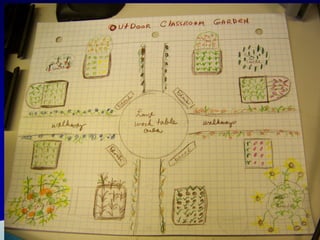
Next Steps—Outdoor Nature
         Classroom/Art
• Center Garden—Re-plant beds –outdoor
  nature classroom & handicapped acccess
  also work with adult day care center
• Schrom Hills---Cover crop—plant—forest
  garden
• Springhill Lake—16 beds—work with
  school and camp fire—stream
  monitoring—forest garden
Homescale Demonstration
       Workshop topics
• Permaculture
• Biointensive
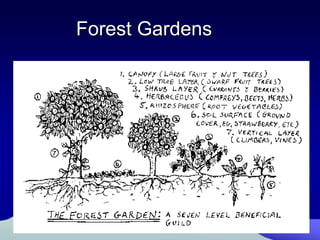
• Forest gardens
• Eco-circles
• Organic farming and land care
• Square foot gardening
• Conservation landscaping—native, wild
  life
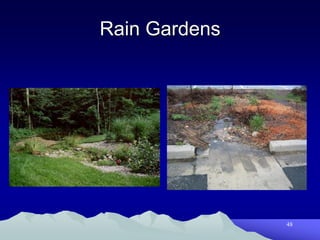
• Bio-retention—rain gardens
Permaculture is an
    interdisciplinary design system.

•   The observation of natural ecosystems
•   The wisdom of indigenous peoples
•   Traditional farming systems
•   Modern scientific and technological
    knowledge
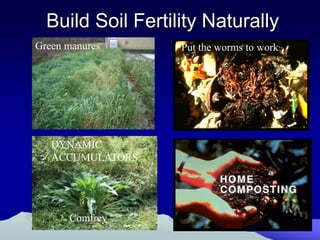
Build Soil Fertility Naturally
Green manures      Put the worms to work


   DYNAMIC
   ACCUMULATORS


      Comfrey
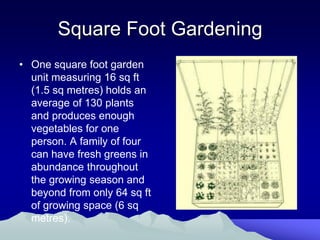
Square Foot Gardening
• One square foot garden
  unit measuring 16 sq ft
  (1.5 sq metres) holds an
  average of 130 plants
  and produces enough
  vegetables for one
  person. A family of four
  can have fresh greens in
  abundance throughout
  the growing season and
  beyond from only 64 sq ft
  of growing space (6 sq
  metres).
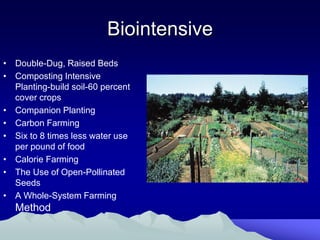
Biointensive
• Double-Dug, Raised Beds
• Composting Intensive
  Planting-build soil-60 percent
  cover crops
• Companion Planting
• Carbon Farming
• Six to 8 times less water use
  per pound of food
• Calorie Farming
• The Use of Open-Pollinated
  Seeds
• A Whole-System Farming
   Method
Eco-circles
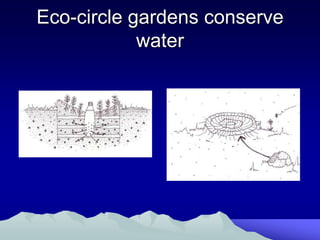
Eco-circle gardens conserve
            water
Forest Gardens
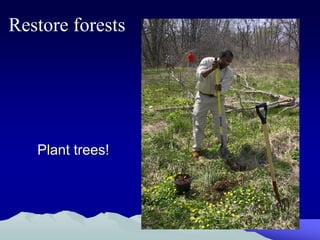
Restore forests


   Plant trees!
Rain Gardens


               48
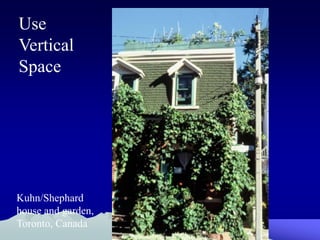
Use
Vertical
Space


Kuhn/Shephard
house and garden,
Toronto, Canada
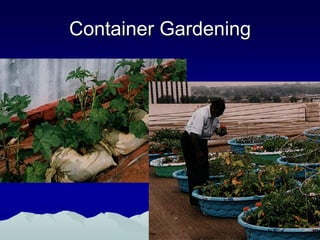
Container Gardening

Greenbelt Three Sisters Garden Update August 2011

  • 1.
    Greenbelt Three SistersDemonstration Gardens & Urban Foodshed Project August 2011
  • 2.
  • 3.
    Greenbelt Original Plan Included Gardens
  • 4.
  • 5.
    In a senseits all about water and soil flow
  • 6.
    2010—Food Security—Urban Food Movement • Non-local –dependence on fossil fuels, --waste issues--pesticides • Water issues ---Current unsustainable agricultural water use practices use 80 percent of water for agriculture • Public health –chronic diseases--childhood obesity • Peak soil –Long since reached -estimate 40 years of soil left every pound eaten 6 to 24 pounds lost to erosion • Desertification—over grazing • Global warming may cut agricultural production in half by 2020 • Fossil fuel dependent agriculture and land care • In US-- 2/5 of 1 percent of population are farmers—average age 55 • Mono-culture loss of diversity--95 percent of seeds used in agriculture are lost
  • 7.
    Watershed—Bay Health • On a per acre basis, urban and suburban contribute 7 times the pollution to bay as agricultural areas
  • 8.
    Grew out ofGreen Aces Pesticide and Land Care Report Recommendations The City and partners engage in a strong public education campaign designed to inform residents of Bay friendly and Organic Land Care, and to provide interested citizens with knowledge of alternatives to pesticide use. Outreach and education tools include: household brochures, workshops, Greenbelt Recreation Department courses, and experimental community demonstration gardens
  • 9.
    Four Equal InterrelatedGoals • Provide additional gardening opportunity for urban dwellers—participate in food production • Promote Bay Friendly edible and native plant landscaping—help run off to Bay issues • Promote community and co-learning in different areas of Greenbelt • Educational, Scientific and Artistic and creative expression
  • 10.
    Principles • Inclusive—multi-age andethnicity— handicapped access • Organic –Bay Friendly practices • Use of unused space now in grass • Provide for sustainability of gardens–on- going infrastructure • Incorporate education and art—creative expression; On-going life long co-learning
  • 11.
    Three Sister Areasof Greenbelt • Idea is that would work together on plans and each help get started- – Greenbelt—Center—Back of community center – Greenbelt—West---Springhill Lake Recreation Center grounds – Greenbelt—East—Schrom Hills Park
  • 12.
  • 13.
  • 14.
  • 15.
    The Three SistersCorn, Beans and Squash—Center Garden 2010
  • 16.
    Time to Playand Bond with the Soil
  • 17.
  • 18.
    Making Fairy Housesto Place in the Gardens—Putting the Gardens to Bed: October 2010
  • 19.
  • 20.
  • 22.
  • 23.
  • 24.
  • 25.
    Help Us Climbto the Top of the Hill! Adopt a Box or Pathway Stone
  • 26.
    Adopt a GardenBox and Pathway Project at Springhill Lake Garden! • Site and soil conditions (storm run-off area) indicate that we need to garden at Springhill Lake site in deep raised bed containers. • Design for circle of 16—boxes that are about 4 by 8 feet and two feet deep & eco-art stepping stone pathways.
  • 27.
    There are manyways to contribute—Do one or all three! 1) Donate funds for materials and soil to help build a box or for eco-art pathway stones. 2) Participate in workshops to build the boxes and eco-art stepping stones. 3) Plant and maintain a box working with the CHEARS Chesapeake Conservation Corp volunteer.
  • 28.
    Raising Funds toSupport and Sustain the Gardens --Suggested Donation • We’re asking individuals and groups to give support in donating to this project. All names of contributors of any amount will be acknowledged on boxes and stones • $100 donation needed to support a box (materials, soil, initial plants—(folks may make whole or partial support donation—any amount appreciated) • $25 donation for pathway stone
  • 29.
    Erosion --Next toSpringhill Lake School
  • 30.
    Planting Rain GardenEarth Squad --Earth Day-Greenbelt
  • 31.
    Public Works Supportivewith Conditions • Small manageable— • Design help from city has limited area and is being given—work • Must be aesthetically closely pleasing • City not responsible for • City agrees to allow use vandalism; Accept may of water from near by loose; near community buildings centers help • Volunteers must • Chears agrees to be implement and sustain responsible for any gardens; Plan to hold needed restoration workshops to implement
  • 32.
    Center Sister – Workshops(Four-Square, Biointensive and Three Sisters Gardens) – Plantings 4 fruit trees( 2 cherry trees, peach, and plum) – Herbs and veggies ( Greens, cabbage, chard, peppers, corn, beans squash, tomatoes, pumpkins, sunflowers)
  • 33.
    East Sister • SchromHills Park—July 25—BIG STORM Day—Kick off – Workshop s • Drought Tolerant & Eco-Circles with Master Gardeners • Vertical gardens—construction with bamboo – Plantings • Fruit Trees/bushes (Persimmon, figs, grapes, kiwi) • Drought tolerant herbs and flowers
  • 34.
    Greenbelt West SisterKick-Off • Kick-off September: 2010 • Equinox Celebration and Medicine Wheel Gardens • Camp Fire Inc Partnership
  • 35.
    Goals for 2011 –Sustain/start gardens/workshops continue – Outdoor Nature Classroom (Arbor Day Project) – Urban/suburban food shed (link to Green Aces sustainablity plan) – Handicapped access – Community partnerships—adult day care, camp fire – Food Forest – Link to reducing run off and monitor
  • 36.
    Next Steps—Outdoor Nature Classroom/Art • Center Garden—Re-plant beds –outdoor nature classroom & handicapped acccess also work with adult day care center • Schrom Hills---Cover crop—plant—forest garden • Springhill Lake—16 beds—work with school and camp fire—stream monitoring—forest garden
  • 39.
    Homescale Demonstration Workshop topics • Permaculture • Biointensive • Forest gardens • Eco-circles • Organic farming and land care • Square foot gardening • Conservation landscaping—native, wild life • Bio-retention—rain gardens
  • 40.
    Permaculture is an interdisciplinary design system. • The observation of natural ecosystems • The wisdom of indigenous peoples • Traditional farming systems • Modern scientific and technological knowledge
  • 41.
    Build Soil FertilityNaturally Green manures Put the worms to work DYNAMIC ACCUMULATORS Comfrey
  • 42.
    Square Foot Gardening •One square foot garden unit measuring 16 sq ft (1.5 sq metres) holds an average of 130 plants and produces enough vegetables for one person. A family of four can have fresh greens in abundance throughout the growing season and beyond from only 64 sq ft of growing space (6 sq metres).
  • 43.
    Biointensive • Double-Dug, RaisedBeds • Composting Intensive Planting-build soil-60 percent cover crops • Companion Planting • Carbon Farming • Six to 8 times less water use per pound of food • Calorie Farming • The Use of Open-Pollinated Seeds • A Whole-System Farming Method
  • 44.
  • 45.
  • 46.
  • 47.
    Restore forests Plant trees!
  • 48.
  • 49.
  • 50.