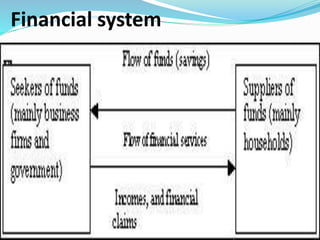
Financial system 
09/09/2014 2
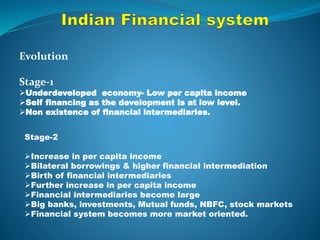
Evolution 
Stage-1 
Underdeveloped economy- Low per capita income 
Self financing as the development is at low level. 
Non existence of financial intermediaries. 
Stage-2 
Increase in per capita income 
Bilateral borrowings & higher financial intermediation 
Birth of financial intermediaries 
Further increase in per capita income 
Financial intermediaries become large 
Big banks, investments, Mutual funds, NBFC, stock markets 
Financial system becomes more market oriented.
Formal Informal 
Organized & regulated 
Under purview of RBI & MoF/ SEBI 
(Banks/NBFC/ Financial instruments 
/financial services .) 
Unorganized & unregulated 
Flexibility in operations 
Low transaction cost 
Minimum default risk 
High interest rates 
(money lenders/ land lords/ 
Local chits/ savings clubs/ 
Pawn brokers) 
Coexistence
Indian Financial system 
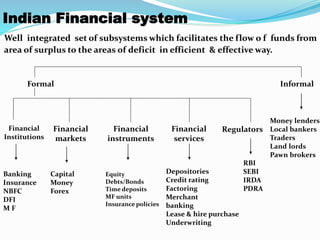
Well integrated set of subsystems which facilitates the flow o f funds from 
area of surplus to the areas of deficit in efficient & effective way. 
Formal Informal 
Financial 
Institutions 
Financial 
markets 
Regulators 
RBI 
SEBI 
IRDA 
PDRA 
Financial 
instruments 
Financial 
services 
Money lenders 
Local bankers 
Traders 
Land lords 
Pawn brokers 
Depositories 
Credit rating 
Factoring 
Merchant 
banking 
Lease & hire purchase 
Underwriting 
Equity 
Debts/Bonds 
Time deposits 
MF units 
Insurance policies 
Banking 
Insurance 
NBFC 
DFI 
M F 
Capital 
Money 
Forex
Indian Financial system (cont’d) 
Banking 
Institutions 
Non Banking 
Fin. Companies 
SCB Sch 
Co–op 
Banks 
P.S.Banks 
Pvt Banks (Old/New) 
Foreign Banks 
RRB 
Mutual 
funds 
Insurance & 
Pension 
Financial Institutions 
NBFC DFI 
Public MF’s 
Private MF’s 
National State others 
IFCI, IDBI,SIDBI, 
NABARD, HDFC 
Exim bank, NHB 
SFC 
SIDC 
ECGC 
DICGC 
Public sector 
Pvt sector
Indian Financial system (cont’d) 
Capital market Money market 
Equity Debt 
Market Market 
Forex market 
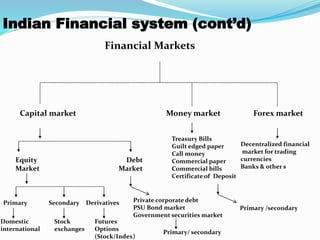
Financial Markets 
Decentralized financial 
market for trading 
currencies 
Banks & other s 
Primary Secondary Derivatives Private corporate debt 
PSU Bond market 
Government securities market 
Primary/ secondary 
Domestic 
international 
Stock 
exchanges 
Futures 
Options 
(Stock/Index) 
Treasury Bills 
Guilt edged paper 
Call money 
Commercial paper 
Commercial bills 
Certificate of Deposit 
Primary /secondary
Characteristics / Functions of Fin Mkts 
Characteristics 
 Larger volume 
 Speed of resource movement from one market to other 
 Saver decides the place to invest 
 Scope for instant arbitrage among various instruments in the market 
 High volatility 
( Failure of one segment affects others both domestic & international) 
Functions 
 Efficient payment mechanism 
 Providing information's to the company 
 Gives sufficient indications to investors to track their portfolio.
Call Money market 
Call Money /Inter Bank money market is short term ( over night/fortnight) 
Overnight is Call Money( C M) & otherwise is Notice money ( N M ) 
Surplus funds of Banks are traded . They are USL. 
Participants are Banks/ Co-Op Banks/ Discount finance houses/ Security 
trading Corporation 
C M M is located primarily in Mumbai, also at Kolkata/ Chennai/Ahmedabad/ 
Delhi/Bangalore 
Only banks can participate in Call money market .
Commercial Bills market 
• Important mode of financing working capital requirement for Industry & trade. 
• BoE is a written instrument / unconditional order signed by the maker , directing a 
person to pay a certain amount only to or order of a certain person or to the barer of 
the instrument as per N I act 1881 
• BoE is a freely exchangeable instrument evidencing a commercial transaction. 
• Three parties are involved , drawer of the bill, drawee to whom direction is given & 
payee to whom payment is to be made. 
• C B’s can be endorsed & by the endorser & the person to whom it is endorsed is 
endorsee. 
• Bills can be Sight/ Usance/ Supply / Accommodation. It can be Indian or foreign 
• A strong bills market can support liquidity in the M M & in turn to the financial system. 
• Its important character is self liquidating capability. It is next best to cash & TB 
• Banks can meet short term liquidity as the bills can be rediscounted with central bank
Treasury bills market 
Short term rupee borrowing instrument of the Government. 
More liquid /safe/ . Default risk absent. 
Regularly available / RBI auctions on weekly/fortnightly basis. 
Eligible for inclusion as SLR securities. 
Participants are all entities registered in India 
Types of T bills 
91 days 182 days 364 days 
Introduced in 1993 
Weekly auction on Wednesday 
& payment on following Friday 
Best way to park surplus funds 
Size- Rs 25,000 & multiples 
thereafter 
Reintroduced in April 2005. 
Weekly auction on Wednesday 
Of non reporting week & 
payment on following Friday 
Introduced in 1992 
Fortnightly auction on Wednesday 
Of reporting week & payment on 
following Friday. 
Good opportunity for Banks 
& other market participants. 
Size- Rs 1 crore & multiples & 
thereafter
Guilt edged securities (G securities) 
Government needs funds for development & non Development 
expenditure & to repay existing loans and they raise funds through G 
securities 
These are debt market instruments and is a larger than Industries securities 
market 
Traded both in primary & secondary markets . 
These are unconditionally guaranteed by central & State governments. 
All G securities are issued by RBI & are normally coupon. 
Coupon rate is fixed during the tenor of the term of the security. 
The market players are all entities registered in India.
Commercial Paper market 
• A promissory note issued by large companies to raise short term funds with 
high credit rating 
• These are unsecured but backed by lines of credit from their Bankers. 
• C P’s are redeemable at par on maturity which ranges from one week to an year 
• The denominations Rs 5 lakhs & multiples thereof 
• Involved parties are 
a) issuing company b) Issuing & Paying agent 
c) Credit rating agency (ICRA - A2, CRISIL- P2, CARE – PR2 ,) 
d) investor (Individuals, Banks, FI’s other corporates, MMMF’s, NRI’s, FII’s ) 
e) Banker (indirectly) 
• The eligibility for the company to issue CP’s are 
1) latest TNW not less than Rs 4 crs 
2) Working capital limits from banks not less than Rs 4 crs, 
3) Company to be classified as standard asset by the Bank
Certificate of Deposits 
• CD is a Unsecured , marketable short term instrument introduced by RBI in 1989 . 
• Can be issued only by Banks & specified FI’s 
• The buyers are individuals, cos, trusts, associations, Banks , NRI’s etc. ( MF’s are banned) 
• They are issued in demat form & transferable after 7 days of issue. 
• Minimum denomination is Rs 1.00 lakh and is issued at discount (stamp duty/issuing cost) 
• The minimum period of maturity is 7 days & max is 1 year. 
• To support banks to maintain their share in Financial markets & acts as intermediary . 
• Helps banks to mop up excess liquidity from the system . 
• The advantages of CD’s are 
( Short term investment, highly liquid (transferable by endorsement) , availability of 
secondary market through DFHI), traded in NSE.
Capital markets 
Equity Market Debt Market 
Primary Secondary Derivatives 
Private corporate debt 
PSU Bond market 
Government securities 
Domestic 
(IPO) 
International 
(ADR/GDR) 
Stock 
Exchanges 
Trading 
of securities 
Futures / Options 
(Stock/Index)
Regulators- SEBI 
Set up in 1988 & got legal teeth since 1992 with wide range of powers. 
Capital 
Market 
Capital 
Market 
Intermediaries 
Mutual 
Funds 
Venture 
capital 
FII’s Corporate 
Bond 
market 
09/09/2014 18
Role & Functions of SEBI 
19 
To Protects investors interest, educate & address their grievances . 
Develop & regulate securities market through appropriate measures. 
Register & regulate all the market intermediaries, regulate the working of stock 
brokers, sub brokers, share transfer agents . 
Inspection of stock exchanges, brokers, sub brokers, depositories, Mutual funds , 
review operations & administrative control of each exchange. 
Proactive oversight on market monitoring & market surveillance on continuous 
basis. 
Promote self regulatory organizations for making regulations more effective. 
Strengthening insiders trading regulations to make the securities market more 
transparent. 
Can suspend/ cancel license if the dealers / brokers/ participants violate norms
Financial system  markets

Financial system markets

  • 2.
  • 3.
    Evolution Stage-1 Underdevelopedeconomy- Low per capita income Self financing as the development is at low level. Non existence of financial intermediaries. Stage-2 Increase in per capita income Bilateral borrowings & higher financial intermediation Birth of financial intermediaries Further increase in per capita income Financial intermediaries become large Big banks, investments, Mutual funds, NBFC, stock markets Financial system becomes more market oriented.
  • 4.
    Formal Informal Organized& regulated Under purview of RBI & MoF/ SEBI (Banks/NBFC/ Financial instruments /financial services .) Unorganized & unregulated Flexibility in operations Low transaction cost Minimum default risk High interest rates (money lenders/ land lords/ Local chits/ savings clubs/ Pawn brokers) Coexistence
  • 5.
    Indian Financial system Well integrated set of subsystems which facilitates the flow o f funds from area of surplus to the areas of deficit in efficient & effective way. Formal Informal Financial Institutions Financial markets Regulators RBI SEBI IRDA PDRA Financial instruments Financial services Money lenders Local bankers Traders Land lords Pawn brokers Depositories Credit rating Factoring Merchant banking Lease & hire purchase Underwriting Equity Debts/Bonds Time deposits MF units Insurance policies Banking Insurance NBFC DFI M F Capital Money Forex
  • 6.
    Indian Financial system(cont’d) Banking Institutions Non Banking Fin. Companies SCB Sch Co–op Banks P.S.Banks Pvt Banks (Old/New) Foreign Banks RRB Mutual funds Insurance & Pension Financial Institutions NBFC DFI Public MF’s Private MF’s National State others IFCI, IDBI,SIDBI, NABARD, HDFC Exim bank, NHB SFC SIDC ECGC DICGC Public sector Pvt sector
  • 7.
    Indian Financial system(cont’d) Capital market Money market Equity Debt Market Market Forex market Financial Markets Decentralized financial market for trading currencies Banks & other s Primary Secondary Derivatives Private corporate debt PSU Bond market Government securities market Primary/ secondary Domestic international Stock exchanges Futures Options (Stock/Index) Treasury Bills Guilt edged paper Call money Commercial paper Commercial bills Certificate of Deposit Primary /secondary
  • 8.
    Characteristics / Functionsof Fin Mkts Characteristics  Larger volume  Speed of resource movement from one market to other  Saver decides the place to invest  Scope for instant arbitrage among various instruments in the market  High volatility ( Failure of one segment affects others both domestic & international) Functions  Efficient payment mechanism  Providing information's to the company  Gives sufficient indications to investors to track their portfolio.
  • 10.
    Call Money market Call Money /Inter Bank money market is short term ( over night/fortnight) Overnight is Call Money( C M) & otherwise is Notice money ( N M ) Surplus funds of Banks are traded . They are USL. Participants are Banks/ Co-Op Banks/ Discount finance houses/ Security trading Corporation C M M is located primarily in Mumbai, also at Kolkata/ Chennai/Ahmedabad/ Delhi/Bangalore Only banks can participate in Call money market .
  • 11.
    Commercial Bills market • Important mode of financing working capital requirement for Industry & trade. • BoE is a written instrument / unconditional order signed by the maker , directing a person to pay a certain amount only to or order of a certain person or to the barer of the instrument as per N I act 1881 • BoE is a freely exchangeable instrument evidencing a commercial transaction. • Three parties are involved , drawer of the bill, drawee to whom direction is given & payee to whom payment is to be made. • C B’s can be endorsed & by the endorser & the person to whom it is endorsed is endorsee. • Bills can be Sight/ Usance/ Supply / Accommodation. It can be Indian or foreign • A strong bills market can support liquidity in the M M & in turn to the financial system. • Its important character is self liquidating capability. It is next best to cash & TB • Banks can meet short term liquidity as the bills can be rediscounted with central bank
  • 12.
    Treasury bills market Short term rupee borrowing instrument of the Government. More liquid /safe/ . Default risk absent. Regularly available / RBI auctions on weekly/fortnightly basis. Eligible for inclusion as SLR securities. Participants are all entities registered in India Types of T bills 91 days 182 days 364 days Introduced in 1993 Weekly auction on Wednesday & payment on following Friday Best way to park surplus funds Size- Rs 25,000 & multiples thereafter Reintroduced in April 2005. Weekly auction on Wednesday Of non reporting week & payment on following Friday Introduced in 1992 Fortnightly auction on Wednesday Of reporting week & payment on following Friday. Good opportunity for Banks & other market participants. Size- Rs 1 crore & multiples & thereafter
  • 13.
    Guilt edged securities(G securities) Government needs funds for development & non Development expenditure & to repay existing loans and they raise funds through G securities These are debt market instruments and is a larger than Industries securities market Traded both in primary & secondary markets . These are unconditionally guaranteed by central & State governments. All G securities are issued by RBI & are normally coupon. Coupon rate is fixed during the tenor of the term of the security. The market players are all entities registered in India.
  • 14.
    Commercial Paper market • A promissory note issued by large companies to raise short term funds with high credit rating • These are unsecured but backed by lines of credit from their Bankers. • C P’s are redeemable at par on maturity which ranges from one week to an year • The denominations Rs 5 lakhs & multiples thereof • Involved parties are a) issuing company b) Issuing & Paying agent c) Credit rating agency (ICRA - A2, CRISIL- P2, CARE – PR2 ,) d) investor (Individuals, Banks, FI’s other corporates, MMMF’s, NRI’s, FII’s ) e) Banker (indirectly) • The eligibility for the company to issue CP’s are 1) latest TNW not less than Rs 4 crs 2) Working capital limits from banks not less than Rs 4 crs, 3) Company to be classified as standard asset by the Bank
  • 15.
    Certificate of Deposits • CD is a Unsecured , marketable short term instrument introduced by RBI in 1989 . • Can be issued only by Banks & specified FI’s • The buyers are individuals, cos, trusts, associations, Banks , NRI’s etc. ( MF’s are banned) • They are issued in demat form & transferable after 7 days of issue. • Minimum denomination is Rs 1.00 lakh and is issued at discount (stamp duty/issuing cost) • The minimum period of maturity is 7 days & max is 1 year. • To support banks to maintain their share in Financial markets & acts as intermediary . • Helps banks to mop up excess liquidity from the system . • The advantages of CD’s are ( Short term investment, highly liquid (transferable by endorsement) , availability of secondary market through DFHI), traded in NSE.
  • 17.
    Capital markets EquityMarket Debt Market Primary Secondary Derivatives Private corporate debt PSU Bond market Government securities Domestic (IPO) International (ADR/GDR) Stock Exchanges Trading of securities Futures / Options (Stock/Index)
  • 18.
    Regulators- SEBI Setup in 1988 & got legal teeth since 1992 with wide range of powers. Capital Market Capital Market Intermediaries Mutual Funds Venture capital FII’s Corporate Bond market 09/09/2014 18
  • 19.
    Role & Functionsof SEBI 19 To Protects investors interest, educate & address their grievances . Develop & regulate securities market through appropriate measures. Register & regulate all the market intermediaries, regulate the working of stock brokers, sub brokers, share transfer agents . Inspection of stock exchanges, brokers, sub brokers, depositories, Mutual funds , review operations & administrative control of each exchange. Proactive oversight on market monitoring & market surveillance on continuous basis. Promote self regulatory organizations for making regulations more effective. Strengthening insiders trading regulations to make the securities market more transparent. Can suspend/ cancel license if the dealers / brokers/ participants violate norms