INDIAN FINANCIAL SYSTEM
BUSINESS ENVIRONMENT: MODULE 4
FINANCIAL SYSTEM
 Financial System: An institutional framework existing in a country to
enable financial transactions.
 Three main parts:
1. Financial assets (loans, deposits, bonds, equities, etc.)
2. Financial institutions (banks, mutual funds, insurance companies, etc.)
3. Financial markets (money market, capital market, forex market, etc.)
 Regulation is another aspect of the financial system (RBI, SEBI, IRDA,
FMC)
 Payment and Settlement System Plays a crucial role in it.
4/10/2015PREPARED BY: KAVYA M BHAT
2
FINANCIAL SYSTEM CONTINUED……
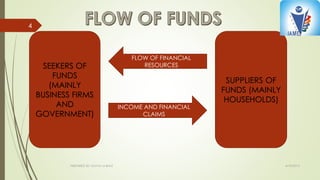
 There are areas or people with surplus funds and there are those
with a deficit. A financial system or financial sector functions as
an intermediary and facilitates the flow of funds from the areas of
surplus to the areas of deficit
 A Financial System is a composition of various institutions, markets,
regulations and laws, practices, money manager, analysts,
transactions and claims and liabilities
4/10/2015PREPARED BY: KAVYA M BHAT
3
4/10/2015PREPARED BY: KAVYA M BHAT
4
SEEKERS OF
FUNDS
(MAINLY
BUSINESS FIRMS
AND
GOVERNMENT)
SUPPLIERS OF
FUNDS (MAINLY
HOUSEHOLDS)
FLOW OF FINANCIAL
RESOURCES
INCOME AND FINANCIAL
CLAIMS
FINANCIAL ASSETS/INSTRUMENTS
 Financial Assets/Instruments
• Enable channelizing funds from surplus units to deficit units
• There are instruments for savers such as deposits, equities, mutual fund units, etc.
• There are instruments for borrowers such as loans, overdrafts, etc.
• Like businesses, governments too raise funds through issuing of bonds, Treasury bills, etc.
• Instruments like PPF, KVP, etc. are available to savers who wish to lend money to the government
 Major Financial Instruments
• Money
• Savings account
• Credit market Instruments-bonds, mortgages
• Common Stocks
• Money market funds and mutual funds
• Pension funds
• Financial Derivatives
4/10/2015PREPARED BY: KAVYA M BHAT
5
FINANCIAL INSTITUTIONS
A financial institution is an institution that provides financial services for its clients or
members
 Includes institutions and mechanisms which
 Affect generation of savings by the community
 Mobilization of savings
 Effective distribution of savings
 Institutions are banks, insurance companies, mutual funds- promote savings
 Individual investors, industrial and trading companies- borrowers
4/10/2015PREPARED BY: KAVYA M BHAT
6
FINANCIAL MARKETS
 Money Market- for short-term funds (less than a year)
 Organized (Banks)
 Unorganized (money lenders, chit funds, etc.)
 Capital Market- for long-term funds
 Primary Issues Market
 Stock Market
 Bond Market
4/10/2015PREPARED BY: KAVYA M BHAT
7
INTRODUCTION TO INDIAN
FINANCIAL SYSTEM
 The financial system plays an important role in promoting economic
growth not only by channelling savings into investments but also by
improving allocative efficiency of resources.
 The recent empirical evidence, in fact, suggests that financial
system contributes to economic growth more by improving the
allocative efficiency of resources than by channelling of resources
from savers to investors. An efficient financial system is now
regarded as a necessary pre-condition for growth.
4/10/2015PREPARED BY: KAVYA M BHAT
8
CONTINUED….
 This shift in the emphasis along with opening up of domestic
economies to international competition has encouraged emerging
market economies (EMEs) to introduce financial sector reforms.
 In the wake of the financial crises of the 1990s however, the role of
the financial system in growth has been subjected to a critical
reassessment.
 Increased financial integration has exposed the countries to the risk
of contagion. It is now widely recognised that stability of the
financial system is critical for a sustainable growth.
4/10/2015PREPARED BY: KAVYA M BHAT
9
EVOLUTION OF INDIAN FINANCIAL
SYSTEM (IFS)
 The environment in which the IFS has functioned in the post independent
era can be divided into 3 distinct periods.
1. First period: 1949 and 1969
2. Second period: 1969 till 1991
3. Third period starts from 1991
4/10/2015PREPARED BY: KAVYA M BHAT
10
FIRST PERIOD (1949-1969)
 Soon after independence, banking sector was recognized as the major
sector of IFS.
 The RBI was nationalized in January 1949.
 All banks were required by the RBI Act to maintain 5% demand liabilities
and 2% of their time liabilities on a daily basis and SLR 20% of demand and
time liabilities.
 In 1962: CRR was raised to 3-15% and SLR 25% above CRR.
 Prior to 1964 the interest payable on deposits were decided by important
banks but since 1964 RBI directly regulated the interest rates.
4/10/2015PREPARED BY: KAVYA M BHAT
11
CONTINUED…
 RBI was envisaged to play a promotional role in promoting credit to
agricultural sectors.
 The allocation of credit from commercial banks was largely to industry.
 Increase in share of credit to industry from 37.5% in 1951 to 67.5% in 1968.
 The share of credit from banks to agricultural sector was little over 2%.
4/10/2015PREPARED BY: KAVYA M BHAT
12
SECOND PERIOD (1969-1991)
 Nationalization of 14 largest Indian Scheduled Commercial Banks. This
inhibited the competition in the banking sector.
 Other financial institutions like LIC, UTI, IDBI, IFCI and ICICI was nationalized
in this period with special objectives.
• UTI to promote stock market.
• IDBI to provide direct and long-term loans to industrial sector.
• IFCI and ICICI to provide term loans
4/10/2015PREPARED BY: KAVYA M BHAT
13
CONTINUED….
 Financial repression set in due to government’s increasing need to use
banking sectors for financing its own deficits.
 Financial repression led to segmented and underdeveloped financial
markets.
 The need for financial reforms came with the submission of 2 committee
reports- Chakravarthy Committee Report 1985 and Vaghul Committee
Report in 1987.
4/10/2015PREPARED BY: KAVYA M BHAT
14
 Chakravarthy Committee Report:
• To develop treasury bills as monetary instrument.
• Revise upwards yield of government securities so as to create a demand
for public debt.
• Adopt monetary targeting as an important monetary tool with price
stability.
4/10/2015PREPARED BY: KAVYA M BHAT
15
 Vaghul Committee Report: phased decontrol and development of money
markets and gradual integration of these markets with other short term
markets such as treasury bill markets.
 The actual reform started in mid eighties with RBI implementing some of the
recommendations of these 2 committees.
 The major steps taken by RBI are:
1. Introduction of 182-day treasury bills in 1986.
2. Introduction of commercial papers and certificate of deposits in 1989.
3. Introduction of institution of DFHI in 1988.
4/10/2015PREPARED BY: KAVYA M BHAT
16
THIRD PERIOD (FROM 1991 TILL NOW)
 The financial sector got a major boost with the implementation of
recommendations given by Narasimhan Committee.
1. Reducing SLR to 25% and using CRR as an instrument for monetary policy.
2. Phasing out directed credit programmes and to bring the interest rate on
government borrowing in line with other market determined interest rates.
3. Banks and financial institutions achieve a minimum 4% capital adequacy ratio
in relation to risk weighted assets by March 1993.
4. Banks and financial institutions adopt uniform accounting policies.
5. Liberalizing policies towards foreign banks with regard to opening of offices as
branches or subsidiaries.
6. Freedom should be given to issuers of capital to decide on the nature of the
instruments, its terms and pricing in the capital market.
4/10/2015PREPARED BY: KAVYA M BHAT
17
 Most of these recommendations were implemented by 1955-56 which has
led to significant deregulation and development of money market.
4/10/2015PREPARED BY: KAVYA M BHAT
18
REFERENCES
 http://business.mapsofindia.com/banks-in-india/nationalised-banks-in-
india.html
 http://en.wikipedia.org/wiki/Financial_institution
 http://en.wikipedia.org/wiki/Financial_instrument
 http://en.wikipedia.org/wiki/Financial_market
4/10/2015PREPARED BY: KAVYA M BHAT
19
Indian financial system

Indian financial system

  • 1.
    INDIAN FINANCIAL SYSTEM BUSINESSENVIRONMENT: MODULE 4
  • 2.
    FINANCIAL SYSTEM  FinancialSystem: An institutional framework existing in a country to enable financial transactions.  Three main parts: 1. Financial assets (loans, deposits, bonds, equities, etc.) 2. Financial institutions (banks, mutual funds, insurance companies, etc.) 3. Financial markets (money market, capital market, forex market, etc.)  Regulation is another aspect of the financial system (RBI, SEBI, IRDA, FMC)  Payment and Settlement System Plays a crucial role in it. 4/10/2015PREPARED BY: KAVYA M BHAT 2
  • 3.
    FINANCIAL SYSTEM CONTINUED…… There are areas or people with surplus funds and there are those with a deficit. A financial system or financial sector functions as an intermediary and facilitates the flow of funds from the areas of surplus to the areas of deficit  A Financial System is a composition of various institutions, markets, regulations and laws, practices, money manager, analysts, transactions and claims and liabilities 4/10/2015PREPARED BY: KAVYA M BHAT 3
  • 4.
    4/10/2015PREPARED BY: KAVYAM BHAT 4 SEEKERS OF FUNDS (MAINLY BUSINESS FIRMS AND GOVERNMENT) SUPPLIERS OF FUNDS (MAINLY HOUSEHOLDS) FLOW OF FINANCIAL RESOURCES INCOME AND FINANCIAL CLAIMS
  • 5.
    FINANCIAL ASSETS/INSTRUMENTS  FinancialAssets/Instruments • Enable channelizing funds from surplus units to deficit units • There are instruments for savers such as deposits, equities, mutual fund units, etc. • There are instruments for borrowers such as loans, overdrafts, etc. • Like businesses, governments too raise funds through issuing of bonds, Treasury bills, etc. • Instruments like PPF, KVP, etc. are available to savers who wish to lend money to the government  Major Financial Instruments • Money • Savings account • Credit market Instruments-bonds, mortgages • Common Stocks • Money market funds and mutual funds • Pension funds • Financial Derivatives 4/10/2015PREPARED BY: KAVYA M BHAT 5
  • 6.
    FINANCIAL INSTITUTIONS A financialinstitution is an institution that provides financial services for its clients or members  Includes institutions and mechanisms which  Affect generation of savings by the community  Mobilization of savings  Effective distribution of savings  Institutions are banks, insurance companies, mutual funds- promote savings  Individual investors, industrial and trading companies- borrowers 4/10/2015PREPARED BY: KAVYA M BHAT 6
  • 7.
    FINANCIAL MARKETS  MoneyMarket- for short-term funds (less than a year)  Organized (Banks)  Unorganized (money lenders, chit funds, etc.)  Capital Market- for long-term funds  Primary Issues Market  Stock Market  Bond Market 4/10/2015PREPARED BY: KAVYA M BHAT 7
  • 8.
    INTRODUCTION TO INDIAN FINANCIALSYSTEM  The financial system plays an important role in promoting economic growth not only by channelling savings into investments but also by improving allocative efficiency of resources.  The recent empirical evidence, in fact, suggests that financial system contributes to economic growth more by improving the allocative efficiency of resources than by channelling of resources from savers to investors. An efficient financial system is now regarded as a necessary pre-condition for growth. 4/10/2015PREPARED BY: KAVYA M BHAT 8
  • 9.
    CONTINUED….  This shiftin the emphasis along with opening up of domestic economies to international competition has encouraged emerging market economies (EMEs) to introduce financial sector reforms.  In the wake of the financial crises of the 1990s however, the role of the financial system in growth has been subjected to a critical reassessment.  Increased financial integration has exposed the countries to the risk of contagion. It is now widely recognised that stability of the financial system is critical for a sustainable growth. 4/10/2015PREPARED BY: KAVYA M BHAT 9
  • 10.
    EVOLUTION OF INDIANFINANCIAL SYSTEM (IFS)  The environment in which the IFS has functioned in the post independent era can be divided into 3 distinct periods. 1. First period: 1949 and 1969 2. Second period: 1969 till 1991 3. Third period starts from 1991 4/10/2015PREPARED BY: KAVYA M BHAT 10
  • 11.
    FIRST PERIOD (1949-1969) Soon after independence, banking sector was recognized as the major sector of IFS.  The RBI was nationalized in January 1949.  All banks were required by the RBI Act to maintain 5% demand liabilities and 2% of their time liabilities on a daily basis and SLR 20% of demand and time liabilities.  In 1962: CRR was raised to 3-15% and SLR 25% above CRR.  Prior to 1964 the interest payable on deposits were decided by important banks but since 1964 RBI directly regulated the interest rates. 4/10/2015PREPARED BY: KAVYA M BHAT 11
  • 12.
    CONTINUED…  RBI wasenvisaged to play a promotional role in promoting credit to agricultural sectors.  The allocation of credit from commercial banks was largely to industry.  Increase in share of credit to industry from 37.5% in 1951 to 67.5% in 1968.  The share of credit from banks to agricultural sector was little over 2%. 4/10/2015PREPARED BY: KAVYA M BHAT 12
  • 13.
    SECOND PERIOD (1969-1991) Nationalization of 14 largest Indian Scheduled Commercial Banks. This inhibited the competition in the banking sector.  Other financial institutions like LIC, UTI, IDBI, IFCI and ICICI was nationalized in this period with special objectives. • UTI to promote stock market. • IDBI to provide direct and long-term loans to industrial sector. • IFCI and ICICI to provide term loans 4/10/2015PREPARED BY: KAVYA M BHAT 13
  • 14.
    CONTINUED….  Financial repressionset in due to government’s increasing need to use banking sectors for financing its own deficits.  Financial repression led to segmented and underdeveloped financial markets.  The need for financial reforms came with the submission of 2 committee reports- Chakravarthy Committee Report 1985 and Vaghul Committee Report in 1987. 4/10/2015PREPARED BY: KAVYA M BHAT 14
  • 15.
     Chakravarthy CommitteeReport: • To develop treasury bills as monetary instrument. • Revise upwards yield of government securities so as to create a demand for public debt. • Adopt monetary targeting as an important monetary tool with price stability. 4/10/2015PREPARED BY: KAVYA M BHAT 15
  • 16.
     Vaghul CommitteeReport: phased decontrol and development of money markets and gradual integration of these markets with other short term markets such as treasury bill markets.  The actual reform started in mid eighties with RBI implementing some of the recommendations of these 2 committees.  The major steps taken by RBI are: 1. Introduction of 182-day treasury bills in 1986. 2. Introduction of commercial papers and certificate of deposits in 1989. 3. Introduction of institution of DFHI in 1988. 4/10/2015PREPARED BY: KAVYA M BHAT 16
  • 17.
    THIRD PERIOD (FROM1991 TILL NOW)  The financial sector got a major boost with the implementation of recommendations given by Narasimhan Committee. 1. Reducing SLR to 25% and using CRR as an instrument for monetary policy. 2. Phasing out directed credit programmes and to bring the interest rate on government borrowing in line with other market determined interest rates. 3. Banks and financial institutions achieve a minimum 4% capital adequacy ratio in relation to risk weighted assets by March 1993. 4. Banks and financial institutions adopt uniform accounting policies. 5. Liberalizing policies towards foreign banks with regard to opening of offices as branches or subsidiaries. 6. Freedom should be given to issuers of capital to decide on the nature of the instruments, its terms and pricing in the capital market. 4/10/2015PREPARED BY: KAVYA M BHAT 17
  • 18.
     Most ofthese recommendations were implemented by 1955-56 which has led to significant deregulation and development of money market. 4/10/2015PREPARED BY: KAVYA M BHAT 18
  • 19.
    REFERENCES  http://business.mapsofindia.com/banks-in-india/nationalised-banks-in- india.html  http://en.wikipedia.org/wiki/Financial_institution http://en.wikipedia.org/wiki/Financial_instrument  http://en.wikipedia.org/wiki/Financial_market 4/10/2015PREPARED BY: KAVYA M BHAT 19

Editor's Notes

  • #14 Central Bank of India, Bank of India, Punjab National Bank, Bank of Baroda, United Commercial Bank, Canara Bank, Dena Bank, United Bank, Syndicate Bank, Allahabad Bank, Indian Bank, Bank of Maharashtra, Indian Overseas Bank and Union Bank. ICICI- Industrial Credit and Investment Corporation of India IDBI- Industrial Development Bank of India IFCI- Industrial Finance corporation of India
  • #17 DFHI- Discount and Finance House of India