Indian Financial System Dilipraj Dongre
Financial System Existence of a well organized financial system Promotes the well being and standard of living of the people of a country Money and monetary assets  Mobilize the saving  Promotes investment
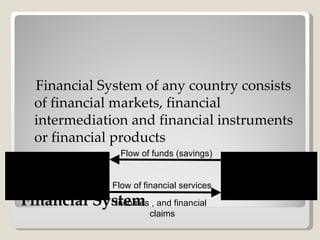
Financial System Financial System of any country consists of financial markets, financial intermediation and financial instruments or financial products  Suppliers of funds (Mainly households) Flow of financial services Incomes , and financial  claims Seekers of funds  (Mainly business firms and government) Flow of funds (savings)
Indian Financial System  Non-  Organized   Organized   Money lenders Local bankers  Traders Landlords Pawn brokers Chit Funds Regulators Financial Institutions Financial Markets Financial services
Evolution of Financial System Barter Money Lender Nidhi's/Chit Funds Indigenous Banking Cooperative Movement Societies Banks Joint-Stock Banks
Consolidation Commercial Banks Nationalization Investment Banks Development Financial Institutions Investment/Insurance Companies Stock Exchanges Market Operations Specialized Financial Institutions Merchant Banking Universal Banking
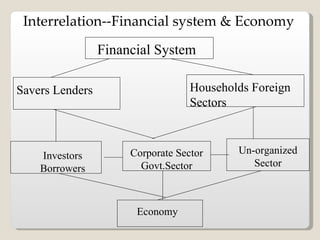
Financial System Savers Lenders Households Foreign Sectors Investors Borrowers Corporate Sector Govt.Sector Un-organized Sector Economy Interrelation--Financial system & Economy
Organized Indian Financial System  Money Market  Instrument Capital Market  Instrument Forex  Market Capital  Market Money  Market Credit  Market Primary Market Financial Instruments  Financial Markets Financial Intermediaries  Secondary Market  Regulators
Financial Markets Mechanism which allows people to trade Affected by forces of supply and demand Process used In Finance, Financial markets facilitates
Why Capital Markets Exist Capital markets facilitate the transfer of capital ( i.e.  financial) assets from one owner to another. They provide liquidity. Liquidity refers to how easily an asset can be transferred without loss of value. A side benefit of capital markets is that the transaction price provides a measure of the value of the asset.
Role of Capital Markets Mobilization of Savings & acceleration of Capital Formation Promotion of Industrial Growth Raising of long term Capital Ready & Continuous Markets Proper Channelisation of Funds Provision of a variety of Services
Indian Capital Market -  Historical perspective Stock Market was for a privileged few Archaic systems - Out cry method Lack of Transparency - High tones costs No use of Technology Outdated banking system Volumes - less than Rs. 300 cr per day No settlement guarantee mechanism - High risks
Indian Capital markets - Chronology 1994-Equity Trading commences on NSE 1995-All Trading goes Electronic 1996- Depository comes in to existence 1999- FIIs Participation- Globalisation 2000- over 80% trades in Demat form 2001- Major Stocks move to Rolling Sett 2003- T+2 settlements in all stocks 2003 - Demutualisation of Exchanges
Capital Markets - Reforms Each scam has brought in reforms - 1992 / 2001 Screen based Trading through NSE Capital adequacy norms stipulated Dematerialization of Shares - risks of fraudulent paper eliminated Entry of Foreign Investors Investor awareness programs Rolling settlements Inter-action between banking and exchanges
Reforms / Initiatives post 2000 Corporatisation of exchange memberships Banning of Badla / ALBM  Introduction of Derivative products - Index / Stock Futures & Options Reforms/Changes in the margining system STP - electronic contracts Margin Lending Securities Lending
MARKET STRUCTURE  (JULY 31, 2005) 22 Stock Exchanges,  Over 10000 Electronic Terminals at over 400 locations all over India. 9108 Stock Brokers and 14582 Sub brokers  9644 Listed Companies 2 Depositories and 483 Depository Participants 128 Merchant Bankers, 59 Underwriters 34 Debenture  Trustees,  96 Portfolio  Managers 83 Registrars & Transfer Agents, 59 Bankers to Issue 4 Credit Rating Agencies
Indian Capital Market Market Instruments Intermediaries   Primary Secondary Equity Debt Hybrid Regulator   Brokers  Investment Bankers  Stock Exchanges Underwriters SEBI Players Corporate Intermediaries CRA Banks/FI FDI /FII Individual
Stock Exchanges in INDIA  Mangalore Stock Exchange  Hyderabad Stock Exchange  Uttar Pradesh Stock Exchange Coimbatore Stock Exchange Cochin Stock Exchange  Bangalore Stock Exchange  Saurashtra Kutch Stock Exchange  Pune Stock Exchange  National Stock Exchange  OTC Exchange of India  Calcutta Stock Exchange  Inter-connected Stock   Exchange (NEW) Madras Stock Exchange Bombay Stock Exchange  Madhya Pradesh Stock Exchange  Vadodara Stock Exchange  The Ahmedabad Stock Exchange  Magadh Stock Exchange  Gauhati Stock Exchange Bhubaneswar Stock Exchange Jaipur Stock Exchange  Delhi Stock Exchange Assoc  Ludhiana Stock Exchange
The role of the stock exchange  Raising capital for businesses Mobilizing savings for investment Facilitate company growth Redistribution of wealth
The role of the stock exchange  Corporate governance Creates investment opportunities for small investors Government raises capital for development projects Barometer of the economy
Growth Pattern of the Indian Stock Market Sl.No. As on 31st December 1946 1961 1971 1975 1980 1985 1991 1995 1  No. of Stock Exchanges 7  7 8  8 9 14 20 22 2 No. of  Listed Cos. 1125  1203 1599 1552 2265 4344 6229 8593 3  No. of Stock Issues of  Listed Cos.  1506 2111 2838 3230 3697 6174 8967 11784 4  Capital of Listed Cos. (Cr. Rs.) 270 753 1812 2614 3973 9723 32041 59583 5  Market value of Capital of Listed Cos. (Cr. Rs.)  971 1292 2675 3273 6750 25302 110279 478121 6  Capital per Listed Cos. (4/2) (Lakh Rs.) 24 63 113 168 175 224 514 693 7 Market Value of Capital per Listed Cos. (Lakh Rs.) (5/2)  86 107 167 211 298 582 1770 5564 8  Appreciated value  of Capital per Listed Cos. (Lak Rs.) 358 170 148 126 170 260 344 803
Capital Market Instruments ADR / GDR Equity Debt Equity Shares  Preference Shares  Debentures  Zero coupon  bonds  Deep  Discount Bonds  Hybrid
Factors contributing to growth of Indian Capital Market  Establishment of Development banks & Industrial financial institution. Legislative measures Growing public confidence  Increasing awareness of investment opportunities
Factors contributing to growth of Indian Capital Market  Growth of underwriting business Setting up of SEBI Mutual Funds  Credit Rating Agencies
Indian Capital Market deficiencies  Lack of transparency  Physical settlement  Variety of manipulative practices  Institutional deficiencies  Insider trading
Money Market Market for short-term money and financial assets that are near substitutes for money. Short-Term means generally period upto one year and near substitutes to money is used to denote any financial asset which can be quickly converted into money with minimum transaction cost
Money Market It is a place for Large Institutions and government to manage their short-term cash needs It is a subsection of the Fixed Income Market It specializes in very short-term debt securities They are also called as Cash Investments
Defects of Money Market Lack of Integration Lack of Rational Interest Rates structure Absence of an organized bill market Shortage of funds in the Money Market Seasonal Stringency of funds and fluctuations in Interest rates Inadequate banking facilities
Money Market Instruments Treasury Bills Commercial Paper Certificate of Deposit Money Market Mutual Funds Repo Market
Segment   Issuer   Instruments   Government  Central Government  Zero Coupon Bonds, Coupon Bearing Bonds, Capital Index Bonds, Treasury Bills.  Public Sector  Government Agencies / Statutory Bodies  Govt. Guaranteed Bonds, Debentures  Public Sector Units  PSU Bonds, Debenture, Commercial Paper  Private  Corporate  Debentures, Bonds, Commercial Paper, Floating Rate Bonds, Zero Coupon Bonds, Inter-Corporate Deposits  Banks  Certificate of Deposits, Bonds  Financial Institutions  Certificate of Deposits, Bonds
Financial  Regulators
Financial Regulators Securities and Exchange Board of India (SEBI) Reserve Bank of India Ministry of Finance
Security Exchange Board of India (SEBI) Securities and Exchange Board of India (SEBI) was first established in the year 1988 Its a non-statutory body for regulating the securities market It became an autonomous body in 1992
Functions Of SEBI  Regulates Capital Market. Checks Trading of securities. Checks the malpractices in securities market.
Functions Of SEBI  It enhances investor's knowledge on market by providing education. It regulates the stockbrokers and sub-brokers. To promote Research and Investigation
Objectives of SEBI  It tries to develop the securities market. Promotes Investors Interest. Makes rules and regulations for the securities market.
The Recent Initiatives  Undertaken   Sole Control on Brokers For Underwriters For Share Prices For Mutual Funds
Reserve Bank of India Established on April 1, 1935 in accordance with the provisions of the RBI Act, 1934. The Central Office of the Reserve Bank has been in Mumbai. It acts as the apex monetary authority of the country.
Functions Of RBI Monetary Authority:   Formulation and Implementation of monetary policies. Maintaining price stability and ensuring adequate flow of credit to the Productive sectors. Issuer of currency:   Issues and exchanges or destroys currency and coins. Provide the public adequate quantity of supplies of currency notes and coins.
Regulator and supervisor of the financial system: Prescribes broad parameters of banking operations Maintain public confidence, protect depositors' interest and  provide cost-effective banking services. Authority On Foreign Exchange: Manages the Foreign Exchange Management Act, 1999. Facilitate external trade, payment, promote orderly development and maintenance of foreign exchange market.   Functions Of RBI
Developmental role:  Performs a wide range of promotional functions to support national objectives. Related Functions: Banker to the Government: performs merchant banking function for the central and the state governments. Maintains banking accounts of all scheduled banks.  Functions Of RBI
Monetary Measures  (a)  Bank Rate:   The Bank Rate was kept unchanged at 6.0 per cent.  (b)  Reverse Repo Rate: The Repo rate is around 7 per cent and Reverse  repo rate is around 6.10 per cent. (c)  Cash Reserve Ratio: The cash reserve ratio (CRR) of scheduled banks is  currently at 5.0 per cent.
Reforms in the Financial System Pre-reforms period Steps taken Objectives  Conclusion
Pre-Reforms Period  The period from the mid 1960s to the early 1990s. Characterized by: Administered interest rates Industrial licensing and controls Dominant public sector Limited competition High capital-output ratio
Pre-Reforms Period  Banks and financial institutions acted as a deposit agencies. Price discovery process was prevented. Government failed to generate resources for investment and public services. Till 90s it was closed, highly regulated, and segmented system.
Steps Taken Economic reforms initiated in June 1991. The committee appointed under the chairmanship of M Narasimham. He submitted report with all the recommendations Government liberalized the various sectors in the economy. Reform of the public sector and tax system.
Objectives Reorientation of the economy Macro economic stability To Increase competitive efficiency in the operations To remove structural rigidities and inefficiencies To attain a balance between the goals of financial stability & integrated & efficient markets
Recommendations Reduce the level of state ownership in banking   Lift restrictions on foreign ownership of banks   Spur the development of the corporate-bond market   Strengthen legal protections
Recommendations Deregulate the insurance industry Drop proposed limits on pension reforms   Increase consumer ownership of mutual-fund products   Introduce a gold deposit scheme
Recommendations Speed up the development of electronic payments.   Separate the RBI's regulatory and central-bank functions   Lift the remaining capital account controls   Phase out statutory priority lending and restrictions on asset allocation
Conclusion The financial system is fairly integrated, stable, efficient. Weaknesses need to be addressed. The reforms have been more capital centric in nature. Foreign capital flows and foreign exchange reserves have increased but absorption of foreign capital is low.
Thank you

Indian Financial System

  • 1.
    Indian Financial SystemDilipraj Dongre
  • 2.
    Financial System Existenceof a well organized financial system Promotes the well being and standard of living of the people of a country Money and monetary assets Mobilize the saving Promotes investment
  • 3.
    Financial System FinancialSystem of any country consists of financial markets, financial intermediation and financial instruments or financial products Suppliers of funds (Mainly households) Flow of financial services Incomes , and financial claims Seekers of funds (Mainly business firms and government) Flow of funds (savings)
  • 4.
    Indian Financial System Non- Organized Organized Money lenders Local bankers Traders Landlords Pawn brokers Chit Funds Regulators Financial Institutions Financial Markets Financial services
  • 5.
    Evolution of FinancialSystem Barter Money Lender Nidhi's/Chit Funds Indigenous Banking Cooperative Movement Societies Banks Joint-Stock Banks
  • 6.
    Consolidation Commercial BanksNationalization Investment Banks Development Financial Institutions Investment/Insurance Companies Stock Exchanges Market Operations Specialized Financial Institutions Merchant Banking Universal Banking
  • 7.
    Financial System SaversLenders Households Foreign Sectors Investors Borrowers Corporate Sector Govt.Sector Un-organized Sector Economy Interrelation--Financial system & Economy
  • 8.
    Organized Indian FinancialSystem Money Market Instrument Capital Market Instrument Forex Market Capital Market Money Market Credit Market Primary Market Financial Instruments Financial Markets Financial Intermediaries Secondary Market Regulators
  • 9.
    Financial Markets Mechanismwhich allows people to trade Affected by forces of supply and demand Process used In Finance, Financial markets facilitates
  • 10.
    Why Capital MarketsExist Capital markets facilitate the transfer of capital ( i.e. financial) assets from one owner to another. They provide liquidity. Liquidity refers to how easily an asset can be transferred without loss of value. A side benefit of capital markets is that the transaction price provides a measure of the value of the asset.
  • 11.
    Role of CapitalMarkets Mobilization of Savings & acceleration of Capital Formation Promotion of Industrial Growth Raising of long term Capital Ready & Continuous Markets Proper Channelisation of Funds Provision of a variety of Services
  • 12.
    Indian Capital Market- Historical perspective Stock Market was for a privileged few Archaic systems - Out cry method Lack of Transparency - High tones costs No use of Technology Outdated banking system Volumes - less than Rs. 300 cr per day No settlement guarantee mechanism - High risks
  • 13.
    Indian Capital markets- Chronology 1994-Equity Trading commences on NSE 1995-All Trading goes Electronic 1996- Depository comes in to existence 1999- FIIs Participation- Globalisation 2000- over 80% trades in Demat form 2001- Major Stocks move to Rolling Sett 2003- T+2 settlements in all stocks 2003 - Demutualisation of Exchanges
  • 14.
    Capital Markets -Reforms Each scam has brought in reforms - 1992 / 2001 Screen based Trading through NSE Capital adequacy norms stipulated Dematerialization of Shares - risks of fraudulent paper eliminated Entry of Foreign Investors Investor awareness programs Rolling settlements Inter-action between banking and exchanges
  • 15.
    Reforms / Initiativespost 2000 Corporatisation of exchange memberships Banning of Badla / ALBM Introduction of Derivative products - Index / Stock Futures & Options Reforms/Changes in the margining system STP - electronic contracts Margin Lending Securities Lending
  • 16.
    MARKET STRUCTURE (JULY 31, 2005) 22 Stock Exchanges, Over 10000 Electronic Terminals at over 400 locations all over India. 9108 Stock Brokers and 14582 Sub brokers 9644 Listed Companies 2 Depositories and 483 Depository Participants 128 Merchant Bankers, 59 Underwriters 34 Debenture Trustees, 96 Portfolio Managers 83 Registrars & Transfer Agents, 59 Bankers to Issue 4 Credit Rating Agencies
  • 17.
    Indian Capital MarketMarket Instruments Intermediaries Primary Secondary Equity Debt Hybrid Regulator Brokers Investment Bankers Stock Exchanges Underwriters SEBI Players Corporate Intermediaries CRA Banks/FI FDI /FII Individual
  • 18.
    Stock Exchanges inINDIA Mangalore Stock Exchange Hyderabad Stock Exchange Uttar Pradesh Stock Exchange Coimbatore Stock Exchange Cochin Stock Exchange Bangalore Stock Exchange Saurashtra Kutch Stock Exchange Pune Stock Exchange National Stock Exchange OTC Exchange of India Calcutta Stock Exchange Inter-connected Stock Exchange (NEW) Madras Stock Exchange Bombay Stock Exchange Madhya Pradesh Stock Exchange Vadodara Stock Exchange The Ahmedabad Stock Exchange Magadh Stock Exchange Gauhati Stock Exchange Bhubaneswar Stock Exchange Jaipur Stock Exchange Delhi Stock Exchange Assoc Ludhiana Stock Exchange
  • 19.
    The role ofthe stock exchange Raising capital for businesses Mobilizing savings for investment Facilitate company growth Redistribution of wealth
  • 20.
    The role ofthe stock exchange Corporate governance Creates investment opportunities for small investors Government raises capital for development projects Barometer of the economy
  • 21.
    Growth Pattern ofthe Indian Stock Market Sl.No. As on 31st December 1946 1961 1971 1975 1980 1985 1991 1995 1 No. of Stock Exchanges 7 7 8 8 9 14 20 22 2 No. of Listed Cos. 1125 1203 1599 1552 2265 4344 6229 8593 3 No. of Stock Issues of Listed Cos. 1506 2111 2838 3230 3697 6174 8967 11784 4 Capital of Listed Cos. (Cr. Rs.) 270 753 1812 2614 3973 9723 32041 59583 5 Market value of Capital of Listed Cos. (Cr. Rs.) 971 1292 2675 3273 6750 25302 110279 478121 6 Capital per Listed Cos. (4/2) (Lakh Rs.) 24 63 113 168 175 224 514 693 7 Market Value of Capital per Listed Cos. (Lakh Rs.) (5/2) 86 107 167 211 298 582 1770 5564 8 Appreciated value of Capital per Listed Cos. (Lak Rs.) 358 170 148 126 170 260 344 803
  • 22.
    Capital Market InstrumentsADR / GDR Equity Debt Equity Shares Preference Shares Debentures Zero coupon bonds Deep Discount Bonds Hybrid
  • 23.
    Factors contributing togrowth of Indian Capital Market Establishment of Development banks & Industrial financial institution. Legislative measures Growing public confidence Increasing awareness of investment opportunities
  • 24.
    Factors contributing togrowth of Indian Capital Market Growth of underwriting business Setting up of SEBI Mutual Funds Credit Rating Agencies
  • 25.
    Indian Capital Marketdeficiencies Lack of transparency Physical settlement Variety of manipulative practices Institutional deficiencies Insider trading
  • 26.
    Money Market Marketfor short-term money and financial assets that are near substitutes for money. Short-Term means generally period upto one year and near substitutes to money is used to denote any financial asset which can be quickly converted into money with minimum transaction cost
  • 27.
    Money Market Itis a place for Large Institutions and government to manage their short-term cash needs It is a subsection of the Fixed Income Market It specializes in very short-term debt securities They are also called as Cash Investments
  • 28.
    Defects of MoneyMarket Lack of Integration Lack of Rational Interest Rates structure Absence of an organized bill market Shortage of funds in the Money Market Seasonal Stringency of funds and fluctuations in Interest rates Inadequate banking facilities
  • 29.
    Money Market InstrumentsTreasury Bills Commercial Paper Certificate of Deposit Money Market Mutual Funds Repo Market
  • 30.
    Segment Issuer Instruments Government Central Government Zero Coupon Bonds, Coupon Bearing Bonds, Capital Index Bonds, Treasury Bills. Public Sector Government Agencies / Statutory Bodies Govt. Guaranteed Bonds, Debentures Public Sector Units PSU Bonds, Debenture, Commercial Paper Private Corporate Debentures, Bonds, Commercial Paper, Floating Rate Bonds, Zero Coupon Bonds, Inter-Corporate Deposits Banks Certificate of Deposits, Bonds Financial Institutions Certificate of Deposits, Bonds
  • 31.
  • 32.
    Financial Regulators Securitiesand Exchange Board of India (SEBI) Reserve Bank of India Ministry of Finance
  • 33.
    Security Exchange Boardof India (SEBI) Securities and Exchange Board of India (SEBI) was first established in the year 1988 Its a non-statutory body for regulating the securities market It became an autonomous body in 1992
  • 34.
    Functions Of SEBI Regulates Capital Market. Checks Trading of securities. Checks the malpractices in securities market.
  • 35.
    Functions Of SEBI It enhances investor's knowledge on market by providing education. It regulates the stockbrokers and sub-brokers. To promote Research and Investigation
  • 36.
    Objectives of SEBI It tries to develop the securities market. Promotes Investors Interest. Makes rules and regulations for the securities market.
  • 37.
    The Recent Initiatives Undertaken Sole Control on Brokers For Underwriters For Share Prices For Mutual Funds
  • 38.
    Reserve Bank ofIndia Established on April 1, 1935 in accordance with the provisions of the RBI Act, 1934. The Central Office of the Reserve Bank has been in Mumbai. It acts as the apex monetary authority of the country.
  • 39.
    Functions Of RBIMonetary Authority: Formulation and Implementation of monetary policies. Maintaining price stability and ensuring adequate flow of credit to the Productive sectors. Issuer of currency: Issues and exchanges or destroys currency and coins. Provide the public adequate quantity of supplies of currency notes and coins.
  • 40.
    Regulator and supervisorof the financial system: Prescribes broad parameters of banking operations Maintain public confidence, protect depositors' interest and provide cost-effective banking services. Authority On Foreign Exchange: Manages the Foreign Exchange Management Act, 1999. Facilitate external trade, payment, promote orderly development and maintenance of foreign exchange market. Functions Of RBI
  • 41.
    Developmental role: Performs a wide range of promotional functions to support national objectives. Related Functions: Banker to the Government: performs merchant banking function for the central and the state governments. Maintains banking accounts of all scheduled banks. Functions Of RBI
  • 42.
    Monetary Measures (a) Bank Rate: The Bank Rate was kept unchanged at 6.0 per cent. (b) Reverse Repo Rate: The Repo rate is around 7 per cent and Reverse repo rate is around 6.10 per cent. (c) Cash Reserve Ratio: The cash reserve ratio (CRR) of scheduled banks is currently at 5.0 per cent.
  • 43.
    Reforms in theFinancial System Pre-reforms period Steps taken Objectives Conclusion
  • 44.
    Pre-Reforms Period The period from the mid 1960s to the early 1990s. Characterized by: Administered interest rates Industrial licensing and controls Dominant public sector Limited competition High capital-output ratio
  • 45.
    Pre-Reforms Period Banks and financial institutions acted as a deposit agencies. Price discovery process was prevented. Government failed to generate resources for investment and public services. Till 90s it was closed, highly regulated, and segmented system.
  • 46.
    Steps Taken Economicreforms initiated in June 1991. The committee appointed under the chairmanship of M Narasimham. He submitted report with all the recommendations Government liberalized the various sectors in the economy. Reform of the public sector and tax system.
  • 47.
    Objectives Reorientation ofthe economy Macro economic stability To Increase competitive efficiency in the operations To remove structural rigidities and inefficiencies To attain a balance between the goals of financial stability & integrated & efficient markets
  • 48.
    Recommendations Reduce thelevel of state ownership in banking Lift restrictions on foreign ownership of banks Spur the development of the corporate-bond market Strengthen legal protections
  • 49.
    Recommendations Deregulate theinsurance industry Drop proposed limits on pension reforms Increase consumer ownership of mutual-fund products Introduce a gold deposit scheme
  • 50.
    Recommendations Speed upthe development of electronic payments. Separate the RBI's regulatory and central-bank functions Lift the remaining capital account controls Phase out statutory priority lending and restrictions on asset allocation
  • 51.
    Conclusion The financialsystem is fairly integrated, stable, efficient. Weaknesses need to be addressed. The reforms have been more capital centric in nature. Foreign capital flows and foreign exchange reserves have increased but absorption of foreign capital is low.
  • 52.