Financial system
 An institutional framework existing in a country to enable
financial transactions.
 The following are the four main components of Indian
Financial system
1. Financial institutions
2. Financial Markets
3. Financial Instruments/Assets/Securities
4. Financial Services
Functions of financial system
Mobilising savings
Promoting investment
Encouraging investment
in financial asset
Creating credit
Providing financial
services
Developing backward
areas
Classification of financial markets
 Unorganized market-Not controlled by RBI.
 Organized market-controlled by RBI and other
regulatory bodies.
 Capital market-Deals with long term securities,
maturity period is above 1 year.
 Industrial security market-securities like share and
debenture issued.
 Primary market-Also known as new issue market.
 Secondary market-Trading of securities takes place
which have passed through primary market.
 Government securities market-securities issued by
central state or semi government.eg-port trust
 Long term loan market-loans are given for long term
generally for 5 yrs to 20 yrs.
 Term loan market-supply long term or medium term
loan to corporate customer.
 Mortgage market-loan given against immovable
property.
 Financial guarantee market-finance is given against
the third party.
 Money market-It is short term fund market may have
maturity up to 1 year.
 Call money market-loans are given for short period
say 1 day or 14 days.
 Commercial bill money-It is a market for bill of
exchange.
 Treasury bills market-They have short term
maturity, issued by government.
 Short-term loan market-In the form of cash credit
and overdraft.
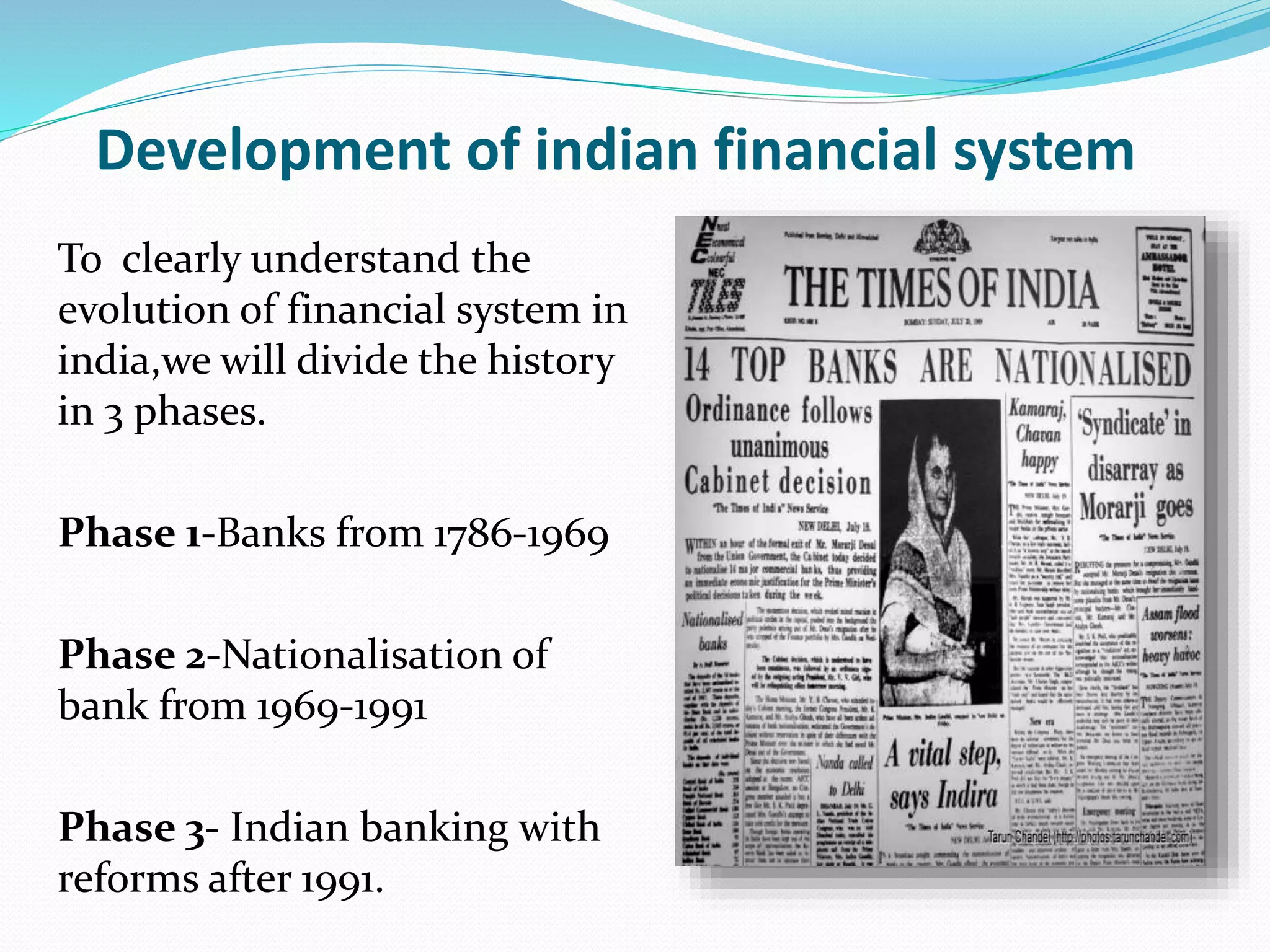
Development of indian financial system
To clearly understand the
evolution of financial system in
india,we will divide the history
in 3 phases.
Phase 1-Banks from 1786-1969
Phase 2-Nationalisation of
bank from 1969-1991
Phase 3- Indian banking with
reforms after 1991.
Growth of financial market in india
•Growth of capital
market
•Growth of insurance
sector
•Growth of venture
capital
Global financial crisis of 2008
Impact of the US financial crises on Indian economy
•Impact on stock market
•Impact on india’s export
•Exchange rate depreciation
•IT-BPO sector
The great fall of china
Impact of chinese crises on indian economy
Positive impacts
 Low oil prices
 Cheaper infrastructure
 Mobiles can be cheaper
 Good for deficit and
inflation management
Negative impacts
 Foreign debts
 Market confidence
 Exports affected
Boost for indian financial system
 Make in india
 Pradhan mantri jan dhan yojana
 Pradhan mantri mudra yojana
Top 5 game changers for the indian financial
system in 2015
 Licensing of 11 Payments Banks by the RBI.
 RBI grants “in principle” approval of 10 applicants
for small finance banks.
 Insolvency and bankruptcy bill
 Continuation of the direct benefit transfer
scheme via aadhar.
 Universal reporting to credit bureaus
conclusion
 The size of banking assets in India reached US$ 1.46
trillion as on November 13, 2015 and is expected to
touch US$ 28.5 trillion by FY25.
 As on 29 January, banks had opened nearly 124 million
accounts under the Prime Minister’s financial
inclusion scheme.
 India is today one of the most vibrant global
economies, on the back of robust banking and
insurance sectors. The country is projected to become
the fifth largest banking sector globally by 2020.

Indian financial system

  • 2.
    Financial system  Aninstitutional framework existing in a country to enable financial transactions.  The following are the four main components of Indian Financial system 1. Financial institutions 2. Financial Markets 3. Financial Instruments/Assets/Securities 4. Financial Services
  • 3.
    Functions of financialsystem Mobilising savings Promoting investment Encouraging investment in financial asset Creating credit Providing financial services Developing backward areas
  • 5.
    Classification of financialmarkets  Unorganized market-Not controlled by RBI.  Organized market-controlled by RBI and other regulatory bodies.  Capital market-Deals with long term securities, maturity period is above 1 year.  Industrial security market-securities like share and debenture issued.  Primary market-Also known as new issue market.  Secondary market-Trading of securities takes place which have passed through primary market.
  • 6.
     Government securitiesmarket-securities issued by central state or semi government.eg-port trust  Long term loan market-loans are given for long term generally for 5 yrs to 20 yrs.  Term loan market-supply long term or medium term loan to corporate customer.  Mortgage market-loan given against immovable property.  Financial guarantee market-finance is given against the third party.
  • 7.
     Money market-Itis short term fund market may have maturity up to 1 year.  Call money market-loans are given for short period say 1 day or 14 days.  Commercial bill money-It is a market for bill of exchange.  Treasury bills market-They have short term maturity, issued by government.  Short-term loan market-In the form of cash credit and overdraft.
  • 8.
    Development of indianfinancial system To clearly understand the evolution of financial system in india,we will divide the history in 3 phases. Phase 1-Banks from 1786-1969 Phase 2-Nationalisation of bank from 1969-1991 Phase 3- Indian banking with reforms after 1991.
  • 9.
    Growth of financialmarket in india •Growth of capital market •Growth of insurance sector •Growth of venture capital
  • 10.
  • 11.
    Impact of theUS financial crises on Indian economy •Impact on stock market •Impact on india’s export •Exchange rate depreciation •IT-BPO sector
  • 12.
  • 14.
    Impact of chinesecrises on indian economy Positive impacts  Low oil prices  Cheaper infrastructure  Mobiles can be cheaper  Good for deficit and inflation management Negative impacts  Foreign debts  Market confidence  Exports affected
  • 15.
    Boost for indianfinancial system  Make in india  Pradhan mantri jan dhan yojana  Pradhan mantri mudra yojana
  • 16.
    Top 5 gamechangers for the indian financial system in 2015  Licensing of 11 Payments Banks by the RBI.  RBI grants “in principle” approval of 10 applicants for small finance banks.  Insolvency and bankruptcy bill  Continuation of the direct benefit transfer scheme via aadhar.  Universal reporting to credit bureaus
  • 17.
    conclusion  The sizeof banking assets in India reached US$ 1.46 trillion as on November 13, 2015 and is expected to touch US$ 28.5 trillion by FY25.  As on 29 January, banks had opened nearly 124 million accounts under the Prime Minister’s financial inclusion scheme.  India is today one of the most vibrant global economies, on the back of robust banking and insurance sectors. The country is projected to become the fifth largest banking sector globally by 2020.