© The WallStreet School (M): +91 99537 29651 (e): himanshu@thewallstreetschool.com www.thewallstreetschool.com | 1
The Dream Begins…!!!
The WallStreet School
Financial Statements
Certification in Investment Banking
The Dream Begins…!!!
The Wall Street School
The WallStreet School
© The WallStreet School (M): +91 99537 29651 (e): himanshu@thewallstreetschool.com www.thewallstreetschool.com | 2
The Dream Begins…!!!
The WallStreet School
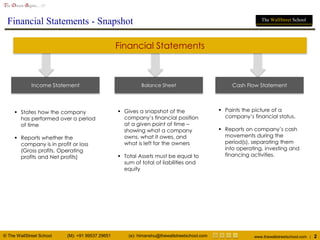
Financial Statements - Snapshot
Income Statement Balance Sheet Cash Flow Statement
 States how the company
has performed over a period
of time
 Reports whether the
company is in profit or loss
(Gross profits, Operating
profits and Net profits)
 Gives a snapshot of the
company’s financial position
at a given point of time –
showing what a company
owns, what it owes, and
what is left for the owners
 Total Assets must be equal to
sum of total of liabilities and
equity
 Paints the picture of a
company’s financial status.
 Reports on company’s cash
movements during the
period(s), separating them
into operating, investing and
financing activities.
Financial Statements
© The WallStreet School (M): +91 99537 29651 (e): himanshu@thewallstreetschool.com www.thewallstreetschool.com | 3
The Dream Begins…!!!
The WallStreet School
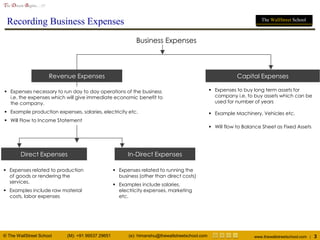
Recording Business Expenses
Business Expenses
Capital Expenses
Revenue Expenses
 Expenses to buy long term assets for
company i.e. to buy assets which can be
used for number of years
 Example Machinery, Vehicles etc.
 Will flow to Balance Sheet as Fixed Assets
 Expenses necessary to run day to day operations of the business
i.e. the expenses which will give immediate economic benefit to
the company.
 Example production expenses, salaries, electricity etc.
 Will Flow to Income Statement
Direct Expenses In-Direct Expenses
 Expenses related to production
of goods or rendering the
services.
 Examples include raw material
costs, labor expenses
 Expenses related to running the
business (other than direct costs)
 Examples include salaries,
electricity expenses, marketing
etc.
© The WallStreet School (M): +91 99537 29651 (e): himanshu@thewallstreetschool.com www.thewallstreetschool.com | 4
The Dream Begins…!!!
The WallStreet School
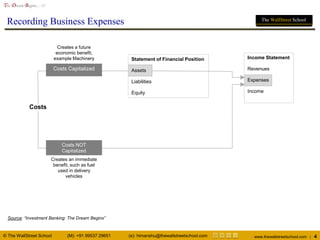
Statement of Financial Position
Assets
Liabilities
Equity
Income Statement
Revenues
Expenses
Income
Costs
Costs NOT
Capitalized
Creates an immediate
benefit, such as fuel
used in delivery
vehicles
Creates a future
economic benefit,
example Machinery
Costs Capitalized
Source: “Investment Banking: The Dream Begins”
Recording Business Expenses
© The WallStreet School (M): +91 99537 29651 (e): himanshu@thewallstreetschool.com www.thewallstreetschool.com | 5
The Dream Begins…!!!
The WallStreet School
Income Statement
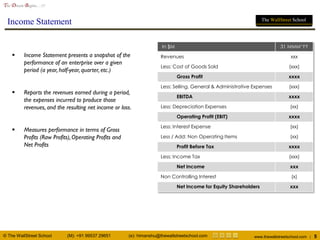
 Income Statement presents a snapshot of the
performance of an enterprise over a given
period (a year, half-year, quarter, etc.)
 Reports the revenues earned during a period,
the expenses incurred to produce those
revenues, and the resulting net income or loss.
 Measures performance in terms of Gross
Profits (Raw Profits), Operating Profits and
Net Profits
In $M 31 MMM’YY
Revenues xxx
Less: Cost of Goods Sold (xxx)
Gross Profit xxxx
Less: Selling, General & Administrative Expenses (xxx)
EBITDA xxxx
Less: Depreciation Expenses (xx)
Operating Profit (EBIT) xxxx
Less: Interest Expense (xx)
Less / Add: Non Operating Items (xx)
Profit Before Tax xxxx
Less: Income Tax (xxx)
Net Income xxx
Non Controlling Interest (x)
Net Income for Equity Shareholders xxx
© The WallStreet School (M): +91 99537 29651 (e): himanshu@thewallstreetschool.com www.thewallstreetschool.com | 6
The Dream Begins…!!!
The WallStreet School
Income Statement Components
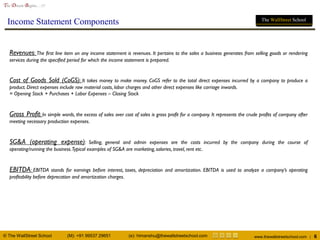
Revenues: The first line item on any income statement is revenues. It pertains to the sales a business generates from selling goods or rendering
services during the specified period for which the income statement is prepared.
Cost of Goods Sold (CoGS): It takes money to make money. CoGS refer to the total direct expenses incurred by a company to produce a
product. Direct expenses include raw material costs, labor charges and other direct expenses like carriage inwards.
= Opening Stock + Purchases + Labor Expenses – Closing Stock
Gross Profit: In simple words, the excess of sales over cost of sales is gross profit for a company. It represents the crude profits of company after
meeting necessary production expenses.
SG&A (operating expense): Selling, general and admin expenses are the costs incurred by the company during the course of
operating/running the business.Typical examples of SG&A are marketing, salaries, travel, rent etc.
EBITDA: EBITDA stands for earnings before interest, taxes, depreciation and amortization. EBITDA is used to analyze a company’s operating
profitability before deprecation and amortization charges.
© The WallStreet School (M): +91 99537 29651 (e): himanshu@thewallstreetschool.com www.thewallstreetschool.com | 7
The Dream Begins…!!!
The WallStreet School
Income Statement Components
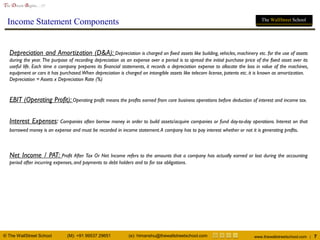
Depreciation and Amortization (D&A): Depreciation is charged on fixed assets like building, vehicles, machinery etc. for the use of assets
during the year. The purpose of recording depreciation as an expense over a period is to spread the initial purchase price of the fixed asset over its
useful life. Each time a company prepares its financial statements, it records a depreciation expense to allocate the loss in value of the machines,
equipment or cars it has purchased.When depreciation is charged on intangible assets like telecom license, patents etc. it is known as amortization.
Depreciation = Assets x Depreciation Rate (%)
EBIT (Operating Profit): Operating profit means the profits earned from core business operations before deduction of interest and income tax.
Interest Expenses: Companies often borrow money in order to build assets/acquire companies or fund day-to-day operations. Interest on that
borrowed money is an expense and must be recorded in income statement.A company has to pay interest whether or not it is generating profits.
Net Income / PAT: Profit After Tax Or Net Income refers to the amounts that a company has actually earned or lost during the accounting
period after incurring expenses, and payments to debt holders and to for tax obligations.
© The WallStreet School (M): +91 99537 29651 (e): himanshu@thewallstreetschool.com www.thewallstreetschool.com | 8
The Dream Begins…!!!
The WallStreet School
Balance Sheet
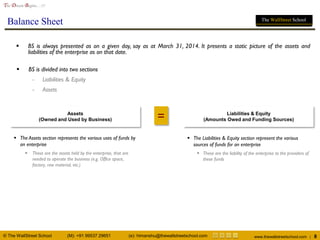
 BS is divided into two sections
- Liabilities & Equity
- Assets
Assets
(Owned and Used by Business)
Liabilities & Equity
(Amounts Owed and Funding Sources)
 The Liabilities & Equity section represent the various
sources of funds for an enterprise
 These are the liability of the enterprise to the providers of
these funds
 The Assets section represents the various uses of funds by
an enterprise
 These are the assets held by the enterprise, that are
needed to operate the business (e.g. Office space,
factory, raw material, etc.)
=
 BS is always presented as on a given day, say as at March 31, 2014. It presents a static picture of the assets and
liabilities of the enterprise as on that date.
© The WallStreet School (M): +91 99537 29651 (e): himanshu@thewallstreetschool.com www.thewallstreetschool.com | 9
The Dream Begins…!!!
The WallStreet School
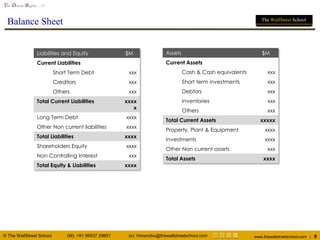
Balance Sheet
Liabilities and Equity $M
Current Liabilities
Short Term Debt xxx
Creditors xxx
Others xxx
Total Current Liabilities xxxx
x
Long Term Debt xxxx
Other Non current liabilities xxxx
Total Liabilities xxxx
Shareholders Equity xxxx
Non Controlling Interest xxx
Total Equity & Liabilities xxxx
Assets $M
Current Assets
Cash & Cash equivalents xxx
Short term investments xxx
Debtors xxx
Inventories xxx
Others xxx
Total Current Assets xxxxx
Property, Plant & Equipment xxxx
Investments xxxx
Other Non current assets xxx
Total Assets xxxx
© The WallStreet School (M): +91 99537 29651 (e): himanshu@thewallstreetschool.com www.thewallstreetschool.com | 10
The Dream Begins…!!!
The WallStreet School
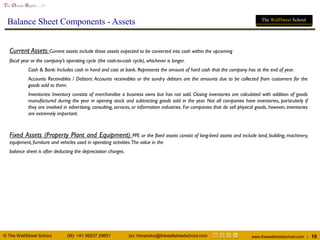
Balance Sheet Components - Assets
Current Assets: Current assets include those assets expected to be converted into cash within the upcoming
fiscal year or the company’s operating cycle (the cash-to-cash cycle), whichever is longer.
Cash & Bank: Includes cash in hand and cast at bank. Represents the amount of hard cash that the company has at the end of year.
Accounts Receivables / Debtors: Accounts receivables or the sundry debtors are the amounts due to be collected from customers for the
goods sold to them.
Inventories: Inventory consists of merchandise a business owns but has not sold. Closing inventories are calculated with addition of goods
manufactured during the year in opening stock and subtracting goods sold in the year. Not all companies have inventories, particularly if
they are involved in advertising, consulting, services, or information industries. For companies that do sell physical goods, however, inventories
are extremely important.
Fixed Assets (Property Plant and Equipment): PPE or the fixed assets consist of long-lived assets and include land, building, machinery,
equipment, furniture and vehicles used in operating activities.The value in the
balance sheet is after deducting the depreciation charges.
© The WallStreet School (M): +91 99537 29651 (e): himanshu@thewallstreetschool.com www.thewallstreetschool.com | 11
The Dream Begins…!!!
The WallStreet School
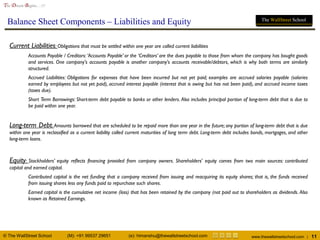
Balance Sheet Components – Liabilities and Equity
Current Liabilities: Obligations that must be settled within one year are called current liabilities
Accounts Payable / Creditors: ‘Accounts Payable’ or the ‘Creditors’ are the dues payable to those from whom the company has bought goods
and services. One company's accounts payable is another company's accounts receivable/debtors, which is why both terms are similarly
structured.
Accrued Liabilities: Obligations for expenses that have been incurred but not yet paid; examples are accrued salaries payable (salaries
earned by employees but not yet paid), accrued interest payable (interest that is owing but has not been paid), and accrued income taxes
(taxes due).
Short Term Borrowings: Short-term debt payable to banks or other lenders. Also includes principal portion of long-term debt that is due to
be paid within one year.
Long-term Debt: Amounts borrowed that are scheduled to be repaid more than one year in the future; any portion of long-term debt that is due
within one year is reclassified as a current liability called current maturities of long term debt. Long-term debt includes bonds, mortgages, and other
long-term loans.
Equity: Stockholders’ equity reflects financing provided from company owners. Shareholders' equity comes from two main sources: contributed
capital and earned capital.
Contributed capital is the net funding that a company received from issuing and reacquiring its equity shares; that is, the funds received
from issuing shares less any funds paid to repurchase such shares.
Earned capital is the cumulative net income (loss) that has been retained by the company (not paid out to shareholders as dividends. Also
known as Retained Earnings.
© The WallStreet School (M): +91 99537 29651 (e): himanshu@thewallstreetschool.com www.thewallstreetschool.com | 12
The Dream Begins…!!!
The WallStreet School
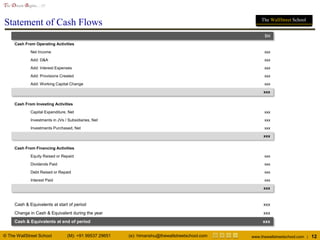
Statement of Cash Flows
$M
Cash From Operating Activities
Net Income xxx
Add: D&A xxx
Add: Interest Expenses xxx
Add: Provisions Created xxx
Add: Working Capital Change xxx
xxx
Cash From Investing Activities
Capital Expenditure, Net xxx
Investments in JVs / Subsidiaries, Net xxx
Investments Purchased, Net xxx
xxx
Cash From Financing Activities
Equity Raised or Repaid xxx
Dividends Paid xxx
Debt Raised or Repaid xxx
Interest Paid xxx
xxx
Cash & Equivalents at start of period xxx
Change in Cash & Equivalent during the year xxx
Cash & Equivalents at end of period xxx
© The WallStreet School (M): +91 99537 29651 (e): himanshu@thewallstreetschool.com www.thewallstreetschool.com | 13
The Dream Begins…!!!
The WallStreet School
Statement of Cash Flows
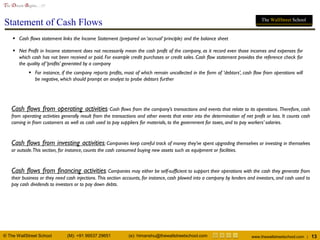
 Cash flows statement links the Income Statement (prepared on ‘accrual’ principle) and the balance sheet
 Net Profit in Income statement does not necessarily mean the cash profit of the company, as it record even those incomes and expenses for
which cash has not been received or paid. For example credit purchases or credit sales. Cash flow statement provides the reference check for
the quality of ‘profits’ generated by a company
 For instance, if the company reports profits, most of which remain uncollected in the form of ‘debtors’, cash flow from operations will
be negative, which should prompt an analyst to probe debtors further
Cash flows from operating activities: Cash flows from the company’s transactions and events that relate to its operations. Therefore, cash
from operating activities generally result from the transactions and other events that enter into the determination of net profit or loss. It counts cash
coming in from customers as well as cash used to pay suppliers for materials, to the government for taxes, and to pay workers’ salaries.
Cash flows from investing activities: Companies keep careful track of money they’ve spent upgrading themselves or investing in themselves
or outside.This section, for instance, counts the cash consumed buying new assets such as equipment or facilities.
Cash flows from financing activities: Companies may either be self-sufficient to support their operations with the cash they generate from
their business or they need cash injections. This section accounts, for instance, cash plowed into a company by lenders and investors, and cash used to
pay cash dividends to investors or to pay down debts.
© The WallStreet School (M): +91 99537 29651 (e): himanshu@thewallstreetschool.com www.thewallstreetschool.com | 14
The Dream Begins…!!!
The WallStreet School
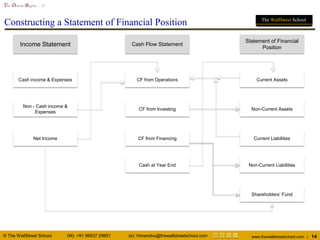
Constructing a Statement of Financial Position
Income Statement Cash Flow Statement
Statement of Financial
Position
Cash income & Expenses
Non - Cash income &
Expenses
Net Income
CF from Operations
CF from Investing
CF from Financing
Cash at Year End
Current Assets
Non-Current Assets
Current Liabilities
Non-Current Liabilities
Shareholders’ Fund
© The WallStreet School (M): +91 99537 29651 (e): himanshu@thewallstreetschool.com www.thewallstreetschool.com | 15
The Dream Begins…!!!
The WallStreet School
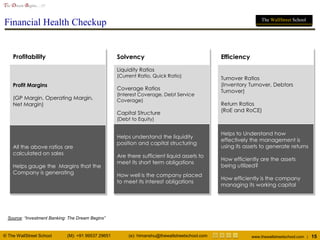
Financial Health Checkup
Profitability
Profit Margins
(GP Margin, Operating Margin,
Net Margin)
All the above ratios are
calculated on sales
Helps gauge the Margins that the
Company is generating
Solvency
Liquidity Ratios
(Current Ratio, Quick Ratio)
Coverage Ratios
(Interest Coverage, Debt Service
Coverage)
Capital Structure
(Debt to Equity)
Helps understand the liquidity
position and capital structuring
Are there sufficient liquid assets to
meet its short term obligations
How well is the company placed
to meet its interest obligations
Efficiency
Turnover Ratios
(Inventory Turnover, Debtors
Turnover)
Return Ratios
(RoE and RoCE)
Helps to Understand how
effectively the management is
using its assets to generate returns
How efficiently are the assets
being utilized?
How efficiently is the company
managing its working capital
Source: “Investment Banking: The Dream Begins”
© The WallStreet School (M): +91 99537 29651 (e): himanshu@thewallstreetschool.com www.thewallstreetschool.com | 16
The Dream Begins…!!!
The WallStreet School
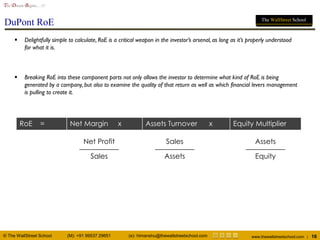
DuPont RoE
 Delightfully simple to calculate, RoE is a critical weapon in the investor’s arsenal, as long as it’s properly understood
for what it is.
 Breaking RoE into these component parts not only allows the investor to determine what kind of RoE is being
generated by a company, but also to examine the quality of that return as well as which financial levers management
is pulling to create it.
RoE = Net Margin x Assets Turnover x Equity Multiplier
Sales
Net Profit
Assets
Sales
Equity
Assets
© The WallStreet School (M): +91 99537 29651 (e): himanshu@thewallstreetschool.com www.thewallstreetschool.com | 17
The Dream Begins…!!!
The WallStreet School
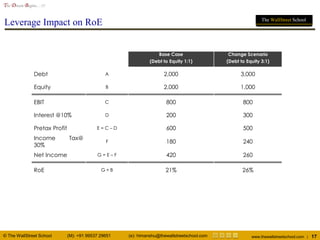
Leverage Impact on RoE
Base Case
(Debt to Equity 1:1)
Change Scenario
(Debt to Equity 3:1)
Debt A 2,000 3,000
Equity B 2,000 1,000
EBIT C 800 800
Interest @10% D 200 300
Pretax Profit E = C – D 600 500
Income Tax@
30%
F 180 240
Net Income G = E – F 420 260
RoE G ÷ B 21% 26%
© The WallStreet School (M): +91 99537 29651 (e): himanshu@thewallstreetschool.com www.thewallstreetschool.com | 18
The Dream Begins…!!!
The WallStreet School
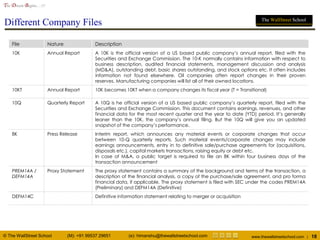
Different Company Files
File Nature Description
10K Annual Report A 10K is the official version of a US based public company’s annual report, filed with the
Securities and Exchange Commission. The 10-K normally contains information with respect to
business description, audited financial statements, management discussion and analysis
(MD&A), outstanding debt, basic shares outstanding, and stock options etc. It often includes
information not found elsewhere. Oil companies often report changes in their proven
reserves. Manufacturing companies will list all of their owned locations.
10KT Annual Report 10K becomes 10KT when a company changes its fiscal year (T = Transitional)
10Q Quarterly Report A 10Q is he official version of a US based public company’s quarterly report, filed with the
Securities and Exchange Commission. This document contains earnings, revenues, and other
financial data for the most recent quarter and the year to date (YTD) period. It’s generally
leaner than the 10K, the company’s annual filing. But the 10Q will give you an updated
snapshot of the company’s performance.
8K Press Release Interim report, which announces any material events or corporate changes that occur
between 10-Q quarterly reports. Such material events/corporate changes may include
earnings announcements, entry in to definitive sale/purchase agreements for (acquisitions,
disposals etc.), capital markets transactions, raising equity or debt etc.
In case of M&A, a public target is required to file an 8K within four business days of the
transaction announcement
PREM14A /
DEFM14A
Proxy Statement The proxy statement contains a summary of the background and terms of the transaction, a
description of the financial analysis, a copy of the purchase/sale agreement, and pro forma
financial data, if applicable. The proxy statement is filed with SEC under the codes PREM14A
(Preliminary) and DEFM14A (Definitive)
DEFM14C Definitive information statement relating to merger or acquisition
© The WallStreet School (M): +91 99537 29651 (e): himanshu@thewallstreetschool.com www.thewallstreetschool.com | 19
The Dream Begins…!!!
The WallStreet School
Thank You
The Dream Begins…!!!
ARC School of Finance
The WallStreet School
Suite 402, Pearls Business Park
Netaji Subhash Place
Pitampura, New Delhi
(Adjacent Fun Cinemas)
Himanshu Jain
(Cell): +91 99537 29651
(Email): himanshu@thewallstreetschool.com
(Web): www.thewallstreetschool.com
The Wall Street School

Wall Street shoool financial modelling c

  • 1.
    © The WallStreetSchool (M): +91 99537 29651 (e): himanshu@thewallstreetschool.com www.thewallstreetschool.com | 1 The Dream Begins…!!! The WallStreet School Financial Statements Certification in Investment Banking The Dream Begins…!!! The Wall Street School The WallStreet School
  • 2.
    © The WallStreetSchool (M): +91 99537 29651 (e): himanshu@thewallstreetschool.com www.thewallstreetschool.com | 2 The Dream Begins…!!! The WallStreet School Financial Statements - Snapshot Income Statement Balance Sheet Cash Flow Statement  States how the company has performed over a period of time  Reports whether the company is in profit or loss (Gross profits, Operating profits and Net profits)  Gives a snapshot of the company’s financial position at a given point of time – showing what a company owns, what it owes, and what is left for the owners  Total Assets must be equal to sum of total of liabilities and equity  Paints the picture of a company’s financial status.  Reports on company’s cash movements during the period(s), separating them into operating, investing and financing activities. Financial Statements
  • 3.
    © The WallStreetSchool (M): +91 99537 29651 (e): himanshu@thewallstreetschool.com www.thewallstreetschool.com | 3 The Dream Begins…!!! The WallStreet School Recording Business Expenses Business Expenses Capital Expenses Revenue Expenses  Expenses to buy long term assets for company i.e. to buy assets which can be used for number of years  Example Machinery, Vehicles etc.  Will flow to Balance Sheet as Fixed Assets  Expenses necessary to run day to day operations of the business i.e. the expenses which will give immediate economic benefit to the company.  Example production expenses, salaries, electricity etc.  Will Flow to Income Statement Direct Expenses In-Direct Expenses  Expenses related to production of goods or rendering the services.  Examples include raw material costs, labor expenses  Expenses related to running the business (other than direct costs)  Examples include salaries, electricity expenses, marketing etc.
  • 4.
    © The WallStreetSchool (M): +91 99537 29651 (e): himanshu@thewallstreetschool.com www.thewallstreetschool.com | 4 The Dream Begins…!!! The WallStreet School Statement of Financial Position Assets Liabilities Equity Income Statement Revenues Expenses Income Costs Costs NOT Capitalized Creates an immediate benefit, such as fuel used in delivery vehicles Creates a future economic benefit, example Machinery Costs Capitalized Source: “Investment Banking: The Dream Begins” Recording Business Expenses
  • 5.
    © The WallStreetSchool (M): +91 99537 29651 (e): himanshu@thewallstreetschool.com www.thewallstreetschool.com | 5 The Dream Begins…!!! The WallStreet School Income Statement  Income Statement presents a snapshot of the performance of an enterprise over a given period (a year, half-year, quarter, etc.)  Reports the revenues earned during a period, the expenses incurred to produce those revenues, and the resulting net income or loss.  Measures performance in terms of Gross Profits (Raw Profits), Operating Profits and Net Profits In $M 31 MMM’YY Revenues xxx Less: Cost of Goods Sold (xxx) Gross Profit xxxx Less: Selling, General & Administrative Expenses (xxx) EBITDA xxxx Less: Depreciation Expenses (xx) Operating Profit (EBIT) xxxx Less: Interest Expense (xx) Less / Add: Non Operating Items (xx) Profit Before Tax xxxx Less: Income Tax (xxx) Net Income xxx Non Controlling Interest (x) Net Income for Equity Shareholders xxx
  • 6.
    © The WallStreetSchool (M): +91 99537 29651 (e): himanshu@thewallstreetschool.com www.thewallstreetschool.com | 6 The Dream Begins…!!! The WallStreet School Income Statement Components Revenues: The first line item on any income statement is revenues. It pertains to the sales a business generates from selling goods or rendering services during the specified period for which the income statement is prepared. Cost of Goods Sold (CoGS): It takes money to make money. CoGS refer to the total direct expenses incurred by a company to produce a product. Direct expenses include raw material costs, labor charges and other direct expenses like carriage inwards. = Opening Stock + Purchases + Labor Expenses – Closing Stock Gross Profit: In simple words, the excess of sales over cost of sales is gross profit for a company. It represents the crude profits of company after meeting necessary production expenses. SG&A (operating expense): Selling, general and admin expenses are the costs incurred by the company during the course of operating/running the business.Typical examples of SG&A are marketing, salaries, travel, rent etc. EBITDA: EBITDA stands for earnings before interest, taxes, depreciation and amortization. EBITDA is used to analyze a company’s operating profitability before deprecation and amortization charges.
  • 7.
    © The WallStreetSchool (M): +91 99537 29651 (e): himanshu@thewallstreetschool.com www.thewallstreetschool.com | 7 The Dream Begins…!!! The WallStreet School Income Statement Components Depreciation and Amortization (D&A): Depreciation is charged on fixed assets like building, vehicles, machinery etc. for the use of assets during the year. The purpose of recording depreciation as an expense over a period is to spread the initial purchase price of the fixed asset over its useful life. Each time a company prepares its financial statements, it records a depreciation expense to allocate the loss in value of the machines, equipment or cars it has purchased.When depreciation is charged on intangible assets like telecom license, patents etc. it is known as amortization. Depreciation = Assets x Depreciation Rate (%) EBIT (Operating Profit): Operating profit means the profits earned from core business operations before deduction of interest and income tax. Interest Expenses: Companies often borrow money in order to build assets/acquire companies or fund day-to-day operations. Interest on that borrowed money is an expense and must be recorded in income statement.A company has to pay interest whether or not it is generating profits. Net Income / PAT: Profit After Tax Or Net Income refers to the amounts that a company has actually earned or lost during the accounting period after incurring expenses, and payments to debt holders and to for tax obligations.
  • 8.
    © The WallStreetSchool (M): +91 99537 29651 (e): himanshu@thewallstreetschool.com www.thewallstreetschool.com | 8 The Dream Begins…!!! The WallStreet School Balance Sheet  BS is divided into two sections - Liabilities & Equity - Assets Assets (Owned and Used by Business) Liabilities & Equity (Amounts Owed and Funding Sources)  The Liabilities & Equity section represent the various sources of funds for an enterprise  These are the liability of the enterprise to the providers of these funds  The Assets section represents the various uses of funds by an enterprise  These are the assets held by the enterprise, that are needed to operate the business (e.g. Office space, factory, raw material, etc.) =  BS is always presented as on a given day, say as at March 31, 2014. It presents a static picture of the assets and liabilities of the enterprise as on that date.
  • 9.
    © The WallStreetSchool (M): +91 99537 29651 (e): himanshu@thewallstreetschool.com www.thewallstreetschool.com | 9 The Dream Begins…!!! The WallStreet School Balance Sheet Liabilities and Equity $M Current Liabilities Short Term Debt xxx Creditors xxx Others xxx Total Current Liabilities xxxx x Long Term Debt xxxx Other Non current liabilities xxxx Total Liabilities xxxx Shareholders Equity xxxx Non Controlling Interest xxx Total Equity & Liabilities xxxx Assets $M Current Assets Cash & Cash equivalents xxx Short term investments xxx Debtors xxx Inventories xxx Others xxx Total Current Assets xxxxx Property, Plant & Equipment xxxx Investments xxxx Other Non current assets xxx Total Assets xxxx
  • 10.
    © The WallStreetSchool (M): +91 99537 29651 (e): himanshu@thewallstreetschool.com www.thewallstreetschool.com | 10 The Dream Begins…!!! The WallStreet School Balance Sheet Components - Assets Current Assets: Current assets include those assets expected to be converted into cash within the upcoming fiscal year or the company’s operating cycle (the cash-to-cash cycle), whichever is longer. Cash & Bank: Includes cash in hand and cast at bank. Represents the amount of hard cash that the company has at the end of year. Accounts Receivables / Debtors: Accounts receivables or the sundry debtors are the amounts due to be collected from customers for the goods sold to them. Inventories: Inventory consists of merchandise a business owns but has not sold. Closing inventories are calculated with addition of goods manufactured during the year in opening stock and subtracting goods sold in the year. Not all companies have inventories, particularly if they are involved in advertising, consulting, services, or information industries. For companies that do sell physical goods, however, inventories are extremely important. Fixed Assets (Property Plant and Equipment): PPE or the fixed assets consist of long-lived assets and include land, building, machinery, equipment, furniture and vehicles used in operating activities.The value in the balance sheet is after deducting the depreciation charges.
  • 11.
    © The WallStreetSchool (M): +91 99537 29651 (e): himanshu@thewallstreetschool.com www.thewallstreetschool.com | 11 The Dream Begins…!!! The WallStreet School Balance Sheet Components – Liabilities and Equity Current Liabilities: Obligations that must be settled within one year are called current liabilities Accounts Payable / Creditors: ‘Accounts Payable’ or the ‘Creditors’ are the dues payable to those from whom the company has bought goods and services. One company's accounts payable is another company's accounts receivable/debtors, which is why both terms are similarly structured. Accrued Liabilities: Obligations for expenses that have been incurred but not yet paid; examples are accrued salaries payable (salaries earned by employees but not yet paid), accrued interest payable (interest that is owing but has not been paid), and accrued income taxes (taxes due). Short Term Borrowings: Short-term debt payable to banks or other lenders. Also includes principal portion of long-term debt that is due to be paid within one year. Long-term Debt: Amounts borrowed that are scheduled to be repaid more than one year in the future; any portion of long-term debt that is due within one year is reclassified as a current liability called current maturities of long term debt. Long-term debt includes bonds, mortgages, and other long-term loans. Equity: Stockholders’ equity reflects financing provided from company owners. Shareholders' equity comes from two main sources: contributed capital and earned capital. Contributed capital is the net funding that a company received from issuing and reacquiring its equity shares; that is, the funds received from issuing shares less any funds paid to repurchase such shares. Earned capital is the cumulative net income (loss) that has been retained by the company (not paid out to shareholders as dividends. Also known as Retained Earnings.
  • 12.
    © The WallStreetSchool (M): +91 99537 29651 (e): himanshu@thewallstreetschool.com www.thewallstreetschool.com | 12 The Dream Begins…!!! The WallStreet School Statement of Cash Flows $M Cash From Operating Activities Net Income xxx Add: D&A xxx Add: Interest Expenses xxx Add: Provisions Created xxx Add: Working Capital Change xxx xxx Cash From Investing Activities Capital Expenditure, Net xxx Investments in JVs / Subsidiaries, Net xxx Investments Purchased, Net xxx xxx Cash From Financing Activities Equity Raised or Repaid xxx Dividends Paid xxx Debt Raised or Repaid xxx Interest Paid xxx xxx Cash & Equivalents at start of period xxx Change in Cash & Equivalent during the year xxx Cash & Equivalents at end of period xxx
  • 13.
    © The WallStreetSchool (M): +91 99537 29651 (e): himanshu@thewallstreetschool.com www.thewallstreetschool.com | 13 The Dream Begins…!!! The WallStreet School Statement of Cash Flows  Cash flows statement links the Income Statement (prepared on ‘accrual’ principle) and the balance sheet  Net Profit in Income statement does not necessarily mean the cash profit of the company, as it record even those incomes and expenses for which cash has not been received or paid. For example credit purchases or credit sales. Cash flow statement provides the reference check for the quality of ‘profits’ generated by a company  For instance, if the company reports profits, most of which remain uncollected in the form of ‘debtors’, cash flow from operations will be negative, which should prompt an analyst to probe debtors further Cash flows from operating activities: Cash flows from the company’s transactions and events that relate to its operations. Therefore, cash from operating activities generally result from the transactions and other events that enter into the determination of net profit or loss. It counts cash coming in from customers as well as cash used to pay suppliers for materials, to the government for taxes, and to pay workers’ salaries. Cash flows from investing activities: Companies keep careful track of money they’ve spent upgrading themselves or investing in themselves or outside.This section, for instance, counts the cash consumed buying new assets such as equipment or facilities. Cash flows from financing activities: Companies may either be self-sufficient to support their operations with the cash they generate from their business or they need cash injections. This section accounts, for instance, cash plowed into a company by lenders and investors, and cash used to pay cash dividends to investors or to pay down debts.
  • 14.
    © The WallStreetSchool (M): +91 99537 29651 (e): himanshu@thewallstreetschool.com www.thewallstreetschool.com | 14 The Dream Begins…!!! The WallStreet School Constructing a Statement of Financial Position Income Statement Cash Flow Statement Statement of Financial Position Cash income & Expenses Non - Cash income & Expenses Net Income CF from Operations CF from Investing CF from Financing Cash at Year End Current Assets Non-Current Assets Current Liabilities Non-Current Liabilities Shareholders’ Fund
  • 15.
    © The WallStreetSchool (M): +91 99537 29651 (e): himanshu@thewallstreetschool.com www.thewallstreetschool.com | 15 The Dream Begins…!!! The WallStreet School Financial Health Checkup Profitability Profit Margins (GP Margin, Operating Margin, Net Margin) All the above ratios are calculated on sales Helps gauge the Margins that the Company is generating Solvency Liquidity Ratios (Current Ratio, Quick Ratio) Coverage Ratios (Interest Coverage, Debt Service Coverage) Capital Structure (Debt to Equity) Helps understand the liquidity position and capital structuring Are there sufficient liquid assets to meet its short term obligations How well is the company placed to meet its interest obligations Efficiency Turnover Ratios (Inventory Turnover, Debtors Turnover) Return Ratios (RoE and RoCE) Helps to Understand how effectively the management is using its assets to generate returns How efficiently are the assets being utilized? How efficiently is the company managing its working capital Source: “Investment Banking: The Dream Begins”
  • 16.
    © The WallStreetSchool (M): +91 99537 29651 (e): himanshu@thewallstreetschool.com www.thewallstreetschool.com | 16 The Dream Begins…!!! The WallStreet School DuPont RoE  Delightfully simple to calculate, RoE is a critical weapon in the investor’s arsenal, as long as it’s properly understood for what it is.  Breaking RoE into these component parts not only allows the investor to determine what kind of RoE is being generated by a company, but also to examine the quality of that return as well as which financial levers management is pulling to create it. RoE = Net Margin x Assets Turnover x Equity Multiplier Sales Net Profit Assets Sales Equity Assets
  • 17.
    © The WallStreetSchool (M): +91 99537 29651 (e): himanshu@thewallstreetschool.com www.thewallstreetschool.com | 17 The Dream Begins…!!! The WallStreet School Leverage Impact on RoE Base Case (Debt to Equity 1:1) Change Scenario (Debt to Equity 3:1) Debt A 2,000 3,000 Equity B 2,000 1,000 EBIT C 800 800 Interest @10% D 200 300 Pretax Profit E = C – D 600 500 Income Tax@ 30% F 180 240 Net Income G = E – F 420 260 RoE G ÷ B 21% 26%
  • 18.
    © The WallStreetSchool (M): +91 99537 29651 (e): himanshu@thewallstreetschool.com www.thewallstreetschool.com | 18 The Dream Begins…!!! The WallStreet School Different Company Files File Nature Description 10K Annual Report A 10K is the official version of a US based public company’s annual report, filed with the Securities and Exchange Commission. The 10-K normally contains information with respect to business description, audited financial statements, management discussion and analysis (MD&A), outstanding debt, basic shares outstanding, and stock options etc. It often includes information not found elsewhere. Oil companies often report changes in their proven reserves. Manufacturing companies will list all of their owned locations. 10KT Annual Report 10K becomes 10KT when a company changes its fiscal year (T = Transitional) 10Q Quarterly Report A 10Q is he official version of a US based public company’s quarterly report, filed with the Securities and Exchange Commission. This document contains earnings, revenues, and other financial data for the most recent quarter and the year to date (YTD) period. It’s generally leaner than the 10K, the company’s annual filing. But the 10Q will give you an updated snapshot of the company’s performance. 8K Press Release Interim report, which announces any material events or corporate changes that occur between 10-Q quarterly reports. Such material events/corporate changes may include earnings announcements, entry in to definitive sale/purchase agreements for (acquisitions, disposals etc.), capital markets transactions, raising equity or debt etc. In case of M&A, a public target is required to file an 8K within four business days of the transaction announcement PREM14A / DEFM14A Proxy Statement The proxy statement contains a summary of the background and terms of the transaction, a description of the financial analysis, a copy of the purchase/sale agreement, and pro forma financial data, if applicable. The proxy statement is filed with SEC under the codes PREM14A (Preliminary) and DEFM14A (Definitive) DEFM14C Definitive information statement relating to merger or acquisition
  • 19.
    © The WallStreetSchool (M): +91 99537 29651 (e): himanshu@thewallstreetschool.com www.thewallstreetschool.com | 19 The Dream Begins…!!! The WallStreet School Thank You The Dream Begins…!!! ARC School of Finance The WallStreet School Suite 402, Pearls Business Park Netaji Subhash Place Pitampura, New Delhi (Adjacent Fun Cinemas) Himanshu Jain (Cell): +91 99537 29651 (Email): himanshu@thewallstreetschool.com (Web): www.thewallstreetschool.com The Wall Street School