By:-
eFinanceManagement.com
https://efinancemanagement.com/international-financial-management/banking-facility
International Banking Facility
1. Introduction
2. Establishment and Structuring of IBFs
3. Advantages
4. Restrictions on IBF
5. Reference
Content
IBF is a facility wherein the US Banking institutions provide banking services such as granting loans, accepting deposits,
to foreign residents and foreign banks. Banks establish a separate account to provide these services, they, however, can
conduct their IBF operations from their existing US-based offices.
Introduction
• In July 1978, the New York Clearing House proposed the concept of IBFs to the Board of Governors in the Federal
Reserve Board, citing the economic sense to the US out of it.
• In June 1981, the formation of IBFs got approval.
• IN 1981, Federal legislation exempted IBFs from Insurance Coverage given by The Federal Deposit Insurance
Corporation.
Establishment & Structuring of IBFs
• IBF operations of a bank are free of the reserve requirements or the interest rate ceilings under the Federal Reserve
System.
• The IBF deposits attract a higher rate of interest.
• IBFs can offer time deposits in large denominations to foreign residents.
Advantages
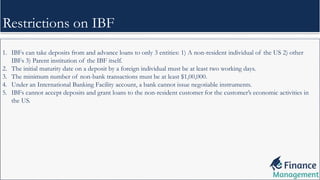
1. IBFs can take deposits from and advance loans to only 3 entities: 1) A non-resident individual of the US 2) other
IBFs 3) Parent institution of the IBF itself.
2. The initial maturity date on a deposit by a foreign individual must be at least two working days.
3. The minimum number of non-bank transactions must be at least $1,00,000.
4. Under an International Banking Facility account, a bank cannot issue negotiable instruments.
5. IBFs cannot accept deposits and grant loans to the non-resident customer for the customer’s economic activities in
the US.
Restrictions on IBF
Reference
To know more about it, click on the link given below:
https://efinancemanagement.com/international-financial-management/banking-facility

International Banking Facility

  • 1.
  • 2.
    1. Introduction 2. Establishmentand Structuring of IBFs 3. Advantages 4. Restrictions on IBF 5. Reference Content
  • 3.
    IBF is afacility wherein the US Banking institutions provide banking services such as granting loans, accepting deposits, to foreign residents and foreign banks. Banks establish a separate account to provide these services, they, however, can conduct their IBF operations from their existing US-based offices. Introduction
  • 4.
    • In July1978, the New York Clearing House proposed the concept of IBFs to the Board of Governors in the Federal Reserve Board, citing the economic sense to the US out of it. • In June 1981, the formation of IBFs got approval. • IN 1981, Federal legislation exempted IBFs from Insurance Coverage given by The Federal Deposit Insurance Corporation. Establishment & Structuring of IBFs
  • 5.
    • IBF operationsof a bank are free of the reserve requirements or the interest rate ceilings under the Federal Reserve System. • The IBF deposits attract a higher rate of interest. • IBFs can offer time deposits in large denominations to foreign residents. Advantages
  • 6.
    1. IBFs cantake deposits from and advance loans to only 3 entities: 1) A non-resident individual of the US 2) other IBFs 3) Parent institution of the IBF itself. 2. The initial maturity date on a deposit by a foreign individual must be at least two working days. 3. The minimum number of non-bank transactions must be at least $1,00,000. 4. Under an International Banking Facility account, a bank cannot issue negotiable instruments. 5. IBFs cannot accept deposits and grant loans to the non-resident customer for the customer’s economic activities in the US. Restrictions on IBF
  • 7.
    Reference To know moreabout it, click on the link given below: https://efinancemanagement.com/international-financial-management/banking-facility