


Major Functions of Bank and
Financial Institutions In Nepal
Presented By: Group “E”
Amit Gyawali
Jasmine Rajkarnikar
Kalpana Subedi
Mahesh Raj Joshi
Tikaram Budha
Highlights
‱ Introduction
‱ History of banking system
‱ Functions of Commercial Banks
‱ Functions of Development Bank
‱ Functions of Financial Companies
‱ Functions of Micro Finance Companies
‱ Conclusions
“Bank is a financial institution, which provides financial services
that may be in the form of accepting deposits, advancing loan,
providing necessary technical advices, dealing over foreign
currencies, remitting funds, etc”- Nepal Rastra Bank Act
2002.
INTRODUCTION
‱ The word BANK was initiated form Latin word Bancus, French
word Banque and Italian word Banca, which means a Bench where
sitting over their investment, exchange and keep record of money
and cash. History tells us that initiation of bank in eastern side of
world was mentioned in economics of Kautilya and Manusmirti.
Likely, in west banking system was started from ‘Bank of Venice,
1157 Bank of Barcelona. Actually banking system was inaugurated
after established of Bank of England.
‱ In Nepalese perspective, The establishment of ‘Tejarath Adda’ during the
Tenure of Prime Minister Ranoddip Singh in 1933 B.S. (1976 A.D) was
first step towards the institutional development of banking in Nepal.
‱ Later, ‘Tejrath’ was replaced by the first commercial bank, Nepal Bank
Limited stablished on 30th Kartik 1994 B.S. Then NRB was established on
B.S 2013/01/14 as the central bank under the NRB act 2012 BS.
HISTORY
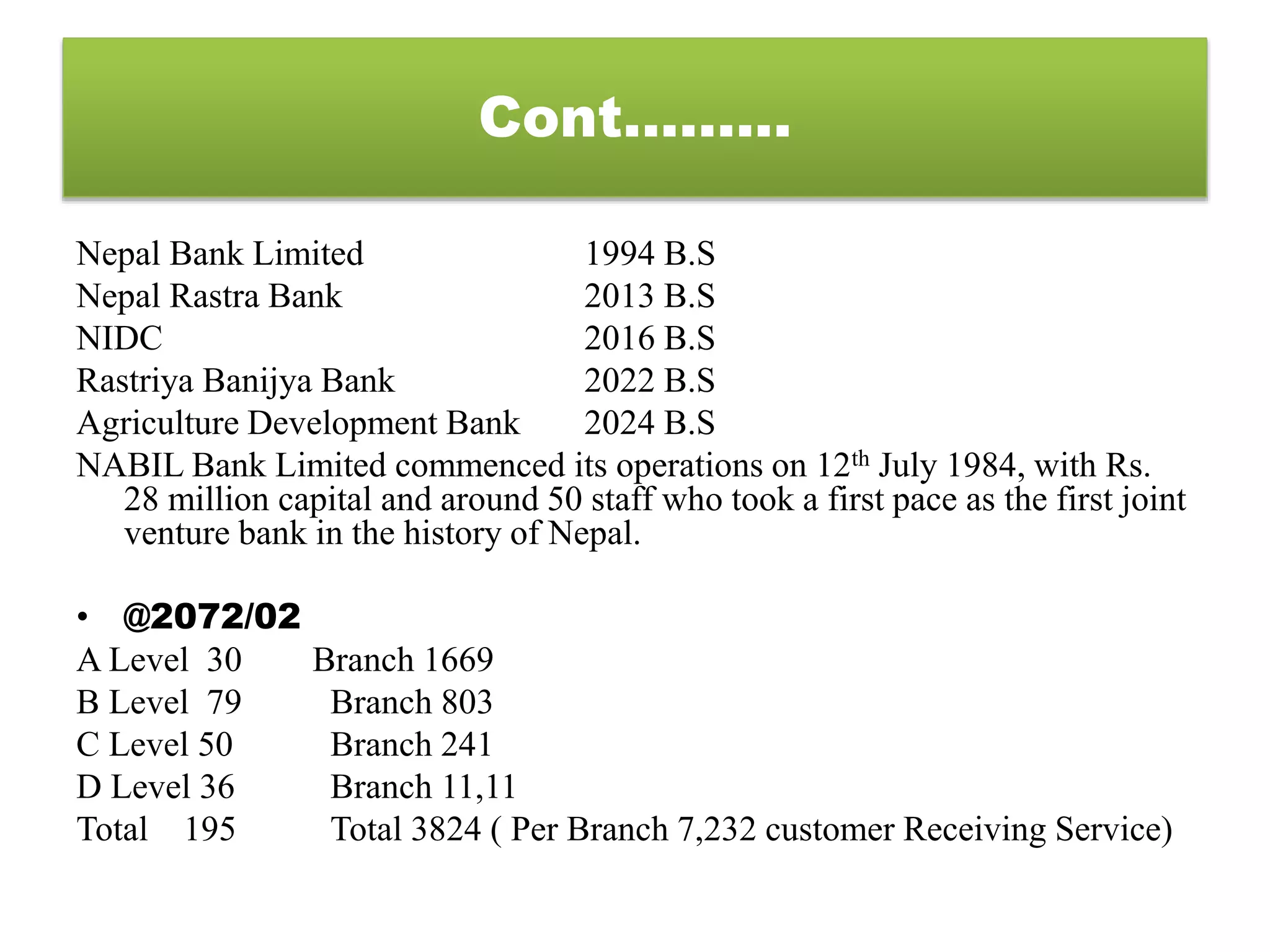
Nepal Bank Limited 1994 B.S
Nepal Rastra Bank 2013 B.S
NIDC 2016 B.S
Rastriya Banijya Bank 2022 B.S
Agriculture Development Bank 2024 B.S
NABIL Bank Limited commenced its operations on 12th July 1984, with Rs.
28 million capital and around 50 staff who took a first pace as the first joint
venture bank in the history of Nepal.
‱ @2072/02
A Level 30 Branch 1669
B Level 79 Branch 803
C Level 50 Branch 241
D Level 36 Branch 11,11
Total 195 Total 3824 ( Per Branch 7,232 customer Receiving Service)
Cont.........
Commercial Bank
A profit motive institution usually accepting deposits, arranging
business loans and offering related services.
Functions Of Commercial Bank
 The main functions of commercial banks are accepting
deposits(with or without interest ) and refund such deposits
from the public and advancing them loans.
 Dealing in foreign exchange, subject to the laws in force
 Supplying credit for hire-purchase, hypothecation, leasing,
housing and service business
 Issuing and accepting credit cards, debit cards, charge cards
and other financial instruments
 Providing overdraft to persons whom it trusts
 Remitting or transmitting funds to different places within or
outside the State of Nepal
 Mobilizing capital through shares, debentures, bonds, loan-
bonds, saving-bonds or other financial instruments within the
limit prescribed by the Nepal Rastra Bank
Development Bank
 Development Bank is a finance institution, created by a
country's government, that provides financing for the purposes
of economic development of the country
 Development banks in Nepal are playing vital roles for the
development of economy status of Nepal
Functions of Development Bank
 accepting deposits with or without interest, and refund such
deposits
 Supplying credit, other than hypothecation credit, as
prescribed
 It provides guarantee to the third parties the money lender
bank or merchant on the behalf of its client.
 Issuing, accepting, paying, discounting or purchasing and
selling bills of exchange, promissory notes, cheques, travelers
cheques, drafts or hundies
 Arranging for safe deposit vaults
 Issuing guarantees on behalf of its customers, having such
customers execute necessary bonds in consideration thereof,
obtaining security, and acquiring their movable or immovable
assets as collateral or on mortgage, or the assets of third
persons as collateral
 Providing overdraft to persons whom it trusts
 Operating projects such as purchase of lands and construction
of buildings for land development and residential purposes,
and selling and managing
Finance companies & Co-operatives
 A company that makes usually small short-term loans usually
to individuals.
 It is an organization that originates loans for both businesses
and consumers.
 Much like a Bank, a typical finance company acts as a lending
entity by extending credit.
 A finance company may extend credit to individuals for
various consumer purchases, as well as to corporations for
commercial use.
 A finance company may also specialize in providing financing
for a variety of installment plan sales.
Function of Financial companies
 Distribution of personal or individual loans.
 Accepting deposits with or without interest, and refund such
deposits.
 Carrying on merchant banking business.
 Supplying credit (leasing finance) to any person, firm,
company or institution for hiring a motor vehicle, machine,
tools, equipment, durable household good.
 Borrowing funds from banks themselves, or acquiring the
funds from money market activities.
Micro-finance Development Bank
 Micro Credit Development Banks are licensed by Nepal Rastra
Bank in ‘Class D’.
 Micro Credit Development Banks in Nepal are also playing
vital roles for the development of economy status of Nepal.
 Microfinance is relatively a new innovation in the age-old
banking industry
 microfinance has evolved as an economic development
approach intended to benefits low –income women and men
Functions of MFDB
 Supplying micro-credit, with or without any movable or
immovable property as the collateral or security
 Engaging in micro-enterprises of such type as may improve
the economic condition of low-income persons
 Providing necessary services to a group in respect of the
mobilization of micro-credit
 Monitoring whether micro-credits have been properly utilized,
and, if they are found not to have been properly utilized,
issuing necessary directives
 Taking necessary action towards the timely realization of
micro-credits
Conclusion
 21st century has being a symbol of magic corporatization and
globalization.
 Bank is one who carries on as his principal business the
accepting of deposits of money
 Financial sector is the backbone of the economy
 Economic stability and developed the banking transactions
Thank You

Group e.-major-function-of-bank............

  • 1.
    Major Functions ofBank and Financial Institutions In Nepal Presented By: Group “E” Amit Gyawali Jasmine Rajkarnikar Kalpana Subedi Mahesh Raj Joshi Tikaram Budha
  • 2.
    Highlights ‱ Introduction ‱ Historyof banking system ‱ Functions of Commercial Banks ‱ Functions of Development Bank ‱ Functions of Financial Companies ‱ Functions of Micro Finance Companies ‱ Conclusions
  • 3.
    “Bank is afinancial institution, which provides financial services that may be in the form of accepting deposits, advancing loan, providing necessary technical advices, dealing over foreign currencies, remitting funds, etc”- Nepal Rastra Bank Act 2002. INTRODUCTION
  • 4.
    ‱ The wordBANK was initiated form Latin word Bancus, French word Banque and Italian word Banca, which means a Bench where sitting over their investment, exchange and keep record of money and cash. History tells us that initiation of bank in eastern side of world was mentioned in economics of Kautilya and Manusmirti. Likely, in west banking system was started from ‘Bank of Venice, 1157 Bank of Barcelona. Actually banking system was inaugurated after established of Bank of England. ‱ In Nepalese perspective, The establishment of ‘Tejarath Adda’ during the Tenure of Prime Minister Ranoddip Singh in 1933 B.S. (1976 A.D) was first step towards the institutional development of banking in Nepal. ‱ Later, ‘Tejrath’ was replaced by the first commercial bank, Nepal Bank Limited stablished on 30th Kartik 1994 B.S. Then NRB was established on B.S 2013/01/14 as the central bank under the NRB act 2012 BS. HISTORY
  • 5.
    Nepal Bank Limited1994 B.S Nepal Rastra Bank 2013 B.S NIDC 2016 B.S Rastriya Banijya Bank 2022 B.S Agriculture Development Bank 2024 B.S NABIL Bank Limited commenced its operations on 12th July 1984, with Rs. 28 million capital and around 50 staff who took a first pace as the first joint venture bank in the history of Nepal. ‱ @2072/02 A Level 30 Branch 1669 B Level 79 Branch 803 C Level 50 Branch 241 D Level 36 Branch 11,11 Total 195 Total 3824 ( Per Branch 7,232 customer Receiving Service) Cont.........
  • 6.
    Commercial Bank A profitmotive institution usually accepting deposits, arranging business loans and offering related services.
  • 7.
    Functions Of CommercialBank  The main functions of commercial banks are accepting deposits(with or without interest ) and refund such deposits from the public and advancing them loans.  Dealing in foreign exchange, subject to the laws in force  Supplying credit for hire-purchase, hypothecation, leasing, housing and service business  Issuing and accepting credit cards, debit cards, charge cards and other financial instruments  Providing overdraft to persons whom it trusts
  • 8.
     Remitting ortransmitting funds to different places within or outside the State of Nepal  Mobilizing capital through shares, debentures, bonds, loan- bonds, saving-bonds or other financial instruments within the limit prescribed by the Nepal Rastra Bank
  • 9.
    Development Bank  DevelopmentBank is a finance institution, created by a country's government, that provides financing for the purposes of economic development of the country  Development banks in Nepal are playing vital roles for the development of economy status of Nepal
  • 10.
    Functions of DevelopmentBank  accepting deposits with or without interest, and refund such deposits  Supplying credit, other than hypothecation credit, as prescribed  It provides guarantee to the third parties the money lender bank or merchant on the behalf of its client.  Issuing, accepting, paying, discounting or purchasing and selling bills of exchange, promissory notes, cheques, travelers cheques, drafts or hundies  Arranging for safe deposit vaults
  • 11.
     Issuing guaranteeson behalf of its customers, having such customers execute necessary bonds in consideration thereof, obtaining security, and acquiring their movable or immovable assets as collateral or on mortgage, or the assets of third persons as collateral  Providing overdraft to persons whom it trusts  Operating projects such as purchase of lands and construction of buildings for land development and residential purposes, and selling and managing
  • 12.
    Finance companies &Co-operatives  A company that makes usually small short-term loans usually to individuals.  It is an organization that originates loans for both businesses and consumers.  Much like a Bank, a typical finance company acts as a lending entity by extending credit.  A finance company may extend credit to individuals for various consumer purchases, as well as to corporations for commercial use.  A finance company may also specialize in providing financing for a variety of installment plan sales.
  • 13.
    Function of Financialcompanies  Distribution of personal or individual loans.  Accepting deposits with or without interest, and refund such deposits.  Carrying on merchant banking business.  Supplying credit (leasing finance) to any person, firm, company or institution for hiring a motor vehicle, machine, tools, equipment, durable household good.  Borrowing funds from banks themselves, or acquiring the funds from money market activities.
  • 14.
    Micro-finance Development Bank Micro Credit Development Banks are licensed by Nepal Rastra Bank in ‘Class D’.  Micro Credit Development Banks in Nepal are also playing vital roles for the development of economy status of Nepal.  Microfinance is relatively a new innovation in the age-old banking industry  microfinance has evolved as an economic development approach intended to benefits low –income women and men
  • 15.
    Functions of MFDB Supplying micro-credit, with or without any movable or immovable property as the collateral or security  Engaging in micro-enterprises of such type as may improve the economic condition of low-income persons  Providing necessary services to a group in respect of the mobilization of micro-credit  Monitoring whether micro-credits have been properly utilized, and, if they are found not to have been properly utilized, issuing necessary directives  Taking necessary action towards the timely realization of micro-credits
  • 16.
    Conclusion  21st centuryhas being a symbol of magic corporatization and globalization.  Bank is one who carries on as his principal business the accepting of deposits of money  Financial sector is the backbone of the economy  Economic stability and developed the banking transactions
  • 17.