INDIAN FINANCIAL
INDIAN FINANCIAL
SYSTEM
SYSTEM
Financial System
Financial System
The economic development of
The economic development of
any country depends upon the
existence of a well organized
financial system. It is the
financial system which supplies
the necessary financial inputs for
the production of goods and
services which in turn promote
the well being and standard of
living of the people of a country.
Financial System
Financial System
The financial system is a broader
The financial system is a broader
term which brings under its fold
the financial markets and the
financial institution which support
the system. The major assets
traded in the financial system are
money and monetary assets.
Financial System
Financial System
Definition-A set of institutions,
Definition-A set of institutions,
instruments and markets which
promote savings and channel
them to their most efficient
use.
use.
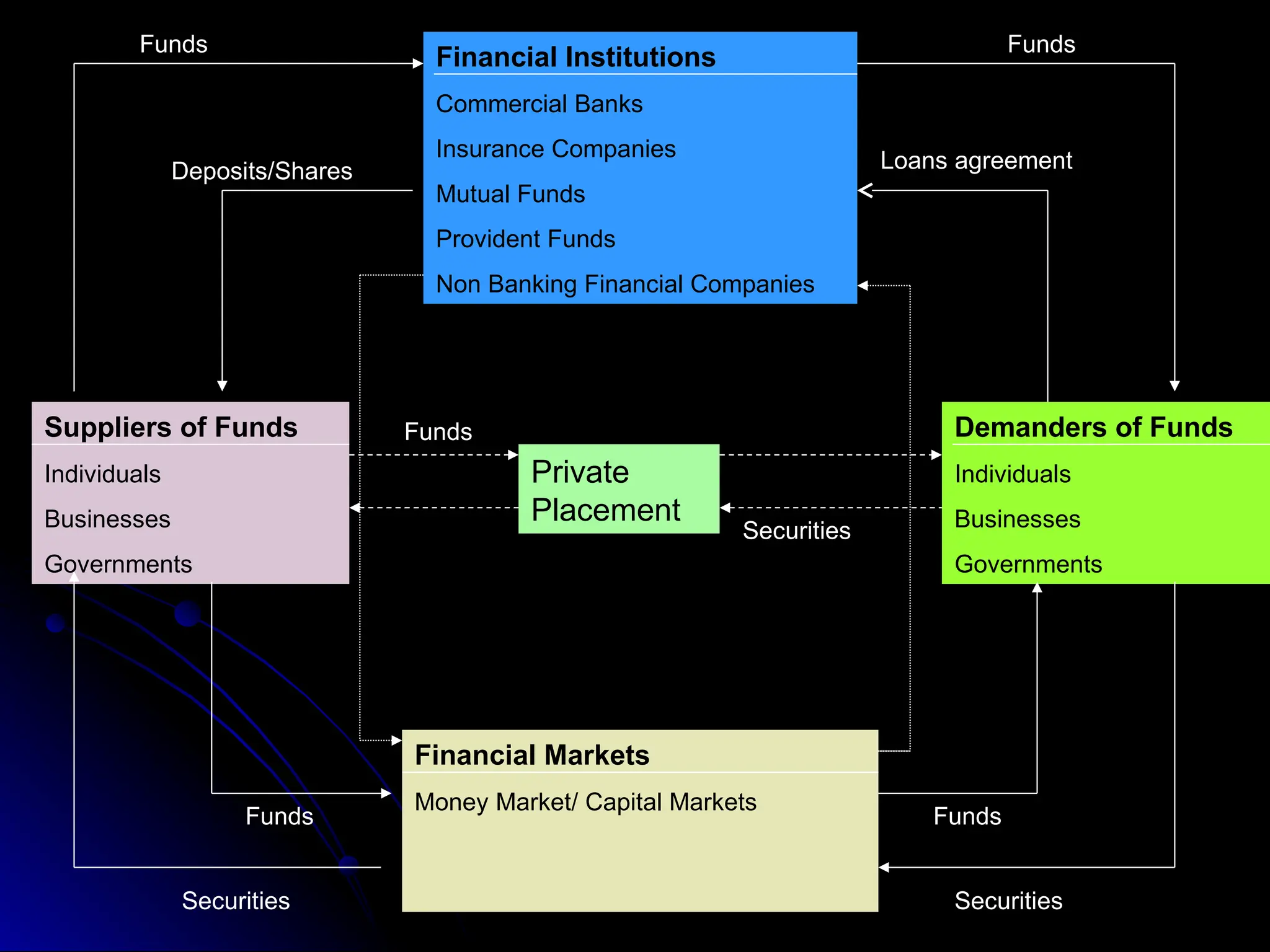
Financial Institutions
Commercial Banks
Insurance Companies
Mutual Funds
Provident Funds
Non Banking Financial Companies
Demanders of Funds
Individuals
Businesses
Governments
Suppliers of Funds
Individuals
Businesses
Governments
Financial Markets
Money Market/ Capital Markets
Private
Placement
Funds
Deposits/Shares
Funds
Loans agreement
Funds
Securities
Funds
Securities
Funds
Securities
Importance of Financial
System
System
Mobilize the savings
Mobilize the savings
Facilitates the free flow of funds
Facilitates the free flow of funds
Provides the intermediation
Provides the intermediation
Functions of the Financial
System
System
It provides a payment system for
It provides a payment system for
the exchange of goods and
services.
services.
It enables the pooling of funds for
It enables the pooling of funds for
undertaking large – scale
enterprises.
enterprises.
It provides a mechanism temporal
It provides a mechanism temporal
transfer of resources.
It provides a way for managing
It provides a way for managing
uncertainty and controlling risk.
It generates information that
It generates information that
helps in coordinating
decentralized decision-making.
It helps in dealing with the
It helps in dealing with the
incentive problem when one
party has an informational
advantage
advantage.
.
Functions of the Financial
System
System
Provision of Liquidity
Provision of Liquidity : The
: The
major function of the financial
system is the provision of
money and monetary assets for
the production of goods and
services. In financial language,
the money and monetary assets
are referred as liquidity.
Mobilization of savings:
Mobilization of savings: it refers
it refers
to mobilize the savings of public
and channelise them into
productive activities. In other
words, the financial system
facilitates the transformation of
savings into investment and
consumption.
consumption.
Economic growth:
Economic growth: it promotes
it promotes
economic growth by balancing of
distribution of finds, particularly
to the under privileged and the
poorer section of society .
Development of financial
system in India
system in India
At the time of independence in
At the time of independence in
1947, there was no strong
financial system in India.
The industrial sector also had
The industrial sector also had
no access to the savings of
the public.
the public.
Some serious attention was paid to
Some serious attention was paid to
development of sound financial
system of India only after the
launching the planning era in
country.
country.
With the adoption of mixed
With the adoption of mixed
economy, the development of the
financial system took a different
turn so as to fulfill the socio-
economic and political objectives
GROWTH IN THE INDIAN
FINANCIAL SYSTEM
FINANCIAL SYSTEM
Emergence of a wide range of
Emergence of a wide range of
financial institutions to provide
a variety of services.
Significant expansion of the
Significant expansion of the
network of commercial banks
and operations of the financial
institutions.
institutions.
Introduction of a variety of
Introduction of a variety of
schemes and instruments for
mobilizing savings remarkable
growth in the primary as well
as the secondary segments of
the capital market
the capital market.
.
TREND IN THE INDIAN
TREND IN THE INDIAN
FINANCIAL SYSTEM
FINANCIAL SYSTEM
The field of market-determined
The field of market-determined
interest rates is increasing and
correspondingly the domain of
administered interest rates is
shrinking. This is accompanied
by greater volatility in interest
rates.
rates.
Financial intermediaries like
Financial intermediaries like
the industrial Development
Bank of India, which
traditionally had substantial
access to cheaper SLR
borrowing, have to now rely
more on the capital market
In the regulation of financial
In the regulation of financial
markets and financial
intermediaries, prudential
regulation and supervision
(capital adequacy, disclosure,
transparency, and so on) are
being emphasized and product
and price controls are being
done away with.
done away with.
Financial innovation
Financial innovation
(introduction of new financial
instruments or processes) is
gaining momentum. Options
and futures have been
introduced in India.
Financial Sector Reforms
in India
in India
Removal of financial
Removal of financial
repression.
repression.
Creation of efficient,
Creation of efficient,
productive, and profitable
financial sector.
financial sector.
Evolution of market-
Evolution of market-
determined interest rates.
Granting of operational and
Granting of operational and
functional autonomy to
institutions.
institutions.
Opening up of the external
Opening up of the external
sector in a calibrated fashion.
Maintenance of financial
Maintenance of financial
stability in face of domestic
and external disturbances.
Weakness of Indian
Weakness of Indian
Financial System
Financial System
Lack of Co-ordination between
Lack of Co-ordination between
different Financial Institutions
Monopolistic Market Structures
Monopolistic Market Structures
Dominance of Development
Dominance of Development
Banks in Industrial Financing
Inactive Capital Market
Inactive Capital Market
Components / Organization
of financial system
of financial system
a. Financial assets
a. Financial assets
b. Financial intermediaries
c. Financial markets
d. Financial instruments
e. Financial Services
Financial Instruments & Assets
It refers to those documents
It refers to those documents
which represent financial
claim on assets; for ex. Bills of
exchange, Promissory notes,
Shares, Debentures
Shares, Debentures
Financial assets
Financial assets:
: the basic
the basic
product of any financial
system is the financial assets.
A financial asset is one, which
is used for production or
consumption or for further
creation of assets
creation of assets
FINANCIAL INTERMEDIARIES
Financial intermediaries are
Financial intermediaries are
firms that provide services and
products that customers may
not be able to get more
efficiently by them in financial
markets.
markets.
FINANCIAL MARKETS
FINANCIAL MARKETS
A financial market is a market
A financial market is a market
for creation and exchange of
financial assets. If you buy or
sell financial assets, you will
participate in financial markets
in some way or the other.
Functional of Financial
Markets
Markets
Financial markets facilitate
Financial markets facilitate
price discovery
price discovery
Financial markets provide
Financial markets provide
liquidity to financial assets
Financial markets
Financial markets
considerably reduce the cost
of transacting
of transacting
Classification of Financial
Markets
Markets
Financial markets can classified
as different types
as different types
Financial claim- Fixed claims (debt
Financial claim- Fixed claims (debt
instruments) and Residual claims
(equity instruments).
Maturity of claims- Short – term
Maturity of claims- Short – term
financial claims (money market)
and Long – term financial claims
(capital market).
(capital market).
Issue Claim- New issues (Primary
Issue Claim- New issues (Primary
market) and outstanding issues
(Secondary Market).
(Secondary Market).
Timing of delivery- Cash or Spot
Timing of delivery- Cash or Spot
market and Future or Forward
Market.
Market.
Organizational structure. –
Organizational structure. –
Centralized and Decentralized
market.
market.
Main Classification of
Financial Market
Financial Market
Financial markets can be referred to
those centers and arrangement
which facilitate buying and selling of
financial assets and services.
There are mainly two types of
Financial Capital
Financial Capital
Unorganized Markets.
Unorganized Markets.
Organized Markets
Organized Markets
Organized markets
Organized markets
These organized markets can be
further classified into two they are:
Capital Market
Capital Market
Money Market
Money Market
Capital Market:
Capital Market:
The capital market is a market for
financial assets, which have a long or
indefinite maturity, which have a
maturity period of more than one year.
Capital market may be further divided
into three namely:
into three namely:
Industrial securities market
Industrial securities market
Government securities market
Government securities market
Long term market
Long term market
Industrial Securities Market
Industrial Securities Market:
:
As the name implies, it is a market
for industrial securities namely
Equity shares or ordinary shares.
Equity shares or ordinary shares.
Preference shares, and
Preference shares, and
Debentures or bonds.
Debentures or bonds.
It is a market where industrial
concerns raise their capital or
debt by issuing appropriate
instruments. It can be further
sub-divided into two:
 Primary market or New issue
Primary market or New issue
market
market
 Secondary market or stock
Secondary market or stock
exchange.
exchange.
Primary Market
Primary Market
There are three ways by which a
company may raise capital in a
primary market. They are:
 Public Issue
Public Issue
 Rights issue – (Issue of additional
Rights issue – (Issue of additional
shares to existing shareholders)
 Private placement – selling of
Private placement – selling of
securities privately to a small
group of investors.
group of investors.
Secondary Market:
Secondary Market:
It is a market for secondary sale of
It is a market for secondary sale of
securities. In other words, securities
which have already passed through
the new issue market are traded in
this market. This market consists of
all stock exchange recognized by
government of India. The stock
exchanges in India are regulated
under the securities controls
(Regulation) Act, 1956.
Government Securities Market
It is a market where government
It is a market where government
securities are traded. In India there
are many kinds of Government
securities-- short term and long
term. Government securities are
issued in denomination of Rs. 100.
Interest is payable half-yearly and
they carry tax exemption also.
Long-Term Loans Market
Development banks and
commercial banks plan a
significant role in this market by
supplying long-term loans to
corporate customers. Long-term
loans market may further be
classified into.
classified into.
 Term loans market – IDBI, IFCI
Term loans market – IDBI, IFCI
 Mortgage market – HUDCO, LIC,
Mortgage market – HUDCO, LIC,
Land Development Banks
 Financial guarantees market.
Financial guarantees market.
Importance Of Capital
Market
Market
It serves as an important source
It serves as an important source
for the productive use of the
economy’s saving.
economy’s saving.
It provides incentives to savings
It provides incentives to savings
and facilitates capital formation by
offering suitable rates of interest.
It provides an avenue for investors
It provides an avenue for investors
to invest in financial assets.
It facilitates increase in production
It facilitates increase in production
and productivity in the economy
and thus, enhances the economic
welfare of the society.
A healthy capital market consisting
A healthy capital market consisting
of expert intermediaries promotes
stability in values of securities.
It serves as an important source for
It serves as an important source for
technological up gradation in the
industrial sector by utilizing the
funds invested by the public
Money Market
Money Market
Money market is a market for
Money market is a market for
dealing with financial assets and
securities which have a maturity
period of up to one year. In other
words, it is a market for purely
short term funds.
short term funds.
Types of Money Market
 Call money market
Call money market
 Commercial Bill Market
Commercial Bill Market
 Treasury Bills Market
Treasury Bills Market
 Short-Term Loan Market
Short-Term Loan Market
Foreign Exchange Market
The term foreign exchange refers to
The term foreign exchange refers to
the process of converting home
currencies into foreign currencies
and vice-versa. According to Dr.
Paul Einzing “Foreign exchange is
the system or process of
converting one national currency
into another, and of transferring
money form one country to
another”
another”
Functions Foreign
Functions Foreign
Exchange Market
Exchange Market
 To make necessary arrangements
To make necessary arrangements
to transfer purchasing power from
one country to another.
 To provide adequate credit
To provide adequate credit
facilities for the promotion of
foreign trade.
foreign trade.
 To cover foreign exchange risks by
To cover foreign exchange risks by
providing hedging facilities.
Financial Assets
Financial Assets
 The basic product of any financial system is
The basic product of any financial system is
the financial assets. A financial asset is one,
which is used for production or consumption
or for further creation of assets. For
instance, A buys equity shares and these
shares are financial assets since they can
earn income.
earn income.
 In this context, one must know the
In this context, one must know the
distinction between financial assets and
physical assets are not useful for further
production of goods or earning income. For
instance, X purchases land and buildings,
gold and silver. These are physical assets.
Classification of financial
assets
assets
Financial assets can be classified
Financial assets can be classified
differently under different
circumstances. One such
classification is :
classification is :
1.marketable assets
1.marketable assets
2.non-marketable assets
Marketable assets
Marketable assets
Marketable assets are those, which
Marketable assets are those, which
can be easily transferred from one
person to another without much
hindrance. Examples: shares of
listed companies, government
securities etc.
securities etc.
Non-Marketable Assets
The assets which can’t be
transferred easily from one person
to another is termed as non-
marketable assets such as
▪
▪ Bank Deposits
Bank Deposits
▪
▪ Provident Funds/Pension Funds
Provident Funds/Pension Funds
▪
▪ National Savings Certificates
National Savings Certificates
▪
▪ Insurance Policies
Insurance Policies
Financial Intermediaries
The term financial intermediary
The term financial intermediary
includes all kinds of organizations,
which intermediate and facilitate
financial transactions of both
individuals and corporate customer.
Thus, it refers to all kinds of financial
institutions and investing institutions,
which facilitate financial transaction in
financial markets
financial markets

Indian financial system ppt...............

  • 1.
  • 2.
    Financial System Financial System Theeconomic development of The economic development of any country depends upon the any country depends upon the existence of a well organized existence of a well organized financial system. It is the financial system. It is the financial system which supplies financial system which supplies the necessary financial inputs for the necessary financial inputs for the production of goods and the production of goods and services which in turn promote services which in turn promote the well being and standard of the well being and standard of living of the people of a country. living of the people of a country.
  • 3.
    Financial System Financial System Thefinancial system is a broader The financial system is a broader term which brings under its fold term which brings under its fold the financial markets and the the financial markets and the financial institution which support financial institution which support the system. The major assets the system. The major assets traded in the financial system are traded in the financial system are money and monetary assets. money and monetary assets.
  • 4.
    Financial System Financial System Definition-Aset of institutions, Definition-A set of institutions, instruments and markets which instruments and markets which promote savings and channel promote savings and channel them to their most efficient them to their most efficient use. use.
  • 5.
    Financial Institutions Commercial Banks InsuranceCompanies Mutual Funds Provident Funds Non Banking Financial Companies Demanders of Funds Individuals Businesses Governments Suppliers of Funds Individuals Businesses Governments Financial Markets Money Market/ Capital Markets Private Placement Funds Deposits/Shares Funds Loans agreement Funds Securities Funds Securities Funds Securities
  • 6.
    Importance of Financial Importanceof Financial System System Mobilize the savings Mobilize the savings Facilitates the free flow of funds Facilitates the free flow of funds Provides the intermediation Provides the intermediation
  • 7.
    Functions of theFinancial Functions of the Financial System System It provides a payment system for It provides a payment system for the exchange of goods and the exchange of goods and services. services. It enables the pooling of funds for It enables the pooling of funds for undertaking large – scale undertaking large – scale enterprises. enterprises. It provides a mechanism temporal It provides a mechanism temporal transfer of resources. transfer of resources.
  • 8.
    It provides away for managing It provides a way for managing uncertainty and controlling risk. uncertainty and controlling risk. It generates information that It generates information that helps in coordinating helps in coordinating decentralized decision-making. decentralized decision-making. It helps in dealing with the It helps in dealing with the incentive problem when one incentive problem when one party has an informational party has an informational advantage advantage. .
  • 9.
    Functions of theFinancial Functions of the Financial System System Provision of Liquidity Provision of Liquidity : The : The major function of the financial major function of the financial system is the provision of system is the provision of money and monetary assets for money and monetary assets for the production of goods and the production of goods and services. In financial language, services. In financial language, the money and monetary assets the money and monetary assets are referred as liquidity. are referred as liquidity.
  • 10.
    Mobilization of savings: Mobilizationof savings: it refers it refers to mobilize the savings of public to mobilize the savings of public and channelise them into and channelise them into productive activities. In other productive activities. In other words, the financial system words, the financial system facilitates the transformation of facilitates the transformation of savings into investment and savings into investment and consumption. consumption. Economic growth: Economic growth: it promotes it promotes economic growth by balancing of economic growth by balancing of distribution of finds, particularly distribution of finds, particularly to the under privileged and the to the under privileged and the poorer section of society . poorer section of society .
  • 11.
    Development of financial Developmentof financial system in India system in India At the time of independence in At the time of independence in 1947, there was no strong 1947, there was no strong financial system in India. financial system in India. The industrial sector also had The industrial sector also had no access to the savings of no access to the savings of the public. the public.
  • 12.
    Some serious attentionwas paid to Some serious attention was paid to development of sound financial development of sound financial system of India only after the system of India only after the launching the planning era in launching the planning era in country. country. With the adoption of mixed With the adoption of mixed economy, the development of the economy, the development of the financial system took a different financial system took a different turn so as to fulfill the socio- turn so as to fulfill the socio- economic and political objectives economic and political objectives
  • 13.
    GROWTH IN THEINDIAN GROWTH IN THE INDIAN FINANCIAL SYSTEM FINANCIAL SYSTEM Emergence of a wide range of Emergence of a wide range of financial institutions to provide financial institutions to provide a variety of services. a variety of services. Significant expansion of the Significant expansion of the network of commercial banks network of commercial banks and operations of the financial and operations of the financial institutions. institutions.
  • 14.
    Introduction of avariety of Introduction of a variety of schemes and instruments for schemes and instruments for mobilizing savings remarkable mobilizing savings remarkable growth in the primary as well growth in the primary as well as the secondary segments of as the secondary segments of the capital market the capital market. .
  • 15.
    TREND IN THEINDIAN TREND IN THE INDIAN FINANCIAL SYSTEM FINANCIAL SYSTEM The field of market-determined The field of market-determined interest rates is increasing and interest rates is increasing and correspondingly the domain of correspondingly the domain of administered interest rates is administered interest rates is shrinking. This is accompanied shrinking. This is accompanied by greater volatility in interest by greater volatility in interest rates. rates.
  • 16.
    Financial intermediaries like Financialintermediaries like the industrial Development the industrial Development Bank of India, which Bank of India, which traditionally had substantial traditionally had substantial access to cheaper SLR access to cheaper SLR borrowing, have to now rely borrowing, have to now rely more on the capital market more on the capital market
  • 17.
    In the regulationof financial In the regulation of financial markets and financial markets and financial intermediaries, prudential intermediaries, prudential regulation and supervision regulation and supervision (capital adequacy, disclosure, (capital adequacy, disclosure, transparency, and so on) are transparency, and so on) are being emphasized and product being emphasized and product and price controls are being and price controls are being done away with. done away with.
  • 18.
    Financial innovation Financial innovation (introductionof new financial (introduction of new financial instruments or processes) is instruments or processes) is gaining momentum. Options gaining momentum. Options and futures have been and futures have been introduced in India. introduced in India.
  • 19.
    Financial Sector Reforms FinancialSector Reforms in India in India Removal of financial Removal of financial repression. repression. Creation of efficient, Creation of efficient, productive, and profitable productive, and profitable financial sector. financial sector. Evolution of market- Evolution of market- determined interest rates. determined interest rates.
  • 20.
    Granting of operationaland Granting of operational and functional autonomy to functional autonomy to institutions. institutions. Opening up of the external Opening up of the external sector in a calibrated fashion. sector in a calibrated fashion. Maintenance of financial Maintenance of financial stability in face of domestic stability in face of domestic and external disturbances. and external disturbances.
  • 21.
    Weakness of Indian Weaknessof Indian Financial System Financial System Lack of Co-ordination between Lack of Co-ordination between different Financial Institutions different Financial Institutions Monopolistic Market Structures Monopolistic Market Structures Dominance of Development Dominance of Development Banks in Industrial Financing Banks in Industrial Financing Inactive Capital Market Inactive Capital Market
  • 22.
    Components / Organization Components/ Organization of financial system of financial system a. Financial assets a. Financial assets b. Financial intermediaries b. Financial intermediaries c. Financial markets c. Financial markets d. Financial instruments d. Financial instruments e. Financial Services e. Financial Services
  • 23.
    Financial Instruments &Assets Financial Instruments & Assets It refers to those documents It refers to those documents which represent financial which represent financial claim on assets; for ex. Bills of claim on assets; for ex. Bills of exchange, Promissory notes, exchange, Promissory notes, Shares, Debentures Shares, Debentures
  • 24.
    Financial assets Financial assets: :the basic the basic product of any financial product of any financial system is the financial assets. system is the financial assets. A financial asset is one, which A financial asset is one, which is used for production or is used for production or consumption or for further consumption or for further creation of assets creation of assets
  • 25.
    FINANCIAL INTERMEDIARIES FINANCIAL INTERMEDIARIES Financialintermediaries are Financial intermediaries are firms that provide services and firms that provide services and products that customers may products that customers may not be able to get more not be able to get more efficiently by them in financial efficiently by them in financial markets. markets.
  • 26.
    FINANCIAL MARKETS FINANCIAL MARKETS Afinancial market is a market A financial market is a market for creation and exchange of for creation and exchange of financial assets. If you buy or financial assets. If you buy or sell financial assets, you will sell financial assets, you will participate in financial markets participate in financial markets in some way or the other. in some way or the other.
  • 27.
    Functional of Financial Functionalof Financial Markets Markets Financial markets facilitate Financial markets facilitate price discovery price discovery Financial markets provide Financial markets provide liquidity to financial assets liquidity to financial assets Financial markets Financial markets considerably reduce the cost considerably reduce the cost of transacting of transacting
  • 28.
    Classification of Financial Classificationof Financial Markets Markets Financial markets can classified Financial markets can classified as different types as different types Financial claim- Fixed claims (debt Financial claim- Fixed claims (debt instruments) and Residual claims instruments) and Residual claims (equity instruments). (equity instruments). Maturity of claims- Short – term Maturity of claims- Short – term financial claims (money market) financial claims (money market) and Long – term financial claims and Long – term financial claims (capital market). (capital market).
  • 29.
    Issue Claim- Newissues (Primary Issue Claim- New issues (Primary market) and outstanding issues market) and outstanding issues (Secondary Market). (Secondary Market). Timing of delivery- Cash or Spot Timing of delivery- Cash or Spot market and Future or Forward market and Future or Forward Market. Market. Organizational structure. – Organizational structure. – Centralized and Decentralized Centralized and Decentralized market. market.
  • 30.
    Main Classification of MainClassification of Financial Market Financial Market Financial markets can be referred to Financial markets can be referred to those centers and arrangement those centers and arrangement which facilitate buying and selling of which facilitate buying and selling of financial assets and services. financial assets and services. There are mainly two types of There are mainly two types of Financial Capital Financial Capital Unorganized Markets. Unorganized Markets. Organized Markets Organized Markets
  • 31.
    Organized markets Organized markets Theseorganized markets can be These organized markets can be further classified into two they are: further classified into two they are: Capital Market Capital Market Money Market Money Market
  • 32.
    Capital Market: Capital Market: Thecapital market is a market for The capital market is a market for financial assets, which have a long or financial assets, which have a long or indefinite maturity, which have a indefinite maturity, which have a maturity period of more than one year. maturity period of more than one year. Capital market may be further divided Capital market may be further divided into three namely: into three namely: Industrial securities market Industrial securities market Government securities market Government securities market Long term market Long term market
  • 33.
    Industrial Securities Market IndustrialSecurities Market: : As the name implies, it is a market As the name implies, it is a market for industrial securities namely for industrial securities namely Equity shares or ordinary shares. Equity shares or ordinary shares. Preference shares, and Preference shares, and Debentures or bonds. Debentures or bonds.
  • 34.
    It is amarket where industrial It is a market where industrial concerns raise their capital or concerns raise their capital or debt by issuing appropriate debt by issuing appropriate instruments. It can be further instruments. It can be further sub-divided into two: sub-divided into two:  Primary market or New issue Primary market or New issue market market  Secondary market or stock Secondary market or stock exchange. exchange.
  • 35.
    Primary Market Primary Market Thereare three ways by which a There are three ways by which a company may raise capital in a company may raise capital in a primary market. They are: primary market. They are:  Public Issue Public Issue  Rights issue – (Issue of additional Rights issue – (Issue of additional shares to existing shareholders) shares to existing shareholders)  Private placement – selling of Private placement – selling of securities privately to a small securities privately to a small group of investors. group of investors.
  • 36.
    Secondary Market: Secondary Market: Itis a market for secondary sale of It is a market for secondary sale of securities. In other words, securities securities. In other words, securities which have already passed through which have already passed through the new issue market are traded in the new issue market are traded in this market. This market consists of this market. This market consists of all stock exchange recognized by all stock exchange recognized by government of India. The stock government of India. The stock exchanges in India are regulated exchanges in India are regulated under the securities controls under the securities controls (Regulation) Act, 1956. (Regulation) Act, 1956.
  • 37.
    Government Securities Market GovernmentSecurities Market It is a market where government It is a market where government securities are traded. In India there securities are traded. In India there are many kinds of Government are many kinds of Government securities-- short term and long securities-- short term and long term. Government securities are term. Government securities are issued in denomination of Rs. 100. issued in denomination of Rs. 100. Interest is payable half-yearly and Interest is payable half-yearly and they carry tax exemption also. they carry tax exemption also.
  • 38.
    Long-Term Loans Market Long-TermLoans Market Development banks and Development banks and commercial banks plan a commercial banks plan a significant role in this market by significant role in this market by supplying long-term loans to supplying long-term loans to corporate customers. Long-term corporate customers. Long-term loans market may further be loans market may further be classified into. classified into.  Term loans market – IDBI, IFCI Term loans market – IDBI, IFCI  Mortgage market – HUDCO, LIC, Mortgage market – HUDCO, LIC, Land Development Banks Land Development Banks  Financial guarantees market. Financial guarantees market.
  • 39.
    Importance Of Capital ImportanceOf Capital Market Market It serves as an important source It serves as an important source for the productive use of the for the productive use of the economy’s saving. economy’s saving. It provides incentives to savings It provides incentives to savings and facilitates capital formation by and facilitates capital formation by offering suitable rates of interest. offering suitable rates of interest. It provides an avenue for investors It provides an avenue for investors to invest in financial assets. to invest in financial assets.
  • 40.
    It facilitates increasein production It facilitates increase in production and productivity in the economy and productivity in the economy and thus, enhances the economic and thus, enhances the economic welfare of the society. welfare of the society. A healthy capital market consisting A healthy capital market consisting of expert intermediaries promotes of expert intermediaries promotes stability in values of securities. stability in values of securities. It serves as an important source for It serves as an important source for technological up gradation in the technological up gradation in the industrial sector by utilizing the industrial sector by utilizing the funds invested by the public funds invested by the public
  • 41.
    Money Market Money Market Moneymarket is a market for Money market is a market for dealing with financial assets and dealing with financial assets and securities which have a maturity securities which have a maturity period of up to one year. In other period of up to one year. In other words, it is a market for purely words, it is a market for purely short term funds. short term funds.
  • 42.
    Types of MoneyMarket Types of Money Market  Call money market Call money market  Commercial Bill Market Commercial Bill Market  Treasury Bills Market Treasury Bills Market  Short-Term Loan Market Short-Term Loan Market
  • 43.
    Foreign Exchange Market ForeignExchange Market The term foreign exchange refers to The term foreign exchange refers to the process of converting home the process of converting home currencies into foreign currencies currencies into foreign currencies and vice-versa. According to Dr. and vice-versa. According to Dr. Paul Einzing “Foreign exchange is Paul Einzing “Foreign exchange is the system or process of the system or process of converting one national currency converting one national currency into another, and of transferring into another, and of transferring money form one country to money form one country to another” another”
  • 44.
    Functions Foreign Functions Foreign ExchangeMarket Exchange Market  To make necessary arrangements To make necessary arrangements to transfer purchasing power from to transfer purchasing power from one country to another. one country to another.  To provide adequate credit To provide adequate credit facilities for the promotion of facilities for the promotion of foreign trade. foreign trade.  To cover foreign exchange risks by To cover foreign exchange risks by providing hedging facilities. providing hedging facilities.
  • 45.
    Financial Assets Financial Assets The basic product of any financial system is The basic product of any financial system is the financial assets. A financial asset is one, the financial assets. A financial asset is one, which is used for production or consumption which is used for production or consumption or for further creation of assets. For or for further creation of assets. For instance, A buys equity shares and these instance, A buys equity shares and these shares are financial assets since they can shares are financial assets since they can earn income. earn income.  In this context, one must know the In this context, one must know the distinction between financial assets and distinction between financial assets and physical assets are not useful for further physical assets are not useful for further production of goods or earning income. For production of goods or earning income. For instance, X purchases land and buildings, instance, X purchases land and buildings, gold and silver. These are physical assets. gold and silver. These are physical assets.
  • 46.
    Classification of financial Classificationof financial assets assets Financial assets can be classified Financial assets can be classified differently under different differently under different circumstances. One such circumstances. One such classification is : classification is : 1.marketable assets 1.marketable assets 2.non-marketable assets 2.non-marketable assets
  • 47.
    Marketable assets Marketable assets Marketableassets are those, which Marketable assets are those, which can be easily transferred from one can be easily transferred from one person to another without much person to another without much hindrance. Examples: shares of hindrance. Examples: shares of listed companies, government listed companies, government securities etc. securities etc.
  • 48.
    Non-Marketable Assets Non-Marketable Assets Theassets which can’t be The assets which can’t be transferred easily from one person transferred easily from one person to another is termed as non- to another is termed as non- marketable assets such as marketable assets such as ▪ ▪ Bank Deposits Bank Deposits ▪ ▪ Provident Funds/Pension Funds Provident Funds/Pension Funds ▪ ▪ National Savings Certificates National Savings Certificates ▪ ▪ Insurance Policies Insurance Policies
  • 49.
    Financial Intermediaries Financial Intermediaries Theterm financial intermediary The term financial intermediary includes all kinds of organizations, includes all kinds of organizations, which intermediate and facilitate which intermediate and facilitate financial transactions of both financial transactions of both individuals and corporate customer. individuals and corporate customer. Thus, it refers to all kinds of financial Thus, it refers to all kinds of financial institutions and investing institutions, institutions and investing institutions, which facilitate financial transaction in which facilitate financial transaction in financial markets financial markets