Microfinance Policy and Regulatory Framework
    Diagnostic of Nepal: Recommendations


                             Tejhari Ghimire and Tulasi Prasad Uprety


                              Center for Microfinance (CMF)

                      2009    Bahtbhateni, Kathmandu, Nepal
                              Tel: 977 1 4434041, 4443984
                              Email: cmf@cmfnepal.org
                              Internet: www.cmfnepal.org
Copy rights

2008 Center for Microfinance (CMF), Kathmandu

All rights reserved. No part of this publication may be reproduced, stored in a retrieval system, or
transmitted, in any form or by any means, without the prior written permission of the Center for
Microfinance (CMF). CMF does not guarantee the accuracy of the data included in this publication
and accepts no responsibility for any consequences in their use.

This publication Microfinance Policy and Regulatory Framework Diagnostic of Nepal:
Recommendations was published with the financial support of The Asia Foundation. The study was
conducted by the following team:

Tejhari Ghimire, Team Leader
Tulasi Prasad Upreti, Microfinance Consultant;
Sushila Gautam, Naresh Nepal, Ganesh Bista, Ruchi Bhagat, and Mimu Raghubamshi, Field
Researchers


The views expressed in this publication are those of the authors and do not necessarily reflect the
views of the CMF and The Asia Foundation.


Center for Microfinance (CMF)
Bahtbhateni, Kathmandu, Nepal
Tel: 977 1 4434041, 4443984
Email: cmf@cmfnepal.org
Internet: www.cmfnepal.org


                                                                                                      i
ABSTRACTS

The objectives of the study were to review the current legal and regulatory frameworks related
to microfinance institutions in Nepal; to identify stakeholder policy and regulatory framework
issues; and to suggest measures required for MF sustainability and growth. The study team
reviewed the regulatory frameworks of other countries; held group and individual discussions
with MF industry representatives; and held a national seminar to share the outcome results
before finalizing the study.

Many MF practitioners believe that the “Market is the best regulator”. They also realize the
need to have some form of government regulation. The possibility of a stakeholder(investor)
panic ‘run’ on an MFI due to lack of information; the public’s concern regarding the
opportunistic and risky behavior of agents; the need for consumer protection; and the
requirement to ensure stability and protection of wholesale lenders are often put forward as
the reasons for having appropriate regulation and supervision. In addition, the building of an MF
database; facilitating the acquisition of a legal identity; ensuring a healthy development of the
sector i.e. performance standards; and facilitating the linkages that enable banks to become
involved in direct micro-finance are considered some of the other important areas that help to
establish need.

Nepal has experimented with different types of MF models i.e. Grameen replication, Savings &
Credit Cooperatives (SACCOs), Financial Intermediary NGOs (FINGOs) as well as project/
program based models. These models are apart from any informal MF practices.

Many of the MFDBs and FINGOs regulations are acceptable to MFIs but there are areas where
reform is required to ensure the growth and sustainability of the sector. The co-operative MF
sector lacks regulation. Unfortunately, the policy and legal framework now under discussion at
the Central Bank lacks the required direction. Consequently, MF industry stakeholders are
committed to draft an appropriate policy and framework using a participatory approach. The
multi agency regulations for different types of MFIs (current model) are appropriate but a
number of provisions required revision.

Rather than applying the Basel Framework of regulations, the Government should use the
PEARLS rating system to regulate and supervise MFIs. The Pearls rating system is simpler, more
realistic and comparable to the worldwide MF database. It is also recognized that setting
performance standards, self-regulatory norms and promoting best practices can be enhanced
through appropriate policy and regulation application.

An outcome of this study was the model Microfinance Act of 2009. Its’ adoption by
Government is expected to set a level playing field for all MFIs, aid the growth of the sector,
widen MFI outreach and help to reduce poverty.


                                                                                               ii
TABLE OF CONTENTS
Abstracts...................................................................................................................................ii
Acronyms .................................................................................................................................v
List of Tables...........................................................................................................................vii
1 Introduction............................................................................................................................1
   1.1 Context................................................................................................................................. 1
   1.2 Methodology ....................................................................................................................... 3
   1.3 Limitations ........................................................................................................................... 3
2 Microfinance Market Environment ........................................................................................4
       2.1.1 Outreach Growth........................................................................................................... 4
       2.1.2 Market Penetration........................................................................................................ 5
3 Policy and regulatory environment.........................................................................................8
   3.1 Defining Microfinance.......................................................................................................... 8
   3.2 Principles and Characteristics .............................................................................................. 9
   3.3 Best Practices ....................................................................................................................... 9
   3.4 Why Enabling Regulatory Environment.............................................................................. 10
   3.5 Principles of Enabling Environment.................................................................................... 11
   3.6 The role of Government and the Central Bank................................................................... 12
   3.7 Impact of Micro- finance in Nepal...................................................................................... 12
   3.8 Regulations for Microfinance Institutions ........................................................................... 13
   3.9 Establishment Criterion...................................................................................................... 13
       3.9.1 General......................................................................................................................... 13
       3.9.2 Licensing Norms for FINGOs......................................................................................... 15
       3.9.3 Registration Norms and SACCOs.................................................................................. 16
   3.10 Regulations for Micro Finance Development Bank (MFDB) .............................................. 16
   3.11 Regulations to Savings and Credit Co-operative Societies (SACCOs) .................................20
   3.12 Regulations for FINGOs..................................................................................................... 22
4 Micro-Finance Policy, 2065 (2008).........................................................................................22
5 Survey findings.....................................................................................................................24
   5.1 Survey Coverage................................................................................................................. 24
   5.2 Policy Issues Awareness...................................................................................................... 24

                                                                                                                                              iii
5.3 Policy Issues raised by the Actors....................................................................................... 25
      5.3.1 Co-operatives.............................................................................................................. 25
      5.3.2 FINGOs ........................................................................................................................ 26
      5.3.3 MFDBs.......................................................................................................................... 27
      5.3.4 Policy Organizations..................................................................................................... 27
      5.3.5 Donor Agencies / INGOs............................................................................................... 28
6 Recommendations................................................................................................................30
   6.1 Legal/Regulatory Framework.............................................................................................. 30
   6.2 Performance Standards/Indicators..................................................................................... 35
   6.3 Model Microfinance Regulation Act 2009.......................................................................... 36
   6.4 Other Suggestions .............................................................................................................. 36
Annexes..................................................................................................................................37
Bibliography............................................................................................................................60


                                                                                                                                           iv
ACRONYMS

ACCION   ACCION International - a Latin American MFI system
ADB      Asian Development Bank, Manila
ADB/N    Agriculture Development Banks, Nepal
ASA      Association for Social Advancement, Bangladesh
BASEL    Basel Committee for Banking Supervision, Bank for International Settlement,
         Switzerland, BASEL
BFI      Bank and Financial Institutions
GBB      Grameen Bank Bangladesh
BRAC     Bangladesh Rural Advancement Committee
CAMELS   ‘Capital Adequacy, Asset Quality, Management, Earning, Liquidity and
         Sensitivity’ to Market Risk
CAR      Capital Adequacy Ratio
CMF      Center for Micro- Finance, Kathmandu, Nepal
CBs      Commercial Banks
CBOs     Community Based Organizations
CEO      Chief Executive Officer
CRR      Cash Reserve Ratio
CSD      Center for Self Help Development, FINGO
CGAP     Consultative Group to Assist the Poorest
CGISP    Community Ground Water Irrigation Sector Project
DDB      Deprosc Development Bank
DLGSP    Decentralized Local Governance Support Program.
DSL      Deprived Sector Lending
FCs      Finance Companies
FD       Fixed Deposit
FGD      Focus Group Discussion
FI       Financial Institution
FINGO    Financial Intermediary Non-Government Organization
FSS      Financial Self-Sufficiency
FWGB     Far Western GB
GB       Grameen Bank
INAFI    International Network of Alternative Financial Institutions
LLP      Loans Loss Provision
LOI      Letter of Intent
MCPW     Micro-Credit Project for Women
MCR      Minimum Capital Requirement
MEDEP    Micro Enterprise Development Program
MDGs     Millennium Development Goals
MF       Micro-finance
MFDB     Micro Finance Development Bank

                                                                                       v
MFI       Microfinance Institution
MGB       Madhyamanchal GB
MWGB      Madhya Paschimanchal GB
MIS       Management Information System
NCDB      National Co-operative Development Board
NCF       National Co-operatives Federation
NEFSCUN   National Federation of Saving and Credit Co-operatives
NGO       Non-Government Organization
NRB       Nepal Rastra Bank
NUBL      Nirdhan Utthan Bank Limited
OSS       Operational Self-Sufficiency
PAF       Poverty Alleviation Fund
PCRW      Productive Credit for Rural Women
PEARLS    Protection, Effective financial structure, Asset Quality, Rates of return and costs,
          Liquidity, Sign of growth
PGB       Paschimanchal GB
PuGB      Purbanchal GB
RFP       Rural Finance Project
RMDC      Rural Micro-Finance Development Centre
RSRF      Rural Self-Reliance Fund
SACCOS    Savings and Credit Co-operative Societies
SFCL      Small Farmer Co- operative Ltd
SFDP      Small Farmer Development Project
SHGs      Self-Help Groups
SKBB      Sana Kishan Bikash Bank
SBB       Swabalamban Bikas Bank
SOL       Single Obligor Limit
SPOs      Sub Project Offices (SFDP)
STI       Second Tier Institution
TLDP      Third Livestock Development Program
UN        United Nations.
VICCU     Vijaya SACCOS, Nawalparasi
WOCCU     World Co-operative Union


                                                                                            vi
LIST OF TABLES

Table 1: MFI Categories and Client base

Table 2: Current Microfinance Market size and penetration

Table 3: Microfinance Market breakdown by regional type

Table 4: Market Concentration in thirteen ( 13) districts

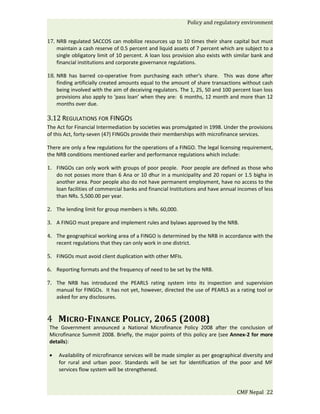
Table 5: Minimum Capital Requirement in Nepalese Rs in Millions

Table 6: MFIs and Organizations Surveyed during policy diagnostic


                                                                    vii
Introduction


1 INTRODUCTION
1.1 CONTEXT
Microfinance has been one of the few effective tools for poverty reduction. As a result of the
creation of sound microfinance institutions and systems, poor people can safely deposit money
and accumulate funds for future investments or emergencies as well as access loans for
productive purposes leading to higher incomes. Additionally, microfinance has produced an
impact in other areas including good governance, participation in the political process, women
empowerment, social inclusion and conflict transformation.1
Currently, more than 1.6 million individuals in the rural population have access to microfinance
services. This figure represents approximately 7 percent of the population and approximately
22.7 percent of the people living below the poverty line. The outreach of sustainable and sound
microfinance institutions to the rural and urban poor still needs, however, to be increased in
order to further diminish poverty. Despite ongoing development efforts, poverty remains
widespread with approximately 31 percent of the population living below the poverty line. The
incidence of poverty is highest in rural areas, particularly in the remote hill and mountain areas.
The Microfinance Summit Nepal held from February 14 to 16, 2008 discussed the major issues in
the microfinance sector. These issues included:

      •   Lack of an enabling microfinance policy based on a broad consensus among
          policymakers and stakeholders;

      •   Lack of coordination among microfinance stakeholders (including the international
          donor community) which has lead to market distortions and overlapping interventions;

      •   Lack of appropriate strategies to build a strong and inclusive microfinance sector which
          responds to the needs of all segments of society, and actively contributes to creating a
          peaceful and socially equitable society;

      •   Lack of microfinance sector baseline data on key stakeholders and customers which
          hinders the development of targeted and tailor-made support strategies for different
          client groups (i.e. how to bring microfinance services to hill areas? How to better access
          dalit and janajati communities?);

      •   Lack of information sharing on innovations, new technologies and strategies which
          impedes increased outreach, particularly to the less accessible areas.

Delegates (838) of private, government and public microfinance stakeholders together with the
international donor community attempted to address these issues at the Summit. Microfinance

1
    Microfinance Summit Nepal 2008


                                                                                        CMF Nepal      60
Introduction


stakeholders shared their experiences with microfinance issues and jointly decide on the future
direction of microfinance in Nepal. The Summit promulgated the ‘21 Point Kathmandu
Declaration’ and established goals for Nepal only after recalling national and global
commitments.

    •   The national development plan; and the United Nations Millennium Development Goals
        (MDGs) call for reducing international poverty by half by the Year 2015, thereby globally
        reaching 175 million poor families;

    •   Bearing in mind that the Global Microcredit Summit held in Halifax, Canada declared a
        goal of ensuring that 100 million of the world’s poorest families move from below USD 1
        day earnings to an adjusted purchasing power parity above USD 1 a day;

    •   Recognizing that adopting an inclusive approach for poverty reduction through
        appropriate financial services contributes to ensuring a peaceful, democratic future for
        Nepal.
The Summit set as its goal:
    •   Reaching 2 million of the ‘poorest of the poor’ with microfinance services for their
        sustainable income by 2010;
    •   Reaching a total of 3 million of the ‘poorest of the poor’ by 2015


The Summit also formulated a two year action plan to meet this goal. The most important step
was to form a fifteen (15) member Taskforce to lobby for the formulation of a microfinance
policy and the creation of an enabling regulatory environment. The Summit recognized that an
enabling policy and regulatory environment was a necessary pre condition to meeting its goal. In
the course of this action, a review of new policy, regulations and regulatory provisions was felt
to be necessary. This recognition prompted CMF and The Asia Foundation to implement the
project “Advocacy for Enabling Microfinance Policy Environment in Nepal” (May 10, 2008 to
January 31, 2009).
The partnership conducted primary and secondary research to diagnose the current regulatory
gaps and ambiguities in Nepal’s microfinance policy in close coordination with the Summit’s
Taskforce. This diagnostic report is the outcome of the primary and secondary research, and the
in-depth discussions held with the Microfinance Policy Taskforce formed at the Summit.

Rationale:

Microfinance in Nepal is emerging and transforming itself from a directed public sector
environment to a market led private effort. This does not mean, however, that the
Government, the Central Bank and donor institutions are not giving it the necessary attention.
Their role is recognized as systematizing, regulating, supervising, promoting and facilitating the
systems, methods and institutions.

Nepal's Central Bank (Nepal Rastra Bank) is considered the prominent regulator. It is always in
support of poverty reduction strategies through the provision of development finance especially
microfinance. In this mission it has created not only laws and regulations but also institutions at
various points in time. In recent years it has concentrated on regulatory reforms in the banking


                                                                                   CMF Nepal     2
Introduction


and financial system in line with Basel II for creating a safe and sound financial system. This is
the basic requirement of sound macroeconomic stability. Currently, NRB is in the process of
strengthening microfinance systems, regulations and regulatory frameworks.

Objectives

This diagnostic study on the policy and regulatory framework for microfinance in Nepal had the
following objectives:

    1. To review the existing policy, legal and regulatory frameworks for different models of
       micro finance institutions;

    2. To identify issues related to policy and regulatory framework from the perspective of
       stakeholders; and

    3. To suggest measures and a regulatory framework for MFIs with the aim of enhancing
       their sustainability and growth.

1.2 METHODOLOGY
    •   The study reviewed the policy and regulatory framework of the microfinance sector.
        Available literature on principles, issues and practices of regulation and policy
        framework of several countries were also reviewed.

    •   Individual consultations were held with forty-four microfinance institutions, policy
        making organizations, donor agencies and INGOs.

    •   The national Microfinance Summit held in February 2008 in Kathmandu proposed a
        national Taskforce Committee be formed to prepare and suggest policy and regulatory
        issues in micro-finance to the next Summit to be held in February 2010. The
        Microfinance Secretariat formally constituted the Taskforce and conducted a series of
        nine meetings with members, the NRB governor, and NRB officials. The outcome results
        of a desk-top audit and field review were submitted to this Committee. The final
        comments of the Committee including final draft recommendations were then
        submitted at a wider stakeholders meeting including the National Steering Committee
        members on January 26, 2009. The model draft Microfinance Act and stakeholder
        suggestions on it are attached as Annex-1-2.

1.3 LIMITATIONS
The study focused on the regulatory environment, reviewing current practices and
recommending how to reform them. It did not focus on the depth of outreach, sustainability
factors and probability of sector growth. This was due to the availability of resources. As a
consequence, there exists further scope for study in each of these areas.


                                                                                  CMF Nepal     3
Microfinance Market Environment


2 MICROFINANCE MARKET ENVIRONMENT
An unstructured form of microfinance service started in the 1950s when several saving and
credit co-operative societies were formed in Chitwan district. Available study data indicates that
while this informal financial system (SACCOs) remains dominant the microfinance sector has
undergone many changes. The sector has experienced a rapid growth of institutions (MFIs) and
significant progress has been made in terms of client out-reach, savings and credit management
services. The number and outreach of microfinance institutions in Nepal has increased
substantially over the last 13 years.

Market Outreach

The table below shows the microfinance market in Nepal by category of financial model. The
number of institutions in each category, the number of clients served per institution, and the
total client base are shown. This information was gathered mostly from secondary sources.

                             Table 1: MFI Categories and Clients

 MFI Categories                   Number      Number of Clients (Range)            Client Base
                                  of MFIs

 MFDBs                            10          20,000-96,000                        455,782

 SACCOs                           4,432       100-5,000                            686,453

 FINGOs                           47          5,000-40,000                         343,596

 SFCLs                            219         500-1,500                            139,368

         Sources: NRB (2008), CMF (2008), Department of Cooperative (2008), SKBBL (2008).

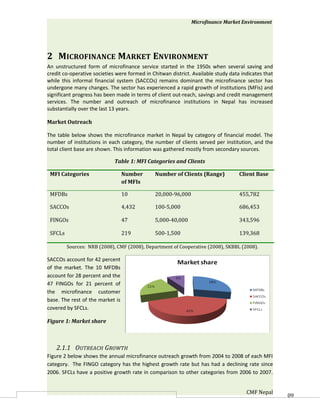
SACCOs account for 42 percent
of the market. The 10 MFDBs
account for 28 percent and the
47 FINGOs for 21 percent of
the microfinance customer
base. The rest of the market is
covered by SFCLs.

Figure 1: Market share


    2.1.1 OUTREACH GROWTH
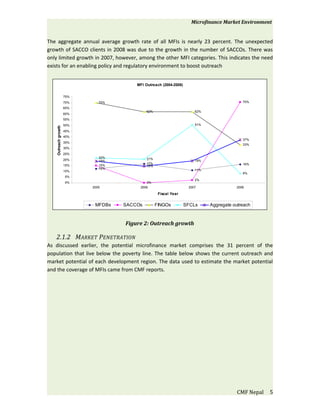
Figure 2 below shows the annual microfinance outreach growth from 2004 to 2008 of each MFI
category. The FINGO category has the highest growth rate but has had a declining rate since
2006. SFCLs have a positive growth rate in comparison to other categories from 2006 to 2007.


                                                                                      CMF Nepal      60
Microfinance Market Environment


The aggregate annual average growth rate of all MFIs is nearly 23 percent. The unexpected
growth of SACCO clients in 2008 was due to the growth in the number of SACCOs. There was
only limited growth in 2007, however, among the other MFI categories. This indicates the need
exists for an enabling policy and regulatory environment to boost outreach


                                        MFI Outreach (2004-2008)


                     75%
                     70%      70%                                                          70%
                     65%
                                             62%                       62%
                     60%
                     55%
                     50%                                               51%
   Outreach growth


                     45%
                     40%
                                                                                           37%
                     35%
                                                                                           33%
                     30%
                     25%
                              22%            21%
                     20%      19%                                      19%
                                             17%                                           16%
                     15%      15%            15%
                              12%                                      11%
                     10%
                                                                                           8%
                     5%
                                                                       2%
                     0%                     0%
                           2005          2006                       2007                2008

                                                    Fiscal Year

                            MFDBs   SACCOs         FINGOs          SFCLs     Aggregate outreach


                                    Figure 2: Outreach growth

   2.1.2 MARKET PENETRATION
As discussed earlier, the potential microfinance market comprises the 31 percent of the
population that live below the poverty line. The table below shows the current outreach and
market potential of each development region. The data used to estimate the market potential
and the coverage of MFIs came from CMF reports.


                                                                                         CMF Nepal   5
Microfinance Market Environment


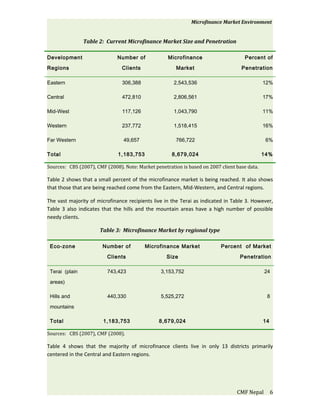
                Table 2: Current Microfinance Market Size and Penetration

Development                   Number of             Microfinance                      Percent of

Regions                         Clients                 Market                      Penetration

Eastern                         306,388                2,543,536                               12%

Central                         472,810                2,806,561                               17%

Mid-West                        117,126                1,043,790                               11%

Western                         237,772                1,518,415                               16%

Far Western                      49,657                 766,722                                 6%

Total                         1,183,753               8,679,024                                14%

Sources: CBS (2007), CMF (2008). Note: Market penetration is based on 2007 client base data.

Table 2 shows that a small percent of the microfinance market is being reached. It also shows
that those that are being reached come from the Eastern, Mid-Western, and Central regions.

The vast majority of microfinance recipients live in the Terai as indicated in Table 3. However,
Table 3 also indicates that the hills and the mountain areas have a high number of possible
needy clients.

                      Table 3: Microfinance Market by regional type

 Eco-zone               Number of         Microfinance Market              Percent of Market

                          Clients                   Size                           Penetration

 Terai (plain             743,423                3,153,752                                     24

 areas)

 Hills and                440,330                5,525,272                                      8

 mountains

 Total                  1,183,753               8,679,024                                      14

Sources: CBS (2007), CMF (2008).

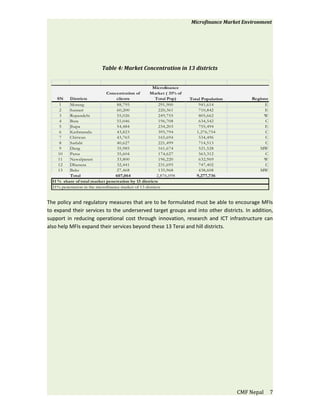
Table 4 shows that the majority of microfinance clients live in only 13 districts primarily
centered in the Central and Eastern regions.


                                                                                  CMF Nepal         6
Microfinance Market Environment


                           Table 4: Market Concentration in 13 districts


                                                       Microfinance
                              Concentration of       Market ( 31% of
     SN   Districts                clients               Total Pop)    Total Population        Regions
      1   Morang                    88,795                 291,900         941,614                   E
      2   Sunsari                   60,200                 220,361         710,842                   E
      3   Rupandehi                 55,026                 249,755         805,662                  W
      4   Bara                      55,046                 196,708         634,542                   C
      5   Jhapa                     54,484                 234,203         755,494                   E
      6   Kathmandu                 43,823                 395,794        1,276,754                  C
      7   Chitwan                   43,765                 165,694         534,496                   C
      8   Sarlahi                   40,627                 221,499         714,513                   C
      9   Dang                      35,985                 161,674         521,528                MW
     10   Parsa                     35,604                 174,627         563,312                   C
     11   Nawalparasi               33,800                 196,220         632,969                  W
     12   Dhanusa                   32,441                 231,695         747,402                   C
     13   Bake                      27,468                 135,968         438,608                MW
          Total                    607,064                2,876,098       9,277,736
  51 % share of total market penetration by 13 districts
  21% penetration in the microfinance market of 13 districts


The policy and regulatory measures that are to be formulated must be able to encourage MFIs
to expand their services to the underserved target groups and into other districts. In addition,
support in reducing operational cost through innovation, research and ICT infrastructure can
also help MFIs expand their services beyond these 13 Terai and hill districts.


                                                                                          CMF Nepal      7
Policy and regulatory environment


3 POLICY AND REGULATORY ENVIRONMENT
3.1 DEFINING MICROFINANCE
Micro-finance has emerged as a powerful tool for poverty reduction. Historically, different
forms of intermediation and development strategies have not been able to trigger poverty
reduction economic activities. This has caused policy makers and practitioners to re-think
microfinance as an emerging tool for poverty reduction. This re-thinking reflects the paradigm
shift in rural development attitudes world -wide.

Microfinance has been defined in different ways to suit both academics as well as MF
practitioners. Its origin, however, can be traced back 50 years when development focused on a
planned approach. As a consequence of this approach, rural development programs, especially
those lending to agricultural, agro business and related businesses had the objective of attaining
growth with social justice.

The Asian Development Bank (ADB) defines micro-finance as “the provision of a broad range of
financial services such as deposits, loans, payment services, money transfers and insurances to
the poor and low income households and enterprises.”

The World Bank defines it as “the provision of financial services to low income clients, including
the self employed. It includes both financial and social intermediation. It is not simply banking, it
is a development tool.”

Similarly, Rachel Rock defines it as the “development of small amounts of short term working
capital and in some cases, long term investment loans and provision of deposit facility to small
scale business and households.”

“Microfinance is the supply of loans, savings, and other basic financial services to the poor"
(CGAP).

A microfinance institution (MFI) is defined as an organization that provides microfinance
services, ranging from small non-profit organizations to large commercial banks. CGAP broadly
defines an MFI as any organization—credit union, downscaled commercial bank, financial NGO,
or credit cooperative that provides financial services to the poor.

Nepal’s National Microfinance Policy 2008 defines microfinance as the financial services that
help poor communities develop their professional skill and become involved in income related
activities by offering self employment opportunities through micro saving, micro credit, and
micro credit insurance/micro credit security activities.


                                                                                         CMF Nepal      60
Policy and regulatory environment


3.2 PRINCIPLES AND CHARACTERISTICS
Microfinance encompasses key principles that have evolved over the years through the
interaction of stakeholders, researchers and academicians. These principles clearly demonstrate
that MF has created its own development and academic identity.

Key Microfinance Principles: 2

     1.    “Poor people need a variety of financial services, not just loans.
     2.    Poor people are bankable, can pay loans and can also save.
     3.    It is a powerful tool to fight poverty.
     4.    It means building financial systems that serve the poor.
     5.    It can pay for itself, and must do so if it is to reach very large numbers of poor people.
     6.    It is about building permanent local financial institutions.
     7.    Micro-credit is not always the only answer.
     8.    Interest rate ceilings hurt poor people by making it harder for them to get credit.
     9.    The role of government is to enable financial services, not to provide them directly.
     10.   Donor funds should complement private capital, not compete with it.
     11.   The key bottleneck is the shortage of strong institutions and managers.
     12.   Micro-finance works best when it measures and discloses its performance.”

Characteristics of Microfinance: Microfinance possesses characteristics which separates it from
other forms of finance. Some of these characteristics include:

     1.    MF is mostly collateral free
     1.    MFIs go to clients rather than clients go to MFIs
     2.    Simplified savings and loan procedures
     3.    Small size of loans and savings
     4.    Repeat Loans
     5.    Loan sizes increases when there are repeated loans or in subsequent cycles
     6.    Interest rate is usually between that charged by money lenders and formal banks
     7.    Free use of loans (no restrictions on specified purpose)
     8.    Loan repayment considers incomes from business as well as other sources
     9.    Loan and saving products within manageable numbers

3.3 BEST PRACTICES
Initiatives to develop microfinance have attracted the attention of development agencies, i.e.
the United Nation proclaimed 2005 as the “Year of Micro-credit”. From the various
development agency initiatives a number of MF models have been developed and practiced
over the years. As a consequence of this experience, a large knowledge base has developed
which in turn has led to the development of guiding principles, often termed ‘best practices’,
which can help MFIs achieve sustainable operations for longer periods of time.

International ‘best practices’ include: building effective management information systems
(MIS); offering outreach services to attract a larger number of clients (vision of growth);

2
    CGAP


                                                                                            CMF Nepal   60
Policy and regulatory environment


promoting and diversifying savings services; offering services that fit client needs; diversifying
loan products; and simplifying loan procedures. In addition, there exists the need to motivate
clients to repay loans which focus on high repayments; attain operational self sufficiency (OSS)
and financial self sufficiency (OSS) by charging adequate and appropriate interest rates and fees;
involve clients when designing services; promoting effective governance characterized by
democratic and transparent decision-making; and properly targeting clients..

‘Best practices’ also includes a focus on financial services (provision of business development
services as a separate but parallel intervention not as a part of, or, condition of finance);
development of institutional linkages; implementation of incentives systems that promote
efficiency and maintain quality; and implementation of an internal control system that
minimizes financial and credit liquidity, interest rate charges, transactional and operational risks
and the risk of fraud. It is regrettable that the majority of MFIs in Nepal can not follow these
‘best practices’ due to the absence of a proper infrastructure, regulatory environment and
market standards.

3.4 WHY ENABLING REGULATORY ENVIRONMENT
There is no unanimous opinion among MF practitioners and regulators on the issue of
regulation for microfinance operations. Some say the “Market is the best regulator” while
others argue that MF should be left outside the purview of formal regulation. The later envisions
a scenario where MF works are viewed as noble social work versus as a professional financial
activity.

The general consensus that has emerged, however, is that some conducive, facilitative or
growth oriented regulation could boost the MF sector. According to Fukaya and Shadagopan
(2001) “The motivation for regulatory intervention is based on the assumption that an
asymmetry of information exists between the lender and the borrower.” They argue that
regulation has to match the actions of the institutions (Agent) and the clients (Principal) in such
a way that the actions of the agents are controlled, decision making power of the agents are
restricted and provide incentives in doing so by harmonizing the benefits to principal and the
agents. In summary, the reasons for an enabling regulatory environment are:

    •   The possibility of a ‘run’ on an MFI due to a lack of information to the stakeholders
        (investors).

    •   The opportunistic and risky behavior of an agent even for MFIs that do not take deposits
        may pose a serious threat to the functioning of the MFI.

    •   The need for consumer protection in order to ensure stability.

    •   The protection of wholesale lenders (some could be banks in which case public funds
        are involved, others could be bilateral or multilateral agencies where returnable funds
        may have as a condition the requirement for appropriate regulation and supervision
        before disbursement to the MFI).


                                                                                    CMF Nepal 10
Policy and regulatory environment


    •   The need to ensure a healthy development of the sector through performance
        standards

    •   The need to facilitate linkages with commercial sources of finance.

    •   The need for the prudential regulation of savings

    •   The opportunity for banks to become involved in direct microfinance.

Once microfinance activities start various needs emerge according to changes in the market.
The enabling regulatory environment creates a competitive market for microfinance. It
determines the size of the micro enterprise sector, the supply of credit, the assessment of the
credit gap, the interest rate setting, the number and types of institutions, the capital
requirement, the product design, etc. It also protects the quality of a portfolio through
documentation requirements, group guarantees, insurances, and either the CAMEL or PEARLS
rating systems. In addition, the enabling environment builds the institutional capacity of an
agency, obtains timely and adequate financial information and establishes effective off and
onsite supervisory mechanisms and handles potential insolvencies.

Nepalese experience and studies suggest that building an enabling and sound regulatory
environment is very important for an efficient and effective microfinance industry. The enabling
environment in the Nepalese context consists of creating a legal framework; developing self
regulatory norms; ensuring good management practices and governance; developing
appropriate internal control and institutional rating systems; and public disclosure of norms,
deposits and credit insurance schemes as well as the development of performance standards.

Generally, non bank MFIs are not subjected to prudential regulation when they do not accept
public deposits (McGuire and Conroy 1999). This study suggests that for most non-bank MFIs,
prudential regulation is not always effective in preserving financial health. Suggestions arise
from observation that leads one to find ways for developing institutions that are sustainable,
self regulated and governed with sound performance management systems. Additionally, these
actions can be supported by the use of independent credit rating systems and the disclosure of
financial and social performance information. If these actions are taken, it will facilitate
wholesale funds, and better enable commercial banks and foreign financial institutions to
provide funding to MFIs. Ultimately, this will lead to self-led supervision under performance
criterion and strong loan repayment performance.

3.5 PRINCIPLES OF ENABLING ENVIRONMENT
Globally practiced enabling regulatory environment principles include:

    1. Competitive neutrality: The regulatory environment needs that all types of MFIs play
       on a level field. There should not be any discriminatory policies for any type of MFI
       (Government owned/ Private/ Cooperatives/ Banks/ FINGOs, etc.).

    2. Negative effect of regulation: Regulations that effect efficiency should be minimized to
       allow for reducing the cost of intermediation.

    3. Do not mix social objective (political agenda): Avoid self-interest in promoting financial
       markets.


                                                                                 CMF Nepal 11
Policy and regulatory environment


    4. Avoid institutional failure: The purpose of regulation and supervision should be to do
       this.

    5. Provide competition: Regulation must rely, as much as possible on the self-interest of
       the economic agent.

    6. Regulatory framework should not be static: Markets always innovate and find ways to
       avoid regulation. Therefore, there must be a strong will on the part of regulators to
       discover changes.

The regulatory framework should be flexible enough to regulate different intermediaries in
different manners as required.

3.6 THE ROLE OF GOVERNMENT AND THE CENTRAL BANK
The role of Government and Central Bank has been discussed earlier. From the 1950s until the
1980s most countries pursued a guided rural, small or micro- financial approach. The aim was to
provide funds to poor rural people at concessional rates, sometimes together with other
interventions to replace the traditional informal sector, which was considered as exploitative.
Consequently, many governments and central banks launched directed credit programs. During
the 1990s this approach was criticized as financial repression.

Rapid outreach was not considered possible due to a lack of funds. Ultimately, the poor did not
benefit due to the non availability of funds at the required time. (Uprety, 2005) The success of
Grameen Bank Bangladesh model in reaching a large number of poor people without a
government subsidy and intervention has led many policy makers and practitioners to rethink
and act in different ways. Today, MF theorists have the view that role of the government and
the central bank should only be to facilitate and not control. This will be discussed more in the
section on the Analysis of the Nepal MF Policy Framework.

3.7 IMPACT OF MICRO- FINANCE IN NEPAL
There are only a few studies available on the generic impact of microfinance services in Nepal.
Generally, however, it has been found that MFs can contribute to poverty reduction by
encouraging the acquisition of new assets, income growth, women empowerment, better
health care and better education for the client’s children. Some specific observations made by
Dhakal and Uprety, 2005 include:

         MF services are not very diversified.

         Micro- credit has been used for both production (66 percent) and consumption (36
          per cent) activities.

         MF contributes to a reduction in a client’s household poverty (56 percent reported an
          increase in their income after participation).

         MF has served to lessen the dependency on moneylenders by reducing the average
          interest rate.


                                                                                 CMF Nepal 12
Policy and regulatory environment


         Participation in income generating micro- enterprise activities has increased income
          and employment as well as created more employment in the ratio of 1:1.28.

         Access to financial services has had a significant impact on clients for a wide range of
          economic and social indicators including: increased income, improved nutrition,
          higher quality food and clothing, better housing, lower child mortality, lower birth
          rate, higher family planning practices adoption, better health care, better education
          for their children, women empowerment and participation in social and political
          activities. Thus, MF is directly helping Nepal to attain its MDG goals.

3.8 REGULATIONS FOR MICROFINANCE INSTITUTIONS
The term regulation is understood differently by organizations depending on their place in
society. Broadly, regulation in banking and finance can be referred to as "binding rules
governing the conduct of legal entities and individuals, whether they are adapted by a legislative
body (laws) or an executive body (regulations)” (CGAP, 2003). Regulations can be further
described as: 1. Self-Regulation; 2. Prudential Regulation; 3. Non-prudential Regulation; and 4.
Enabling. Regulation.

Self-Regulation: Regulation and/ or supervision by a body that is effectively controlled by the
entities being regulated or supervised based on predetermined performance criterions or rating
system (PEARLS rating system is applied by many MFIs as self-regulation norms in many
countries).

Prudential Regulation: Regulations aimed at protecting the financial system as a whole as well
as protecting the safety of small deposits in individual institutions. Many such regulations stem
from the BASEL principles and CAMELS rating, which may be a burden to some smaller MFIs to
adhere to especially for those who do not take public deposits and to regulators.

Non-Prudential Regulation: Outside of a central banks purview there are regulations covering
"fit and proper", "dos and don'ts" maintained by various government bodies, industry
associations, audit firms, rating tools, etc. Many believe that an MF portfolio covering 2 percent
(on average) of total financial asset does not pose a safety soundness risk to the financial system
and thus does not require prudential regulation.

Enabling Regulation: Regulation having a positive outlook that allows MFIs easy entry and
involvement in new activities is considered as an enabling or promoting regulation.

The worldwide issues in regulation and supervision are: the movement of deposit vs. on-
deposit taking; small vs. large outreach volume; donor funded vs. commercial fund accessed
MFIs; and rating services availability etc.

3.9 ESTABLISHMENT CRITERION
    3.9.1 GENERAL
Based on the above theoretical understanding of regulation and supervision, an analysis of
the existing MFI regulations in Nepal is possible. MFIs in Nepal are subject to many


                                                                                   CMF Nepal 13
Policy and regulatory environment


different types of regulations including the establishment of criterion, prudential and non-
prudential regulation (a few regulations could even be termed enabling).

Minimum Capital Requirement

The minimum capital requirements to establish a Banking Finance Institution (BFI) are
determined based on the category type and functional area. The establishment norm for MFIs
is considered as facilitative and promotional but does not reflect on the future return to the
equity holders.

                Table 5: Minimum Capital Requirement: NRs in Millions

     Category of          Central      Regional       From 4-10        From 1-3       Priority
      Financial            Level        Level*         Districts*      Districts*     Areas ***
     Institution
 Commercial Bank         2,000            -               -                -              -
 Development Bank         640*            -             300**            300**           20
                                                        200              100
 Finance Company          300**           -               -              300**           10
                          200                                            100
 Microfinance             100            60              20               10              -
 Development Bank
                                                      + 5 Hill
                                                      districts
*Outside Kathmandu Valley only
*Includes leasing business
***Priority areas where there are less than 5 bank branches / VDCs or municipalities having
no banking services.


Facts
1. Promoters must invest at least 51 percent of the required equity, while 30 percent can be
   set-aside for the general public (of which 5 percent can be allocated to staff members).

2. Joint venture partners can invest up to 85 percent in the equity of a bank or financial
   institution. If Joint venture partners invest less than 50 percent, 30 percent needs to be set-
   aside for the general public. If they invest 50 percent or more than 15 percent needs to be
   set-aside for the general public.

3. Individual, firms or companies must submit their latest tax clearance certificates, source of
   fund and for a company their audited balance sheet for the last 2 years as well as a record of
   their retained profit. In the case of micro-finance development bank companies are required
   to submit at least one-year’s balance sheet.


                                                                                  CMF Nepal 14
Policy and regulatory environment


4. Promoters of a bank or financial Institutions need to deposit 5 percent of paid-up equity at
   the time of application; 45 percent at the time of receiving the Letter of Intent (LOI); and the
   remainder at the time of receiving the operating license from Nepal Rastra Bank (NRB).

5. Promoters of a bank or and financial institution must have a clear financial record. If they
   were blacklisted in the past they need to have completed at least 3 years after their names
   were deleted from the black list by the Credit Information Center.

6. At least one third of the promoters should have a bachelor’s degree.

7. The investment limit for a single person, their family or firm is a maximum of 15 percent of
   the paid-up equity. A type 'D' or Micro-Finance Development Banks is set at a maximum of
   25 percent.

8. Banks and financial Institutions in various categories (type A, B, C and D) have a maximum
   establishment expense limit of 0.5; 1.0; 1.5 and 2 percent respectively. Banks and financial
   institutions must submit 0.01 percent of their issued capital as a licensing fee at the time of
   application (non refundable).

9. Banks and financial Institutions must start operations within 6 months from the date of
   approval of the NRB license. If they do not, their license will automatically be cancelled.

10. Microfinance Development Banks (MFDBs) can expand branches at a cost in the ratio of NRs
    2.5 million in capital per branch.

Other conditions can be found in the licensing norms, Bank and Finance Institution Act and NRB
regulations relating to the incorporation, corporate governance and other topics that need to be
followed as a precondition. Banks and MFIs are also required to disclose other matters as
mentioned in the laws, regulation and policies.

    3.9.2 LICENSING NORMS FOR FINGO S
Facts:

1. The minimum capital requirement is NRs. 100,000. The capital of Non-Government
   Organizations (NGOs) is defined as membership fees, reserves and capital grants.

2. NGOs must have at least 500 members in the Kathmandu Valley and Terai and 300 in other
   districts (with at least 50 percent women member) to apply for a financial intermediation
   license.

3. At least 2 working committee members must have a Bachelor’s degree and 50 percent SLC
   level qualifications.

4. At least 2 members of working committee must be trained in micro-finance.

5. Working committee members should not have been blacklisted by any bank or finance
   institutions and also have no criminal offences.

6. NGOs must have at least 3 years of continuous experience in the social sector.


                                                                                   CMF Nepal 15
Policy and regulatory environment


7. Priority will be given to NGOs having worked in PCRW, MCPW and having functioned as the
   credit agent of a commercial bank or as a borrower from RSRF with satisfactory results.
   NGOs also targeting dalits and disadvantaged ethnic group will also be given priority.

8. A business plan and other documents need to be submitted as required by the NRB together
   with the application for a license.

9. NRB has suspended taking any application for a FINGO license since 2004.


    3.9.3 REGISTRATION NORMS AND SACCOS
Facts:

1. There should be at least 25 persons to organize a co-operative society. All corporative
   societies are not necessarily MFIs as they may focus on micro-finance for a targeted group.
   In either case, the registration requirement is the same.

2. Members of a co-operative society can be individuals, firms, and international co-operative
   alliance member institutions (maximum 20 percent of paid-up share).

3. Single shareholder limit is a maximum of 20 percent.

4. Voting right is "one member, one vote" and not on the basis of number of share owned, as
   per the principles of co-operatives.

5. SACCOs can issue and sell shares to members on the basis of 'open to all' principle at any
   time.

6. Working area can be 5 VDCs or all the wards of a municipality or the 5 adjoined wards of a
   greater / sub greater municipality.

7. Branches can not be opened without the prior permission of the Department of
   Cooperatives (DOC).

3.10 REGULATIONS FOR MICRO FINANCE DEVELOPMENT BANK (MFDB)
Micro Finance Development Banks are type 'D' financial institution as defined in the Banking and
Financial Institutions Act, 2006, and are regulated by NRB. Therefore, they are regulated by the
Bank and Financial Institution Act, 2006, Nepal Rastra Bank Act, 2003 and other regulations
issued by the Nepal Rastra Bank from time to time. Some of the major regulations affecting
performance are:

1. Board of Directors

Micro Finance Development Bank, like all other banks and finance institutions are required to
organize a management board having 5 to 9 directors. One member should be a professional
director appointed from the list of professionals published by NRB. A professional director
requires a master's degree qualification and 5 years of experience at the executive level.
Unfortunately, these qualifications make it difficult to find sufficient interested professionals.


                                                                                  CMF Nepal 16
Policy and regulatory environment


2. Permissible Activities
•   Lending as per NRB directives
•   Micro-credit provision in accordance with NRB directives
•   Borrowing from local and/or foreign institutions for micro lending or strengthening micro-
    finance systems
•   Providing services to promote microfinance i.e., training and conducting seminars.
•   Taking deposits (with or without interest) from the public as per the conditions stated by
    the NRB.
3. Capital Adequacy Ratio (CAR)

The CAR is set at a lower rate for MFDBs than other BFIs. CAR - primary capital 4% and total
capital fund 8 percent of risk weighted asset. [For commercial banks, development banks, and
finance companies the CAR is 5.5 and 11 percent. Recent changes for type A, B and C BFIs
require a minimum CAR of 8 percent and additional capital provision as per BASEL II regulations]
Risk Weights applicable to Micro Finance Development Banks (MFDBs)                          %

        Cash                                                                                0
        Balance held at Nepal Rastra Bank                                                   0
        Nepal Government/Nepal Rastra Bank securities
        Balance with other Banks and FIs                                                   20
        Loans against govt. securities                                                      0
        Accrued interest to be received (Government securities)                             0
        Loans against other Bank and Finance institutions FDs                              20
        Balance held with Foreign Banks                                                    20
        Money at call                                                                      20
        Investment in shares/debenture                                                    100
        Loans                                                                             100
        Fixed assets                                                                      100
        Other assets                                                                      100


4. Loan Loss Provision

       Categories                                                                        LLP %

        Pass - Principle not overdue or due up to 3 months                                 1%

        Sub-standard - Principle overdue from 3 to 6 months                               25%

        Doubtful - Principle overdue from 6 to 12 months                                  50%

        Loss - Principle overdue from more than a year                                   100%

A term loan (more than one year) installment due is counted as the total due and provision
need to be made accordingly. A loan to a missing borrower and a miss-utilized loan are
counted in the loss category whether overdue or not .


                                                                                CMF Nepal 17
Policy and regulatory environment


5. Single Borrower Limit

The loan limit of a Micro Finance Development Banks (MFDB) involved in wholesale lending is
the same as for a commercial bank and financial Institution - that is a maximum of 25% of core
capital to a single borrower (MFI). The loan limits for an MFDB at retail is:

•   Maximum of NRs. 60,000/- per person (group member) - Group guarantee and collateral
    free.

•   Micro-enterprise (Income generating occupation having less than 10 persons involved) loan
    to group members (graduated) up to NRs. 150,000/- (with collateral).

•   Micro Finance Development Bank (MFDB) can invest only up to 25% of their total lending in
    a micro-enterprise portfolio.

6. Accounting Policy and Financial Returns

Accounting and reporting formats for MFDBs have not been issued separately. Informally they
were advised to use the same format (prescribed for commercial banks, development banks and
finance companies) that process is complicated, lengthy and basically unnecessary for them to
complete. Even so, this does not facilitate nor provide the required information for an MF
comparative database.

7. Regulation for Minimizing Transaction Risk

This is a common regulation for all types of banks and financial Institutions. Many of the
provisions under this regulation may not be applicable to MFIs i.e. gap analysis.

8. Regulations on Corporate Governance

    Duties of the Board of Directors:

Maintain Minimum Acceptable Behavior: To commit to compliance to Nepal Rastra Bank
guidelines; not to interfere in the day to day operations; and to disclose any involvement in the
transaction of the concerned MFI.

Not to be involved against the MFI's Interest: The Board of Directors of a bank or a financial
institution cannot be a Director of another bank or financial institution (Bank and Finance
Institution Act, 2006).

    Appointment of Chief Executive Officer (CEO)

A qualified, experienced and capable person must be appointed as CEO.

CEO/Staff Discipline: Maintenance of confidentiality, CEO is not to abuse the position and
information received; maintains trustworthiness; does not act against the interests of the
institution; and needs permission for part-time work to be approved in advance.


                                                                                 CMF Nepal 18
Policy and regulatory environment


Shareholders: (with more than 1% of shares), Board of Directors and staff are restricted from
borrowing from the bank (except loans) as per staff rules and in pledging collateral for others in
the bank.

9. Regulations on Investment

•   Investments can be made according to the investment policy approved by the MFDBs Board
    of Directors.

•   There is no restriction to invest in Government and Nepal Rastra Bank (NRB) securities.

•   Banks and financial institutions can only invest in listed companies, and only up to a
    maximum of 10 percent in a single company and in total 30 percent of its own primary
    capital. Banks and financial institutions can invest up to 20 percent in a related company
    but that amount needs to be deducted from its primary capital for calculation purposes.

•   The valuation of an equity investment or debenture has to be made on the basis of the
    purchase price or market price whichever is less. If the market price is less, then a provision
    has to be made for the purchase price in the same amount. A bank or a financial institution
    can not invest in the equity, debenture or hybrid capital instruments of another BFI. Banks
    and financial institutions in type 'A', 'B' and 'C' categories can, however, invest in type 'D'
    (Micro Finance Development Bank) securities

10. Regulations on Compulsory Reserve (Liquidity)

•   MFDBs are required to maintain 2.5 percent of their deposit liability in the form of liquid
    assets. Liquid assets are defined as cash in the vault, investments in Government and Nepal
    Rastra Bank securities, and deposits in commercial banks.

•   MFDB’s are required to maintain a compulsory reserve with the Nepal Rastra Bank, and
    where there is no Nepal Rastra Bank branch with a commercial banks in a current account
    for 0.5 percent of their member’s deposit and borrowed fund

•   Liquidity is calculated monthly on a daily average basis.

•   There is a limited penalty provision for non-compliance.

11. Branch Expansion

 MFDBs are allowed to open, close or merge their branches within approved geographical areas.
They are required to inform Nepal Rastra Bank, however, within 15 days of doing so. Three to
ten district MFDBs can expand their branches into an additional 5 hill districts with the same
capital. They can also expand branches at the additional capital ratio of NRs 2.5 million per one
district.

12. Interest Rate

MFDBs are not restricted to a fix flat rate. They can fix interest rates at any time by placing an
announcement on their notice board. Like other banks and financial institutions, they are not


                                                                                   CMF Nepal 19
Policy and regulatory environment


required to publish a change in the national newspaper, but only need to inform the Nepal
Rastra Bank after the change.

13. Financial Resource Mobilization

•   MFDBs can mobilize financial resources (deposits, borrowings and debentures) up to 30
    times their core capital (subject to maintaining a CAR of 8 percent)

•   MFDBs are not permitted to collect deposits from non-members.

•   Borrowing from foreign sources requires the approval of the Nepal Rastra Bank (NRB).

•   The Issuance of debentures and debt instruments is conditional. Banks and financial
    institutions must have completed 5 years of operation, public shares must have been issued
    and their listing has occurred at least 3 years before. In addition, any initial operating loss
    has already been recovered.

•   If excess resources have been mobilized, they should be brought within limits within 3
    months time. Until this happens the bank or financial institution cannot announce or
    distribute a dividend or mobilize further resources.

3.11 REGULATIONS TO SAVINGS AND CREDIT CO-OPERATIVE SOCIETIES (SACCOS)

SACCOs are registered in accordance with the Co-operative Act, 1992 and operate according to
the Acts, rules and bylaws. All SACCOs are not Micro Finance Institutions. Many of them have,
however, adopted micro finance principles and practices in their operations. There are no
separate regulations for such co-operatives. Some of the SACCOs (16 out of 3000) have also
received limited banking licenses from the Nepal Rastra Bank but only a few are involved in
microfinance. Even so, the Nepal Rastra Bank regulations are also not specific regarding
microfinance formicrofinance for SACCOS.

SACCOS, worldwide, are governed by the ‘Seven (7) Principles’ of co-operatives and the
international practices of credit unions. Each SACCO is an autonomous institution governed
democratically by its member.

Nepal has had some bitter experience in the co-operative field. During the past 5 years more
than 100 co-operatives have lost member's money. There are also co-operatives abusing the co-
operative principles and acting as financial institutions without appropriate regulation and the
absence of prudential supervision. This has created a negative image for the functioning of
financially sound co-operatives.

According to the Co-operative Act certain general regulations govern co-operatives. These
regulations include:

1. Registration: At least 25 persons residing in the described geographical area and agreeing to
   apply co-operatives principles can apply for registration.

2. Bylaws must be in accordance with Cooperative Act and its rules.


                                                                                   CMF Nepal 20
Policy and regulatory environment


3. The annual general meeting (AGM) for shareholders must be conducted within 6 month of
   the end of the fiscal year.

4. The Board of Director must be appointed for a maximum of 5 years by the AGM (members 5
   to 11); an audit committee (1 co-coordinator and 2 members); and other sub-committees
   must also be formed based on the approved bylaws.

5. SACCOS can generate resources by issuing shares to individuals, members and other
   agencies, and foreign co-operatives (international co-operation alliance) up to a maximum
   of 20 percent for all categories; accept savings from members (individuals only); and issue
   debt instruments with the approval of Government.

6. The principle of one member one vote applies as opposed to the normal company practice
   of one share one vote.

7. Co-operatives can accept savings and provide loans to members and also conduct other
   banking activities with members with NRB approval.

8. Co-operatives must transfer 25 percent of their surplus (annual profit) to a reserve fund as
   per their bylaws. They can only distribute a maximum of 15 percent in dividends to
   shareholders from the net surplus.

9. Co-operatives can merge or separate in accordance with the law.

10. Co-operatives are subject to supervision by either a registrar or another designated person.

11. Co-operatives should follow the PEARLS rating system while supervising co-operative
    societies.

12. Co-operatives can not discriminate by categorizing members as promoters, general
    members and share only members.

13. Co-operatives can fix interest rate spreads of not more than 6 per cent.

14. Co-operatives can mobilize member deposit up to 10 times the cooperatives share capital. If
    the co-operative‘s capital has eroded, however, it can still collect (receive) deposits.

15. Co-operatives can lend up to 5, 10 or 20 percent of their capital to an individual for the first,
    second and third loan respectively. They can also take collateral and can lend based on a
    group guarantee. They can not lend, however, to more than 49 percent of their members at
    any time. Lastly, they need to maintain a minimum debt equity ratio of 80:20 while lending.

16. Co-operatives should maintain at least a10 percent liquidity in relationship to their total
    savings. This does not take into consideration borrowing, however, which may cause them
    to fall into a liquidity trap. At least 2 per cent of any liquid asset should be cash in the vault
    or cash at a commercial bank. Liquidity data should be published monthly and must be
    submitted quarterly to the concerned district co-operative offices.


                                                                                     CMF Nepal 21
Policy and regulatory environment


17. NRB regulated SACCOS can mobilize resources up to 10 times their share capital but must
    maintain a cash reserve of 0.5 percent and liquid assets of 7 percent which are subject to a
    single obligatory limit of 10 percent. A loan loss provision also exists with similar bank and
    financial institutions and corporate governance regulations.

18. NRB has barred co-operative from purchasing each other's share. This was done after
    finding artificially created amounts equal to the amount of share transactions without cash
    being involved with the aim of deceiving regulators. The 1, 25, 50 and 100 percent loan loss
    provisions also apply to ‘pass loan’ when they are: 6 months, 12 month and more than 12
    months over due.

3.12 REGULATIONS FOR FINGOS
The Act for Financial Intermediation by societies was promulgated in 1998. Under the provisions
of this Act, forty-seven (47) FINGOs provide their memberships with microfinance services.

There are only a few regulations for the operations of a FINGO. The legal licensing requirement,
the NRB conditions mentioned earlier and performance regulations which include:

1. FINGOs can only work with groups of poor people. Poor people are defined as those who
   do not posses more than 6 Ana or 10 dhur in a municipality and 20 ropani or 1.5 bigha in
   another area. Poor people also do not have permanent employment, have no access to the
   loan facilities of commercial banks and financial Institutions and have annual incomes of less
   than NRs. 5,500.00 per year.

2. The lending limit for group members is NRs. 60,000.

3. A FINGO must prepare and implement rules and bylaws approved by the NRB.

4. The geographical working area of a FINGO is determined by the NRB in accordance with the
   recent regulations that they can only work in one district.

5. FINGOs must avoid client duplication with other MFIs.

6. Reporting formats and the frequency of need to be set by the NRB.

7. The NRB has introduced the PEARLS rating system into its inspection and supervision
   manual for FINGOs. It has not yet, however, directed the use of PEARLS as a rating tool or
   asked for any disclosures.


4 MICRO-FINANCE POLICY, 2065 (2008)
 The Government announced a National Microfinance Policy 2008 after the conclusion of
 Microfinance Summit 2008. Briefly, the major points of this policy are (see Annex-2 for more
 details):

 •   Availability of microfinance services will be made simpler as per geographical diversity and
     for rural and urban poor. Standards will be set for identification of the poor and MF
     services flow system will be strengthened.


                                                                                  CMF Nepal 22
Policy and regulatory environment


 •   Support will be made available to MFIs for their strengthening, institutional development
     and wholesale financing from the public and private sectors

 •   Programs addressing poverty will be implemented in a co-ordinate manner.

 •   Micro enterprise and similar skills will be promoted.

 •   Local community institutions and saving credit groups involved in MF will be legally
     recognized and linked to other MFIs.

 •   Micro saving will be encouraged.

 •   A second tier institution (STI) will be established under the NRB for effective regulation,
     supervision, monitoring and evaluation of MFIs.

 •   A Micro Finance Development Fund will be established and funds available from domestic
     and donor agencies will be mobilized through this Fund.

 •   A survey will be conducted to gather information on MFI outreach and activities.

 •   Capacity building of MFI practitioners will be done through training.

 •   A simplified policy will be adopted for MFI deposit mobilization depending on their services
     and share capital.

 •   A flexible policy will be adopted on the corporate and deposit tax system for MFIs.

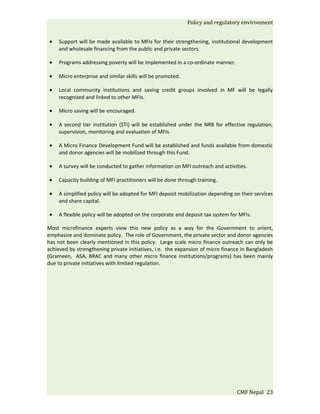
Most microfinance experts view this new policy as a way for the Government to orient,
emphasize and dominate policy. The role of Government, the private sector and donor agencies
has not been clearly mentioned in this policy. Large scale micro finance outreach can only be
achieved by strengthening private initiatives, i.e. the expansion of micro finance in Bangladesh
(Grameen, ASA, BRAC and many other micro finance institutions/programs) has been mainly
due to private initiatives with limited regulation.


                                                                                 CMF Nepal 23
Survey Findings


5 SURVEY FINDINGS
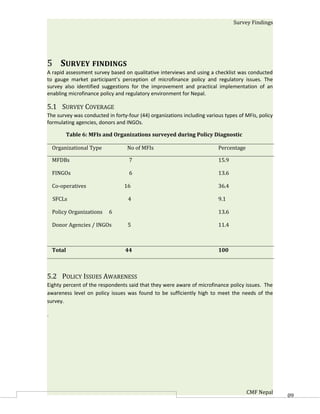
A rapid assessment survey based on qualitative interviews and using a checklist was conducted
to gauge market participant’s perception of microfinance policy and regulatory issues. The
survey also identified suggestions for the improvement and practical implementation of an
enabling microfinance policy and regulatory environment for Nepal.

5.1 SURVEY COVERAGE
The survey was conducted in forty-four (44) organizations including various types of MFIs, policy
formulating agencies, donors and INGOs.

            Table 6: MFIs and Organizations surveyed during Policy Diagnostic

    Organizational Type           No of MFIs                             Percentage

    MFDBs                          7                                     15.9

    FINGOs                         6                                     13.6

    Co-operatives                16                                      36.4

    SFCLs                         4                                      9.1

    Policy Organizations   6                                             13.6

    Donor Agencies / INGOs        5                                      11.4


    Total                        44                                      100


5.2 POLICY ISSUES AWARENESS
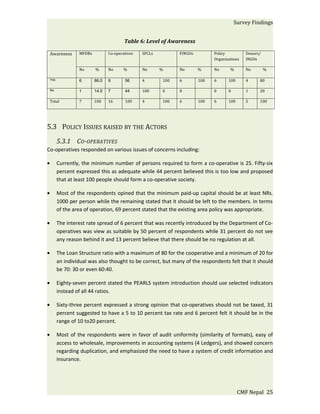
Eighty percent of the respondents said that they were aware of microfinance policy issues. The
awareness level on policy issues was found to be sufficiently high to meet the needs of the
survey.

.


                                                                                      CMF Nepal     60
Survey Findings


                                          Table 6: Level of Awareness

    Awareness      MFDBs          Co-operatives   SFCLs         FINGOs         Policy          Donors/
                                                                               Organizations   INGOs

                   No      %      No     %        No      %     No       %     No      %       No        %

    Yes            6       86.0   9       56      4       100   6        100   6      100      4     80

    No             1       14.0   7       44      100     0     0              0      0        1     20

    Total          7       100    16      100     4       100   6        100   6      100      5     100


5.3 POLICY ISSUES RAISED BY THE ACTORS
          5.3.1 CO-OPERATIVES
Co-operatives responded on various issues of concerns including:

•         Currently, the minimum number of persons required to form a co-operative is 25. Fifty-six
          percent expressed this as adequate while 44 percent believed this is too low and proposed
          that at least 100 people should form a co-operative society.

•         Most of the respondents opined that the minimum paid-up capital should be at least NRs.
          1000 per person while the remaining stated that it should be left to the members. In terms
          of the area of operation, 69 percent stated that the existing area policy was appropriate.

•         The interest rate spread of 6 percent that was recently introduced by the Department of Co-
          operatives was view as suitable by 50 percent of respondents while 31 percent do not see
          any reason behind it and 13 percent believe that there should be no regulation at all.

•         The Loan Structure ratio with a maximum of 80 for the cooperative and a minimum of 20 for
          an individual was also thought to be correct, but many of the respondents felt that it should
          be 70: 30 or even 60:40.

•         Eighty-seven percent stated the PEARLS system introduction should use selected indicators
          instead of all 44 ratios.

•         Sixty-three percent expressed a strong opinion that co-operatives should not be taxed, 31
          percent suggested to have a 5 to 10 percent tax rate and 6 percent felt it should be in the
          range of 10 to20 percent.

•         Most of the respondents were in favor of audit uniformity (similarity of formats), easy of
          access to wholesale, improvements in accounting systems (4 Ledgers), and showed concern
          regarding duplication, and emphasized the need to have a system of credit information and
          insurance.


                                                                                            CMF Nepal 25
Survey Findings


•   Regulatory restriction on dividend payment to members (not exceeding 15 per cent)
    invoked a mixed response. Some were happy with the current regulation while others
    suggested it should not be regulated.

Other suggestions included:

    •   Transactions with non members should be allowed within the rules and regulations
    •   Loans should be available at low interest rates.
    •   If more than 10% of cooperative members want, this should be the quorum necessary
        to convene an AGM
    •   Priority should be given to selecting women for decision making position
    •   Co-operative categorization should be done according to the tax rate; and be regulated
    •   The NRB should be more flexible in regulating cooperatives.
    •   Unhealthy competition should be removed
    •   Permission should be required to open a branch


SFCLs, a special category of small farmer co-operative, have almost similar views. On taxation
issues 100 percent of the SFCL respondents suggested that there should not be tax on co-
operatives. Other suggestions given by SFCLs included:

    •   Corporate governance should be strengthened in cooperatives
    •   Government should have a concrete policy towards cooperatives
    •   There should b a flexible environment for the smooth operation of cooperatives
    •   Farmers should be given ownership
    •   Flexible policy is needed to introduce new products in the cooperative
    •   Frequent monitoring is required
    •   The Central SFCL Federation should be more active

    5.3.2 FINGO S
Most FINGOs selected were well aware of the policy and regulatory issues. They showed
concern on the geographical area restriction (recent NRB circular), the licensing restriction for
an unknown period, taxation and most argued for a new approach in provisioning. Almost all (83
percent) were against board member’s personal guarantee for obtaining wholesale funds. Some
also expressed that the MF loan limit of NRs. 60,000 should be raised to NRs. 100,000. Others
suggestions given were:

    •   According to their progress and performance FINGOs should be given permission to
        expand their working area, especially in the hill areas,
    •   While paying down a loan an IC note should be allowed
    •   Should be reachable for the poorest of the poor
    •   No Tax on MFIs


                                                                                 CMF Nepal 26
Survey Findings


   5.3.3 MFDBS
Most of the MFDBs interviewed believed that the capital requirement was sufficient for
establishment purposes. They also believed that the capital adequacy ratio was acceptable. In
term of liquidity requirement 50 percent of the respondents said it was acceptable. On resource
mobilization all opined that NRB should allow them to have access to public deposits with some
conditions attached.

Some suggestions provided by MFDBs were:

   •   The NRB should give permission to collect deposits
   •   The corporate tax rate (31.5%) should be zero
   •   Government should scrap the deposit tax rate for MFIs
   •   Establish a Microfinance Department and unit related to microfinance in the Ministry of
       Finance
   •   The NRB Microfinance Department should be strengthened and have more specific
       terms of reference
   •    Development Banks, FINGOs and cooperatives should act together for the betterment
       of MF policy
   •   Transactions with non members should be permitted
   •   Some accounting procedures not related to MFDBs should be removed
   •   The MF Act should be formulated and further monitoring and regulation should be
       strengthened
   •   In Grameen banks the board of director’s structure should be supported by the NRB as
       board members are located in Kathmandu. As it is very difficult to conduct a board
       meeting outside the Valley, NRB should manage to depute members from the local
       level.

   5.3.4 POLICY ORGANIZATIONS
            Policy organizations refer to organizations that make and implement policy and
            regulations on financial services. They are the NPC, Ministry of Finance, NRB,
            Beema Samiti and Women development division. All of them are well aware of
            the MF policy environment. Most of them agree on the non involvement of the
            Government in financial services to the poor. Rather, they stress the need to
            provide funds and capacity building services to MFIs using a systematic
            approach. All agree that donor organizations should work with local partners
            rather than provide the financial services themselves.

Some of their suggestions include:

   •   NRB’s monitoring, policy making, amendments and linkage development should be
       strong,
   •   Buildup capacity of MFIs,
   •   A free Interest rate regime is very necessary
   •   Wholesale fund organizations should make funds available on demand
   •   Research on product diversification


                                                                               CMF Nepal 27
Survey Findings


   •   Enterprise development should be encouraged
   •   Micro insurance products need to be developed. MFIs, MFI networks, Government, the
       NRB and Beema Samiti should have the necessary discussions
   •   CMF and NRB should have close linkages in the area of research, training, policy
       development and study
   •   Cooperatives, MFIs, and small enterprises should be structured in one form for
       development
   •   Monitoring, supervision, tools development, financing should be done by NEFSCUN for
       financial co-operatives
   •   Identify enterprises for the poor should be prioritized
   •   Business and market linkages are necessary for microfinance promotion
   •   Other federation should meet their members needs, provide advocacy & support to
       strengthen them and integrate MFIs
   •   On the spot training/capacity building should be provided
   •   Associations should act as good network for sustainable MF and also for benchmarking,
       monitoring and supervision
   •   Suggestions can also be expected for developing implementation mechanisms
   •   Facilitation on development work with network and associations i.e. CMF


   5.3.5 DONOR AGENCIES / INGOS
Most donor agencies and INGOs (80 per cent) are aware of the policy environment. They are in
favor of an enabling and regulatory role for Government. In their own programs they also have
given an emphasis on providing MF services in the hills and mountains areas, the necessity of an
MFI tax rebate facility, embedding micro-insurance and health insurance services within the
services provided by MFIs and MFI capacity building. They also believe that MF wholesale funds
and programs need to be restructured.

High operating costs, dispersed populations, lack of economic opportunities and infrastructure,
a rigid MF model, the absence of a clear cut MF policy, lack of coordination between donors,
lack of an appropriate microfinance act and the absence of BDS services at the community level
are considered some of the hindrances to MF sector growth.

Some of their suggestions include:

   •Services should reach into the hill areas
   •Private social investment should serve as a good indicator rather than public social
       investment
   •Only the deprived sector should get microfinance services
   •There should be more awareness program based on local development
   •Plans for community awareness building should be linked
   •The National Planning Commission (NPC) and Ministry of Finance (MOF) should help
       develop new plans for microfinance
   •The Microfinance Act should be promulgated soon
   •Government should only play an enabling role


                                                                                CMF Nepal 28
Survey Findings


    •Existing MFIs need strengthening
    •Promote increasing the number of MFIs
    •Coordination with the Poverty Alleviation Fund (PAF)

Overall, stakeholders in the micro-finance sector are interested in the development of the
sector in Nepal. Therefore, it is time for stakeholders to implement suitable strategies, policies,
plans and programs to support the sector.


                                                                                   CMF Nepal 29
Recommendations


6 RECOMMENDATIONS

The study team incorporated the issues raised by the Taskforce and made recommendations to
the various stakeholders including: Government, the NRB (Central Bank), apex funds (wholesale
lending micro-finance institutions and programs), microfinance institutions and others.

6.1 LEGAL/REGULATORY FRAMEWORK
   •   The current legal arrangement for regulation and supervision of banks and financial
       institutions appears to be acceptable to MFDBs and FINGOs.

   •   Most MFDBs viewed the proposed Micro-Finance Act (earlier draft) as not suitable for
       the growth of the sector. It was also found not suitable for regulation and supervision
       purposes. The main reason was a mix-up of MFIs and non-MFIs, equity based and non-
       equity based organizations in the same legal framework. MFDBs, FINGOs, SACCOS and
       even CBOs need to have different legal identities to better address their separate
       activities If there is commonality in some areas of activities, they can be addressed by
       the reform of regulations for each. Therefore, it is important that each type of MFI have
       its own required legal framework reviewed separately to accommodate ‘best practices’.

   •   There could be an STI established for supervision purposes only for the various types
       of microfinance institutions. This STI would be subject to the regulation and supervision
       of the NRB. The supervision of SACCOS, other than NRB licensed ones is an issue that
       must be dealt with separately.

   •   Access to Public Deposit: The Bank and Financial Institution Act, 2006 has a provision
       that MFDBs can access public deposit with Nepal Rastra Bank approval. This provision
       needs to be activated but not for everyone at this time. Nepal Rastra Bank could set
       conditions and based on fulfilling such conditions MFDBs could be permitted to have
       access to non-member deposits. This is also necessary for future MFI growth in
       outreach, expected phasing out of the deprived sector credit directives, shrinkage in
       donor funds, wholesale fund not being expended as expected and providing financial
       services to local residents who are not members of MFDBs but poor villagers. Some
       conditions that could be set include:

       -   Experience of at least …. years.
       -   Having a net profit in the last….. years.
       -   Having a capital base of NRs. …. million
       -   Having written off all pre-operational expenses.
       -   Can provide only saving services in the program area and cannot access current
           (demand) deposits.
       -   Subject to higher liquidity requirement as other DBs and FCs for non member
           deposit.


                                                                                    CMF Nepal      60
Recommendations


    -   Subject to fund management policy approved by the board of directors.
    -   Not exceeding a percentage of total resources

    -   MFDB has not been penalized by NRB.

•   Establishment and Expansion: The MCR regulations required for the establishment of
    MFDBs is reasonable except for the expansion provisions, which needs to be updated.

•   The BASEL principles on capital and supervision may not be suitable for MFDBs, FINGOs,
    and SACCOS. Their use would also be burdensome to the Central Bank or other
    designated bodies. Therefore, drawing on CGAP, ACCION and WOCCU practices and
    experiences, it would be better to use the PEARLS rating system.

•   Loan Loss Provision: Currently, the loan loss provision is similar for all banks and
    financial institutions based on due date periods (0 to 3 month, 3 to 6, 6 to12 and above
    12 months for the overdue category). Better methods for micro finance institutions
    exist i.e. minimum of 1 percent and adding as per PAR. (Portfolio at Risk) Some
    microfinance institutions have the provision that if the due date is more than 6
    installments (GBB's own regulation) or 2 percent flat with an evaluation at the end of
    every year. If some microfinance institutions are comfortable with the higher
    percentage for LLP (within 5 percent limit), it should be agreeable to the tax authorities.

•   Micro-enterprise Loan: Nepal Rastra Bank accommodates micro-enterprise loans not
    exceeding NRs. 150,000 to members using the ‘ladder’ model (enhancement approach)
    with collateral. This approach appears to be abused by some MFIs. Instead, ladder
    model loans could be restricted to graduated members only (new member needs)
    otherwise MF may face a crisis after some time. If it is strictly for graduated members,
    collateral could be considered as optional with appropriate risk management tools
    adopted (Insurance, marketing network, guarantee, etc.).

•   MFIs having experience over X years would be allowed to enter into a micro enterprise
    loan at a higher limit (i.e. 500,000) within their working area if the enterprise focused on
    local employment generation.

•   Lending methodologies: There is the need to develop innovative individual lending
    methods apart from the traditional group lending methods. The focus on women is well
    understood but single men in rural or urban areas should not be excluded. Another
    important area for reform is in the lending methodology applied, i.e. MFIs should be
    allowed to lend to local, community-based SACCOS, SCOs, SHGs, CBOs, and user groups
    of different types and village banking units. This will reduce MFIs operational costs
    dramatically and allow them to increase outreach more quickly. It also ensures that
    more MF services will reach the hilly districts. (Uprety, 2002) MFIs need to develop their
    loan assessment guidelines for this to ensure safety and soundness.

•   Regulations on Corporate Governance: The regulation that restricts any bank or
    financial institution Board member from being on the Board of Directors of another
    bank or financial institution has affected MFDBs and FINGOs. The Board of member of
    any bank or financial institution could be allowed to be on the Board of at least one


                                                                                CMF Nepal 31
Recommendations


        microfinance institution to share their knowledge, skills and networks. Separate
        qualifications and experience also need to be set for MFDBs professional director.

    •   Reporting Requirement: Reporting requirements and accounting policy for MFDBs
        should be simple, and comparable across other micro finance institutions in Nepal and
        globally. CGAP, Mix Market Format (with modification) could be a starting point. The
        current trends in development such as inclusiveness should be incorporated into such
        an industry wide database.

    •   Capital Adequacy Ratio and liquidity regulations are acceptable as they are because they
        are market friendly as perceived by current microfinance practitioners.

    •   MFIs should be allowed to deal with already existing groups if they are satisfied with
        modalities confirm to be MF best practices. This will reduce the cost and help achieving
        higher outreach in a faster time.

The role of Government, the Central Bank and the donor agencies should be clearly mentioned
in the policy and should be kept at the end of the document. The Government can help provide
for the research (such as an impact assessment), capacity building (creating a training institute),
and recognizing and rewarding best practices (awards and prizes etc.). Based on the principles,
best practices and the mentioned background elements, a policy document should include:

    •   No participation by Government and the Central Bank from now on in implementing
        microfinance programs or creating new retail micro-finance institutions.

    •   Existing micro-finance institutions/program will be handled by the private sector within
        3 years.

    •   There will be no ceiling on the interest rates charged by microfinance institutions.

    •   The Government and Central Bank will help MFIs in capacity building and institutional
        development by growth oriented regulatory provision and support (financial and other).
        Government may provide land and physical facility to create a national level
        microfinance research and training institution to be run on a free lease basis by private
        sector microfinance experts.

    •   The Government and Central bank will privatize RSRF (or merge it with an appropriate
        apex organization i.e. Rural Micro Finance Development Centre or PAF. The creation of
        parallel institutions having the same purposes can create unhealthy competition and
        develop inefficiencies

    •   The Government and Central Bank can form a "National Level Micro-finance Promotion
        Council" to oversee and facilitate growth with private sector MFI leaders as members
        and chaired by an internationally reputed microfinance expert. High-level policyholders
        could benefit from sitting on this Committee. This will help create future leaders in
        microfinance policy and practices. Government and the Central Bank can also provide
        financial support for an institution of reputation i.e. Center for Micro-finance (CMF).


                                                                                   CMF Nepal 32
Recommendations


    •   Government will provide tax incentives to individuals and organizations which provide
        donations/funds to MFIs There could be tax exemptions of various kinds to further the
        develop of the microfinance sector.

    •   A 50% lower corporate tax rate (15% if it is 30% for other bank and financial
        institutions/companies) for MFDBs, SACCOS doing micro-finance and no tax for FINGOs.

    •   There should be waiver in dividend tax for micro finance institutions shareholders.

    •   Individual donations, corporate donations, and seed money can be deducted for the
        purpose of tax calculation. (Limit can be fixed).

    •   The Government and the Central Bank will arrange an annual visit program within Nepal
        and foreign countries to observe best practices in micro-finance and attend "micro-
        credit summits" and events.

    •   The Government and Central Bank will coordinate with donor agencies to develop
        consensus guidelines and promote ‘best practices’, self-regulation, performance
        standards, rating tools, etc.

    •   The Government and Central Bank will conduct impact assessments of microfinance
        services on poverty reduction and the macro-economy in at intervals (i.e. every two
        years). This can be outsourced to private sector research institutions (i.e., Centre for
        Micro-Finance, INAFI. The Nepal Rastra Bank Microfinance Department could serve as
        the catalyst agency for co-coordinating with donors, Government, microfinance
        institutions, microfinance institutions network and microfinance experts.

The NRB is considering the creation of a Second Tier Institution (STI) for the supervision of MFIs.
The creation of an STI could be established based on the approaches discussed below:

    •   Regulation can be done/improved as per current framework (with modification by the
        respective organizations i.e. Central Bank and Department of Co-operatives and/ or
        NEFSCUN).

    •   The proposed STI would have responsibility for supervising and inspecting (off-site and
        on-site) MFIs (except SACCOS) and taking supervisory actions as delegated by the
        Central Bank. It would act on behalf of the Central Bank but with some autonomy. It
        would submit a detailed annual inspection and supervision report to the NRB with which
        it would work in close co-operation. The NRB would supervise it at given intervals of
        time based on performance indicators.

    •   The STI would prepare a self-regulatory framework, performance standards, rating
        tools, benchmarks and financial ratios to be monitored in consultation with related
        stakeholders.

Recommendations for changes in various laws affecting MF operation: Regulations can be
made within the current legal framework. If there are areas of improvement respective laws


                                                                                   CMF Nepal 33
Recommendations


can be amended. These laws are Bank and Financial Institution Act, 2063, Co-operative Act,
2048 and the FINGOs Act, 2055.

Bank and Financial Institution Act, 2063

At present this Act does not need to be amended as its provisions are market friendly to MFDBs.
Future amendments might be needed, however, to address different types of institutional needs
i.e. RMDC, SKBB and MFDBs. Since RMDC and SKBB are wholesale lenders, their regulations are
not the same as MFDBs (retailers). An example would be that shareholders of BFIs cannot
borrow from the same bank or financial institution where as for an SKBB one must be
shareholders to be eligible to borrow.

Co-operative Act, 2048

There is a need to redraft the chapter on Saving and Credit Co-operatives and the sub-chapter
on SACCOS involved in Microfinance. Some of the points to considered are:

   •   SACCO membership criteria (Restrict over the counter membership and promote best
       practices of co-operative principles)

   •   Saving first approach - Co-operative members must be involved in a saving activity
       period (i.e. 6 months) to be eligible for borrowing. After that there should be a lending
       limit also (i.e. 3 times savings for the first time and a maximum of 5 times there after)
       with or without collateral. This could go up to 10 times savings with collateral plus 2
       additional member's guarantee.

   •   Implement rating tools (PEARLS) and disclosure mechanism.

   •   All SACCOS needs to be the member of district level SCC federation.

   •   Sacco’s registration can be done in 2 stages, the first step being the pre-co-operative
       stage (where there will be limited activity, system development etc.) After NEFSCUN
       approved district federation’s recommendation then they will be registered fully (High
       level task force report - National Planning Commission, 2004).

   •   NEFSCUN (strengthening intervention required) can be entrusted to have the regulatory
       and supervisory role for SACCOs. (Government and donors can work together to provide
       a budget for 5 to 7 years).

   •   Develop a chapter for the regulation of the National Co-operative Bank. Define its
       objectives, establishment procedures, governance, prudential regulations, do's and
       don'ts, wholesale, retail and micro-finance activities. This Bank must be regulated and
       supervised by the Central Bank.

   •   SACCOs, co-operative banks and federations have argued that the Co-operative Act
       needs to be modified to suit present conditions. Separate chapters for regulations and
       supervision of SACCOs and a sub-chapter for micro-finance SACCOs are required to
       establish the do's and don'ts to make a strong co-operative.


                                                                                CMF Nepal 34
Recommendations


    •   One also needs to consider the co-operative principles accepted worldwide i.e.
        democracy, autonomy, member control, best practices, alliances, etc., while protecting
        them and their members from the effect of unsound practices. The NRB regulation to
        licensed co-operatives could work as a starting point for drafting such regulations, with
        appropriate modifications.

    •   Define various types of members in the co-operatives i.e. associate members,
        provisional members etc. a well as introduce the concept of groups and group
        representation in the Board.

    •   Currently, co-operative members do not enjoy the benefits of managing a co-operative
        well. For example, if a co-operative has a general reserve several times greater than
        required and a member needs to sell shares he would need to sell without premium
        causing a loss. It also restricts a member’s intention and willingness to raise capital.
        Therefore, there needs to be a revision in the law to accommodate good financial
        practices.

FINGO Act, 2055

The provisions of this Act (after amendments) seem to be market friendly for new FINGOs. But
as the number of FINGOs grow, the existence of some large and many smaller FINGOs will make
It necessary to amended the Act.

    •   The areas of amendment could be in promoting self-regulation for smaller FINGOs
        (providing a threshold i.e. below NRs. 10 million) and prudential regulation for larger
        FINGOs. This could be based on the size of member and associate members savings
        (ASA- Bangladesh, Grameen Bank Bangladesh model), total loan portfolio above the
        threshold, varieties of services (products) and associate risk calculation.

    •   For the promotion of FINGOs and MFDBs could be waived for licensed MFIs. This would
        enable professional experts in banking and microfinance to contribute to the
        development of microfinance.

    •   Restrictions on FINGOs to operate in additional district other than its home base are not
        suitable. The NRB should therefore reconsider on this. It may develop the pre-conditions
        for area expansion but should not be restrictive.

    •   The personal guarantee of Board members for wholesale loans to FINGOs is too
        restrictive. Wholesale lenders could develop alternative risk management models and
        be satisfied with the institutional guarantee.

6.2 PERFORMANCE STANDARDS/INDICATORS
All types of financial institutions must engage in sound financial management. Financial
management requires periodic review of financial performance which can be done by using
standards in the form of ratios. These financial ratios serve as indicators of a MFIs performance
in terms of sustainability, profitability, growth, capital adequacy and problems from activities.
MFIs need to be advised and implemented performance ratios; declare periodically to


                                                                                 CMF Nepal 35
Recommendations


regulators; and disclose through annual report to their stakeholders. Some of the ratios that
could be used include:

   •   Portfolio Quality – The ratios on Repayment rate, Arrears rate, Portfolio at risk (PAR),
       Number of delinquent borrowers, Loan loss, Productivity and efficiency needs to be
       introduced for the promotion of good MF sector practices.

   •   PEARLS ratios (Protection, Effective financial structure, Asset quality, Rate of return,
       Liquidity and Sign of growth)

   •   Sustainability Ratios – OSS, FSS (Operational Self-sufficiency and Financial Self-
       sufficiency)

6.3 MODEL MICROFINANCE REGULATION ACT 2009
The Taskforce sub-committee finalized the draft model Microfinance Regulation Act 2009
(Annex-1) and submitted it to a wider Stakeholder, Steering and Taskforce Meeting on January
26, 2009. The suggestions received at this meeting are attached as Annex-2. CMF will
incorporate these issues during the reports publication and submission to NRB and the Ministry
of Finance.

6.4 OTHER SUGGESTIONS
   •   Participation in policy formulation: All stakeholders’ voice need to be heard, through a
       mechanism in policy formulation.

   •   Urban model: Government, donors, NRB and MF practitioners need to address urban
       poverty which is increasing at a fast rate.

   •   Promote SACCOS involved in MF.

   •   Promote an inclusive approach in the co-operative and MF sector.

   •   Capacity building of multipurpose co-operatives and SACCOs should be considered as a
       strategy to enhance rural finance.

   •   The provision that restricts SACCOs to promote BFI or buy BFI equity share should be
       revoked.

   •   Facilitate transformation of NGO/SACCO MFIs to BFIs doing MF activities for enhancing
       outreach and sustainability.

The use of this framework could be used for all type of MFIs. This is beneficial to all MFIs
whether they are regulated MFDBs, SACCOS, FINGOs or self regulated SACCOS, SHGs, CBOs
or projects/ programs. All MF services need to be safe, sound and able to be active in the
financial market for a longer period of time to serve the unserved and deserving poor
clients. Only then there will be lasting impact.


                                                                               CMF Nepal 36
Annex-1


    ANNEXES
Model Draft 2: Formulated by the Center for Microfinance (CMF)

                                                                              August, 2009


                          Model Micro-Finance Regulation Act

                                        Preamble

The Legislative Assembly of the Republic of Nepal,

Having regard to the proposal from the Nepal Rastra Bank,

Having regard to the opinion of the stakeholders,

Whereas, the Legislative Assembly recognizes the importance of micro-finance and
cooperative societies as important instruments for sustainable development and for
reducing poverty among urban and rural poor strata by creating the necessary mechanisms
and conditions for self employment, employment, income generation, professional training,
entrepreneurship development and self confidence;

Whereas, the Legislative Assembly is aware of the insufficient institutional structures and
legal framework, necessary to formulate and implement a national microfinance policy;

Whereas, the Legislative Assembly is aware that in order to develop an entrepreneurship
culture among the poor strata and priority sectors, it is necessary to create institutional
mechanisms and a structure to coordinate, simplify, promote, set standards and regulate,
and monitor at the national level the flow of micro-credit and to facilitate the access to
credit of the poor strata and priority sectors;

Hereby, the Legislative Assembly has adopted this Act to regulate the microfinance services
and microfinance institutions with a view of ensuring responsibility towards customers,
transparency, sustainable development, and the promotion of services and institutions in
the area of microfinance.


                                        Chapter 1

                                 Preliminary Provisions

                                  Article 1. Definitions:

(1) “Authority,” means the National Microfinance Authority.

(2) “Microfinance Institution,” means an institution established to perform microfinance
functions.


                                                                                 CMF Nepal    60
Annex-1


(3) “Microfinance Services,” means the provision of a broad range of financial services such
as deposits, loans, payment services, money transfer and insurance to the poor and low
income households and enterprises, or other services as determined by the Authority.

(4) “Approved Institutions,” means those microfinance institutions approved to operate
microfinance services.

(5) “Board,” means the Board of the National Microfinance Authority.

(6) “Chairperson,” means the Chairperson of the Board.

(7) “Member,” means any member of the Board, including the Chairperson.

(8) “CEO,” means the Chief Executive Officer of the Authority.

(8) “Customer,” means any person who receives service(s) from microfinance institutions.

(9) “Service tax,” means the fee, which is to be paid by microfinance institutions to the
Authority.

(10) “Rastra Bank,” means the Nepal Rastra Bank.

(11) “Governor,” means the governor of the Nepal Rastra Bank.


                                          Chapter 2

          Competencies and Responsibilities of the Authority and the Board

                 Article 2. Establishment of the Authority and the Board

(1) The National Microfinance Authority is hereby established to regulate, supervise and
monitor microfinance services and microfinance institutions in Nepal.

(2) The Authority shall be an autonomous body.

(3) The Board of the Authority is hereby established to adopt general policies in the
microfinance area and oversee the functioning of the Authority.

(4) The CEO shall represent the Authority in its relations with third parties.

(5) The Authority shall have a seal of its own for its operations.

(6) The Authority may manage solid or liquid assets. It may use, save, sell, or manage them
accordingly.

(7) The seat of the Authority and the Board is in Kathmandu. The Authority may open on its
initiative branches, other offices, or send representatives to any part of Nepal, if the Board
considers it necessary. The Board shall regulate the functioning of the branches and offices.


                                                                                 CMF Nepal 38
Annex-1


             Article 3. Competencies and Responsibilities of the Authority

(1) The Authority shall classify microfinance services on the basis of services and capital of
microfinance institutions, as well as on the basis of the access of the poor strata to such
services.

(2) The Authority shall classify microfinance institutions on the basis of capital and
services provided by the said institutions, as well as on the basis of the access of the poor to
the said institutions.

(3) The Authority shall prepare the standards of performance according to international
best practices of financial and social efficiency. It shall enforce the said standards to the
functioning of microfinance institutions.

(4) The Authority shall inspect on a continuous basis the functioning and records of
microfinance institutions. The inspection and supervision functions over the microfinance
institutions shall be carried out in conjunction with other institutions specialized in the
microfinance area.

(5) The Authority shall permit the functioning of rating agencies of microfinance services
and institutions.

(6) The Authority shall make the necessary arrangements for the functioning of
microfinance institutions in rural areas.

(7) The Authority shall make the necessary arrangements to provide microfinance services
to the poor strata, women, and minorities or communities.

(8) The Authority shall make the necessary and suitable arrangements to function as a
representative of financial institutions and commercial banks to working microfinance
institutions in rural areas.

(9) The Authority shall establish the necessary structures and take the necessary and
appropriate actions to implement the goals and objectives of this law.


                            Article 4. Composition of the Board

(1) The Board of the Authority shall consist of the following members:

       (a) The Governor of the Nepal Rastra Bank, as the President of the Board;

       (b) A representative of the Nepal Rastra Bank, member;


       (c) A representative of the Registrar of Cooperatives, member;


       (d) A representative of the Ministry of Finance, Joint Secretary level Officer,
       member;

       (e) A representative of the National Planning Commission, member;


                                                                                 CMF Nepal 39
Annex-1


       (f) Four persons nominated by the Nepal Government from distinguished experts,
       who have provided an important contribution in the microfinance area. The Board
       shall recommend four candidates to the Government within three months of its
       constitution;

       (g) The Chief Executive Officer (ex-officio), member without voting rights. The CEO
       shall serve as the Secretary of the Board.

(2) The tenure of the Board members shall be five years, with the right to be reappointed
for another term.


                              Article 5. Exclusivity Question

(1) The Board has the exclusive right to adopt general policies in the microfinance area.

(2) The Board has the right to adopt internal regulations for the functioning of the
Authority, as well as regulations and recommendations in the microfinance area.

(2) The Board may delegate authority to a member, or a committee to carry out its policies
and implement its decisions.


                      Article 6. Meeting Allowances for the Board

The meeting allowances and/or other facilities of the President or Members shall be
determined by the Board.


                                 Article 7. Board Meetings

(1) The Board shall meet at least once a month.

(2) The Board meetings shall be chaired by the Chairperson of the Board. In the absence of
the Chairperson, the meetings shall be chaired by any Board member selected from the
majority present of the Board members.

(3) The Board is convened ex officio, within two months after the entry into force of this
Act, or upon the initiative of one of its Members.

(4) The President of the Board may not be absent without any reason for more than 3
consecutive meetings in a year.

(5) Members may not be absent without any reason for more than 3 consecutive meetings
in a year. The Board shall determine the sanctions for absent members.

(6) At least 5 members must be present to establish quorum.

(7) The decisions of the Board shall be taken with the majority of the votes present. In the
event of a tie vote, the Chairperson, or the meeting’s chairperson, shall cast the decisive
vote.


                                                                              CMF Nepal 40
Annex-1


(8) The agenda, the minutes of the Board meeting, and the roaster of members present
shall be recorded. All members present are required to sign that document. In the event of
dissent, a member can record his/her dissent in the document.

(9) Board decisions enter into force immediately or as provided.


    Article 8. Conditions of Service and Appointment of the Chief Executive Officer


(1) The Board shall appoint a Chief Executive Officer within three months of its first
meeting.

(2) In appointing the Chief Executive Officer, the Board shall make a selection based on an
open and competitive process from persons who have at least a Master’s Degree in
Economics, or in Management, or in Financial Management from reputed educational
Institutions, or from persons who are certified public accountants, and have been working
for at least five years in banking, financial, and microfinance areas.

(3) The Chief Executive Officer shall be the main administrator of the Authority.

(4) The tenure of the Chief Executive Officer shall be for five years, with the possibility re-
appointment.

(5) The CEO shall give three months notice to the Board in case of resignation.

(6) The remuneration and other conditions of service of the Chief Executive Officer shall be
determined by the Board.


      Article 9. Competencies and Responsibilities of the Chief Executive Officer


(1) To implement the decisions of Board, and to supervise and control the functioning of
microfinance institutions.

(2) To prepare the annual budget and working plan of the Authority and submit it to the
Board for approval.

(3) To manage the human resources of the Authority according to the rules, and regulations
adopted by the Board.

(4) To carry out tasks assigned by the Board.

(5) The Chief Executive Officer shall be fully responsible for its actions before the Board.

(6) The Chief Executive Officer shall report to the Board periodically and on any issue
required by the majority of Board Members present in Board meetings.


                                                                                  CMF Nepal 41
Annex-1


(7) The Board has the right to be consulted by the Chief Executive Officer for any action
taken by the Authority.

(8) The Board may sanction the Chief Executive Officer for non performance, negligence or
abuse of power.


                          Article 10. Personnel of the Authority

(1) The Authority shall employ the necessary personnel to assist with its operations.

(2) The Board shall establish recruiting committees composed of the CEO, a Board member
and an external expert to conduct the recruitment for all officer positions. The CEO may
recruit on its own initiative the necessary personnel for logistical support and other
technical positions.

(2) The conditions of service, remuneration and other facilities of the personnel shall be
determined by the Board.


                                         Chapter 3

                        Supervision and Auditing of the Authority

                       Article 11. Supervision by the Rastra Bank

(1) The Rastra Bank may monitor the functioning of the Board.

(2) The Rastra Bank may demand written reports from the Board on the activities of the
Authority.

(3) Conflicts between the Rastra Bank and the Authority shall be subject to mediation, as
determined by the parties, and if that fails, to the court of second instance.


                           Article 12. Funding of the Authority

(1) There shall be a separate fund of the Authority, composed of the following
contributions:

       (a) The amount received from the Rastra Bank;

       (b) The amount received from the Nepal Government;

       (c) The amount equal to the amount of government tax paid by microfinance
           institutions and received by the Nepal Government;

       (d) The amount received from international organizations and institutions;

       (e) The amount received from other sources.


                                                                               CMF Nepal 42
Annex-1


(2) The Board shall secure permission from the Rastra Bank before taking a loan from any
international organization(s).

(3) All the expenses of the Authority shall be supported from the fund.

(4) The Authority may receive donations to conduct its activities.

(4) The funds shall be deposited in an account with the Rastra Bank, or with any financial
institution in Nepal.

(5) The Board shall regulate the operation of the account.


                           Article 13. Accountancy and Auditing

(1) The accounts of income and expenses shall be kept in accordance with existing laws and
accounting standards in Nepal.

(2) The Board shall make the necessary provisions regarding the internal auditing.

(3) The auditing of the Authority shall be done by the Auditor General, or an auditor
assigned by the Auditor General.

(4) If the Rastra Bank finds it necessary, it may inspect the documents or accounts of the
Authority at any time.


                                          Chapter 4

                   Licensing of Microfinance Services and Institutions

                               Article 14. General Provisions

(1) An institution or organization may not operate microfinance services until the Authority
has published in the media the notice of approval.

(2) This article shall not apply to those institutions already functioning in the microfinance
area.


                            Article 15. The Application Process

(1) Any institution or organization must apply for permission to operate microfinance
services to the Authority according to the format and procedure adopted by the Board.

(2) Any institution or organization applying for permission to the Authority shall enclose
the fee published by the Board along with the documents prescribed by the Board, and in
particular the following:

       (a) A notarized copy of the original registration certificates of microfinance
       institutions;


                                                                                CMF Nepal 43
Annex-1


       (b) A notarized copy of the articles of association and bylaws;

       (c) An organizational chart of the institution or organization;

       (d) A statement that demonstrates the capacities and intent to initiate and operate
       microfinance services;

       (e) A statement of the current capital or funds;

       (f) A notarized copy of the internal regulation regarding the salaries, privileges,
   allowances, administrative account section and internal administrative activities;

       (g) The payable service tax.


                                 Article 16. Response Time

(1) The Authority shall provide an answer to the application within 90 days after it receives
the application along with all the necessary supporting documents and the fee.

(2) The Authority shall examine the application materials on an unbiased basis. It may
order an investigation or request other supporting documents if it deems necessary.

(3) The Authority may reject the application if it concludes that the applicant has failed to
provide the necessary documents.


                Article 17. The Classification of Microfinance Institutions

(1) The letter of approval shall be classified on the basis of the nature of the microfinance
institution, depth of reach and the volume of services, as “A”, “B”, “C”, or “D” classes.

(2) The microfinance institutions, classified according to the provision of clause 1, must
have the minimum capital or fund as prescribed by the Board.


                             Article 18. Denial of Application

The Authority may deny the letter of approval in the following circumstances:

       (a) In the case of false statements; or

       (b) If the microfinance institution does not have the minimum fund prescribed by
       the Board;

       (c) If the application does not meet the standards established by the Authority.


                                                                                CMF Nepal 44
Annex-1


                   Article 19. Conditions Prescribed by the Authority

(1) The Authority may prescribe conditions in the letter of approval to the applicant
microfinance institution. The Authority shall monitor the compliance with the said
conditions.

(2) The Authority may alter, add, or drop the conditions in the letter of approval to the
applicant microfinance institution based on the performance of the institution.


                          Article 20. Exemptions from Licensing

The Authority may exempt a microfinance institution or organization, classified as “c” and
“d,” to operate microfinance services in any geographical or economic sector.


                    Article 21. Revoking or Suspension of the License

(1) The Authority may suspend partially or fully the operation of microfinance services by a
microfinance institution in order to protect its members and depositors in the case of non
compliance with the regulations and laws.

(2) The Authority may revoke the letter of approval in the following circumstances:

       (a) Upon the request by the approved microfinance institution;

       (b) When an approved microfinance institution cannot initiate and operate
       microfinance services within six months after the letter of approval is published in
       the media;

       (c) If the results of an investigation by the relevant authorities reveal that the
       microfinance institution has transacted in a serious manner against the welfare and
       rights of its members or depositors;

       (d) If the results of an investigation by the relevant authorities reveal serious
       violations of regulations and laws;

       (e) If the prescribed conditions of the Board are not complied with;

       (g) In the case when insolvency proceedings have started against the microfinance
       institution;

       (h) If it is discovered that the letter of approval is issued based on false statements;

       (i) If the approved institution is merged with another institution.

(3) If the approved institution applies to have the letter of approval revoked, the Authority
shall make a decision within 45 days.


                                                                                CMF Nepal 45
Annex-1


(4) The Authority shall establish a committee to investigate the cases when a letter of
approval shall be suspended or revoked.

(5) The Board shall adopt the necessary rules for the functioning of the investigative
committees.

(6) The letter of suspension or revoke shall contain the decision and the basis for the
decision.

(7) The decision of the Authority may be appealed to the Board, which in turn establishes
an ad hoc committee to investigate the decision.

(8) In the case of suspension proceedings, the Authority shall give a deadline to the
approved institution by which the approved institution shall report to the Authority on the
steps it has taken to address the problem. If the steps taken by the approved institution are
not satisfactory, then the Authority shall proceed with suspending, partially or fully, the
services of the approved institution.

(8) The Authority shall publish the letter of suspension of revoke in the media.


                                          Chapter 5

                         Provisions on Micro Finance Institutions

                                Article 22. Stability of Fund

Approved institutions must ensure the operability of the fund within the time prescribed by
the Board.


                                   Article 23. Capital Fund

(1) Approved institutions shall establish the capital fund in the ratio prescribed by the
Board on the basis of its total assets or risk weighted property.

(2) An approved institution shall inform the Authority if it becomes unable to establish the
capital fund. In such a case, the approved institution shall include the reason of its inability
to establish the capital fund as well as a plan or program to maintain it.

(3) The Authority may sanction an approved institution in cases when the said institution is
unable to fulfill its obligations.


                             Article 24. Risk Supporting Fund

Approved institutions shall establish a risk supporting fund in ratio of its total assets and
risk related to its liability as prescribed by the Board.


                                                                                 CMF Nepal 46
Annex-1


                             Article 25. General Reserve Fund

Approved institutions shall establish a separate general reserve fund as prescribed by the
Board.


                                 Article 26. Liquid Assets

Approved institutions shall maintain liquid assets as prescribed by the Board.


                           Article 27. Observation by the Board

(1) The Authority has the right to observe and inspect the functioning of approved
institutions at any time.

(2) The Authority may adopt the necessary acts to protect customers.

(3) The Authority may delegate the observation or inspection of approved institutions to
other institutions specialized in the microfinance area.

(4) The Authority may summon an officer of an approved institution or external experts to
demand information or explanations.

(5) Approved institutions have the duty to provide costs, statistics, statements, information,
and other necessary documents to the officers, specialists, and relevant institutions
authorized by the Authority.

(6) The designated officer shall conduct its observation or inspection in a comprehensive,
transparent and unbiased way, having in mind the customers’ rights and privileges.

(7) The designated observer or inspector shall submit to the Board a report within 30 days
after finishing its work.


                                         Chapter 6

                        Accounting, Records, Statements, Reports

                             Article 28. Accuracy of Accounts

(1) Approved institutions shall keep accurate account files, books, or records.

(2) Approved institutions shall keep their balance sheets, profit and loss account or cash
flow statement or other financial statement according to the format prescribed by the
Board.

(3) Approved institutions shall audit their balance sheets, profit and loss accounts and cash
flow statements, and other financial statements as determined by the Board within 3
months following the end of the fiscal year. In such statements, at least, the signature of
account manager, chief executive, one director or auditor, is necessary.


                                                                                  CMF Nepal 47
Annex-1


(4) If an approved institution is unable to audit within the allowed period, it may request
the Authority to grant an extension of no more than 3 months.

(5) If the approved institution cannot audit within the allowed time, the Authority shall
appoint an auditor to audit the account(s) of the approved institution.

(6) The auditor appointed according to clause 5 shall submit the auditing report to the
approved institution and to the Authority.

(7) The Authority shall determine the remuneration for the appointed auditor according to
clause 5. The approved institution shall remunerate the appointed auditor as determined by
the Authority.


   Article 29. Conditions under which a person cannot be appointed as an auditor

The following persons cannot be appointed or maintain the position of the auditor:

(1) The director of the approved institution or a family member.

(2) Staff members of the approved institution.

(3) Former employees of the approved institution.

(4) Debtors of the approved institution.

(5) Persons condemned for crimes related to auditing, corruption, and fraud.

(6) Shareholders of the approved institution.


                              Article 30. Duty of Disclosure

In the process of auditing, the approved institution shall submit account, ledger, file and
account to the auditor.


             Article 31. Competencies and Responsibilities of the Auditor

(1) The competencies and responsibilities of the appointed auditor shall be in accordance
with existing laws and regulations.

(2) In addition to complying with existing laws, the auditor shall address the following
questions in the report:

       (a) Whether the approved institution has provided satisfactory answers;

       (b) Whether the balance sheet, profit and loss, account and cash flow statement and
       other financial statement are in the format prescribed by Board;

       (c) Whether the account, ledger or files are kept according to existing laws;


                                                                                CMF Nepal 48
Annex-1


       (d) Whether the staff or officials of the authorized company have complied with
       existing laws;

       (e) Whether the services of the authorized company are satisfactory from a
       customer protection perspective;

       (f) Whether the capital fund, or the risk supporting fund, are at a sufficient level;

       (g) Whether the debt is amortized;

       (h) Other matters that should be informed to shareholders or members.

.

                          Article 32. Reporting to the Authority

(1) The auditor shall submit separate copies of the auditing reports to the approved
institutions and to the Authority.

(2) The Authority may request the auditor to submit all documents pertaining to the
auditing.


                                          Chapter 7

                      Provisions on Non Compliance and Sanctions

                                   Article 33. Violations

The following actions shall be deemed to be in violation of this Act and subject to sanctions:

(1) Operation of microfinance services without permission or against the permission, or
conditions prescribed by the Authority, or against the provisions of this Act, other laws, or
regulations adopted by the Authority.

(2) The breach of secrecy of microfinance services, accounts, books, ledger, and files.


                                   Article 34. Sanctions

(1) Anyone who initiates or operates microfinance services without permission shall have
its property confiscated. If it is difficult to confiscate the property, then, according to the
degree of violation, that person shall be sanctioned no more than 5 lakhs.

(2) Anyone who takes savings or interests against the regulations of the Authority shall be
sanctioned at no more than twice the amount of the deposits.

(3) Any responsible official who does not keep the secrecy of the microfinance services,
accounts, books, and shall be charged no more than 2 lakhs.


                                                                                CMF Nepal 49
Annex-1


(4) The Authority shall punish any violation of this Act or its regulations according to the
seriousness of the violation. In addition to the other forms of sanctions, it may issue a letter
of warning, or a letter of reprimand.


                                  Article 35. Duty to Inform

The Authority shall report to the relevant authorities any breach of this Act or of its
regulations by any approved institution.


                       Article 36. Procedure of Appealing Decisions

Any approved institution or any officer of the said institution may appeal a decision of the
Authority to the court of second instance within 35 days from the day it receives the
decision.

                                           Chapter 8

                                         Termination

                          Article 37. The Rural Self-Reliance Fund

(1) After the entry into force of this Act, the Rastra Bank shall transfer to the Authority all
the property and liabilities of the Rural Self-Reliance Fund.

(2) The Authority shall establish, within a year after this Act enters into force, a company to
manage the Rural Self-Reliance Fund for developing microfinance services.

                             Article 38. Voluntary Termination

(1) An approved institution cannot be voluntarily terminated without the permission of the
Authority.

(2) If an approved institution submits a letter of voluntary termination, the Authority shall
inquire whether the said institution is able to pay its debt and fulfill its responsibilities. In
the case of satisfactory answers, the Authority shall permit the approved institution to fulfill
any prescribed condition and terminate itself accordingly.


               Article 39. Priority of Liabilities in the Case of Termination

If an approved institution is to be terminated, after taking the permission of the Authority
and according to existing law, payments of liabilities shall be based on merit or priority, as
following:

        (a) The expenditure in the time of winding up;

        (b) Payable payment to the depositor;

        (c) Payable fees, tax according to existing law;


                                                                                 CMF Nepal 50
Annex-1


       (d) Payable salary allowance, reserved fund, gratuity and other types of cash to
       staff;

       (e) Other loans taken by the approved institution.


                                         Chapter 9

                                      Final Provisions

                          Article 40. Jurisdiction of the Judiciary

Disputes created between other branches of the government and the Authority shall be
subject to the jurisdiction of the court of second instance.


                                Article 41. Right to Privacy

(1) The contents of account books, ledger, register, file or account statements of the
approved institution and its relation with the customers shall be confidential.

(2) The following acts shall not be considered a violation of secrecy:

       (a) If the information is given to the Authority according to this Act, rules and
       regulations under this Act, as well as under issues directives and orders of the
       Authority;

       (b) If the information is given to the investigation officer in support of investigation
       and prosecution;

       (c) If the information is given to the auditor in process of auditing;

       (d) In the process of obtaining or managing loans, to the least extent possible;

       (e) Information given to the relatives.

                               Article 42. Right to Regulate

(1) The Authority shall adopt the necessary regulations pursuant to this Act.

(2) All provisions of laws and regulations contrary to this Act are hereby abrogated.

                                Article 43. Entry into Force

This Act shall enter into force immediately after adopted.


                                                                                CMF Nepal 51
Annex-2


Annex-2

                             Microfinance Summit Nepal 2008

                   Stakeholders Meeting on Model Draft Microfinance Act

                         and the Micro Insurance Policy Taskforce

                                      January 26, 2009

                              Hotel Annapurna, Kathmandu

                                      Meeting Minutes


The stakeholders meeting for consultation on Model Draft Microfinance Act and Micro
Insurance Policy Taskforce was organized by the Center for Microfinance (CMF), Nepal on
26th January,2009 at Hotel Annapurna, Durbar Marg, Kathmandu.


The agenda for the meeting

1. Model Draft Act prepared by draft act formulation subcommittee of policy taskforce

2. Micro Insurance Policy Taskforce

3. Micro-Insurance Company concept by NUBL

4. If any others

Deliberation and decisions:

Meeting started by the welcome speech from Ms. Sushila Gautam, Sr. Program Officer of the
Center for Microfinance (CMF) and introduction among the committee members was held.
Agenda-wise discussion was started after the agenda highlights by Mr. Tejhari Ghimire,
Chief Executive Officer of CMF.

1. Model Draft Act prepared by draft act formulation subcommittee of policy
taskforce

Mr. Ganesh Bahadur Thapa, Chairperson of the CMF and Coordinator of Draft Microfinance
Act Formulation Subcommittee (DMAFS) made presentation on Model Draft Microfinance
Act 2065 formulated by the subcommittee. The presentation was followed by the floor
discussion on each of the points mentioned in the Act. Major areas of discussions and
questions raised on the Act were as follows

Mr. Shree Ram Shrestha, USC Canada Asia

    •   Microfinance promotion through facilitation is a very good idea


                                                                                CMF Nepal   60
Annex-2


   •   Regulation itself is facilitation, it is not a control.
   •   Do the registered MFIs should again obtain license as mentioned in this Act? If yes it
       is not practical for the MFIs located in remote areas like Humla and Jumla and also
       for small savings and credit cooperatives.
   •   Should have a promotion package for the remote areas


Dr. Laxman Pun, MEDEP

   •   We need to reach in rural areas where very limited access on the microfinance
       services is exists and provide them a special attention.
   •   We should support and develop small development banks to reach to the poorest of
       the poor groups and remove the word non bankable.
   •   Thanked to the working group and also appreciated the contribution that
       microfinance has made to poverty alleviation.
   •   Goal of authority should be clear. The overall cost will increase, if we did not bring
       the large commercial banks in this act.


Mr. Yagya Raj Dhungel, Janasachetan Savings and Credit Cooperative Society Ltd.

   •   The word cooperative should be defined clearly.
   •   Savings and Credit is Microfinance and Credit Union should be under new
       registration and regulation
   •   Wholesale lending should be included in the Act.
   •   There has been a difficulty in regulation and registration. The present Act has also
       not presented the clear idea to the cooperatives.
   •   Instead of making another company of the Grameen Swalamban Kosh, wholesale
       lending should be included so that poor will have access to funds.

Mr. Gokul Pyakurel, MEDEP-UNDP

   •   Informal Sector should be included in the Act.
   •   The Act should not conflict with Microenterprise policy.
   •   Board composition should be reviewed.
   •   Since 1990 we have an act but when we look at it there is only coverage of 40% and
       the remaining area is departed.

Mr. Min Raj Kandel, NEFSCUN

   •   Coordination between Nepal Rastra Bank and Microfinance sector should be clear
   •   Member based institutions should be included in the authority composition.
   •   Five year is a very long time for board of authority.
   •   Approval-6 Chapter: cooperatives should be also included.
   •   Microfinance department representative should be mentioned for the board of
       authority instead of representative of NRB.
   •   Deputy Governor would be ok to chair the authority in stead of Governor
   •   PERLS Monitoring should be included


                                                                              CMF Nepal 53
Annex-2


   •   Provision should made for members to audit the MFIs
   •   There should be market regulation mechanism in the case of rate of interest
   •   FINGO act should not be rejected
   •   Role of Second Tier Institution (STI) should be clear
   •   The word Bima should be given to use legally.


Mr. Tara Prasad Joshi, Poverty Alleviation Fund

   •   The Act mentioned only the word “client” but cooperatives has members so
       members should be included in the definition of clients
   •   Definition of the board has to be mentioned. Classifications and criteria of the board
       have also to be mentioned.
   •   Is this Board? Or Authority.
   •   There should be a separate provision for existing institution and new institutions
   •   Objective-chapter should be included
   •   Definition - MFI and microfinance to be cleared.
   •   Governor should not chair


Mr. Pitambar Prasad Acharya, MIFAN

   • Financial Intermediary art should not be collapsed
   • Information Technology (IT) is needed evaluation of MFIs
   • FINGO provision should come in this Act
   • Approval always should not be needed
   • FINGO Should also be safeguarded in the Chapter 6
   •
Mr. Megh Raj Gajurel, RMDC

   •   Wholesale lending institutions should be included in this Act.
   •   Cooperative interest rate, location determination process should be included in the
       objectives of the Act.
   •   Minimize overlapping- 30%of duplication of the borrower
   •   Home ministry should also be included in the authority.
   •   Secrecy should not be included. it should be transparent
   •   There should be a fund instead of a company.


Mr. Tulasi Prasad Uprety, CMF

   •   Savings and credit co-operatives are those cooperatives which monitors in their
       objectives as Microfinance.
   •   Fund provisions should be included in the act
   •   Political workers may come in Board it should be cleared
   •   What do we do about fees and penalty?


                                                                              CMF Nepal 54
Annex-2


Mr. Bharat Upadhaya, CEAPRED

   •   The act should encourage reaching out to the poor people
   •   Organizations should be promoted
   •   Existing MFIS should invest certain % of their income for poor clients.
   •   Development organizations promoted institutions should be included in this act.
   •   Provision for representation from the development organizations to be done.


Ms. Pampha Devi Rai, CMF

   •   Definition: Cooperatives should be defined clearly
   •   The members should come from the elections. They should not be nominated by the
       government
   •   The Chairperson should not be a Governor
   •   The 10th chapter will control the MFIs. It will not facilitate the MFIs
   •   If cooperative will not take the approval, what will the act do?
   •   Cooperative and Microfinance should be cleared.


Mr. Yan Kerer, GTZ-INCLUDE

   •   What is the role and function of authority? What is the role of federation like
       NEFSCUN?
   •   The role of the authority should be to protect the money of the poor people and
       strengthen the microfinance sector, grow them by providing training to the poor
       people.
   •   Roles of federations should be mentioned in the act.
   •   Small cooperatives should be excluded by the regulation.
   •   How this (RSRF) money are reaching to poor people this should be checked?
   •   Only two re-finance institutions could not reach to the poor and work in future.


Mr. Nibedan Baidya, GTZ

   •   Under pradhikaran kosh amount should be clearly specified.
   •   The role of IT should be specified for quick delivery mechanism.
   •   Should we take IT in rural areas?
   •   Where is the fund of authority? Fee should be included.
   •   What is the role of apex body?


Mr. Dharma Raj Pandey, Paschimanchal Grameen Bank Ltd, Butwal.

   •   Act should be specific and clear
   •   Development fund should be mentioned in the preamble.


                                                                            CMF Nepal 55
Annex-2


   •   The Objective of the authority should be reach to the poor all over the countries.
   •   The word Affiliation or Certification should be mentioned instead of Approval.


Mr. Ram Chandra Joshi, Chhimek Bikas Bank

   •   Provision for prize and award to the institutions to be included.
   •   Tax facility should be provided
   •   How do we get approval for remittance and insurance activities?
   •   Clear statements for new banks should be given whether NRB will provide
       registration/licensing to them or not


Mr. Suman Dhakal, Winrock International

   •   Happy with this act and thanked to all.
   •   It should be an independent act.
   •   RSRF should be given to professional organizations.
   •   Sustainability approach of the authority to be taken
   •   Promotion, capacity building and technical assistance to MFI should be provision


Mr. Ramesh Kumar Gautam, SNV Nepal

   •   Micro leasing should be included as one of the microfinance products
   •   Provision for credit information bureau
   •   Penalty of deprive sector lending should be included as the fund for authority.


Mr. Rajan Dawadi, Department of Cooperative

   •   Cooperative sector should be included in the chapter
   •   We should keep the representative from Cooperative Sector in the authority
   •   Re-registration information should be given to the authority
   •   Promotion should be done by the authority
   •   Central bank should incorporate all the elements of this model draft


Mr. Udaya Raj Khatiwada, Neighborhood Society Service Center

   •   The should be an pen ended definition


Mr. Gopal Kafle, Nepal Rastra Bank

   •   This is good recommendation for the act and by laws
   •   This is a good task done by CMF
   •   Government is in hurry for this act and 50% structure is ready at NRB


                                                                              CMF Nepal 56
Annex-2


   •   We can always improve weakness
   •   Donor suggestions will also be incorporated
   •   Central bank is coming with more liberal way
   •   Development aspect should also be involved in the act such as; STI regulation,
       development fund, and commercial bank deprive sector
   •   Microfinance bank should not go beyond this act. Even commercial bank should
       come under this act.
   •   The central bank interest should also be included in this act
   •   Microfinance development work record is not available in the country. All the
       information should come under this act.
   •   We will borrow good aspects of this act
   •   It will help the draft committee of Nepal Rastra Bank.


2. Micro Insurance Policy Taskforce

The meeting decided Dr. Harihar Dev Pant to be the Coordinator of Micro Insurance
Taskforce. Rest of the members will represent as mentioned in the Summit Declaration. The
secretariat, CMF, will follow up for rest of the taskforce members and next step activities.

 3. Micro-Insurance Company concept by NUBL
Dr. Harihar Dev Pant, Coordinator of Steering Committee, Microfinance Summit Nepal,
made presentation on Micro Insurance Company Concept. The presentation was followed
by the floor discussion on each of the points mentioned in the presentation. Major areas of
discussions and questions raised on the presentation were as follows

   •   Dr. Harihar Dev Pant facilitated discussion about establishing micro insurance
       company.
   •   All the participants were interested to open a separate Micro Insurance Company
   •   Although it is very difficult to establish the micro Insurance Company but all the
       participants were committed to collect the required amount NRs. 25 Corers from
       the sector and will establish legally a company to do micro insurance of the MFIs.
   •   According to the act it is not possible to invest more than 10% of the core capital.


4. If any others

Dr. Rama Basyal raised question about the next step of the microfinance summit Nepal.
Date of next Microfinance Summit was declared by Dr. Harihar Dev Pant, Coordinator of
Microfinance Summit Nepal 2008 for February 14-16, 2010. Mr. Tejhari Ghimire, Member
Secretary of Microfinance Summit Nepal 2008 offers the meeting participants for the
support for upcoming Microfinance Summit 2010. He requested to let secretariat know if
some organization want to support financially and any other way.

Conclusion & Decision

The meeting made decisions as follows.


                                                                               CMF Nepal 57
Annex-2


   1. The meeting agreed to provide an updated version of the Model Draft Microfinance
      Act 2065 incorporating feed backs made by the meeting participants to Nepal
      Rastra Bank and Ministry of Finance.
   2. The meeting nominated Dr. Harihar Dev Pant as Coordinator of Micro Insurance
      Taskforce which will form formally as mentioned in the Declaration and will meet
      soon for Micro Insurance Policy.
   3. The meeting dedicated authority to The Micro Insurance Taskforce to facilitate the
      environment to initiate Micro Insurance Company for MFIs as most of the meeting
      participants were agree to establish a company.
   4. The meeting agreed to provide authority to the Secretariat of Microfinance Summit
      Nepal, CMF, to proceed for next summit 2010.


Dr. Harihar Dev Pant, Chairperson of the meeting thanked to all the participants.

Recorder: Diksha Guragain, Intern, CMF

The following individuals were present in the meeting:

1. Dr. Harihar Dev Pant, Coordinator, Steering Committee, Microfinance Summit Nepal
2. Mr. Ganesh Bahadur Thapa            , Coordinator, Model Draft Microfinance          Act
    Subcommittee
3. Mr. Saroj Adhikari, MCP-DP Manager, Women Cooperative Society
4. Mr. Madhab Poudel, Manager, VYCCU Savings and Credit Cooperative Society Ltd.
5. Mr. Ramesh Pant, Coordinator, NERUDO
6. Mr. Pitamber Prasad Acharya, Executive Director, DERPRSC
7. Ms. Ambika Pradhan, Principal Director, Manushi & CMF Board Member
8. Mr. Keshar Bahadur Shrestha, CEO, Swabalamban Bikas Bank
9. Mr. Rudra Bhattarai, General Manager, NACCF
10. Mr. Shiva Raymajhi, OD Advisor, UMN
11. Mr. Anurag Mishra, Head OCC, Standard Chartered Bank
12. Mr. Mukunda Bahadur Bista, Executive Director, CSD Nepal
13. Ms. Pampha Devi Rai, BOD, CMF
14. Mr. Ramesh Kumar Gautam, Micro finance Advisor, SNV Nepal
15. Mr. Laxman Sharma, Section Officer, Department of Women Development
16. Mr. Gopal Prasad Kafle, Executive Director, Nepal Rastra Bank
17. Mr. Narayan Shankar Shrestha, Officer, MPGB Bank, Nepalgunj
18. Ms. Saraswati Shrestha, Director, WCS
19. Mr. Manohar Pathak, Assistant Coordinator, NMBA
20. Mr. Ramchandra Khanal, Coordinator, World Education
21. Mr. Fatta Bahadur KC, Chairperson, Beema Samittee
22. Mr. Navaraj Upadhya, Manager, National Cooperative Bank
23. Mr. Gokul Pyakural, ID and MFS, MEDEP
24. Mr. Dharma Raj Panday, CEO, PGBB, Butwal
25. Mr. Min Raj Kadel, Chairperson, NEFSCUN
26. Mr. Tara Prasad Joshi, Portfolio Manager, PAF
27. Mr. Upendra Bahadur Karki, General Manager, SKBBL
28. Mr. Bharat Prasad Upadhyay, Executive Director, CEAPRED
29. Mr. Rabindra , Senior Officer, MGBB
30. Mr. Jan Kerer, Senior Advisor, GTZ


                                                                              CMF Nepal 58
Annex-2


31.   Mr. Nibedan Baidya, Advisor, GTZ
32.   Mr. Sushil Acharya, Credit Officer, AEPC
33.   Mr. Manu Binod Aryal, Program Officer, AEPC
34.   Mr. Mahendra Shahi, Program Manager, Mercy Crops
35.   Mr. Megh Raj Gajurel, Senior Manager, RMDC
36.   Mr. Prahlad Thapa, CECI
37.   Mr. Uday Raj Khatiwada, Program Coordinator, NSSC
38.   Mr. Yagya Raj Dhungel, Chairperson, JSCSS
39.   Mr. Tusli Prasad Uprety, BOD, CMF
40.   Mr. Suman Dhakal, Research Officer, Winrock International
41.   Dr. Lakshman Pun, National Program Manager, MEDEP/UNDP
42.   Mr. Shree Ram Shrestha, Representative, USC- Canada Asia
43.   Mr. Rajan Prasad Dawadi, Department of Cooperative
44.   Ms. Rama Basyal, Associated Professor, TU
45.   Mr. Ashok Shrestha, Team Leader, ADRA-Nepal
46.   Mr. Ramesh Pokherel, General Manager, National Cooperative Bank
47.   Mr. Raj Kumar Aryal, Legal Officer, Insurance Board
48.   Mr. Radesh Pant, Chairperson, NBA
49.   Mr. Ram Chandra Joshi, Executive Director, Chhimek Bank
50.   Mr. Charles Pradhan, CCO
51.   Mr. Sanjaya Atreya, Team Leader, MDM France
52.   Mr. Tej Hari Ghimire, CEO, CMF
53.   Ms. Sushila Gautam, Sr. Program Officer, CMF
54.   Mr. Ganesh Bista, Sr. Administration and Finance Officer, CMF
55.   Ms. Ruchi Bhagat, Program Officer, CMF
56.   Mr. Jagdish Tiwari, Program Officer, CMF


                                                                        CMF Nepal 59
Bibliography


    BIBLIOGRAPHY
ADB, 1999 - Micro-finance Development Strategy Asian Development Bank, Manila

Chaves, R. A. and Gonzalez-Vega, c. (1992) – Principles of regulation and prudential
   supervision, occasional paper no. 1979 The Ohio State University, USA

Christen, R. P. (1997) – Issues of regulation and supervision of Micro-finance in ‘Margin to
   mainstream’, Accion international

Dhakal, N.K. (2005), Impact of Micro-finance Services on Poverty Reduction in Nepal,
   INAFI/SAP, Nepal, Kathmandu.

Fukaya, K. and Shadagapan, N. (2001), Micro-finance Regulation in India, Sa-Dhan, New
   Delhi, India.

Ghate, Prabhaker, Dr. (1999) Supervision and regulation of MFIs – Draft paper submitted
   for discussion at ADB seminar on Micro-finance development Strategy, Manila

Ledgerwood, Joanna (1999): Micro-finance handbook: An International and financial
   perspective, The World Bank, Washington D.C,

Liza Valenzuela and Public Young (1999), Consultation on Regulation and Supervision of
    Micro-finance of Workshop Report, USAID, Micro-enterprise Best Practices (MBP).

McGuire, P and Convoy, John D. (1999) The role of Central Banks in Micro-finance – A
   concept paper – ADB services on micro-finance development strategy, Manila

Meagher, P. et. al. (2006), Micro-finance Regulation in Seven Countries Final Report to Sa-
   Dhan, India by IRIS Center, University of Maryland, USA.

Pradhan, K.K. (2005), Development Finance and Nepal Rastra Bank.

Rock, Rachel (1997) Introduction (Chapter-1) in ‘From Margin to mainstream’, ACCION
   International,

Sharma, S.R. (2003), Banking Development and Poverty Alleviation efforts in Nepal,
   Seminar Paper, Kathmandu, Nepal.

Sharma, S.R. (2003), Role of Financial Institutions in Socio-Economic Development of Rural
   in Nepal, Seminar Paper.

Shaw, Edward S. (1973) Financial Deepening in Economic Development. Oxford University
   Press, New York.


                                                                                 CMF Nepal     60
Bibliography


Shrestha, G.K (2000) Legislation, regulation and supervision of MFIs in Nepal, a paper
   presented in APRACA-IFAD, Micro-serve workshop to be held in Cambodia on March
   13-18,

Uprety, T.P. (1999) Issues in Building sustainable micro-finance in Nepal. Arunodaya,
   Kathmandu, Nepal

Uprety, T.P. (2002), Review for Micro-Finance Services in the Hills of Nepal- Center for
   Micro-finance (CMF), Kathmandu, Nepal.

Uprety, T.P. (2005), Micro-finance in Nepal, Impact, Opportunities and Challenges, Seminar
   Paper, Kathmandu, Nepal.

---- Financial intermediation Act, 1998 and by laws 1999 – Nepal government and NRB.

… (1998), Micro-finance – An Interim Action Plan, Asian Development Bank, Manila,
   Philippines.

… (2000), The Role of Central Banks in Micro-finance in Asia and the Pacific, Country
   Studies, Asian Development Bank, Manila, Philippines.

… (2001), An overview of the Micro-finance Sector in Nepal CECI for IFAD, Kathmandu,
   Nepal.

… (2003), Micro-finance Consensus Guidelines, CGAP, Washington D.C.

… (2005), Draft Law "Co-operatives and Micro-Finance Act, 2062) Submitted to Nepal
   Government by Nepal Rastra Bank, being re-considered again at the moment.

… (2005), Draft paper on "Micro-finance"- Submitted by Nepal Rastra Bank to Nepal
   Government for consideration- Nepal Rastra Bank webside, www.nrb.org.np

… (2005), Unified Regulations – Nepal Rastra Bank.

… Bank and Financial Institution Act, 2063 (2006), Nepal Government

… Bylaws of Respective Acts.

… Co-operative Act, 2048 (1992), Nepal Government.

… Financial Intermediation by Societies Act (FINGO), 2055 (1998)

… Monetary policy issued by Nepal Rastra Bank for the F.Y. 2006/07, 2005/06 and
  2004/05.

… Nepal Rastra Bank Act, 2058 (2002)- Nepal Government.


                                                                           CMF Nepal 61
Bibliography


… Regulations issued to limited banking licensed SACCOS, 2060 (2003).

… Various Issues of ADB/N Publication- "Micro-finance Development in Nepal." (2003, 4, 5),
   ADB/N, Kathmandu.

                                           ***


                                                                           CMF Nepal 62

Final study report for publication december 17, 2009

  • 1.
    Microfinance Policy andRegulatory Framework Diagnostic of Nepal: Recommendations Tejhari Ghimire and Tulasi Prasad Uprety Center for Microfinance (CMF) 2009 Bahtbhateni, Kathmandu, Nepal Tel: 977 1 4434041, 4443984 Email: cmf@cmfnepal.org Internet: www.cmfnepal.org
  • 2.
    Copy rights 2008 Centerfor Microfinance (CMF), Kathmandu All rights reserved. No part of this publication may be reproduced, stored in a retrieval system, or transmitted, in any form or by any means, without the prior written permission of the Center for Microfinance (CMF). CMF does not guarantee the accuracy of the data included in this publication and accepts no responsibility for any consequences in their use. This publication Microfinance Policy and Regulatory Framework Diagnostic of Nepal: Recommendations was published with the financial support of The Asia Foundation. The study was conducted by the following team: Tejhari Ghimire, Team Leader Tulasi Prasad Upreti, Microfinance Consultant; Sushila Gautam, Naresh Nepal, Ganesh Bista, Ruchi Bhagat, and Mimu Raghubamshi, Field Researchers The views expressed in this publication are those of the authors and do not necessarily reflect the views of the CMF and The Asia Foundation. Center for Microfinance (CMF) Bahtbhateni, Kathmandu, Nepal Tel: 977 1 4434041, 4443984 Email: cmf@cmfnepal.org Internet: www.cmfnepal.org i
  • 3.
    ABSTRACTS The objectives ofthe study were to review the current legal and regulatory frameworks related to microfinance institutions in Nepal; to identify stakeholder policy and regulatory framework issues; and to suggest measures required for MF sustainability and growth. The study team reviewed the regulatory frameworks of other countries; held group and individual discussions with MF industry representatives; and held a national seminar to share the outcome results before finalizing the study. Many MF practitioners believe that the “Market is the best regulator”. They also realize the need to have some form of government regulation. The possibility of a stakeholder(investor) panic ‘run’ on an MFI due to lack of information; the public’s concern regarding the opportunistic and risky behavior of agents; the need for consumer protection; and the requirement to ensure stability and protection of wholesale lenders are often put forward as the reasons for having appropriate regulation and supervision. In addition, the building of an MF database; facilitating the acquisition of a legal identity; ensuring a healthy development of the sector i.e. performance standards; and facilitating the linkages that enable banks to become involved in direct micro-finance are considered some of the other important areas that help to establish need. Nepal has experimented with different types of MF models i.e. Grameen replication, Savings & Credit Cooperatives (SACCOs), Financial Intermediary NGOs (FINGOs) as well as project/ program based models. These models are apart from any informal MF practices. Many of the MFDBs and FINGOs regulations are acceptable to MFIs but there are areas where reform is required to ensure the growth and sustainability of the sector. The co-operative MF sector lacks regulation. Unfortunately, the policy and legal framework now under discussion at the Central Bank lacks the required direction. Consequently, MF industry stakeholders are committed to draft an appropriate policy and framework using a participatory approach. The multi agency regulations for different types of MFIs (current model) are appropriate but a number of provisions required revision. Rather than applying the Basel Framework of regulations, the Government should use the PEARLS rating system to regulate and supervise MFIs. The Pearls rating system is simpler, more realistic and comparable to the worldwide MF database. It is also recognized that setting performance standards, self-regulatory norms and promoting best practices can be enhanced through appropriate policy and regulation application. An outcome of this study was the model Microfinance Act of 2009. Its’ adoption by Government is expected to set a level playing field for all MFIs, aid the growth of the sector, widen MFI outreach and help to reduce poverty. ii
  • 4.
    TABLE OF CONTENTS Abstracts...................................................................................................................................ii Acronyms.................................................................................................................................v List of Tables...........................................................................................................................vii 1 Introduction............................................................................................................................1 1.1 Context................................................................................................................................. 1 1.2 Methodology ....................................................................................................................... 3 1.3 Limitations ........................................................................................................................... 3 2 Microfinance Market Environment ........................................................................................4 2.1.1 Outreach Growth........................................................................................................... 4 2.1.2 Market Penetration........................................................................................................ 5 3 Policy and regulatory environment.........................................................................................8 3.1 Defining Microfinance.......................................................................................................... 8 3.2 Principles and Characteristics .............................................................................................. 9 3.3 Best Practices ....................................................................................................................... 9 3.4 Why Enabling Regulatory Environment.............................................................................. 10 3.5 Principles of Enabling Environment.................................................................................... 11 3.6 The role of Government and the Central Bank................................................................... 12 3.7 Impact of Micro- finance in Nepal...................................................................................... 12 3.8 Regulations for Microfinance Institutions ........................................................................... 13 3.9 Establishment Criterion...................................................................................................... 13 3.9.1 General......................................................................................................................... 13 3.9.2 Licensing Norms for FINGOs......................................................................................... 15 3.9.3 Registration Norms and SACCOs.................................................................................. 16 3.10 Regulations for Micro Finance Development Bank (MFDB) .............................................. 16 3.11 Regulations to Savings and Credit Co-operative Societies (SACCOs) .................................20 3.12 Regulations for FINGOs..................................................................................................... 22 4 Micro-Finance Policy, 2065 (2008).........................................................................................22 5 Survey findings.....................................................................................................................24 5.1 Survey Coverage................................................................................................................. 24 5.2 Policy Issues Awareness...................................................................................................... 24 iii
  • 5.
    5.3 Policy Issuesraised by the Actors....................................................................................... 25 5.3.1 Co-operatives.............................................................................................................. 25 5.3.2 FINGOs ........................................................................................................................ 26 5.3.3 MFDBs.......................................................................................................................... 27 5.3.4 Policy Organizations..................................................................................................... 27 5.3.5 Donor Agencies / INGOs............................................................................................... 28 6 Recommendations................................................................................................................30 6.1 Legal/Regulatory Framework.............................................................................................. 30 6.2 Performance Standards/Indicators..................................................................................... 35 6.3 Model Microfinance Regulation Act 2009.......................................................................... 36 6.4 Other Suggestions .............................................................................................................. 36 Annexes..................................................................................................................................37 Bibliography............................................................................................................................60 iv
  • 6.
    ACRONYMS ACCION ACCION International - a Latin American MFI system ADB Asian Development Bank, Manila ADB/N Agriculture Development Banks, Nepal ASA Association for Social Advancement, Bangladesh BASEL Basel Committee for Banking Supervision, Bank for International Settlement, Switzerland, BASEL BFI Bank and Financial Institutions GBB Grameen Bank Bangladesh BRAC Bangladesh Rural Advancement Committee CAMELS ‘Capital Adequacy, Asset Quality, Management, Earning, Liquidity and Sensitivity’ to Market Risk CAR Capital Adequacy Ratio CMF Center for Micro- Finance, Kathmandu, Nepal CBs Commercial Banks CBOs Community Based Organizations CEO Chief Executive Officer CRR Cash Reserve Ratio CSD Center for Self Help Development, FINGO CGAP Consultative Group to Assist the Poorest CGISP Community Ground Water Irrigation Sector Project DDB Deprosc Development Bank DLGSP Decentralized Local Governance Support Program. DSL Deprived Sector Lending FCs Finance Companies FD Fixed Deposit FGD Focus Group Discussion FI Financial Institution FINGO Financial Intermediary Non-Government Organization FSS Financial Self-Sufficiency FWGB Far Western GB GB Grameen Bank INAFI International Network of Alternative Financial Institutions LLP Loans Loss Provision LOI Letter of Intent MCPW Micro-Credit Project for Women MCR Minimum Capital Requirement MEDEP Micro Enterprise Development Program MDGs Millennium Development Goals MF Micro-finance MFDB Micro Finance Development Bank v
  • 7.
    MFI Microfinance Institution MGB Madhyamanchal GB MWGB Madhya Paschimanchal GB MIS Management Information System NCDB National Co-operative Development Board NCF National Co-operatives Federation NEFSCUN National Federation of Saving and Credit Co-operatives NGO Non-Government Organization NRB Nepal Rastra Bank NUBL Nirdhan Utthan Bank Limited OSS Operational Self-Sufficiency PAF Poverty Alleviation Fund PCRW Productive Credit for Rural Women PEARLS Protection, Effective financial structure, Asset Quality, Rates of return and costs, Liquidity, Sign of growth PGB Paschimanchal GB PuGB Purbanchal GB RFP Rural Finance Project RMDC Rural Micro-Finance Development Centre RSRF Rural Self-Reliance Fund SACCOS Savings and Credit Co-operative Societies SFCL Small Farmer Co- operative Ltd SFDP Small Farmer Development Project SHGs Self-Help Groups SKBB Sana Kishan Bikash Bank SBB Swabalamban Bikas Bank SOL Single Obligor Limit SPOs Sub Project Offices (SFDP) STI Second Tier Institution TLDP Third Livestock Development Program UN United Nations. VICCU Vijaya SACCOS, Nawalparasi WOCCU World Co-operative Union vi
  • 8.
    LIST OF TABLES Table1: MFI Categories and Client base Table 2: Current Microfinance Market size and penetration Table 3: Microfinance Market breakdown by regional type Table 4: Market Concentration in thirteen ( 13) districts Table 5: Minimum Capital Requirement in Nepalese Rs in Millions Table 6: MFIs and Organizations Surveyed during policy diagnostic vii
  • 9.
    Introduction 1 INTRODUCTION 1.1 CONTEXT Microfinancehas been one of the few effective tools for poverty reduction. As a result of the creation of sound microfinance institutions and systems, poor people can safely deposit money and accumulate funds for future investments or emergencies as well as access loans for productive purposes leading to higher incomes. Additionally, microfinance has produced an impact in other areas including good governance, participation in the political process, women empowerment, social inclusion and conflict transformation.1 Currently, more than 1.6 million individuals in the rural population have access to microfinance services. This figure represents approximately 7 percent of the population and approximately 22.7 percent of the people living below the poverty line. The outreach of sustainable and sound microfinance institutions to the rural and urban poor still needs, however, to be increased in order to further diminish poverty. Despite ongoing development efforts, poverty remains widespread with approximately 31 percent of the population living below the poverty line. The incidence of poverty is highest in rural areas, particularly in the remote hill and mountain areas. The Microfinance Summit Nepal held from February 14 to 16, 2008 discussed the major issues in the microfinance sector. These issues included: • Lack of an enabling microfinance policy based on a broad consensus among policymakers and stakeholders; • Lack of coordination among microfinance stakeholders (including the international donor community) which has lead to market distortions and overlapping interventions; • Lack of appropriate strategies to build a strong and inclusive microfinance sector which responds to the needs of all segments of society, and actively contributes to creating a peaceful and socially equitable society; • Lack of microfinance sector baseline data on key stakeholders and customers which hinders the development of targeted and tailor-made support strategies for different client groups (i.e. how to bring microfinance services to hill areas? How to better access dalit and janajati communities?); • Lack of information sharing on innovations, new technologies and strategies which impedes increased outreach, particularly to the less accessible areas. Delegates (838) of private, government and public microfinance stakeholders together with the international donor community attempted to address these issues at the Summit. Microfinance 1 Microfinance Summit Nepal 2008 CMF Nepal 60
  • 10.
    Introduction stakeholders shared theirexperiences with microfinance issues and jointly decide on the future direction of microfinance in Nepal. The Summit promulgated the ‘21 Point Kathmandu Declaration’ and established goals for Nepal only after recalling national and global commitments. • The national development plan; and the United Nations Millennium Development Goals (MDGs) call for reducing international poverty by half by the Year 2015, thereby globally reaching 175 million poor families; • Bearing in mind that the Global Microcredit Summit held in Halifax, Canada declared a goal of ensuring that 100 million of the world’s poorest families move from below USD 1 day earnings to an adjusted purchasing power parity above USD 1 a day; • Recognizing that adopting an inclusive approach for poverty reduction through appropriate financial services contributes to ensuring a peaceful, democratic future for Nepal. The Summit set as its goal: • Reaching 2 million of the ‘poorest of the poor’ with microfinance services for their sustainable income by 2010; • Reaching a total of 3 million of the ‘poorest of the poor’ by 2015 The Summit also formulated a two year action plan to meet this goal. The most important step was to form a fifteen (15) member Taskforce to lobby for the formulation of a microfinance policy and the creation of an enabling regulatory environment. The Summit recognized that an enabling policy and regulatory environment was a necessary pre condition to meeting its goal. In the course of this action, a review of new policy, regulations and regulatory provisions was felt to be necessary. This recognition prompted CMF and The Asia Foundation to implement the project “Advocacy for Enabling Microfinance Policy Environment in Nepal” (May 10, 2008 to January 31, 2009). The partnership conducted primary and secondary research to diagnose the current regulatory gaps and ambiguities in Nepal’s microfinance policy in close coordination with the Summit’s Taskforce. This diagnostic report is the outcome of the primary and secondary research, and the in-depth discussions held with the Microfinance Policy Taskforce formed at the Summit. Rationale: Microfinance in Nepal is emerging and transforming itself from a directed public sector environment to a market led private effort. This does not mean, however, that the Government, the Central Bank and donor institutions are not giving it the necessary attention. Their role is recognized as systematizing, regulating, supervising, promoting and facilitating the systems, methods and institutions. Nepal's Central Bank (Nepal Rastra Bank) is considered the prominent regulator. It is always in support of poverty reduction strategies through the provision of development finance especially microfinance. In this mission it has created not only laws and regulations but also institutions at various points in time. In recent years it has concentrated on regulatory reforms in the banking CMF Nepal 2
  • 11.
    Introduction and financial systemin line with Basel II for creating a safe and sound financial system. This is the basic requirement of sound macroeconomic stability. Currently, NRB is in the process of strengthening microfinance systems, regulations and regulatory frameworks. Objectives This diagnostic study on the policy and regulatory framework for microfinance in Nepal had the following objectives: 1. To review the existing policy, legal and regulatory frameworks for different models of micro finance institutions; 2. To identify issues related to policy and regulatory framework from the perspective of stakeholders; and 3. To suggest measures and a regulatory framework for MFIs with the aim of enhancing their sustainability and growth. 1.2 METHODOLOGY • The study reviewed the policy and regulatory framework of the microfinance sector. Available literature on principles, issues and practices of regulation and policy framework of several countries were also reviewed. • Individual consultations were held with forty-four microfinance institutions, policy making organizations, donor agencies and INGOs. • The national Microfinance Summit held in February 2008 in Kathmandu proposed a national Taskforce Committee be formed to prepare and suggest policy and regulatory issues in micro-finance to the next Summit to be held in February 2010. The Microfinance Secretariat formally constituted the Taskforce and conducted a series of nine meetings with members, the NRB governor, and NRB officials. The outcome results of a desk-top audit and field review were submitted to this Committee. The final comments of the Committee including final draft recommendations were then submitted at a wider stakeholders meeting including the National Steering Committee members on January 26, 2009. The model draft Microfinance Act and stakeholder suggestions on it are attached as Annex-1-2. 1.3 LIMITATIONS The study focused on the regulatory environment, reviewing current practices and recommending how to reform them. It did not focus on the depth of outreach, sustainability factors and probability of sector growth. This was due to the availability of resources. As a consequence, there exists further scope for study in each of these areas. CMF Nepal 3
  • 12.
    Microfinance Market Environment 2MICROFINANCE MARKET ENVIRONMENT An unstructured form of microfinance service started in the 1950s when several saving and credit co-operative societies were formed in Chitwan district. Available study data indicates that while this informal financial system (SACCOs) remains dominant the microfinance sector has undergone many changes. The sector has experienced a rapid growth of institutions (MFIs) and significant progress has been made in terms of client out-reach, savings and credit management services. The number and outreach of microfinance institutions in Nepal has increased substantially over the last 13 years. Market Outreach The table below shows the microfinance market in Nepal by category of financial model. The number of institutions in each category, the number of clients served per institution, and the total client base are shown. This information was gathered mostly from secondary sources. Table 1: MFI Categories and Clients MFI Categories Number Number of Clients (Range) Client Base of MFIs MFDBs 10 20,000-96,000 455,782 SACCOs 4,432 100-5,000 686,453 FINGOs 47 5,000-40,000 343,596 SFCLs 219 500-1,500 139,368 Sources: NRB (2008), CMF (2008), Department of Cooperative (2008), SKBBL (2008). SACCOs account for 42 percent of the market. The 10 MFDBs account for 28 percent and the 47 FINGOs for 21 percent of the microfinance customer base. The rest of the market is covered by SFCLs. Figure 1: Market share 2.1.1 OUTREACH GROWTH Figure 2 below shows the annual microfinance outreach growth from 2004 to 2008 of each MFI category. The FINGO category has the highest growth rate but has had a declining rate since 2006. SFCLs have a positive growth rate in comparison to other categories from 2006 to 2007. CMF Nepal 60
  • 13.
    Microfinance Market Environment Theaggregate annual average growth rate of all MFIs is nearly 23 percent. The unexpected growth of SACCO clients in 2008 was due to the growth in the number of SACCOs. There was only limited growth in 2007, however, among the other MFI categories. This indicates the need exists for an enabling policy and regulatory environment to boost outreach MFI Outreach (2004-2008) 75% 70% 70% 70% 65% 62% 62% 60% 55% 50% 51% Outreach growth 45% 40% 37% 35% 33% 30% 25% 22% 21% 20% 19% 19% 17% 16% 15% 15% 15% 12% 11% 10% 8% 5% 2% 0% 0% 2005 2006 2007 2008 Fiscal Year MFDBs SACCOs FINGOs SFCLs Aggregate outreach Figure 2: Outreach growth 2.1.2 MARKET PENETRATION As discussed earlier, the potential microfinance market comprises the 31 percent of the population that live below the poverty line. The table below shows the current outreach and market potential of each development region. The data used to estimate the market potential and the coverage of MFIs came from CMF reports. CMF Nepal 5
  • 14.
    Microfinance Market Environment Table 2: Current Microfinance Market Size and Penetration Development Number of Microfinance Percent of Regions Clients Market Penetration Eastern 306,388 2,543,536 12% Central 472,810 2,806,561 17% Mid-West 117,126 1,043,790 11% Western 237,772 1,518,415 16% Far Western 49,657 766,722 6% Total 1,183,753 8,679,024 14% Sources: CBS (2007), CMF (2008). Note: Market penetration is based on 2007 client base data. Table 2 shows that a small percent of the microfinance market is being reached. It also shows that those that are being reached come from the Eastern, Mid-Western, and Central regions. The vast majority of microfinance recipients live in the Terai as indicated in Table 3. However, Table 3 also indicates that the hills and the mountain areas have a high number of possible needy clients. Table 3: Microfinance Market by regional type Eco-zone Number of Microfinance Market Percent of Market Clients Size Penetration Terai (plain 743,423 3,153,752 24 areas) Hills and 440,330 5,525,272 8 mountains Total 1,183,753 8,679,024 14 Sources: CBS (2007), CMF (2008). Table 4 shows that the majority of microfinance clients live in only 13 districts primarily centered in the Central and Eastern regions. CMF Nepal 6
  • 15.
    Microfinance Market Environment Table 4: Market Concentration in 13 districts Microfinance Concentration of Market ( 31% of SN Districts clients Total Pop) Total Population Regions 1 Morang 88,795 291,900 941,614 E 2 Sunsari 60,200 220,361 710,842 E 3 Rupandehi 55,026 249,755 805,662 W 4 Bara 55,046 196,708 634,542 C 5 Jhapa 54,484 234,203 755,494 E 6 Kathmandu 43,823 395,794 1,276,754 C 7 Chitwan 43,765 165,694 534,496 C 8 Sarlahi 40,627 221,499 714,513 C 9 Dang 35,985 161,674 521,528 MW 10 Parsa 35,604 174,627 563,312 C 11 Nawalparasi 33,800 196,220 632,969 W 12 Dhanusa 32,441 231,695 747,402 C 13 Bake 27,468 135,968 438,608 MW Total 607,064 2,876,098 9,277,736 51 % share of total market penetration by 13 districts 21% penetration in the microfinance market of 13 districts The policy and regulatory measures that are to be formulated must be able to encourage MFIs to expand their services to the underserved target groups and into other districts. In addition, support in reducing operational cost through innovation, research and ICT infrastructure can also help MFIs expand their services beyond these 13 Terai and hill districts. CMF Nepal 7
  • 16.
    Policy and regulatoryenvironment 3 POLICY AND REGULATORY ENVIRONMENT 3.1 DEFINING MICROFINANCE Micro-finance has emerged as a powerful tool for poverty reduction. Historically, different forms of intermediation and development strategies have not been able to trigger poverty reduction economic activities. This has caused policy makers and practitioners to re-think microfinance as an emerging tool for poverty reduction. This re-thinking reflects the paradigm shift in rural development attitudes world -wide. Microfinance has been defined in different ways to suit both academics as well as MF practitioners. Its origin, however, can be traced back 50 years when development focused on a planned approach. As a consequence of this approach, rural development programs, especially those lending to agricultural, agro business and related businesses had the objective of attaining growth with social justice. The Asian Development Bank (ADB) defines micro-finance as “the provision of a broad range of financial services such as deposits, loans, payment services, money transfers and insurances to the poor and low income households and enterprises.” The World Bank defines it as “the provision of financial services to low income clients, including the self employed. It includes both financial and social intermediation. It is not simply banking, it is a development tool.” Similarly, Rachel Rock defines it as the “development of small amounts of short term working capital and in some cases, long term investment loans and provision of deposit facility to small scale business and households.” “Microfinance is the supply of loans, savings, and other basic financial services to the poor" (CGAP). A microfinance institution (MFI) is defined as an organization that provides microfinance services, ranging from small non-profit organizations to large commercial banks. CGAP broadly defines an MFI as any organization—credit union, downscaled commercial bank, financial NGO, or credit cooperative that provides financial services to the poor. Nepal’s National Microfinance Policy 2008 defines microfinance as the financial services that help poor communities develop their professional skill and become involved in income related activities by offering self employment opportunities through micro saving, micro credit, and micro credit insurance/micro credit security activities. CMF Nepal 60
  • 17.
    Policy and regulatoryenvironment 3.2 PRINCIPLES AND CHARACTERISTICS Microfinance encompasses key principles that have evolved over the years through the interaction of stakeholders, researchers and academicians. These principles clearly demonstrate that MF has created its own development and academic identity. Key Microfinance Principles: 2 1. “Poor people need a variety of financial services, not just loans. 2. Poor people are bankable, can pay loans and can also save. 3. It is a powerful tool to fight poverty. 4. It means building financial systems that serve the poor. 5. It can pay for itself, and must do so if it is to reach very large numbers of poor people. 6. It is about building permanent local financial institutions. 7. Micro-credit is not always the only answer. 8. Interest rate ceilings hurt poor people by making it harder for them to get credit. 9. The role of government is to enable financial services, not to provide them directly. 10. Donor funds should complement private capital, not compete with it. 11. The key bottleneck is the shortage of strong institutions and managers. 12. Micro-finance works best when it measures and discloses its performance.” Characteristics of Microfinance: Microfinance possesses characteristics which separates it from other forms of finance. Some of these characteristics include: 1. MF is mostly collateral free 1. MFIs go to clients rather than clients go to MFIs 2. Simplified savings and loan procedures 3. Small size of loans and savings 4. Repeat Loans 5. Loan sizes increases when there are repeated loans or in subsequent cycles 6. Interest rate is usually between that charged by money lenders and formal banks 7. Free use of loans (no restrictions on specified purpose) 8. Loan repayment considers incomes from business as well as other sources 9. Loan and saving products within manageable numbers 3.3 BEST PRACTICES Initiatives to develop microfinance have attracted the attention of development agencies, i.e. the United Nation proclaimed 2005 as the “Year of Micro-credit”. From the various development agency initiatives a number of MF models have been developed and practiced over the years. As a consequence of this experience, a large knowledge base has developed which in turn has led to the development of guiding principles, often termed ‘best practices’, which can help MFIs achieve sustainable operations for longer periods of time. International ‘best practices’ include: building effective management information systems (MIS); offering outreach services to attract a larger number of clients (vision of growth); 2 CGAP CMF Nepal 60
  • 18.
    Policy and regulatoryenvironment promoting and diversifying savings services; offering services that fit client needs; diversifying loan products; and simplifying loan procedures. In addition, there exists the need to motivate clients to repay loans which focus on high repayments; attain operational self sufficiency (OSS) and financial self sufficiency (OSS) by charging adequate and appropriate interest rates and fees; involve clients when designing services; promoting effective governance characterized by democratic and transparent decision-making; and properly targeting clients.. ‘Best practices’ also includes a focus on financial services (provision of business development services as a separate but parallel intervention not as a part of, or, condition of finance); development of institutional linkages; implementation of incentives systems that promote efficiency and maintain quality; and implementation of an internal control system that minimizes financial and credit liquidity, interest rate charges, transactional and operational risks and the risk of fraud. It is regrettable that the majority of MFIs in Nepal can not follow these ‘best practices’ due to the absence of a proper infrastructure, regulatory environment and market standards. 3.4 WHY ENABLING REGULATORY ENVIRONMENT There is no unanimous opinion among MF practitioners and regulators on the issue of regulation for microfinance operations. Some say the “Market is the best regulator” while others argue that MF should be left outside the purview of formal regulation. The later envisions a scenario where MF works are viewed as noble social work versus as a professional financial activity. The general consensus that has emerged, however, is that some conducive, facilitative or growth oriented regulation could boost the MF sector. According to Fukaya and Shadagopan (2001) “The motivation for regulatory intervention is based on the assumption that an asymmetry of information exists between the lender and the borrower.” They argue that regulation has to match the actions of the institutions (Agent) and the clients (Principal) in such a way that the actions of the agents are controlled, decision making power of the agents are restricted and provide incentives in doing so by harmonizing the benefits to principal and the agents. In summary, the reasons for an enabling regulatory environment are: • The possibility of a ‘run’ on an MFI due to a lack of information to the stakeholders (investors). • The opportunistic and risky behavior of an agent even for MFIs that do not take deposits may pose a serious threat to the functioning of the MFI. • The need for consumer protection in order to ensure stability. • The protection of wholesale lenders (some could be banks in which case public funds are involved, others could be bilateral or multilateral agencies where returnable funds may have as a condition the requirement for appropriate regulation and supervision before disbursement to the MFI). CMF Nepal 10
  • 19.
    Policy and regulatoryenvironment • The need to ensure a healthy development of the sector through performance standards • The need to facilitate linkages with commercial sources of finance. • The need for the prudential regulation of savings • The opportunity for banks to become involved in direct microfinance. Once microfinance activities start various needs emerge according to changes in the market. The enabling regulatory environment creates a competitive market for microfinance. It determines the size of the micro enterprise sector, the supply of credit, the assessment of the credit gap, the interest rate setting, the number and types of institutions, the capital requirement, the product design, etc. It also protects the quality of a portfolio through documentation requirements, group guarantees, insurances, and either the CAMEL or PEARLS rating systems. In addition, the enabling environment builds the institutional capacity of an agency, obtains timely and adequate financial information and establishes effective off and onsite supervisory mechanisms and handles potential insolvencies. Nepalese experience and studies suggest that building an enabling and sound regulatory environment is very important for an efficient and effective microfinance industry. The enabling environment in the Nepalese context consists of creating a legal framework; developing self regulatory norms; ensuring good management practices and governance; developing appropriate internal control and institutional rating systems; and public disclosure of norms, deposits and credit insurance schemes as well as the development of performance standards. Generally, non bank MFIs are not subjected to prudential regulation when they do not accept public deposits (McGuire and Conroy 1999). This study suggests that for most non-bank MFIs, prudential regulation is not always effective in preserving financial health. Suggestions arise from observation that leads one to find ways for developing institutions that are sustainable, self regulated and governed with sound performance management systems. Additionally, these actions can be supported by the use of independent credit rating systems and the disclosure of financial and social performance information. If these actions are taken, it will facilitate wholesale funds, and better enable commercial banks and foreign financial institutions to provide funding to MFIs. Ultimately, this will lead to self-led supervision under performance criterion and strong loan repayment performance. 3.5 PRINCIPLES OF ENABLING ENVIRONMENT Globally practiced enabling regulatory environment principles include: 1. Competitive neutrality: The regulatory environment needs that all types of MFIs play on a level field. There should not be any discriminatory policies for any type of MFI (Government owned/ Private/ Cooperatives/ Banks/ FINGOs, etc.). 2. Negative effect of regulation: Regulations that effect efficiency should be minimized to allow for reducing the cost of intermediation. 3. Do not mix social objective (political agenda): Avoid self-interest in promoting financial markets. CMF Nepal 11
  • 20.
    Policy and regulatoryenvironment 4. Avoid institutional failure: The purpose of regulation and supervision should be to do this. 5. Provide competition: Regulation must rely, as much as possible on the self-interest of the economic agent. 6. Regulatory framework should not be static: Markets always innovate and find ways to avoid regulation. Therefore, there must be a strong will on the part of regulators to discover changes. The regulatory framework should be flexible enough to regulate different intermediaries in different manners as required. 3.6 THE ROLE OF GOVERNMENT AND THE CENTRAL BANK The role of Government and Central Bank has been discussed earlier. From the 1950s until the 1980s most countries pursued a guided rural, small or micro- financial approach. The aim was to provide funds to poor rural people at concessional rates, sometimes together with other interventions to replace the traditional informal sector, which was considered as exploitative. Consequently, many governments and central banks launched directed credit programs. During the 1990s this approach was criticized as financial repression. Rapid outreach was not considered possible due to a lack of funds. Ultimately, the poor did not benefit due to the non availability of funds at the required time. (Uprety, 2005) The success of Grameen Bank Bangladesh model in reaching a large number of poor people without a government subsidy and intervention has led many policy makers and practitioners to rethink and act in different ways. Today, MF theorists have the view that role of the government and the central bank should only be to facilitate and not control. This will be discussed more in the section on the Analysis of the Nepal MF Policy Framework. 3.7 IMPACT OF MICRO- FINANCE IN NEPAL There are only a few studies available on the generic impact of microfinance services in Nepal. Generally, however, it has been found that MFs can contribute to poverty reduction by encouraging the acquisition of new assets, income growth, women empowerment, better health care and better education for the client’s children. Some specific observations made by Dhakal and Uprety, 2005 include:  MF services are not very diversified.  Micro- credit has been used for both production (66 percent) and consumption (36 per cent) activities.  MF contributes to a reduction in a client’s household poverty (56 percent reported an increase in their income after participation).  MF has served to lessen the dependency on moneylenders by reducing the average interest rate. CMF Nepal 12
  • 21.
    Policy and regulatoryenvironment  Participation in income generating micro- enterprise activities has increased income and employment as well as created more employment in the ratio of 1:1.28.  Access to financial services has had a significant impact on clients for a wide range of economic and social indicators including: increased income, improved nutrition, higher quality food and clothing, better housing, lower child mortality, lower birth rate, higher family planning practices adoption, better health care, better education for their children, women empowerment and participation in social and political activities. Thus, MF is directly helping Nepal to attain its MDG goals. 3.8 REGULATIONS FOR MICROFINANCE INSTITUTIONS The term regulation is understood differently by organizations depending on their place in society. Broadly, regulation in banking and finance can be referred to as "binding rules governing the conduct of legal entities and individuals, whether they are adapted by a legislative body (laws) or an executive body (regulations)” (CGAP, 2003). Regulations can be further described as: 1. Self-Regulation; 2. Prudential Regulation; 3. Non-prudential Regulation; and 4. Enabling. Regulation. Self-Regulation: Regulation and/ or supervision by a body that is effectively controlled by the entities being regulated or supervised based on predetermined performance criterions or rating system (PEARLS rating system is applied by many MFIs as self-regulation norms in many countries). Prudential Regulation: Regulations aimed at protecting the financial system as a whole as well as protecting the safety of small deposits in individual institutions. Many such regulations stem from the BASEL principles and CAMELS rating, which may be a burden to some smaller MFIs to adhere to especially for those who do not take public deposits and to regulators. Non-Prudential Regulation: Outside of a central banks purview there are regulations covering "fit and proper", "dos and don'ts" maintained by various government bodies, industry associations, audit firms, rating tools, etc. Many believe that an MF portfolio covering 2 percent (on average) of total financial asset does not pose a safety soundness risk to the financial system and thus does not require prudential regulation. Enabling Regulation: Regulation having a positive outlook that allows MFIs easy entry and involvement in new activities is considered as an enabling or promoting regulation. The worldwide issues in regulation and supervision are: the movement of deposit vs. on- deposit taking; small vs. large outreach volume; donor funded vs. commercial fund accessed MFIs; and rating services availability etc. 3.9 ESTABLISHMENT CRITERION 3.9.1 GENERAL Based on the above theoretical understanding of regulation and supervision, an analysis of the existing MFI regulations in Nepal is possible. MFIs in Nepal are subject to many CMF Nepal 13
  • 22.
    Policy and regulatoryenvironment different types of regulations including the establishment of criterion, prudential and non- prudential regulation (a few regulations could even be termed enabling). Minimum Capital Requirement The minimum capital requirements to establish a Banking Finance Institution (BFI) are determined based on the category type and functional area. The establishment norm for MFIs is considered as facilitative and promotional but does not reflect on the future return to the equity holders. Table 5: Minimum Capital Requirement: NRs in Millions Category of Central Regional From 4-10 From 1-3 Priority Financial Level Level* Districts* Districts* Areas *** Institution Commercial Bank 2,000 - - - - Development Bank 640* - 300** 300** 20 200 100 Finance Company 300** - - 300** 10 200 100 Microfinance 100 60 20 10 - Development Bank + 5 Hill districts *Outside Kathmandu Valley only *Includes leasing business ***Priority areas where there are less than 5 bank branches / VDCs or municipalities having no banking services. Facts 1. Promoters must invest at least 51 percent of the required equity, while 30 percent can be set-aside for the general public (of which 5 percent can be allocated to staff members). 2. Joint venture partners can invest up to 85 percent in the equity of a bank or financial institution. If Joint venture partners invest less than 50 percent, 30 percent needs to be set- aside for the general public. If they invest 50 percent or more than 15 percent needs to be set-aside for the general public. 3. Individual, firms or companies must submit their latest tax clearance certificates, source of fund and for a company their audited balance sheet for the last 2 years as well as a record of their retained profit. In the case of micro-finance development bank companies are required to submit at least one-year’s balance sheet. CMF Nepal 14
  • 23.
    Policy and regulatoryenvironment 4. Promoters of a bank or financial Institutions need to deposit 5 percent of paid-up equity at the time of application; 45 percent at the time of receiving the Letter of Intent (LOI); and the remainder at the time of receiving the operating license from Nepal Rastra Bank (NRB). 5. Promoters of a bank or and financial institution must have a clear financial record. If they were blacklisted in the past they need to have completed at least 3 years after their names were deleted from the black list by the Credit Information Center. 6. At least one third of the promoters should have a bachelor’s degree. 7. The investment limit for a single person, their family or firm is a maximum of 15 percent of the paid-up equity. A type 'D' or Micro-Finance Development Banks is set at a maximum of 25 percent. 8. Banks and financial Institutions in various categories (type A, B, C and D) have a maximum establishment expense limit of 0.5; 1.0; 1.5 and 2 percent respectively. Banks and financial institutions must submit 0.01 percent of their issued capital as a licensing fee at the time of application (non refundable). 9. Banks and financial Institutions must start operations within 6 months from the date of approval of the NRB license. If they do not, their license will automatically be cancelled. 10. Microfinance Development Banks (MFDBs) can expand branches at a cost in the ratio of NRs 2.5 million in capital per branch. Other conditions can be found in the licensing norms, Bank and Finance Institution Act and NRB regulations relating to the incorporation, corporate governance and other topics that need to be followed as a precondition. Banks and MFIs are also required to disclose other matters as mentioned in the laws, regulation and policies. 3.9.2 LICENSING NORMS FOR FINGO S Facts: 1. The minimum capital requirement is NRs. 100,000. The capital of Non-Government Organizations (NGOs) is defined as membership fees, reserves and capital grants. 2. NGOs must have at least 500 members in the Kathmandu Valley and Terai and 300 in other districts (with at least 50 percent women member) to apply for a financial intermediation license. 3. At least 2 working committee members must have a Bachelor’s degree and 50 percent SLC level qualifications. 4. At least 2 members of working committee must be trained in micro-finance. 5. Working committee members should not have been blacklisted by any bank or finance institutions and also have no criminal offences. 6. NGOs must have at least 3 years of continuous experience in the social sector. CMF Nepal 15
  • 24.
    Policy and regulatoryenvironment 7. Priority will be given to NGOs having worked in PCRW, MCPW and having functioned as the credit agent of a commercial bank or as a borrower from RSRF with satisfactory results. NGOs also targeting dalits and disadvantaged ethnic group will also be given priority. 8. A business plan and other documents need to be submitted as required by the NRB together with the application for a license. 9. NRB has suspended taking any application for a FINGO license since 2004. 3.9.3 REGISTRATION NORMS AND SACCOS Facts: 1. There should be at least 25 persons to organize a co-operative society. All corporative societies are not necessarily MFIs as they may focus on micro-finance for a targeted group. In either case, the registration requirement is the same. 2. Members of a co-operative society can be individuals, firms, and international co-operative alliance member institutions (maximum 20 percent of paid-up share). 3. Single shareholder limit is a maximum of 20 percent. 4. Voting right is "one member, one vote" and not on the basis of number of share owned, as per the principles of co-operatives. 5. SACCOs can issue and sell shares to members on the basis of 'open to all' principle at any time. 6. Working area can be 5 VDCs or all the wards of a municipality or the 5 adjoined wards of a greater / sub greater municipality. 7. Branches can not be opened without the prior permission of the Department of Cooperatives (DOC). 3.10 REGULATIONS FOR MICRO FINANCE DEVELOPMENT BANK (MFDB) Micro Finance Development Banks are type 'D' financial institution as defined in the Banking and Financial Institutions Act, 2006, and are regulated by NRB. Therefore, they are regulated by the Bank and Financial Institution Act, 2006, Nepal Rastra Bank Act, 2003 and other regulations issued by the Nepal Rastra Bank from time to time. Some of the major regulations affecting performance are: 1. Board of Directors Micro Finance Development Bank, like all other banks and finance institutions are required to organize a management board having 5 to 9 directors. One member should be a professional director appointed from the list of professionals published by NRB. A professional director requires a master's degree qualification and 5 years of experience at the executive level. Unfortunately, these qualifications make it difficult to find sufficient interested professionals. CMF Nepal 16
  • 25.
    Policy and regulatoryenvironment 2. Permissible Activities • Lending as per NRB directives • Micro-credit provision in accordance with NRB directives • Borrowing from local and/or foreign institutions for micro lending or strengthening micro- finance systems • Providing services to promote microfinance i.e., training and conducting seminars. • Taking deposits (with or without interest) from the public as per the conditions stated by the NRB. 3. Capital Adequacy Ratio (CAR) The CAR is set at a lower rate for MFDBs than other BFIs. CAR - primary capital 4% and total capital fund 8 percent of risk weighted asset. [For commercial banks, development banks, and finance companies the CAR is 5.5 and 11 percent. Recent changes for type A, B and C BFIs require a minimum CAR of 8 percent and additional capital provision as per BASEL II regulations] Risk Weights applicable to Micro Finance Development Banks (MFDBs) % Cash 0 Balance held at Nepal Rastra Bank 0 Nepal Government/Nepal Rastra Bank securities Balance with other Banks and FIs 20 Loans against govt. securities 0 Accrued interest to be received (Government securities) 0 Loans against other Bank and Finance institutions FDs 20 Balance held with Foreign Banks 20 Money at call 20 Investment in shares/debenture 100 Loans 100 Fixed assets 100 Other assets 100 4. Loan Loss Provision Categories LLP % Pass - Principle not overdue or due up to 3 months 1% Sub-standard - Principle overdue from 3 to 6 months 25% Doubtful - Principle overdue from 6 to 12 months 50% Loss - Principle overdue from more than a year 100% A term loan (more than one year) installment due is counted as the total due and provision need to be made accordingly. A loan to a missing borrower and a miss-utilized loan are counted in the loss category whether overdue or not . CMF Nepal 17
  • 26.
    Policy and regulatoryenvironment 5. Single Borrower Limit The loan limit of a Micro Finance Development Banks (MFDB) involved in wholesale lending is the same as for a commercial bank and financial Institution - that is a maximum of 25% of core capital to a single borrower (MFI). The loan limits for an MFDB at retail is: • Maximum of NRs. 60,000/- per person (group member) - Group guarantee and collateral free. • Micro-enterprise (Income generating occupation having less than 10 persons involved) loan to group members (graduated) up to NRs. 150,000/- (with collateral). • Micro Finance Development Bank (MFDB) can invest only up to 25% of their total lending in a micro-enterprise portfolio. 6. Accounting Policy and Financial Returns Accounting and reporting formats for MFDBs have not been issued separately. Informally they were advised to use the same format (prescribed for commercial banks, development banks and finance companies) that process is complicated, lengthy and basically unnecessary for them to complete. Even so, this does not facilitate nor provide the required information for an MF comparative database. 7. Regulation for Minimizing Transaction Risk This is a common regulation for all types of banks and financial Institutions. Many of the provisions under this regulation may not be applicable to MFIs i.e. gap analysis. 8. Regulations on Corporate Governance Duties of the Board of Directors: Maintain Minimum Acceptable Behavior: To commit to compliance to Nepal Rastra Bank guidelines; not to interfere in the day to day operations; and to disclose any involvement in the transaction of the concerned MFI. Not to be involved against the MFI's Interest: The Board of Directors of a bank or a financial institution cannot be a Director of another bank or financial institution (Bank and Finance Institution Act, 2006). Appointment of Chief Executive Officer (CEO) A qualified, experienced and capable person must be appointed as CEO. CEO/Staff Discipline: Maintenance of confidentiality, CEO is not to abuse the position and information received; maintains trustworthiness; does not act against the interests of the institution; and needs permission for part-time work to be approved in advance. CMF Nepal 18
  • 27.
    Policy and regulatoryenvironment Shareholders: (with more than 1% of shares), Board of Directors and staff are restricted from borrowing from the bank (except loans) as per staff rules and in pledging collateral for others in the bank. 9. Regulations on Investment • Investments can be made according to the investment policy approved by the MFDBs Board of Directors. • There is no restriction to invest in Government and Nepal Rastra Bank (NRB) securities. • Banks and financial institutions can only invest in listed companies, and only up to a maximum of 10 percent in a single company and in total 30 percent of its own primary capital. Banks and financial institutions can invest up to 20 percent in a related company but that amount needs to be deducted from its primary capital for calculation purposes. • The valuation of an equity investment or debenture has to be made on the basis of the purchase price or market price whichever is less. If the market price is less, then a provision has to be made for the purchase price in the same amount. A bank or a financial institution can not invest in the equity, debenture or hybrid capital instruments of another BFI. Banks and financial institutions in type 'A', 'B' and 'C' categories can, however, invest in type 'D' (Micro Finance Development Bank) securities 10. Regulations on Compulsory Reserve (Liquidity) • MFDBs are required to maintain 2.5 percent of their deposit liability in the form of liquid assets. Liquid assets are defined as cash in the vault, investments in Government and Nepal Rastra Bank securities, and deposits in commercial banks. • MFDB’s are required to maintain a compulsory reserve with the Nepal Rastra Bank, and where there is no Nepal Rastra Bank branch with a commercial banks in a current account for 0.5 percent of their member’s deposit and borrowed fund • Liquidity is calculated monthly on a daily average basis. • There is a limited penalty provision for non-compliance. 11. Branch Expansion MFDBs are allowed to open, close or merge their branches within approved geographical areas. They are required to inform Nepal Rastra Bank, however, within 15 days of doing so. Three to ten district MFDBs can expand their branches into an additional 5 hill districts with the same capital. They can also expand branches at the additional capital ratio of NRs 2.5 million per one district. 12. Interest Rate MFDBs are not restricted to a fix flat rate. They can fix interest rates at any time by placing an announcement on their notice board. Like other banks and financial institutions, they are not CMF Nepal 19
  • 28.
    Policy and regulatoryenvironment required to publish a change in the national newspaper, but only need to inform the Nepal Rastra Bank after the change. 13. Financial Resource Mobilization • MFDBs can mobilize financial resources (deposits, borrowings and debentures) up to 30 times their core capital (subject to maintaining a CAR of 8 percent) • MFDBs are not permitted to collect deposits from non-members. • Borrowing from foreign sources requires the approval of the Nepal Rastra Bank (NRB). • The Issuance of debentures and debt instruments is conditional. Banks and financial institutions must have completed 5 years of operation, public shares must have been issued and their listing has occurred at least 3 years before. In addition, any initial operating loss has already been recovered. • If excess resources have been mobilized, they should be brought within limits within 3 months time. Until this happens the bank or financial institution cannot announce or distribute a dividend or mobilize further resources. 3.11 REGULATIONS TO SAVINGS AND CREDIT CO-OPERATIVE SOCIETIES (SACCOS) SACCOs are registered in accordance with the Co-operative Act, 1992 and operate according to the Acts, rules and bylaws. All SACCOs are not Micro Finance Institutions. Many of them have, however, adopted micro finance principles and practices in their operations. There are no separate regulations for such co-operatives. Some of the SACCOs (16 out of 3000) have also received limited banking licenses from the Nepal Rastra Bank but only a few are involved in microfinance. Even so, the Nepal Rastra Bank regulations are also not specific regarding microfinance formicrofinance for SACCOS. SACCOS, worldwide, are governed by the ‘Seven (7) Principles’ of co-operatives and the international practices of credit unions. Each SACCO is an autonomous institution governed democratically by its member. Nepal has had some bitter experience in the co-operative field. During the past 5 years more than 100 co-operatives have lost member's money. There are also co-operatives abusing the co- operative principles and acting as financial institutions without appropriate regulation and the absence of prudential supervision. This has created a negative image for the functioning of financially sound co-operatives. According to the Co-operative Act certain general regulations govern co-operatives. These regulations include: 1. Registration: At least 25 persons residing in the described geographical area and agreeing to apply co-operatives principles can apply for registration. 2. Bylaws must be in accordance with Cooperative Act and its rules. CMF Nepal 20
  • 29.
    Policy and regulatoryenvironment 3. The annual general meeting (AGM) for shareholders must be conducted within 6 month of the end of the fiscal year. 4. The Board of Director must be appointed for a maximum of 5 years by the AGM (members 5 to 11); an audit committee (1 co-coordinator and 2 members); and other sub-committees must also be formed based on the approved bylaws. 5. SACCOS can generate resources by issuing shares to individuals, members and other agencies, and foreign co-operatives (international co-operation alliance) up to a maximum of 20 percent for all categories; accept savings from members (individuals only); and issue debt instruments with the approval of Government. 6. The principle of one member one vote applies as opposed to the normal company practice of one share one vote. 7. Co-operatives can accept savings and provide loans to members and also conduct other banking activities with members with NRB approval. 8. Co-operatives must transfer 25 percent of their surplus (annual profit) to a reserve fund as per their bylaws. They can only distribute a maximum of 15 percent in dividends to shareholders from the net surplus. 9. Co-operatives can merge or separate in accordance with the law. 10. Co-operatives are subject to supervision by either a registrar or another designated person. 11. Co-operatives should follow the PEARLS rating system while supervising co-operative societies. 12. Co-operatives can not discriminate by categorizing members as promoters, general members and share only members. 13. Co-operatives can fix interest rate spreads of not more than 6 per cent. 14. Co-operatives can mobilize member deposit up to 10 times the cooperatives share capital. If the co-operative‘s capital has eroded, however, it can still collect (receive) deposits. 15. Co-operatives can lend up to 5, 10 or 20 percent of their capital to an individual for the first, second and third loan respectively. They can also take collateral and can lend based on a group guarantee. They can not lend, however, to more than 49 percent of their members at any time. Lastly, they need to maintain a minimum debt equity ratio of 80:20 while lending. 16. Co-operatives should maintain at least a10 percent liquidity in relationship to their total savings. This does not take into consideration borrowing, however, which may cause them to fall into a liquidity trap. At least 2 per cent of any liquid asset should be cash in the vault or cash at a commercial bank. Liquidity data should be published monthly and must be submitted quarterly to the concerned district co-operative offices. CMF Nepal 21
  • 30.
    Policy and regulatoryenvironment 17. NRB regulated SACCOS can mobilize resources up to 10 times their share capital but must maintain a cash reserve of 0.5 percent and liquid assets of 7 percent which are subject to a single obligatory limit of 10 percent. A loan loss provision also exists with similar bank and financial institutions and corporate governance regulations. 18. NRB has barred co-operative from purchasing each other's share. This was done after finding artificially created amounts equal to the amount of share transactions without cash being involved with the aim of deceiving regulators. The 1, 25, 50 and 100 percent loan loss provisions also apply to ‘pass loan’ when they are: 6 months, 12 month and more than 12 months over due. 3.12 REGULATIONS FOR FINGOS The Act for Financial Intermediation by societies was promulgated in 1998. Under the provisions of this Act, forty-seven (47) FINGOs provide their memberships with microfinance services. There are only a few regulations for the operations of a FINGO. The legal licensing requirement, the NRB conditions mentioned earlier and performance regulations which include: 1. FINGOs can only work with groups of poor people. Poor people are defined as those who do not posses more than 6 Ana or 10 dhur in a municipality and 20 ropani or 1.5 bigha in another area. Poor people also do not have permanent employment, have no access to the loan facilities of commercial banks and financial Institutions and have annual incomes of less than NRs. 5,500.00 per year. 2. The lending limit for group members is NRs. 60,000. 3. A FINGO must prepare and implement rules and bylaws approved by the NRB. 4. The geographical working area of a FINGO is determined by the NRB in accordance with the recent regulations that they can only work in one district. 5. FINGOs must avoid client duplication with other MFIs. 6. Reporting formats and the frequency of need to be set by the NRB. 7. The NRB has introduced the PEARLS rating system into its inspection and supervision manual for FINGOs. It has not yet, however, directed the use of PEARLS as a rating tool or asked for any disclosures. 4 MICRO-FINANCE POLICY, 2065 (2008) The Government announced a National Microfinance Policy 2008 after the conclusion of Microfinance Summit 2008. Briefly, the major points of this policy are (see Annex-2 for more details): • Availability of microfinance services will be made simpler as per geographical diversity and for rural and urban poor. Standards will be set for identification of the poor and MF services flow system will be strengthened. CMF Nepal 22
  • 31.
    Policy and regulatoryenvironment • Support will be made available to MFIs for their strengthening, institutional development and wholesale financing from the public and private sectors • Programs addressing poverty will be implemented in a co-ordinate manner. • Micro enterprise and similar skills will be promoted. • Local community institutions and saving credit groups involved in MF will be legally recognized and linked to other MFIs. • Micro saving will be encouraged. • A second tier institution (STI) will be established under the NRB for effective regulation, supervision, monitoring and evaluation of MFIs. • A Micro Finance Development Fund will be established and funds available from domestic and donor agencies will be mobilized through this Fund. • A survey will be conducted to gather information on MFI outreach and activities. • Capacity building of MFI practitioners will be done through training. • A simplified policy will be adopted for MFI deposit mobilization depending on their services and share capital. • A flexible policy will be adopted on the corporate and deposit tax system for MFIs. Most microfinance experts view this new policy as a way for the Government to orient, emphasize and dominate policy. The role of Government, the private sector and donor agencies has not been clearly mentioned in this policy. Large scale micro finance outreach can only be achieved by strengthening private initiatives, i.e. the expansion of micro finance in Bangladesh (Grameen, ASA, BRAC and many other micro finance institutions/programs) has been mainly due to private initiatives with limited regulation. CMF Nepal 23
  • 32.
    Survey Findings 5 SURVEYFINDINGS A rapid assessment survey based on qualitative interviews and using a checklist was conducted to gauge market participant’s perception of microfinance policy and regulatory issues. The survey also identified suggestions for the improvement and practical implementation of an enabling microfinance policy and regulatory environment for Nepal. 5.1 SURVEY COVERAGE The survey was conducted in forty-four (44) organizations including various types of MFIs, policy formulating agencies, donors and INGOs. Table 6: MFIs and Organizations surveyed during Policy Diagnostic Organizational Type No of MFIs Percentage MFDBs 7 15.9 FINGOs 6 13.6 Co-operatives 16 36.4 SFCLs 4 9.1 Policy Organizations 6 13.6 Donor Agencies / INGOs 5 11.4 Total 44 100 5.2 POLICY ISSUES AWARENESS Eighty percent of the respondents said that they were aware of microfinance policy issues. The awareness level on policy issues was found to be sufficiently high to meet the needs of the survey. . CMF Nepal 60
  • 33.
    Survey Findings Table 6: Level of Awareness Awareness MFDBs Co-operatives SFCLs FINGOs Policy Donors/ Organizations INGOs No % No % No % No % No % No % Yes 6 86.0 9 56 4 100 6 100 6 100 4 80 No 1 14.0 7 44 100 0 0 0 0 1 20 Total 7 100 16 100 4 100 6 100 6 100 5 100 5.3 POLICY ISSUES RAISED BY THE ACTORS 5.3.1 CO-OPERATIVES Co-operatives responded on various issues of concerns including: • Currently, the minimum number of persons required to form a co-operative is 25. Fifty-six percent expressed this as adequate while 44 percent believed this is too low and proposed that at least 100 people should form a co-operative society. • Most of the respondents opined that the minimum paid-up capital should be at least NRs. 1000 per person while the remaining stated that it should be left to the members. In terms of the area of operation, 69 percent stated that the existing area policy was appropriate. • The interest rate spread of 6 percent that was recently introduced by the Department of Co- operatives was view as suitable by 50 percent of respondents while 31 percent do not see any reason behind it and 13 percent believe that there should be no regulation at all. • The Loan Structure ratio with a maximum of 80 for the cooperative and a minimum of 20 for an individual was also thought to be correct, but many of the respondents felt that it should be 70: 30 or even 60:40. • Eighty-seven percent stated the PEARLS system introduction should use selected indicators instead of all 44 ratios. • Sixty-three percent expressed a strong opinion that co-operatives should not be taxed, 31 percent suggested to have a 5 to 10 percent tax rate and 6 percent felt it should be in the range of 10 to20 percent. • Most of the respondents were in favor of audit uniformity (similarity of formats), easy of access to wholesale, improvements in accounting systems (4 Ledgers), and showed concern regarding duplication, and emphasized the need to have a system of credit information and insurance. CMF Nepal 25
  • 34.
    Survey Findings • Regulatory restriction on dividend payment to members (not exceeding 15 per cent) invoked a mixed response. Some were happy with the current regulation while others suggested it should not be regulated. Other suggestions included: • Transactions with non members should be allowed within the rules and regulations • Loans should be available at low interest rates. • If more than 10% of cooperative members want, this should be the quorum necessary to convene an AGM • Priority should be given to selecting women for decision making position • Co-operative categorization should be done according to the tax rate; and be regulated • The NRB should be more flexible in regulating cooperatives. • Unhealthy competition should be removed • Permission should be required to open a branch SFCLs, a special category of small farmer co-operative, have almost similar views. On taxation issues 100 percent of the SFCL respondents suggested that there should not be tax on co- operatives. Other suggestions given by SFCLs included: • Corporate governance should be strengthened in cooperatives • Government should have a concrete policy towards cooperatives • There should b a flexible environment for the smooth operation of cooperatives • Farmers should be given ownership • Flexible policy is needed to introduce new products in the cooperative • Frequent monitoring is required • The Central SFCL Federation should be more active 5.3.2 FINGO S Most FINGOs selected were well aware of the policy and regulatory issues. They showed concern on the geographical area restriction (recent NRB circular), the licensing restriction for an unknown period, taxation and most argued for a new approach in provisioning. Almost all (83 percent) were against board member’s personal guarantee for obtaining wholesale funds. Some also expressed that the MF loan limit of NRs. 60,000 should be raised to NRs. 100,000. Others suggestions given were: • According to their progress and performance FINGOs should be given permission to expand their working area, especially in the hill areas, • While paying down a loan an IC note should be allowed • Should be reachable for the poorest of the poor • No Tax on MFIs CMF Nepal 26
  • 35.
    Survey Findings 5.3.3 MFDBS Most of the MFDBs interviewed believed that the capital requirement was sufficient for establishment purposes. They also believed that the capital adequacy ratio was acceptable. In term of liquidity requirement 50 percent of the respondents said it was acceptable. On resource mobilization all opined that NRB should allow them to have access to public deposits with some conditions attached. Some suggestions provided by MFDBs were: • The NRB should give permission to collect deposits • The corporate tax rate (31.5%) should be zero • Government should scrap the deposit tax rate for MFIs • Establish a Microfinance Department and unit related to microfinance in the Ministry of Finance • The NRB Microfinance Department should be strengthened and have more specific terms of reference • Development Banks, FINGOs and cooperatives should act together for the betterment of MF policy • Transactions with non members should be permitted • Some accounting procedures not related to MFDBs should be removed • The MF Act should be formulated and further monitoring and regulation should be strengthened • In Grameen banks the board of director’s structure should be supported by the NRB as board members are located in Kathmandu. As it is very difficult to conduct a board meeting outside the Valley, NRB should manage to depute members from the local level. 5.3.4 POLICY ORGANIZATIONS Policy organizations refer to organizations that make and implement policy and regulations on financial services. They are the NPC, Ministry of Finance, NRB, Beema Samiti and Women development division. All of them are well aware of the MF policy environment. Most of them agree on the non involvement of the Government in financial services to the poor. Rather, they stress the need to provide funds and capacity building services to MFIs using a systematic approach. All agree that donor organizations should work with local partners rather than provide the financial services themselves. Some of their suggestions include: • NRB’s monitoring, policy making, amendments and linkage development should be strong, • Buildup capacity of MFIs, • A free Interest rate regime is very necessary • Wholesale fund organizations should make funds available on demand • Research on product diversification CMF Nepal 27
  • 36.
    Survey Findings • Enterprise development should be encouraged • Micro insurance products need to be developed. MFIs, MFI networks, Government, the NRB and Beema Samiti should have the necessary discussions • CMF and NRB should have close linkages in the area of research, training, policy development and study • Cooperatives, MFIs, and small enterprises should be structured in one form for development • Monitoring, supervision, tools development, financing should be done by NEFSCUN for financial co-operatives • Identify enterprises for the poor should be prioritized • Business and market linkages are necessary for microfinance promotion • Other federation should meet their members needs, provide advocacy & support to strengthen them and integrate MFIs • On the spot training/capacity building should be provided • Associations should act as good network for sustainable MF and also for benchmarking, monitoring and supervision • Suggestions can also be expected for developing implementation mechanisms • Facilitation on development work with network and associations i.e. CMF 5.3.5 DONOR AGENCIES / INGOS Most donor agencies and INGOs (80 per cent) are aware of the policy environment. They are in favor of an enabling and regulatory role for Government. In their own programs they also have given an emphasis on providing MF services in the hills and mountains areas, the necessity of an MFI tax rebate facility, embedding micro-insurance and health insurance services within the services provided by MFIs and MFI capacity building. They also believe that MF wholesale funds and programs need to be restructured. High operating costs, dispersed populations, lack of economic opportunities and infrastructure, a rigid MF model, the absence of a clear cut MF policy, lack of coordination between donors, lack of an appropriate microfinance act and the absence of BDS services at the community level are considered some of the hindrances to MF sector growth. Some of their suggestions include: •Services should reach into the hill areas •Private social investment should serve as a good indicator rather than public social investment •Only the deprived sector should get microfinance services •There should be more awareness program based on local development •Plans for community awareness building should be linked •The National Planning Commission (NPC) and Ministry of Finance (MOF) should help develop new plans for microfinance •The Microfinance Act should be promulgated soon •Government should only play an enabling role CMF Nepal 28
  • 37.
    Survey Findings •Existing MFIs need strengthening •Promote increasing the number of MFIs •Coordination with the Poverty Alleviation Fund (PAF) Overall, stakeholders in the micro-finance sector are interested in the development of the sector in Nepal. Therefore, it is time for stakeholders to implement suitable strategies, policies, plans and programs to support the sector. CMF Nepal 29
  • 38.
    Recommendations 6 RECOMMENDATIONS The studyteam incorporated the issues raised by the Taskforce and made recommendations to the various stakeholders including: Government, the NRB (Central Bank), apex funds (wholesale lending micro-finance institutions and programs), microfinance institutions and others. 6.1 LEGAL/REGULATORY FRAMEWORK • The current legal arrangement for regulation and supervision of banks and financial institutions appears to be acceptable to MFDBs and FINGOs. • Most MFDBs viewed the proposed Micro-Finance Act (earlier draft) as not suitable for the growth of the sector. It was also found not suitable for regulation and supervision purposes. The main reason was a mix-up of MFIs and non-MFIs, equity based and non- equity based organizations in the same legal framework. MFDBs, FINGOs, SACCOS and even CBOs need to have different legal identities to better address their separate activities If there is commonality in some areas of activities, they can be addressed by the reform of regulations for each. Therefore, it is important that each type of MFI have its own required legal framework reviewed separately to accommodate ‘best practices’. • There could be an STI established for supervision purposes only for the various types of microfinance institutions. This STI would be subject to the regulation and supervision of the NRB. The supervision of SACCOS, other than NRB licensed ones is an issue that must be dealt with separately. • Access to Public Deposit: The Bank and Financial Institution Act, 2006 has a provision that MFDBs can access public deposit with Nepal Rastra Bank approval. This provision needs to be activated but not for everyone at this time. Nepal Rastra Bank could set conditions and based on fulfilling such conditions MFDBs could be permitted to have access to non-member deposits. This is also necessary for future MFI growth in outreach, expected phasing out of the deprived sector credit directives, shrinkage in donor funds, wholesale fund not being expended as expected and providing financial services to local residents who are not members of MFDBs but poor villagers. Some conditions that could be set include: - Experience of at least …. years. - Having a net profit in the last….. years. - Having a capital base of NRs. …. million - Having written off all pre-operational expenses. - Can provide only saving services in the program area and cannot access current (demand) deposits. - Subject to higher liquidity requirement as other DBs and FCs for non member deposit. CMF Nepal 60
  • 39.
    Recommendations - Subject to fund management policy approved by the board of directors. - Not exceeding a percentage of total resources - MFDB has not been penalized by NRB. • Establishment and Expansion: The MCR regulations required for the establishment of MFDBs is reasonable except for the expansion provisions, which needs to be updated. • The BASEL principles on capital and supervision may not be suitable for MFDBs, FINGOs, and SACCOS. Their use would also be burdensome to the Central Bank or other designated bodies. Therefore, drawing on CGAP, ACCION and WOCCU practices and experiences, it would be better to use the PEARLS rating system. • Loan Loss Provision: Currently, the loan loss provision is similar for all banks and financial institutions based on due date periods (0 to 3 month, 3 to 6, 6 to12 and above 12 months for the overdue category). Better methods for micro finance institutions exist i.e. minimum of 1 percent and adding as per PAR. (Portfolio at Risk) Some microfinance institutions have the provision that if the due date is more than 6 installments (GBB's own regulation) or 2 percent flat with an evaluation at the end of every year. If some microfinance institutions are comfortable with the higher percentage for LLP (within 5 percent limit), it should be agreeable to the tax authorities. • Micro-enterprise Loan: Nepal Rastra Bank accommodates micro-enterprise loans not exceeding NRs. 150,000 to members using the ‘ladder’ model (enhancement approach) with collateral. This approach appears to be abused by some MFIs. Instead, ladder model loans could be restricted to graduated members only (new member needs) otherwise MF may face a crisis after some time. If it is strictly for graduated members, collateral could be considered as optional with appropriate risk management tools adopted (Insurance, marketing network, guarantee, etc.). • MFIs having experience over X years would be allowed to enter into a micro enterprise loan at a higher limit (i.e. 500,000) within their working area if the enterprise focused on local employment generation. • Lending methodologies: There is the need to develop innovative individual lending methods apart from the traditional group lending methods. The focus on women is well understood but single men in rural or urban areas should not be excluded. Another important area for reform is in the lending methodology applied, i.e. MFIs should be allowed to lend to local, community-based SACCOS, SCOs, SHGs, CBOs, and user groups of different types and village banking units. This will reduce MFIs operational costs dramatically and allow them to increase outreach more quickly. It also ensures that more MF services will reach the hilly districts. (Uprety, 2002) MFIs need to develop their loan assessment guidelines for this to ensure safety and soundness. • Regulations on Corporate Governance: The regulation that restricts any bank or financial institution Board member from being on the Board of Directors of another bank or financial institution has affected MFDBs and FINGOs. The Board of member of any bank or financial institution could be allowed to be on the Board of at least one CMF Nepal 31
  • 40.
    Recommendations microfinance institution to share their knowledge, skills and networks. Separate qualifications and experience also need to be set for MFDBs professional director. • Reporting Requirement: Reporting requirements and accounting policy for MFDBs should be simple, and comparable across other micro finance institutions in Nepal and globally. CGAP, Mix Market Format (with modification) could be a starting point. The current trends in development such as inclusiveness should be incorporated into such an industry wide database. • Capital Adequacy Ratio and liquidity regulations are acceptable as they are because they are market friendly as perceived by current microfinance practitioners. • MFIs should be allowed to deal with already existing groups if they are satisfied with modalities confirm to be MF best practices. This will reduce the cost and help achieving higher outreach in a faster time. The role of Government, the Central Bank and the donor agencies should be clearly mentioned in the policy and should be kept at the end of the document. The Government can help provide for the research (such as an impact assessment), capacity building (creating a training institute), and recognizing and rewarding best practices (awards and prizes etc.). Based on the principles, best practices and the mentioned background elements, a policy document should include: • No participation by Government and the Central Bank from now on in implementing microfinance programs or creating new retail micro-finance institutions. • Existing micro-finance institutions/program will be handled by the private sector within 3 years. • There will be no ceiling on the interest rates charged by microfinance institutions. • The Government and Central Bank will help MFIs in capacity building and institutional development by growth oriented regulatory provision and support (financial and other). Government may provide land and physical facility to create a national level microfinance research and training institution to be run on a free lease basis by private sector microfinance experts. • The Government and Central bank will privatize RSRF (or merge it with an appropriate apex organization i.e. Rural Micro Finance Development Centre or PAF. The creation of parallel institutions having the same purposes can create unhealthy competition and develop inefficiencies • The Government and Central Bank can form a "National Level Micro-finance Promotion Council" to oversee and facilitate growth with private sector MFI leaders as members and chaired by an internationally reputed microfinance expert. High-level policyholders could benefit from sitting on this Committee. This will help create future leaders in microfinance policy and practices. Government and the Central Bank can also provide financial support for an institution of reputation i.e. Center for Micro-finance (CMF). CMF Nepal 32
  • 41.
    Recommendations • Government will provide tax incentives to individuals and organizations which provide donations/funds to MFIs There could be tax exemptions of various kinds to further the develop of the microfinance sector. • A 50% lower corporate tax rate (15% if it is 30% for other bank and financial institutions/companies) for MFDBs, SACCOS doing micro-finance and no tax for FINGOs. • There should be waiver in dividend tax for micro finance institutions shareholders. • Individual donations, corporate donations, and seed money can be deducted for the purpose of tax calculation. (Limit can be fixed). • The Government and the Central Bank will arrange an annual visit program within Nepal and foreign countries to observe best practices in micro-finance and attend "micro- credit summits" and events. • The Government and Central Bank will coordinate with donor agencies to develop consensus guidelines and promote ‘best practices’, self-regulation, performance standards, rating tools, etc. • The Government and Central Bank will conduct impact assessments of microfinance services on poverty reduction and the macro-economy in at intervals (i.e. every two years). This can be outsourced to private sector research institutions (i.e., Centre for Micro-Finance, INAFI. The Nepal Rastra Bank Microfinance Department could serve as the catalyst agency for co-coordinating with donors, Government, microfinance institutions, microfinance institutions network and microfinance experts. The NRB is considering the creation of a Second Tier Institution (STI) for the supervision of MFIs. The creation of an STI could be established based on the approaches discussed below: • Regulation can be done/improved as per current framework (with modification by the respective organizations i.e. Central Bank and Department of Co-operatives and/ or NEFSCUN). • The proposed STI would have responsibility for supervising and inspecting (off-site and on-site) MFIs (except SACCOS) and taking supervisory actions as delegated by the Central Bank. It would act on behalf of the Central Bank but with some autonomy. It would submit a detailed annual inspection and supervision report to the NRB with which it would work in close co-operation. The NRB would supervise it at given intervals of time based on performance indicators. • The STI would prepare a self-regulatory framework, performance standards, rating tools, benchmarks and financial ratios to be monitored in consultation with related stakeholders. Recommendations for changes in various laws affecting MF operation: Regulations can be made within the current legal framework. If there are areas of improvement respective laws CMF Nepal 33
  • 42.
    Recommendations can be amended.These laws are Bank and Financial Institution Act, 2063, Co-operative Act, 2048 and the FINGOs Act, 2055. Bank and Financial Institution Act, 2063 At present this Act does not need to be amended as its provisions are market friendly to MFDBs. Future amendments might be needed, however, to address different types of institutional needs i.e. RMDC, SKBB and MFDBs. Since RMDC and SKBB are wholesale lenders, their regulations are not the same as MFDBs (retailers). An example would be that shareholders of BFIs cannot borrow from the same bank or financial institution where as for an SKBB one must be shareholders to be eligible to borrow. Co-operative Act, 2048 There is a need to redraft the chapter on Saving and Credit Co-operatives and the sub-chapter on SACCOS involved in Microfinance. Some of the points to considered are: • SACCO membership criteria (Restrict over the counter membership and promote best practices of co-operative principles) • Saving first approach - Co-operative members must be involved in a saving activity period (i.e. 6 months) to be eligible for borrowing. After that there should be a lending limit also (i.e. 3 times savings for the first time and a maximum of 5 times there after) with or without collateral. This could go up to 10 times savings with collateral plus 2 additional member's guarantee. • Implement rating tools (PEARLS) and disclosure mechanism. • All SACCOS needs to be the member of district level SCC federation. • Sacco’s registration can be done in 2 stages, the first step being the pre-co-operative stage (where there will be limited activity, system development etc.) After NEFSCUN approved district federation’s recommendation then they will be registered fully (High level task force report - National Planning Commission, 2004). • NEFSCUN (strengthening intervention required) can be entrusted to have the regulatory and supervisory role for SACCOs. (Government and donors can work together to provide a budget for 5 to 7 years). • Develop a chapter for the regulation of the National Co-operative Bank. Define its objectives, establishment procedures, governance, prudential regulations, do's and don'ts, wholesale, retail and micro-finance activities. This Bank must be regulated and supervised by the Central Bank. • SACCOs, co-operative banks and federations have argued that the Co-operative Act needs to be modified to suit present conditions. Separate chapters for regulations and supervision of SACCOs and a sub-chapter for micro-finance SACCOs are required to establish the do's and don'ts to make a strong co-operative. CMF Nepal 34
  • 43.
    Recommendations • One also needs to consider the co-operative principles accepted worldwide i.e. democracy, autonomy, member control, best practices, alliances, etc., while protecting them and their members from the effect of unsound practices. The NRB regulation to licensed co-operatives could work as a starting point for drafting such regulations, with appropriate modifications. • Define various types of members in the co-operatives i.e. associate members, provisional members etc. a well as introduce the concept of groups and group representation in the Board. • Currently, co-operative members do not enjoy the benefits of managing a co-operative well. For example, if a co-operative has a general reserve several times greater than required and a member needs to sell shares he would need to sell without premium causing a loss. It also restricts a member’s intention and willingness to raise capital. Therefore, there needs to be a revision in the law to accommodate good financial practices. FINGO Act, 2055 The provisions of this Act (after amendments) seem to be market friendly for new FINGOs. But as the number of FINGOs grow, the existence of some large and many smaller FINGOs will make It necessary to amended the Act. • The areas of amendment could be in promoting self-regulation for smaller FINGOs (providing a threshold i.e. below NRs. 10 million) and prudential regulation for larger FINGOs. This could be based on the size of member and associate members savings (ASA- Bangladesh, Grameen Bank Bangladesh model), total loan portfolio above the threshold, varieties of services (products) and associate risk calculation. • For the promotion of FINGOs and MFDBs could be waived for licensed MFIs. This would enable professional experts in banking and microfinance to contribute to the development of microfinance. • Restrictions on FINGOs to operate in additional district other than its home base are not suitable. The NRB should therefore reconsider on this. It may develop the pre-conditions for area expansion but should not be restrictive. • The personal guarantee of Board members for wholesale loans to FINGOs is too restrictive. Wholesale lenders could develop alternative risk management models and be satisfied with the institutional guarantee. 6.2 PERFORMANCE STANDARDS/INDICATORS All types of financial institutions must engage in sound financial management. Financial management requires periodic review of financial performance which can be done by using standards in the form of ratios. These financial ratios serve as indicators of a MFIs performance in terms of sustainability, profitability, growth, capital adequacy and problems from activities. MFIs need to be advised and implemented performance ratios; declare periodically to CMF Nepal 35
  • 44.
    Recommendations regulators; and disclosethrough annual report to their stakeholders. Some of the ratios that could be used include: • Portfolio Quality – The ratios on Repayment rate, Arrears rate, Portfolio at risk (PAR), Number of delinquent borrowers, Loan loss, Productivity and efficiency needs to be introduced for the promotion of good MF sector practices. • PEARLS ratios (Protection, Effective financial structure, Asset quality, Rate of return, Liquidity and Sign of growth) • Sustainability Ratios – OSS, FSS (Operational Self-sufficiency and Financial Self- sufficiency) 6.3 MODEL MICROFINANCE REGULATION ACT 2009 The Taskforce sub-committee finalized the draft model Microfinance Regulation Act 2009 (Annex-1) and submitted it to a wider Stakeholder, Steering and Taskforce Meeting on January 26, 2009. The suggestions received at this meeting are attached as Annex-2. CMF will incorporate these issues during the reports publication and submission to NRB and the Ministry of Finance. 6.4 OTHER SUGGESTIONS • Participation in policy formulation: All stakeholders’ voice need to be heard, through a mechanism in policy formulation. • Urban model: Government, donors, NRB and MF practitioners need to address urban poverty which is increasing at a fast rate. • Promote SACCOS involved in MF. • Promote an inclusive approach in the co-operative and MF sector. • Capacity building of multipurpose co-operatives and SACCOs should be considered as a strategy to enhance rural finance. • The provision that restricts SACCOs to promote BFI or buy BFI equity share should be revoked. • Facilitate transformation of NGO/SACCO MFIs to BFIs doing MF activities for enhancing outreach and sustainability. The use of this framework could be used for all type of MFIs. This is beneficial to all MFIs whether they are regulated MFDBs, SACCOS, FINGOs or self regulated SACCOS, SHGs, CBOs or projects/ programs. All MF services need to be safe, sound and able to be active in the financial market for a longer period of time to serve the unserved and deserving poor clients. Only then there will be lasting impact. CMF Nepal 36
  • 45.
    Annex-1 ANNEXES Model Draft 2: Formulated by the Center for Microfinance (CMF) August, 2009 Model Micro-Finance Regulation Act Preamble The Legislative Assembly of the Republic of Nepal, Having regard to the proposal from the Nepal Rastra Bank, Having regard to the opinion of the stakeholders, Whereas, the Legislative Assembly recognizes the importance of micro-finance and cooperative societies as important instruments for sustainable development and for reducing poverty among urban and rural poor strata by creating the necessary mechanisms and conditions for self employment, employment, income generation, professional training, entrepreneurship development and self confidence; Whereas, the Legislative Assembly is aware of the insufficient institutional structures and legal framework, necessary to formulate and implement a national microfinance policy; Whereas, the Legislative Assembly is aware that in order to develop an entrepreneurship culture among the poor strata and priority sectors, it is necessary to create institutional mechanisms and a structure to coordinate, simplify, promote, set standards and regulate, and monitor at the national level the flow of micro-credit and to facilitate the access to credit of the poor strata and priority sectors; Hereby, the Legislative Assembly has adopted this Act to regulate the microfinance services and microfinance institutions with a view of ensuring responsibility towards customers, transparency, sustainable development, and the promotion of services and institutions in the area of microfinance. Chapter 1 Preliminary Provisions Article 1. Definitions: (1) “Authority,” means the National Microfinance Authority. (2) “Microfinance Institution,” means an institution established to perform microfinance functions. CMF Nepal 60
  • 46.
    Annex-1 (3) “Microfinance Services,”means the provision of a broad range of financial services such as deposits, loans, payment services, money transfer and insurance to the poor and low income households and enterprises, or other services as determined by the Authority. (4) “Approved Institutions,” means those microfinance institutions approved to operate microfinance services. (5) “Board,” means the Board of the National Microfinance Authority. (6) “Chairperson,” means the Chairperson of the Board. (7) “Member,” means any member of the Board, including the Chairperson. (8) “CEO,” means the Chief Executive Officer of the Authority. (8) “Customer,” means any person who receives service(s) from microfinance institutions. (9) “Service tax,” means the fee, which is to be paid by microfinance institutions to the Authority. (10) “Rastra Bank,” means the Nepal Rastra Bank. (11) “Governor,” means the governor of the Nepal Rastra Bank. Chapter 2 Competencies and Responsibilities of the Authority and the Board Article 2. Establishment of the Authority and the Board (1) The National Microfinance Authority is hereby established to regulate, supervise and monitor microfinance services and microfinance institutions in Nepal. (2) The Authority shall be an autonomous body. (3) The Board of the Authority is hereby established to adopt general policies in the microfinance area and oversee the functioning of the Authority. (4) The CEO shall represent the Authority in its relations with third parties. (5) The Authority shall have a seal of its own for its operations. (6) The Authority may manage solid or liquid assets. It may use, save, sell, or manage them accordingly. (7) The seat of the Authority and the Board is in Kathmandu. The Authority may open on its initiative branches, other offices, or send representatives to any part of Nepal, if the Board considers it necessary. The Board shall regulate the functioning of the branches and offices. CMF Nepal 38
  • 47.
    Annex-1 Article 3. Competencies and Responsibilities of the Authority (1) The Authority shall classify microfinance services on the basis of services and capital of microfinance institutions, as well as on the basis of the access of the poor strata to such services. (2) The Authority shall classify microfinance institutions on the basis of capital and services provided by the said institutions, as well as on the basis of the access of the poor to the said institutions. (3) The Authority shall prepare the standards of performance according to international best practices of financial and social efficiency. It shall enforce the said standards to the functioning of microfinance institutions. (4) The Authority shall inspect on a continuous basis the functioning and records of microfinance institutions. The inspection and supervision functions over the microfinance institutions shall be carried out in conjunction with other institutions specialized in the microfinance area. (5) The Authority shall permit the functioning of rating agencies of microfinance services and institutions. (6) The Authority shall make the necessary arrangements for the functioning of microfinance institutions in rural areas. (7) The Authority shall make the necessary arrangements to provide microfinance services to the poor strata, women, and minorities or communities. (8) The Authority shall make the necessary and suitable arrangements to function as a representative of financial institutions and commercial banks to working microfinance institutions in rural areas. (9) The Authority shall establish the necessary structures and take the necessary and appropriate actions to implement the goals and objectives of this law. Article 4. Composition of the Board (1) The Board of the Authority shall consist of the following members: (a) The Governor of the Nepal Rastra Bank, as the President of the Board; (b) A representative of the Nepal Rastra Bank, member; (c) A representative of the Registrar of Cooperatives, member; (d) A representative of the Ministry of Finance, Joint Secretary level Officer, member; (e) A representative of the National Planning Commission, member; CMF Nepal 39
  • 48.
    Annex-1 (f) Four persons nominated by the Nepal Government from distinguished experts, who have provided an important contribution in the microfinance area. The Board shall recommend four candidates to the Government within three months of its constitution; (g) The Chief Executive Officer (ex-officio), member without voting rights. The CEO shall serve as the Secretary of the Board. (2) The tenure of the Board members shall be five years, with the right to be reappointed for another term. Article 5. Exclusivity Question (1) The Board has the exclusive right to adopt general policies in the microfinance area. (2) The Board has the right to adopt internal regulations for the functioning of the Authority, as well as regulations and recommendations in the microfinance area. (2) The Board may delegate authority to a member, or a committee to carry out its policies and implement its decisions. Article 6. Meeting Allowances for the Board The meeting allowances and/or other facilities of the President or Members shall be determined by the Board. Article 7. Board Meetings (1) The Board shall meet at least once a month. (2) The Board meetings shall be chaired by the Chairperson of the Board. In the absence of the Chairperson, the meetings shall be chaired by any Board member selected from the majority present of the Board members. (3) The Board is convened ex officio, within two months after the entry into force of this Act, or upon the initiative of one of its Members. (4) The President of the Board may not be absent without any reason for more than 3 consecutive meetings in a year. (5) Members may not be absent without any reason for more than 3 consecutive meetings in a year. The Board shall determine the sanctions for absent members. (6) At least 5 members must be present to establish quorum. (7) The decisions of the Board shall be taken with the majority of the votes present. In the event of a tie vote, the Chairperson, or the meeting’s chairperson, shall cast the decisive vote. CMF Nepal 40
  • 49.
    Annex-1 (8) The agenda,the minutes of the Board meeting, and the roaster of members present shall be recorded. All members present are required to sign that document. In the event of dissent, a member can record his/her dissent in the document. (9) Board decisions enter into force immediately or as provided. Article 8. Conditions of Service and Appointment of the Chief Executive Officer (1) The Board shall appoint a Chief Executive Officer within three months of its first meeting. (2) In appointing the Chief Executive Officer, the Board shall make a selection based on an open and competitive process from persons who have at least a Master’s Degree in Economics, or in Management, or in Financial Management from reputed educational Institutions, or from persons who are certified public accountants, and have been working for at least five years in banking, financial, and microfinance areas. (3) The Chief Executive Officer shall be the main administrator of the Authority. (4) The tenure of the Chief Executive Officer shall be for five years, with the possibility re- appointment. (5) The CEO shall give three months notice to the Board in case of resignation. (6) The remuneration and other conditions of service of the Chief Executive Officer shall be determined by the Board. Article 9. Competencies and Responsibilities of the Chief Executive Officer (1) To implement the decisions of Board, and to supervise and control the functioning of microfinance institutions. (2) To prepare the annual budget and working plan of the Authority and submit it to the Board for approval. (3) To manage the human resources of the Authority according to the rules, and regulations adopted by the Board. (4) To carry out tasks assigned by the Board. (5) The Chief Executive Officer shall be fully responsible for its actions before the Board. (6) The Chief Executive Officer shall report to the Board periodically and on any issue required by the majority of Board Members present in Board meetings. CMF Nepal 41
  • 50.
    Annex-1 (7) The Boardhas the right to be consulted by the Chief Executive Officer for any action taken by the Authority. (8) The Board may sanction the Chief Executive Officer for non performance, negligence or abuse of power. Article 10. Personnel of the Authority (1) The Authority shall employ the necessary personnel to assist with its operations. (2) The Board shall establish recruiting committees composed of the CEO, a Board member and an external expert to conduct the recruitment for all officer positions. The CEO may recruit on its own initiative the necessary personnel for logistical support and other technical positions. (2) The conditions of service, remuneration and other facilities of the personnel shall be determined by the Board. Chapter 3 Supervision and Auditing of the Authority Article 11. Supervision by the Rastra Bank (1) The Rastra Bank may monitor the functioning of the Board. (2) The Rastra Bank may demand written reports from the Board on the activities of the Authority. (3) Conflicts between the Rastra Bank and the Authority shall be subject to mediation, as determined by the parties, and if that fails, to the court of second instance. Article 12. Funding of the Authority (1) There shall be a separate fund of the Authority, composed of the following contributions: (a) The amount received from the Rastra Bank; (b) The amount received from the Nepal Government; (c) The amount equal to the amount of government tax paid by microfinance institutions and received by the Nepal Government; (d) The amount received from international organizations and institutions; (e) The amount received from other sources. CMF Nepal 42
  • 51.
    Annex-1 (2) The Boardshall secure permission from the Rastra Bank before taking a loan from any international organization(s). (3) All the expenses of the Authority shall be supported from the fund. (4) The Authority may receive donations to conduct its activities. (4) The funds shall be deposited in an account with the Rastra Bank, or with any financial institution in Nepal. (5) The Board shall regulate the operation of the account. Article 13. Accountancy and Auditing (1) The accounts of income and expenses shall be kept in accordance with existing laws and accounting standards in Nepal. (2) The Board shall make the necessary provisions regarding the internal auditing. (3) The auditing of the Authority shall be done by the Auditor General, or an auditor assigned by the Auditor General. (4) If the Rastra Bank finds it necessary, it may inspect the documents or accounts of the Authority at any time. Chapter 4 Licensing of Microfinance Services and Institutions Article 14. General Provisions (1) An institution or organization may not operate microfinance services until the Authority has published in the media the notice of approval. (2) This article shall not apply to those institutions already functioning in the microfinance area. Article 15. The Application Process (1) Any institution or organization must apply for permission to operate microfinance services to the Authority according to the format and procedure adopted by the Board. (2) Any institution or organization applying for permission to the Authority shall enclose the fee published by the Board along with the documents prescribed by the Board, and in particular the following: (a) A notarized copy of the original registration certificates of microfinance institutions; CMF Nepal 43
  • 52.
    Annex-1 (b) A notarized copy of the articles of association and bylaws; (c) An organizational chart of the institution or organization; (d) A statement that demonstrates the capacities and intent to initiate and operate microfinance services; (e) A statement of the current capital or funds; (f) A notarized copy of the internal regulation regarding the salaries, privileges, allowances, administrative account section and internal administrative activities; (g) The payable service tax. Article 16. Response Time (1) The Authority shall provide an answer to the application within 90 days after it receives the application along with all the necessary supporting documents and the fee. (2) The Authority shall examine the application materials on an unbiased basis. It may order an investigation or request other supporting documents if it deems necessary. (3) The Authority may reject the application if it concludes that the applicant has failed to provide the necessary documents. Article 17. The Classification of Microfinance Institutions (1) The letter of approval shall be classified on the basis of the nature of the microfinance institution, depth of reach and the volume of services, as “A”, “B”, “C”, or “D” classes. (2) The microfinance institutions, classified according to the provision of clause 1, must have the minimum capital or fund as prescribed by the Board. Article 18. Denial of Application The Authority may deny the letter of approval in the following circumstances: (a) In the case of false statements; or (b) If the microfinance institution does not have the minimum fund prescribed by the Board; (c) If the application does not meet the standards established by the Authority. CMF Nepal 44
  • 53.
    Annex-1 Article 19. Conditions Prescribed by the Authority (1) The Authority may prescribe conditions in the letter of approval to the applicant microfinance institution. The Authority shall monitor the compliance with the said conditions. (2) The Authority may alter, add, or drop the conditions in the letter of approval to the applicant microfinance institution based on the performance of the institution. Article 20. Exemptions from Licensing The Authority may exempt a microfinance institution or organization, classified as “c” and “d,” to operate microfinance services in any geographical or economic sector. Article 21. Revoking or Suspension of the License (1) The Authority may suspend partially or fully the operation of microfinance services by a microfinance institution in order to protect its members and depositors in the case of non compliance with the regulations and laws. (2) The Authority may revoke the letter of approval in the following circumstances: (a) Upon the request by the approved microfinance institution; (b) When an approved microfinance institution cannot initiate and operate microfinance services within six months after the letter of approval is published in the media; (c) If the results of an investigation by the relevant authorities reveal that the microfinance institution has transacted in a serious manner against the welfare and rights of its members or depositors; (d) If the results of an investigation by the relevant authorities reveal serious violations of regulations and laws; (e) If the prescribed conditions of the Board are not complied with; (g) In the case when insolvency proceedings have started against the microfinance institution; (h) If it is discovered that the letter of approval is issued based on false statements; (i) If the approved institution is merged with another institution. (3) If the approved institution applies to have the letter of approval revoked, the Authority shall make a decision within 45 days. CMF Nepal 45
  • 54.
    Annex-1 (4) The Authorityshall establish a committee to investigate the cases when a letter of approval shall be suspended or revoked. (5) The Board shall adopt the necessary rules for the functioning of the investigative committees. (6) The letter of suspension or revoke shall contain the decision and the basis for the decision. (7) The decision of the Authority may be appealed to the Board, which in turn establishes an ad hoc committee to investigate the decision. (8) In the case of suspension proceedings, the Authority shall give a deadline to the approved institution by which the approved institution shall report to the Authority on the steps it has taken to address the problem. If the steps taken by the approved institution are not satisfactory, then the Authority shall proceed with suspending, partially or fully, the services of the approved institution. (8) The Authority shall publish the letter of suspension of revoke in the media. Chapter 5 Provisions on Micro Finance Institutions Article 22. Stability of Fund Approved institutions must ensure the operability of the fund within the time prescribed by the Board. Article 23. Capital Fund (1) Approved institutions shall establish the capital fund in the ratio prescribed by the Board on the basis of its total assets or risk weighted property. (2) An approved institution shall inform the Authority if it becomes unable to establish the capital fund. In such a case, the approved institution shall include the reason of its inability to establish the capital fund as well as a plan or program to maintain it. (3) The Authority may sanction an approved institution in cases when the said institution is unable to fulfill its obligations. Article 24. Risk Supporting Fund Approved institutions shall establish a risk supporting fund in ratio of its total assets and risk related to its liability as prescribed by the Board. CMF Nepal 46
  • 55.
    Annex-1 Article 25. General Reserve Fund Approved institutions shall establish a separate general reserve fund as prescribed by the Board. Article 26. Liquid Assets Approved institutions shall maintain liquid assets as prescribed by the Board. Article 27. Observation by the Board (1) The Authority has the right to observe and inspect the functioning of approved institutions at any time. (2) The Authority may adopt the necessary acts to protect customers. (3) The Authority may delegate the observation or inspection of approved institutions to other institutions specialized in the microfinance area. (4) The Authority may summon an officer of an approved institution or external experts to demand information or explanations. (5) Approved institutions have the duty to provide costs, statistics, statements, information, and other necessary documents to the officers, specialists, and relevant institutions authorized by the Authority. (6) The designated officer shall conduct its observation or inspection in a comprehensive, transparent and unbiased way, having in mind the customers’ rights and privileges. (7) The designated observer or inspector shall submit to the Board a report within 30 days after finishing its work. Chapter 6 Accounting, Records, Statements, Reports Article 28. Accuracy of Accounts (1) Approved institutions shall keep accurate account files, books, or records. (2) Approved institutions shall keep their balance sheets, profit and loss account or cash flow statement or other financial statement according to the format prescribed by the Board. (3) Approved institutions shall audit their balance sheets, profit and loss accounts and cash flow statements, and other financial statements as determined by the Board within 3 months following the end of the fiscal year. In such statements, at least, the signature of account manager, chief executive, one director or auditor, is necessary. CMF Nepal 47
  • 56.
    Annex-1 (4) If anapproved institution is unable to audit within the allowed period, it may request the Authority to grant an extension of no more than 3 months. (5) If the approved institution cannot audit within the allowed time, the Authority shall appoint an auditor to audit the account(s) of the approved institution. (6) The auditor appointed according to clause 5 shall submit the auditing report to the approved institution and to the Authority. (7) The Authority shall determine the remuneration for the appointed auditor according to clause 5. The approved institution shall remunerate the appointed auditor as determined by the Authority. Article 29. Conditions under which a person cannot be appointed as an auditor The following persons cannot be appointed or maintain the position of the auditor: (1) The director of the approved institution or a family member. (2) Staff members of the approved institution. (3) Former employees of the approved institution. (4) Debtors of the approved institution. (5) Persons condemned for crimes related to auditing, corruption, and fraud. (6) Shareholders of the approved institution. Article 30. Duty of Disclosure In the process of auditing, the approved institution shall submit account, ledger, file and account to the auditor. Article 31. Competencies and Responsibilities of the Auditor (1) The competencies and responsibilities of the appointed auditor shall be in accordance with existing laws and regulations. (2) In addition to complying with existing laws, the auditor shall address the following questions in the report: (a) Whether the approved institution has provided satisfactory answers; (b) Whether the balance sheet, profit and loss, account and cash flow statement and other financial statement are in the format prescribed by Board; (c) Whether the account, ledger or files are kept according to existing laws; CMF Nepal 48
  • 57.
    Annex-1 (d) Whether the staff or officials of the authorized company have complied with existing laws; (e) Whether the services of the authorized company are satisfactory from a customer protection perspective; (f) Whether the capital fund, or the risk supporting fund, are at a sufficient level; (g) Whether the debt is amortized; (h) Other matters that should be informed to shareholders or members. . Article 32. Reporting to the Authority (1) The auditor shall submit separate copies of the auditing reports to the approved institutions and to the Authority. (2) The Authority may request the auditor to submit all documents pertaining to the auditing. Chapter 7 Provisions on Non Compliance and Sanctions Article 33. Violations The following actions shall be deemed to be in violation of this Act and subject to sanctions: (1) Operation of microfinance services without permission or against the permission, or conditions prescribed by the Authority, or against the provisions of this Act, other laws, or regulations adopted by the Authority. (2) The breach of secrecy of microfinance services, accounts, books, ledger, and files. Article 34. Sanctions (1) Anyone who initiates or operates microfinance services without permission shall have its property confiscated. If it is difficult to confiscate the property, then, according to the degree of violation, that person shall be sanctioned no more than 5 lakhs. (2) Anyone who takes savings or interests against the regulations of the Authority shall be sanctioned at no more than twice the amount of the deposits. (3) Any responsible official who does not keep the secrecy of the microfinance services, accounts, books, and shall be charged no more than 2 lakhs. CMF Nepal 49
  • 58.
    Annex-1 (4) The Authorityshall punish any violation of this Act or its regulations according to the seriousness of the violation. In addition to the other forms of sanctions, it may issue a letter of warning, or a letter of reprimand. Article 35. Duty to Inform The Authority shall report to the relevant authorities any breach of this Act or of its regulations by any approved institution. Article 36. Procedure of Appealing Decisions Any approved institution or any officer of the said institution may appeal a decision of the Authority to the court of second instance within 35 days from the day it receives the decision. Chapter 8 Termination Article 37. The Rural Self-Reliance Fund (1) After the entry into force of this Act, the Rastra Bank shall transfer to the Authority all the property and liabilities of the Rural Self-Reliance Fund. (2) The Authority shall establish, within a year after this Act enters into force, a company to manage the Rural Self-Reliance Fund for developing microfinance services. Article 38. Voluntary Termination (1) An approved institution cannot be voluntarily terminated without the permission of the Authority. (2) If an approved institution submits a letter of voluntary termination, the Authority shall inquire whether the said institution is able to pay its debt and fulfill its responsibilities. In the case of satisfactory answers, the Authority shall permit the approved institution to fulfill any prescribed condition and terminate itself accordingly. Article 39. Priority of Liabilities in the Case of Termination If an approved institution is to be terminated, after taking the permission of the Authority and according to existing law, payments of liabilities shall be based on merit or priority, as following: (a) The expenditure in the time of winding up; (b) Payable payment to the depositor; (c) Payable fees, tax according to existing law; CMF Nepal 50
  • 59.
    Annex-1 (d) Payable salary allowance, reserved fund, gratuity and other types of cash to staff; (e) Other loans taken by the approved institution. Chapter 9 Final Provisions Article 40. Jurisdiction of the Judiciary Disputes created between other branches of the government and the Authority shall be subject to the jurisdiction of the court of second instance. Article 41. Right to Privacy (1) The contents of account books, ledger, register, file or account statements of the approved institution and its relation with the customers shall be confidential. (2) The following acts shall not be considered a violation of secrecy: (a) If the information is given to the Authority according to this Act, rules and regulations under this Act, as well as under issues directives and orders of the Authority; (b) If the information is given to the investigation officer in support of investigation and prosecution; (c) If the information is given to the auditor in process of auditing; (d) In the process of obtaining or managing loans, to the least extent possible; (e) Information given to the relatives. Article 42. Right to Regulate (1) The Authority shall adopt the necessary regulations pursuant to this Act. (2) All provisions of laws and regulations contrary to this Act are hereby abrogated. Article 43. Entry into Force This Act shall enter into force immediately after adopted. CMF Nepal 51
  • 60.
    Annex-2 Annex-2 Microfinance Summit Nepal 2008 Stakeholders Meeting on Model Draft Microfinance Act and the Micro Insurance Policy Taskforce January 26, 2009 Hotel Annapurna, Kathmandu Meeting Minutes The stakeholders meeting for consultation on Model Draft Microfinance Act and Micro Insurance Policy Taskforce was organized by the Center for Microfinance (CMF), Nepal on 26th January,2009 at Hotel Annapurna, Durbar Marg, Kathmandu. The agenda for the meeting 1. Model Draft Act prepared by draft act formulation subcommittee of policy taskforce 2. Micro Insurance Policy Taskforce 3. Micro-Insurance Company concept by NUBL 4. If any others Deliberation and decisions: Meeting started by the welcome speech from Ms. Sushila Gautam, Sr. Program Officer of the Center for Microfinance (CMF) and introduction among the committee members was held. Agenda-wise discussion was started after the agenda highlights by Mr. Tejhari Ghimire, Chief Executive Officer of CMF. 1. Model Draft Act prepared by draft act formulation subcommittee of policy taskforce Mr. Ganesh Bahadur Thapa, Chairperson of the CMF and Coordinator of Draft Microfinance Act Formulation Subcommittee (DMAFS) made presentation on Model Draft Microfinance Act 2065 formulated by the subcommittee. The presentation was followed by the floor discussion on each of the points mentioned in the Act. Major areas of discussions and questions raised on the Act were as follows Mr. Shree Ram Shrestha, USC Canada Asia • Microfinance promotion through facilitation is a very good idea CMF Nepal 60
  • 61.
    Annex-2 • Regulation itself is facilitation, it is not a control. • Do the registered MFIs should again obtain license as mentioned in this Act? If yes it is not practical for the MFIs located in remote areas like Humla and Jumla and also for small savings and credit cooperatives. • Should have a promotion package for the remote areas Dr. Laxman Pun, MEDEP • We need to reach in rural areas where very limited access on the microfinance services is exists and provide them a special attention. • We should support and develop small development banks to reach to the poorest of the poor groups and remove the word non bankable. • Thanked to the working group and also appreciated the contribution that microfinance has made to poverty alleviation. • Goal of authority should be clear. The overall cost will increase, if we did not bring the large commercial banks in this act. Mr. Yagya Raj Dhungel, Janasachetan Savings and Credit Cooperative Society Ltd. • The word cooperative should be defined clearly. • Savings and Credit is Microfinance and Credit Union should be under new registration and regulation • Wholesale lending should be included in the Act. • There has been a difficulty in regulation and registration. The present Act has also not presented the clear idea to the cooperatives. • Instead of making another company of the Grameen Swalamban Kosh, wholesale lending should be included so that poor will have access to funds. Mr. Gokul Pyakurel, MEDEP-UNDP • Informal Sector should be included in the Act. • The Act should not conflict with Microenterprise policy. • Board composition should be reviewed. • Since 1990 we have an act but when we look at it there is only coverage of 40% and the remaining area is departed. Mr. Min Raj Kandel, NEFSCUN • Coordination between Nepal Rastra Bank and Microfinance sector should be clear • Member based institutions should be included in the authority composition. • Five year is a very long time for board of authority. • Approval-6 Chapter: cooperatives should be also included. • Microfinance department representative should be mentioned for the board of authority instead of representative of NRB. • Deputy Governor would be ok to chair the authority in stead of Governor • PERLS Monitoring should be included CMF Nepal 53
  • 62.
    Annex-2 • Provision should made for members to audit the MFIs • There should be market regulation mechanism in the case of rate of interest • FINGO act should not be rejected • Role of Second Tier Institution (STI) should be clear • The word Bima should be given to use legally. Mr. Tara Prasad Joshi, Poverty Alleviation Fund • The Act mentioned only the word “client” but cooperatives has members so members should be included in the definition of clients • Definition of the board has to be mentioned. Classifications and criteria of the board have also to be mentioned. • Is this Board? Or Authority. • There should be a separate provision for existing institution and new institutions • Objective-chapter should be included • Definition - MFI and microfinance to be cleared. • Governor should not chair Mr. Pitambar Prasad Acharya, MIFAN • Financial Intermediary art should not be collapsed • Information Technology (IT) is needed evaluation of MFIs • FINGO provision should come in this Act • Approval always should not be needed • FINGO Should also be safeguarded in the Chapter 6 • Mr. Megh Raj Gajurel, RMDC • Wholesale lending institutions should be included in this Act. • Cooperative interest rate, location determination process should be included in the objectives of the Act. • Minimize overlapping- 30%of duplication of the borrower • Home ministry should also be included in the authority. • Secrecy should not be included. it should be transparent • There should be a fund instead of a company. Mr. Tulasi Prasad Uprety, CMF • Savings and credit co-operatives are those cooperatives which monitors in their objectives as Microfinance. • Fund provisions should be included in the act • Political workers may come in Board it should be cleared • What do we do about fees and penalty? CMF Nepal 54
  • 63.
    Annex-2 Mr. Bharat Upadhaya,CEAPRED • The act should encourage reaching out to the poor people • Organizations should be promoted • Existing MFIS should invest certain % of their income for poor clients. • Development organizations promoted institutions should be included in this act. • Provision for representation from the development organizations to be done. Ms. Pampha Devi Rai, CMF • Definition: Cooperatives should be defined clearly • The members should come from the elections. They should not be nominated by the government • The Chairperson should not be a Governor • The 10th chapter will control the MFIs. It will not facilitate the MFIs • If cooperative will not take the approval, what will the act do? • Cooperative and Microfinance should be cleared. Mr. Yan Kerer, GTZ-INCLUDE • What is the role and function of authority? What is the role of federation like NEFSCUN? • The role of the authority should be to protect the money of the poor people and strengthen the microfinance sector, grow them by providing training to the poor people. • Roles of federations should be mentioned in the act. • Small cooperatives should be excluded by the regulation. • How this (RSRF) money are reaching to poor people this should be checked? • Only two re-finance institutions could not reach to the poor and work in future. Mr. Nibedan Baidya, GTZ • Under pradhikaran kosh amount should be clearly specified. • The role of IT should be specified for quick delivery mechanism. • Should we take IT in rural areas? • Where is the fund of authority? Fee should be included. • What is the role of apex body? Mr. Dharma Raj Pandey, Paschimanchal Grameen Bank Ltd, Butwal. • Act should be specific and clear • Development fund should be mentioned in the preamble. CMF Nepal 55
  • 64.
    Annex-2 • The Objective of the authority should be reach to the poor all over the countries. • The word Affiliation or Certification should be mentioned instead of Approval. Mr. Ram Chandra Joshi, Chhimek Bikas Bank • Provision for prize and award to the institutions to be included. • Tax facility should be provided • How do we get approval for remittance and insurance activities? • Clear statements for new banks should be given whether NRB will provide registration/licensing to them or not Mr. Suman Dhakal, Winrock International • Happy with this act and thanked to all. • It should be an independent act. • RSRF should be given to professional organizations. • Sustainability approach of the authority to be taken • Promotion, capacity building and technical assistance to MFI should be provision Mr. Ramesh Kumar Gautam, SNV Nepal • Micro leasing should be included as one of the microfinance products • Provision for credit information bureau • Penalty of deprive sector lending should be included as the fund for authority. Mr. Rajan Dawadi, Department of Cooperative • Cooperative sector should be included in the chapter • We should keep the representative from Cooperative Sector in the authority • Re-registration information should be given to the authority • Promotion should be done by the authority • Central bank should incorporate all the elements of this model draft Mr. Udaya Raj Khatiwada, Neighborhood Society Service Center • The should be an pen ended definition Mr. Gopal Kafle, Nepal Rastra Bank • This is good recommendation for the act and by laws • This is a good task done by CMF • Government is in hurry for this act and 50% structure is ready at NRB CMF Nepal 56
  • 65.
    Annex-2 • We can always improve weakness • Donor suggestions will also be incorporated • Central bank is coming with more liberal way • Development aspect should also be involved in the act such as; STI regulation, development fund, and commercial bank deprive sector • Microfinance bank should not go beyond this act. Even commercial bank should come under this act. • The central bank interest should also be included in this act • Microfinance development work record is not available in the country. All the information should come under this act. • We will borrow good aspects of this act • It will help the draft committee of Nepal Rastra Bank. 2. Micro Insurance Policy Taskforce The meeting decided Dr. Harihar Dev Pant to be the Coordinator of Micro Insurance Taskforce. Rest of the members will represent as mentioned in the Summit Declaration. The secretariat, CMF, will follow up for rest of the taskforce members and next step activities. 3. Micro-Insurance Company concept by NUBL Dr. Harihar Dev Pant, Coordinator of Steering Committee, Microfinance Summit Nepal, made presentation on Micro Insurance Company Concept. The presentation was followed by the floor discussion on each of the points mentioned in the presentation. Major areas of discussions and questions raised on the presentation were as follows • Dr. Harihar Dev Pant facilitated discussion about establishing micro insurance company. • All the participants were interested to open a separate Micro Insurance Company • Although it is very difficult to establish the micro Insurance Company but all the participants were committed to collect the required amount NRs. 25 Corers from the sector and will establish legally a company to do micro insurance of the MFIs. • According to the act it is not possible to invest more than 10% of the core capital. 4. If any others Dr. Rama Basyal raised question about the next step of the microfinance summit Nepal. Date of next Microfinance Summit was declared by Dr. Harihar Dev Pant, Coordinator of Microfinance Summit Nepal 2008 for February 14-16, 2010. Mr. Tejhari Ghimire, Member Secretary of Microfinance Summit Nepal 2008 offers the meeting participants for the support for upcoming Microfinance Summit 2010. He requested to let secretariat know if some organization want to support financially and any other way. Conclusion & Decision The meeting made decisions as follows. CMF Nepal 57
  • 66.
    Annex-2 1. The meeting agreed to provide an updated version of the Model Draft Microfinance Act 2065 incorporating feed backs made by the meeting participants to Nepal Rastra Bank and Ministry of Finance. 2. The meeting nominated Dr. Harihar Dev Pant as Coordinator of Micro Insurance Taskforce which will form formally as mentioned in the Declaration and will meet soon for Micro Insurance Policy. 3. The meeting dedicated authority to The Micro Insurance Taskforce to facilitate the environment to initiate Micro Insurance Company for MFIs as most of the meeting participants were agree to establish a company. 4. The meeting agreed to provide authority to the Secretariat of Microfinance Summit Nepal, CMF, to proceed for next summit 2010. Dr. Harihar Dev Pant, Chairperson of the meeting thanked to all the participants. Recorder: Diksha Guragain, Intern, CMF The following individuals were present in the meeting: 1. Dr. Harihar Dev Pant, Coordinator, Steering Committee, Microfinance Summit Nepal 2. Mr. Ganesh Bahadur Thapa , Coordinator, Model Draft Microfinance Act Subcommittee 3. Mr. Saroj Adhikari, MCP-DP Manager, Women Cooperative Society 4. Mr. Madhab Poudel, Manager, VYCCU Savings and Credit Cooperative Society Ltd. 5. Mr. Ramesh Pant, Coordinator, NERUDO 6. Mr. Pitamber Prasad Acharya, Executive Director, DERPRSC 7. Ms. Ambika Pradhan, Principal Director, Manushi & CMF Board Member 8. Mr. Keshar Bahadur Shrestha, CEO, Swabalamban Bikas Bank 9. Mr. Rudra Bhattarai, General Manager, NACCF 10. Mr. Shiva Raymajhi, OD Advisor, UMN 11. Mr. Anurag Mishra, Head OCC, Standard Chartered Bank 12. Mr. Mukunda Bahadur Bista, Executive Director, CSD Nepal 13. Ms. Pampha Devi Rai, BOD, CMF 14. Mr. Ramesh Kumar Gautam, Micro finance Advisor, SNV Nepal 15. Mr. Laxman Sharma, Section Officer, Department of Women Development 16. Mr. Gopal Prasad Kafle, Executive Director, Nepal Rastra Bank 17. Mr. Narayan Shankar Shrestha, Officer, MPGB Bank, Nepalgunj 18. Ms. Saraswati Shrestha, Director, WCS 19. Mr. Manohar Pathak, Assistant Coordinator, NMBA 20. Mr. Ramchandra Khanal, Coordinator, World Education 21. Mr. Fatta Bahadur KC, Chairperson, Beema Samittee 22. Mr. Navaraj Upadhya, Manager, National Cooperative Bank 23. Mr. Gokul Pyakural, ID and MFS, MEDEP 24. Mr. Dharma Raj Panday, CEO, PGBB, Butwal 25. Mr. Min Raj Kadel, Chairperson, NEFSCUN 26. Mr. Tara Prasad Joshi, Portfolio Manager, PAF 27. Mr. Upendra Bahadur Karki, General Manager, SKBBL 28. Mr. Bharat Prasad Upadhyay, Executive Director, CEAPRED 29. Mr. Rabindra , Senior Officer, MGBB 30. Mr. Jan Kerer, Senior Advisor, GTZ CMF Nepal 58
  • 67.
    Annex-2 31. Mr. Nibedan Baidya, Advisor, GTZ 32. Mr. Sushil Acharya, Credit Officer, AEPC 33. Mr. Manu Binod Aryal, Program Officer, AEPC 34. Mr. Mahendra Shahi, Program Manager, Mercy Crops 35. Mr. Megh Raj Gajurel, Senior Manager, RMDC 36. Mr. Prahlad Thapa, CECI 37. Mr. Uday Raj Khatiwada, Program Coordinator, NSSC 38. Mr. Yagya Raj Dhungel, Chairperson, JSCSS 39. Mr. Tusli Prasad Uprety, BOD, CMF 40. Mr. Suman Dhakal, Research Officer, Winrock International 41. Dr. Lakshman Pun, National Program Manager, MEDEP/UNDP 42. Mr. Shree Ram Shrestha, Representative, USC- Canada Asia 43. Mr. Rajan Prasad Dawadi, Department of Cooperative 44. Ms. Rama Basyal, Associated Professor, TU 45. Mr. Ashok Shrestha, Team Leader, ADRA-Nepal 46. Mr. Ramesh Pokherel, General Manager, National Cooperative Bank 47. Mr. Raj Kumar Aryal, Legal Officer, Insurance Board 48. Mr. Radesh Pant, Chairperson, NBA 49. Mr. Ram Chandra Joshi, Executive Director, Chhimek Bank 50. Mr. Charles Pradhan, CCO 51. Mr. Sanjaya Atreya, Team Leader, MDM France 52. Mr. Tej Hari Ghimire, CEO, CMF 53. Ms. Sushila Gautam, Sr. Program Officer, CMF 54. Mr. Ganesh Bista, Sr. Administration and Finance Officer, CMF 55. Ms. Ruchi Bhagat, Program Officer, CMF 56. Mr. Jagdish Tiwari, Program Officer, CMF CMF Nepal 59
  • 68.
    Bibliography BIBLIOGRAPHY ADB, 1999 - Micro-finance Development Strategy Asian Development Bank, Manila Chaves, R. A. and Gonzalez-Vega, c. (1992) – Principles of regulation and prudential supervision, occasional paper no. 1979 The Ohio State University, USA Christen, R. P. (1997) – Issues of regulation and supervision of Micro-finance in ‘Margin to mainstream’, Accion international Dhakal, N.K. (2005), Impact of Micro-finance Services on Poverty Reduction in Nepal, INAFI/SAP, Nepal, Kathmandu. Fukaya, K. and Shadagapan, N. (2001), Micro-finance Regulation in India, Sa-Dhan, New Delhi, India. Ghate, Prabhaker, Dr. (1999) Supervision and regulation of MFIs – Draft paper submitted for discussion at ADB seminar on Micro-finance development Strategy, Manila Ledgerwood, Joanna (1999): Micro-finance handbook: An International and financial perspective, The World Bank, Washington D.C, Liza Valenzuela and Public Young (1999), Consultation on Regulation and Supervision of Micro-finance of Workshop Report, USAID, Micro-enterprise Best Practices (MBP). McGuire, P and Convoy, John D. (1999) The role of Central Banks in Micro-finance – A concept paper – ADB services on micro-finance development strategy, Manila Meagher, P. et. al. (2006), Micro-finance Regulation in Seven Countries Final Report to Sa- Dhan, India by IRIS Center, University of Maryland, USA. Pradhan, K.K. (2005), Development Finance and Nepal Rastra Bank. Rock, Rachel (1997) Introduction (Chapter-1) in ‘From Margin to mainstream’, ACCION International, Sharma, S.R. (2003), Banking Development and Poverty Alleviation efforts in Nepal, Seminar Paper, Kathmandu, Nepal. Sharma, S.R. (2003), Role of Financial Institutions in Socio-Economic Development of Rural in Nepal, Seminar Paper. Shaw, Edward S. (1973) Financial Deepening in Economic Development. Oxford University Press, New York. CMF Nepal 60
  • 69.
    Bibliography Shrestha, G.K (2000)Legislation, regulation and supervision of MFIs in Nepal, a paper presented in APRACA-IFAD, Micro-serve workshop to be held in Cambodia on March 13-18, Uprety, T.P. (1999) Issues in Building sustainable micro-finance in Nepal. Arunodaya, Kathmandu, Nepal Uprety, T.P. (2002), Review for Micro-Finance Services in the Hills of Nepal- Center for Micro-finance (CMF), Kathmandu, Nepal. Uprety, T.P. (2005), Micro-finance in Nepal, Impact, Opportunities and Challenges, Seminar Paper, Kathmandu, Nepal. ---- Financial intermediation Act, 1998 and by laws 1999 – Nepal government and NRB. … (1998), Micro-finance – An Interim Action Plan, Asian Development Bank, Manila, Philippines. … (2000), The Role of Central Banks in Micro-finance in Asia and the Pacific, Country Studies, Asian Development Bank, Manila, Philippines. … (2001), An overview of the Micro-finance Sector in Nepal CECI for IFAD, Kathmandu, Nepal. … (2003), Micro-finance Consensus Guidelines, CGAP, Washington D.C. … (2005), Draft Law "Co-operatives and Micro-Finance Act, 2062) Submitted to Nepal Government by Nepal Rastra Bank, being re-considered again at the moment. … (2005), Draft paper on "Micro-finance"- Submitted by Nepal Rastra Bank to Nepal Government for consideration- Nepal Rastra Bank webside, www.nrb.org.np … (2005), Unified Regulations – Nepal Rastra Bank. … Bank and Financial Institution Act, 2063 (2006), Nepal Government … Bylaws of Respective Acts. … Co-operative Act, 2048 (1992), Nepal Government. … Financial Intermediation by Societies Act (FINGO), 2055 (1998) … Monetary policy issued by Nepal Rastra Bank for the F.Y. 2006/07, 2005/06 and 2004/05. … Nepal Rastra Bank Act, 2058 (2002)- Nepal Government. CMF Nepal 61
  • 70.
    Bibliography … Regulations issuedto limited banking licensed SACCOS, 2060 (2003). … Various Issues of ADB/N Publication- "Micro-finance Development in Nepal." (2003, 4, 5), ADB/N, Kathmandu. *** CMF Nepal 62