BA 5203 FINANCIAL MANAGEMENT
UNIT 1: FOUNDATIONS OF FINANCE
Prepared and presented,
N. Ganesha Pandian
CONTENT – UNIT 1 FOUNDATION OF FINANCE
 Introduction to finance
 Financial management – nature, scope and functions of
finance
 organization of financial functions
 Objectives of financial management
 Major financial decisions
 Time value of money
 Features and valuation of shares and bonds
 Concept of risk and return
 Single asset and a portfolio
MSMMBA-FinancialmanagmentGanesha
Pandian
2
INTRODUCTION
 Finance life blood of the organization
Meaning of financial management:
- Management of flow of funds within the
organization
- Effective utilization for the attainment of
organizational objectives.
3
MSMMBA-FinancialmanagmentGanesha
Pandian
DEFINITIONS OF FINANCIAL MANAGEMENT
 According to Solomon: “Financial management is
concerned with the efficient use of an important
economic resource namely, capital funds.”
 J.F Bradley : “ Financial management is the area of
the business management devoted to the judicious
use of capital in order to enable a business firm to
move in the direction of reaching its goal.”
4
MSMMBA-FinancialmanagmentGanesha
Pandian
SCOPE OF FINANCIAL MANAGEMENT
1. Traditional approach – raising funds for corporates
(outside view)
2. Modern approach – optimum allocation inside the
organization (inside view)
5
MSMMBA-FinancialmanagmentGanesha
Pandian
OBJECTIVES OF FINANCIAL MANAGEMENT
 Basic objectives - 1. Profit maximization 2. wealth
maximization
 Profit maximization – criticisms (ambiguity, time
value of money and risk factors
 Wealth maximization – maximizing the net present
worth means maximizing the market price of shares
6
MSMMBA-FinancialmanagmentGanesha
Pandian
Contd…
OTHER OBJECTIVES
 Return maximization
 Provide support for decision making
 Manage risks
 Use resource effectively, efficiently and
economically
 Provide a supportive control environment
 Comply with authorities and safeguard assets
7
MSMMBA-FinancialmanagmentGanesha
Pandian
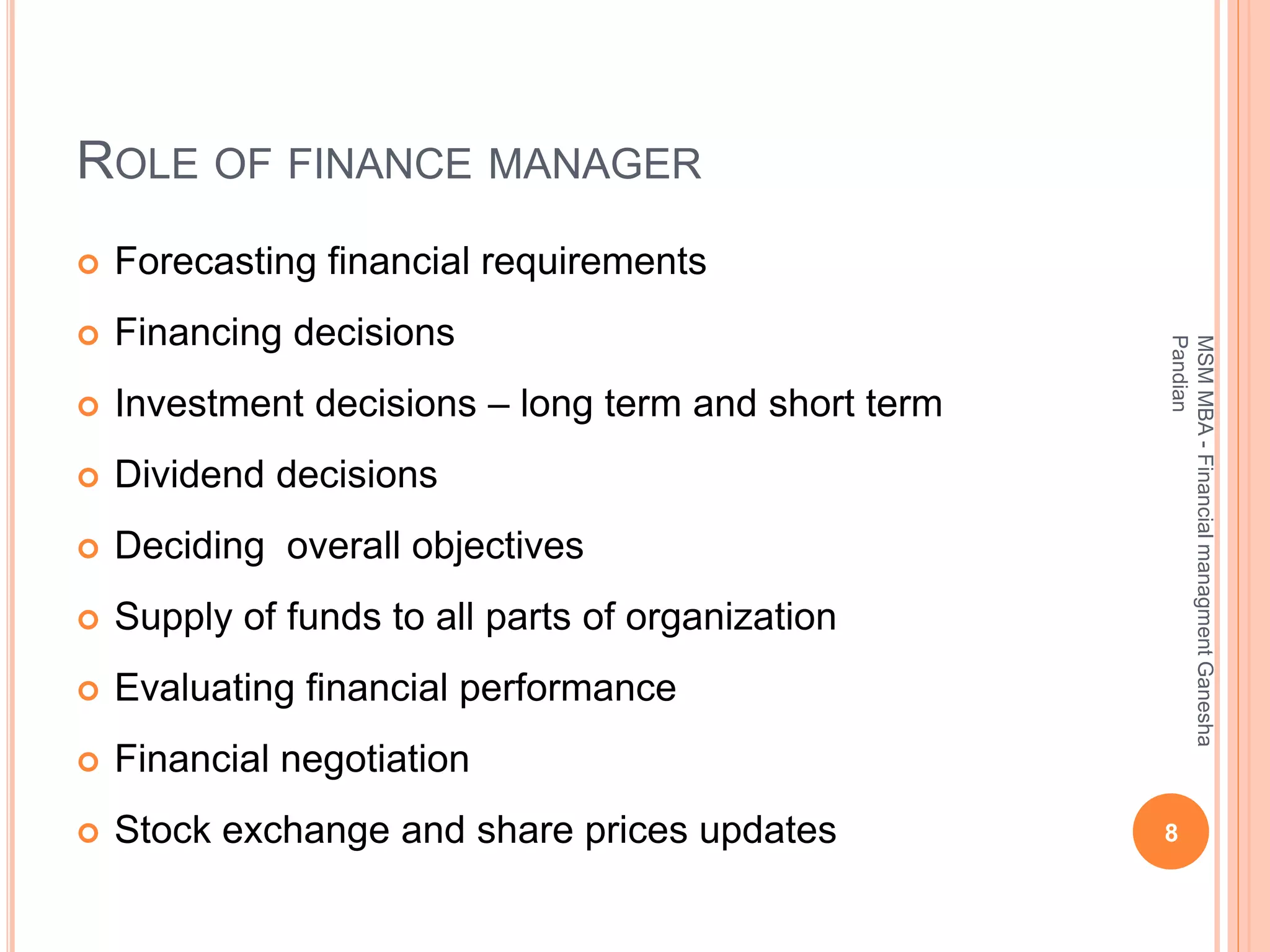
ROLE OF FINANCE MANAGER
 Forecasting financial requirements
 Financing decisions
 Investment decisions – long term and short term
 Dividend decisions
 Deciding overall objectives
 Supply of funds to all parts of organization
 Evaluating financial performance
 Financial negotiation
 Stock exchange and share prices updates 8
MSMMBA-FinancialmanagmentGanesha
Pandian
LIQUIDITY VS. PROFITABILITY
 Liquidity – ability of the firm to pay its debt off
 Profitability – ability to make profit from the
investment
Both are contradictory to one another
9
MSMMBA-FinancialmanagmentGanesha
Pandian
CONCEPT OF RISK AND RETURN
 Risk – variability of the expected return from the
investment made
 Return – gain or profit expected from the investment
 Risk associated return is given by:
Return = risk free return + risk premium
Risk – return trade off = optimization of risk and return
10
MSMMBA-FinancialmanagmentGanesha
Pandian
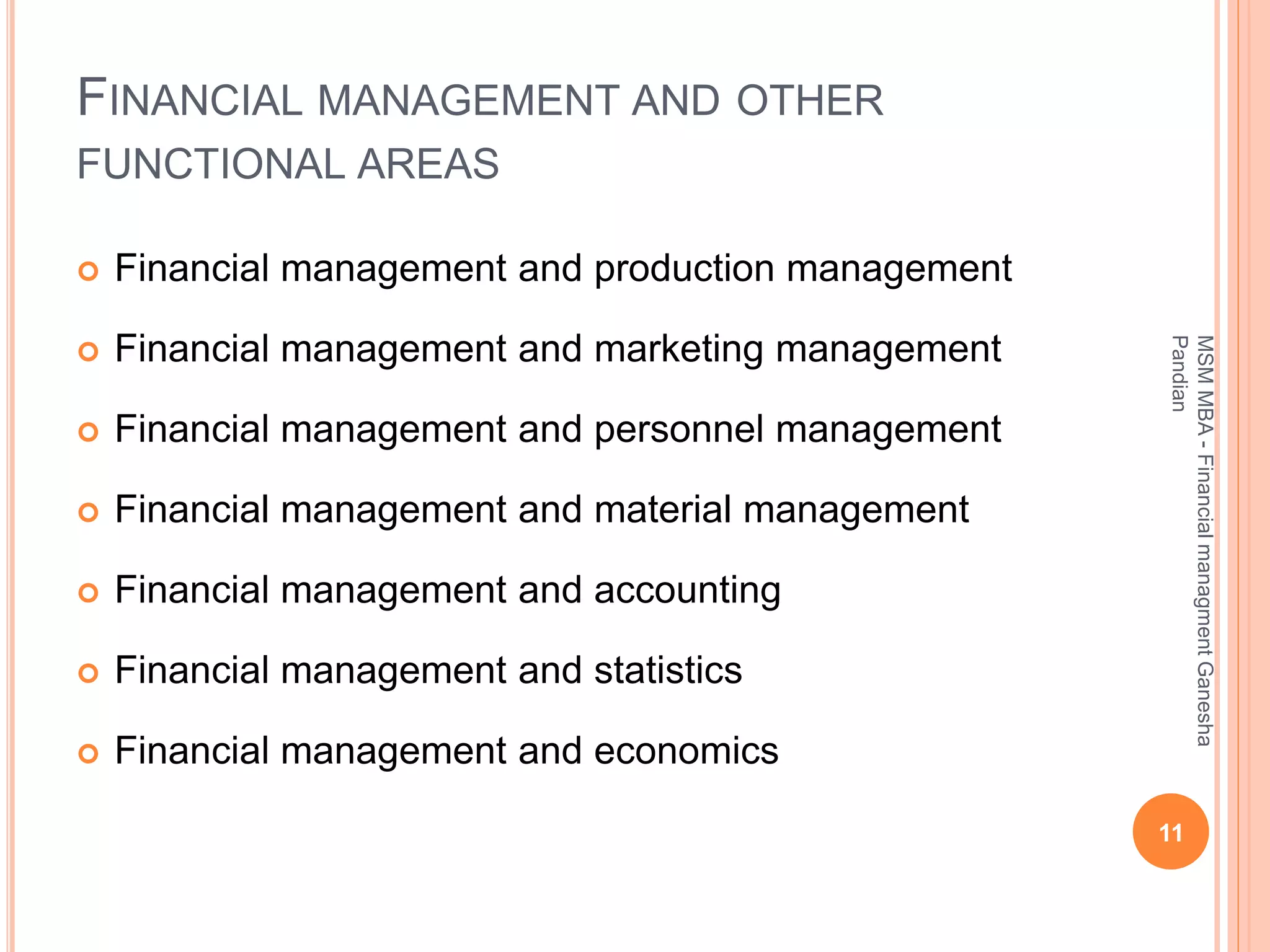
FINANCIAL MANAGEMENT AND OTHER
FUNCTIONAL AREAS
 Financial management and production management
 Financial management and marketing management
 Financial management and personnel management
 Financial management and material management
 Financial management and accounting
 Financial management and statistics
 Financial management and economics
11
MSMMBA-FinancialmanagmentGanesha
Pandian
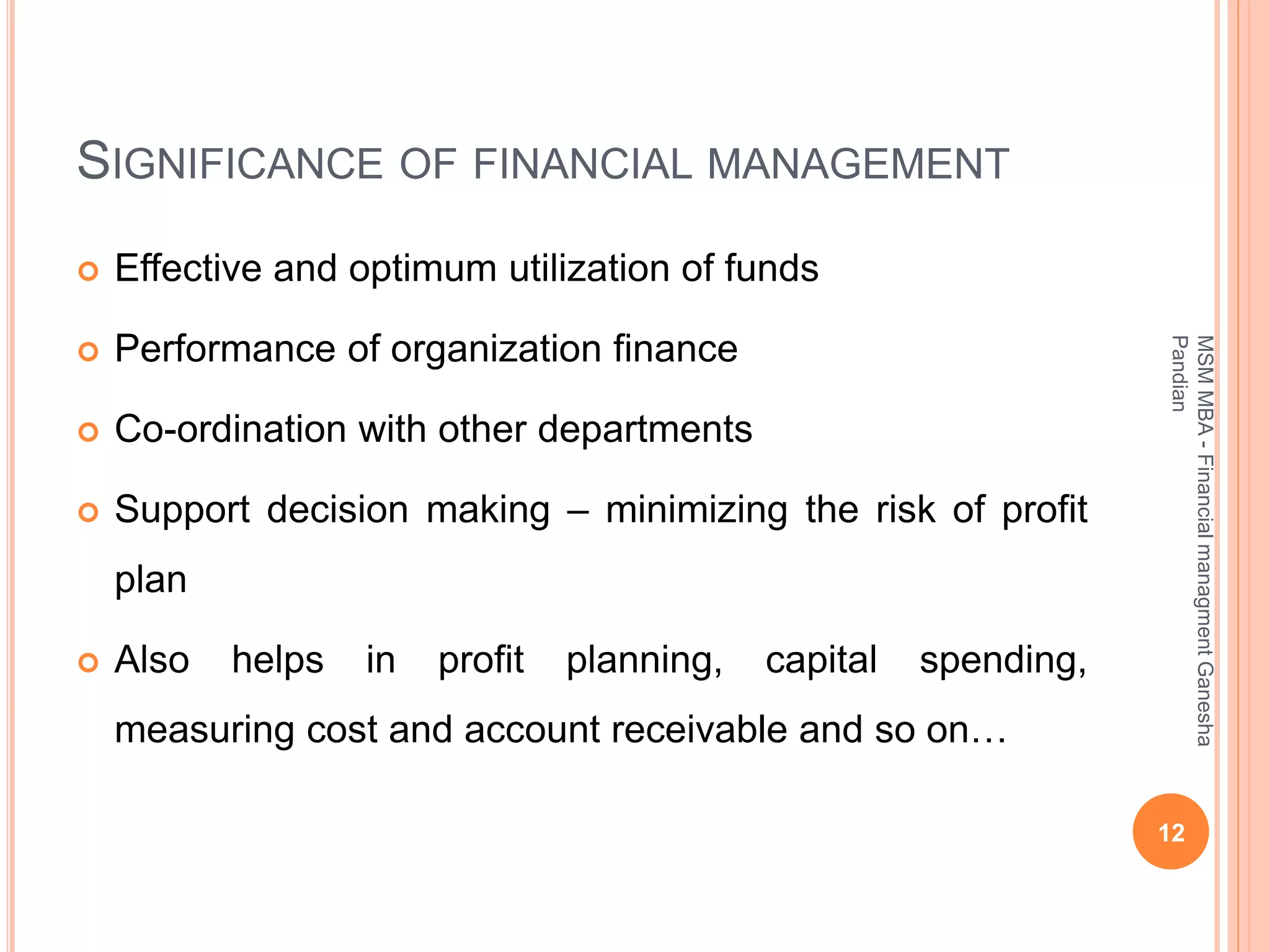
SIGNIFICANCE OF FINANCIAL MANAGEMENT
 Effective and optimum utilization of funds
 Performance of organization finance
 Co-ordination with other departments
 Support decision making – minimizing the risk of profit
plan
 Also helps in profit planning, capital spending,
measuring cost and account receivable and so on…
12
MSMMBA-FinancialmanagmentGanesha
Pandian
CONCEPT OF TIME VALUE OF MONEY
 A rupee worth today is more than a rupee available
at future date
Risk return trade off:
Higher the risk then higher the return, lower
the risk then lower the return
Time value of money – the value of time derived from
the use of money over the time as a result of
investment and re- investment 13
MSMMBA-FinancialmanagmentGanesha
Pandian
REASONS FOR TIME VALUE OF MONEY
Risk
Preference of present consumption
Inflation
Investment opportunity
14
MSMMBA-FinancialmanagmentGanesha
Pandian
METHODS FOR TIME VALUE OF MONEY
CALCULATION
 Calculation of equivalent values from different
points of time is converted into values at particular
point of time (present or future)
 2 techniques :
1. Compounding
2. Discounting
15
MSMMBA-FinancialmanagmentGanesha
Pandian
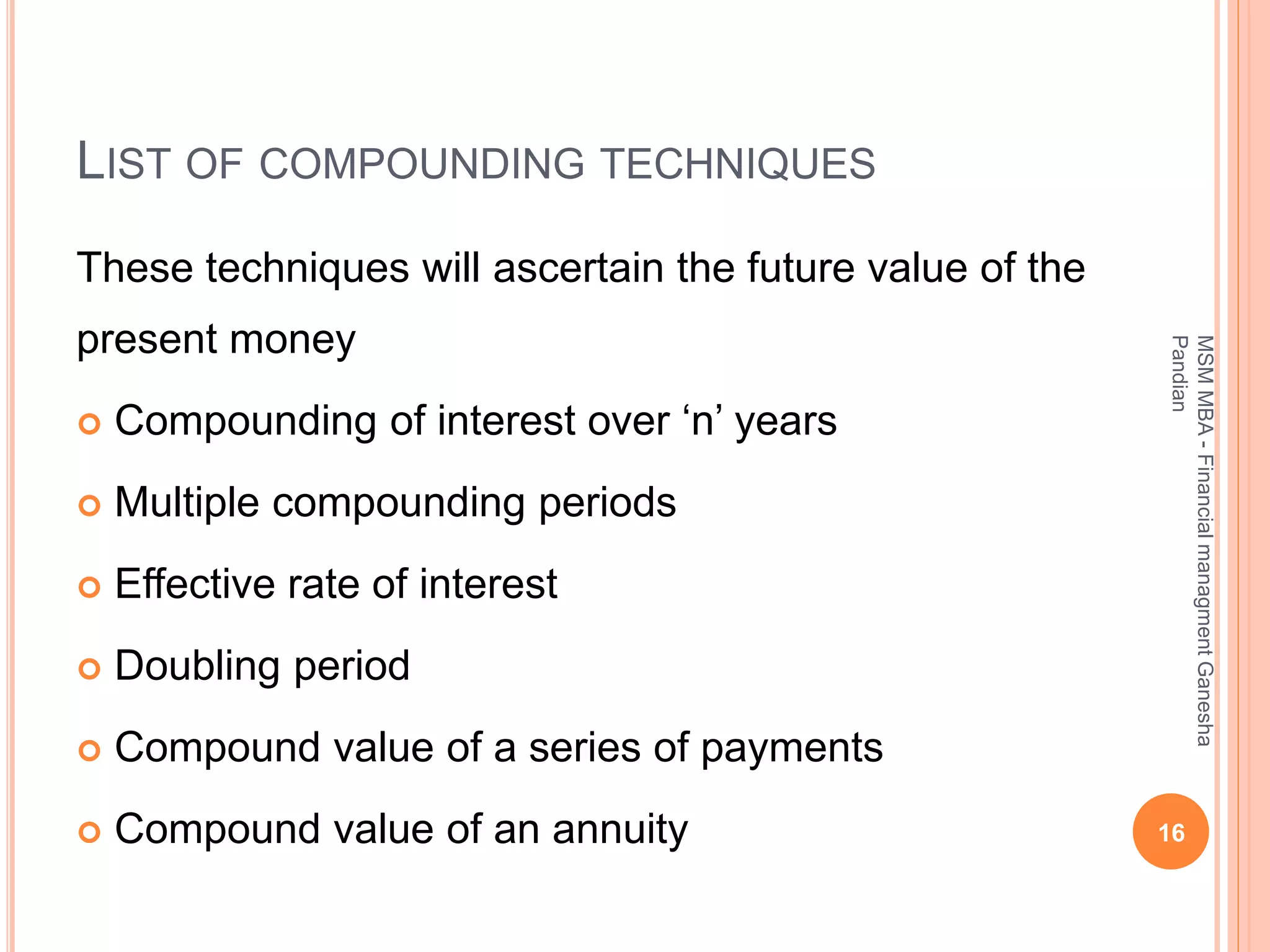
LIST OF COMPOUNDING TECHNIQUES
These techniques will ascertain the future value of the
present money
 Compounding of interest over ‘n’ years
 Multiple compounding periods
 Effective rate of interest
 Doubling period
 Compound value of a series of payments
 Compound value of an annuity 16
MSMMBA-FinancialmanagmentGanesha
Pandian
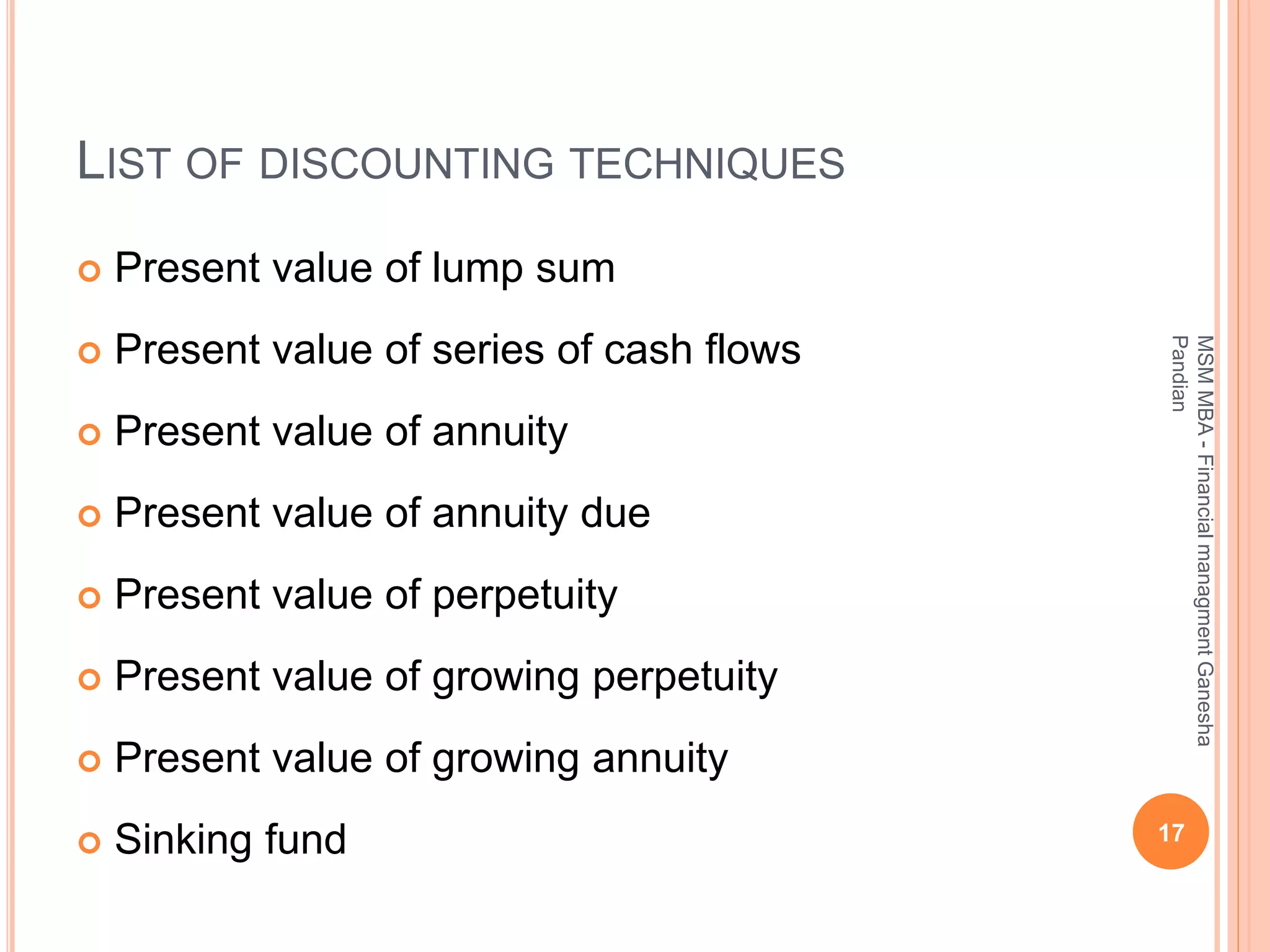
LIST OF DISCOUNTING TECHNIQUES
 Present value of lump sum
 Present value of series of cash flows
 Present value of annuity
 Present value of annuity due
 Present value of perpetuity
 Present value of growing perpetuity
 Present value of growing annuity
 Sinking fund 17
MSMMBA-FinancialmanagmentGanesha
Pandian
RISK AND RETURN OF SINGLE ASSET
 For single asset:
Rate of return = Annual income + (ending price – beginning price)
Beginning price
For example: price at beginning : $ 60.00
Price at end : $ 69.00
Dividend paid : $ 2.40
Rate of return = 2.4 + (69-60) / 60 = 0.19 = 19%
18
MSMMBA-FinancialmanagmentGanesha
Pandian
Contd…
Formula may be refined as,
Rate of return = Annual income + End price – begin price
begin price begin price
Now rate of return = [2.4/60]+[(69-60)/60] = 0.4+0.15
= 0.19 = 19 %
19
MSMMBA-FinancialmanagmentGanesha
Pandian
CALCULATION OF EXPECTED RATE OF RETURN
Economic
condition
Probability
Pi
Rate of return
Ri
Boom 0.3 16
Normal 0.5 11
Recession 0.2 6
20
MSMMBA-FinancialmanagmentGanesha
Pandian
Expected rate of return E(R) = ∑ Pi Ri
Economic
condition
Probability
Pi
Rate of
return Ri
Pi Ri
Boom 0.3 16 4.8
Normal 0.5 11 5.5
Recession 0.2 6 1.2
Contd…
 Expected rate of return E(R) = 11.5%
Calculation of standard deviation of return:
= root of [ ∑ Pi (Ri – E(R))^2 ]
21
MSMMBA-FinancialmanagmentGanesha
Pandian
Econo
mic
conditi
on
Proba
bility
Pi
Rate
of
return
Ri
Pi Ri Ri –
E(R)
Ri –
E(R)^2
Pi(Ri –
E(R)^2
)
Boom 0.3 16 4.8 4.5 20.25 6.075
Normal 0.5 11 5.5 -0.5 0.25 0.125
Reces
sion
0.2 6 1.2 -5.5 30.25 6.050
Contd…
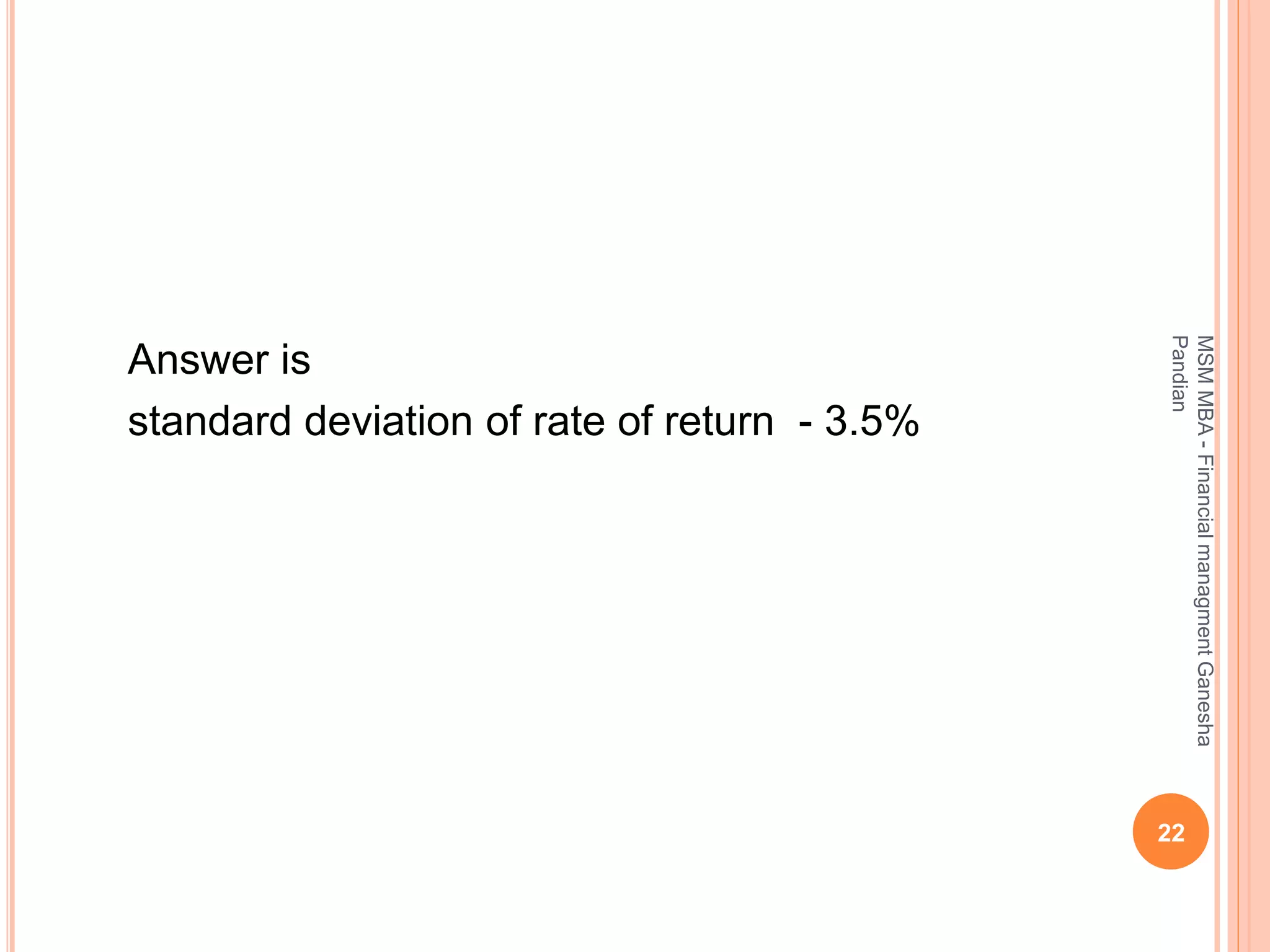
Answer is
standard deviation of rate of return - 3.5%
22
MSMMBA-FinancialmanagmentGanesha
Pandian
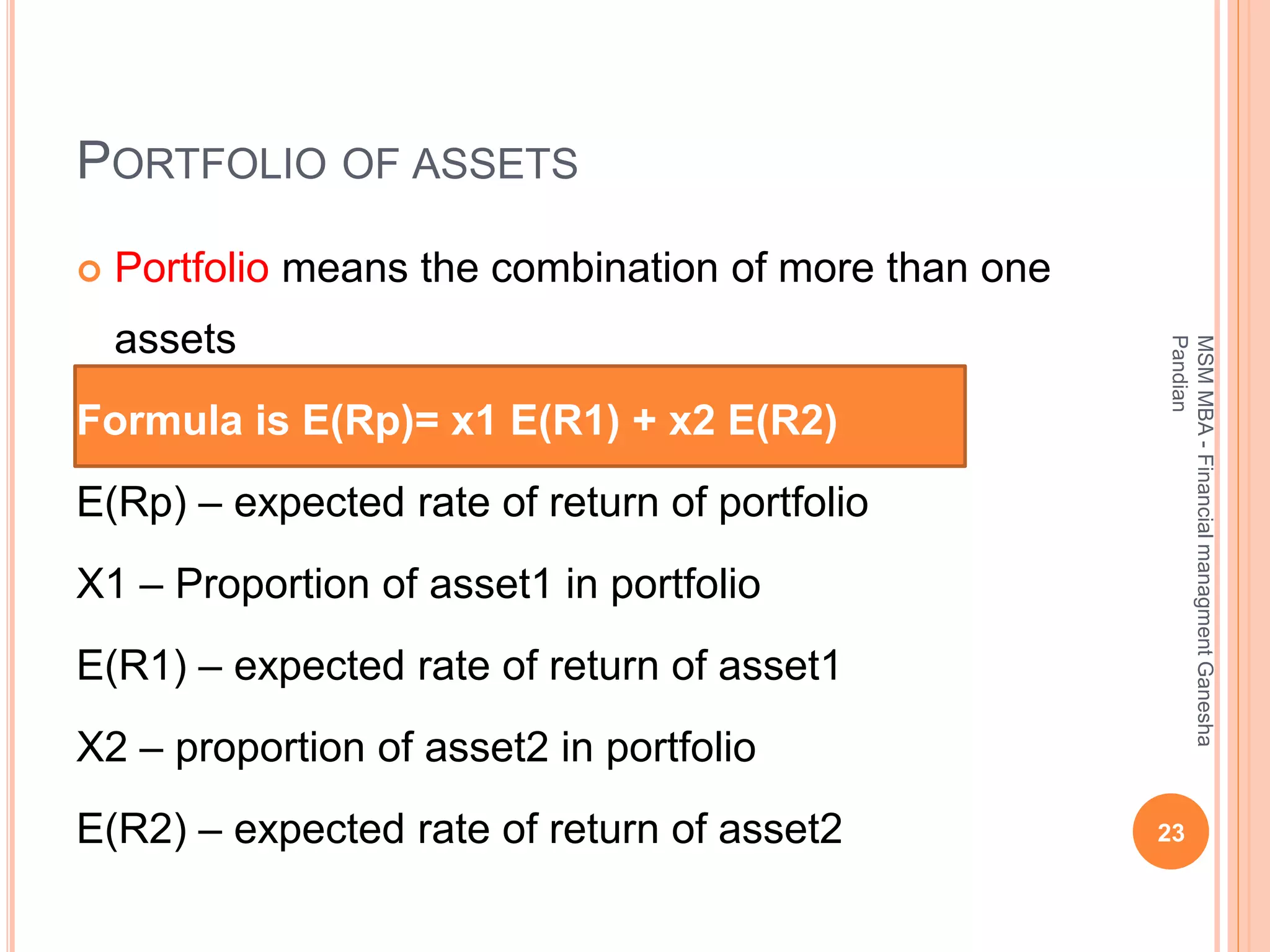
PORTFOLIO OF ASSETS
 Portfolio means the combination of more than one
assets
Formula is E(Rp)= x1 E(R1) + x2 E(R2)
E(Rp) – expected rate of return of portfolio
X1 – Proportion of asset1 in portfolio
E(R1) – expected rate of return of asset1
X2 – proportion of asset2 in portfolio
E(R2) – expected rate of return of asset2 23
MSMMBA-FinancialmanagmentGanesha
Pandian
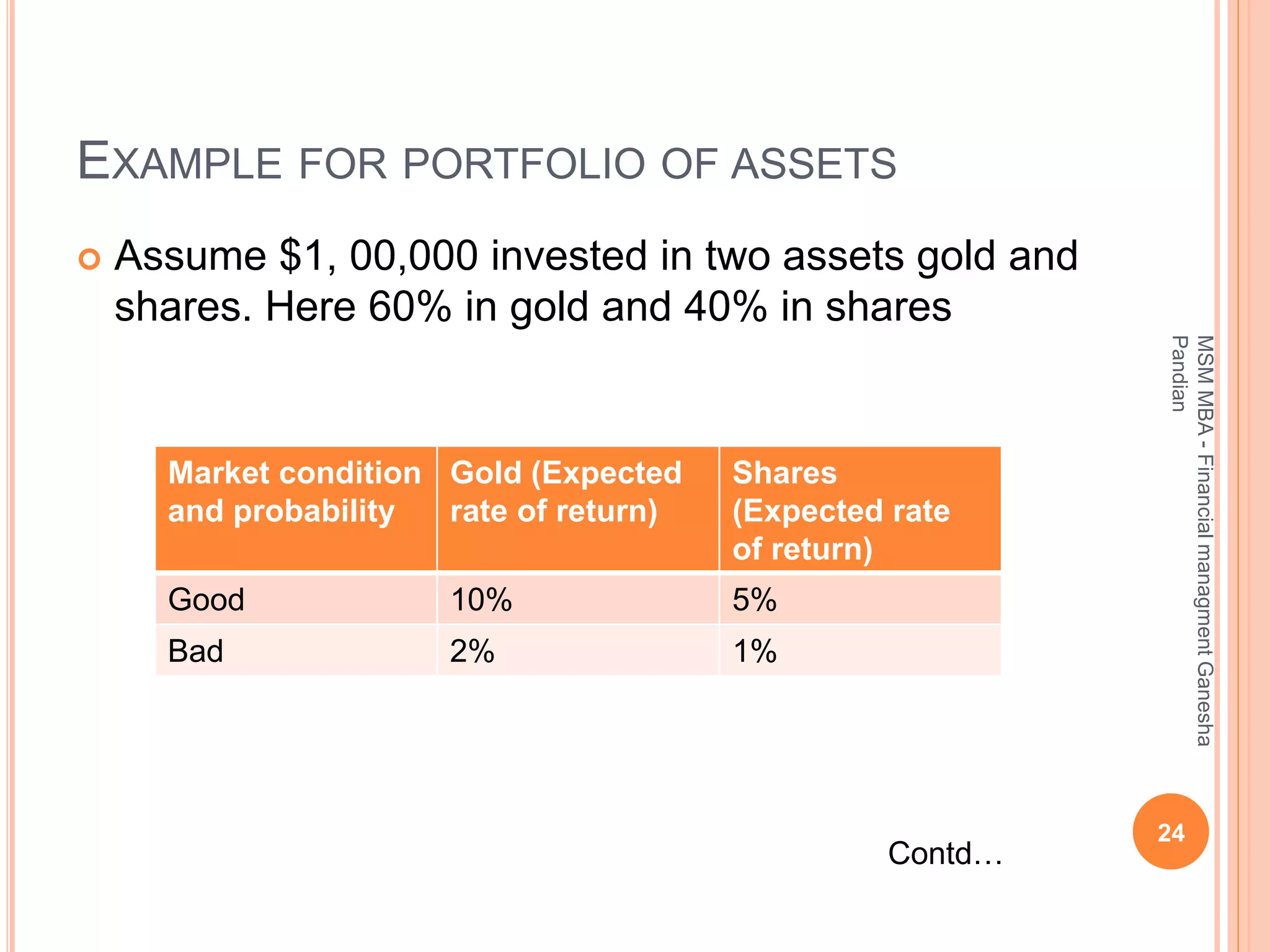
EXAMPLE FOR PORTFOLIO OF ASSETS
 Assume $1, 00,000 invested in two assets gold and
shares. Here 60% in gold and 40% in shares
24
MSMMBA-FinancialmanagmentGanesha
Pandian
Market condition
and probability
Gold (Expected
rate of return)
Shares
(Expected rate
of return)
Good 10% 5%
Bad 2% 1%
Contd…
25
MSMMBA-FinancialmanagmentGanesha
Pandian
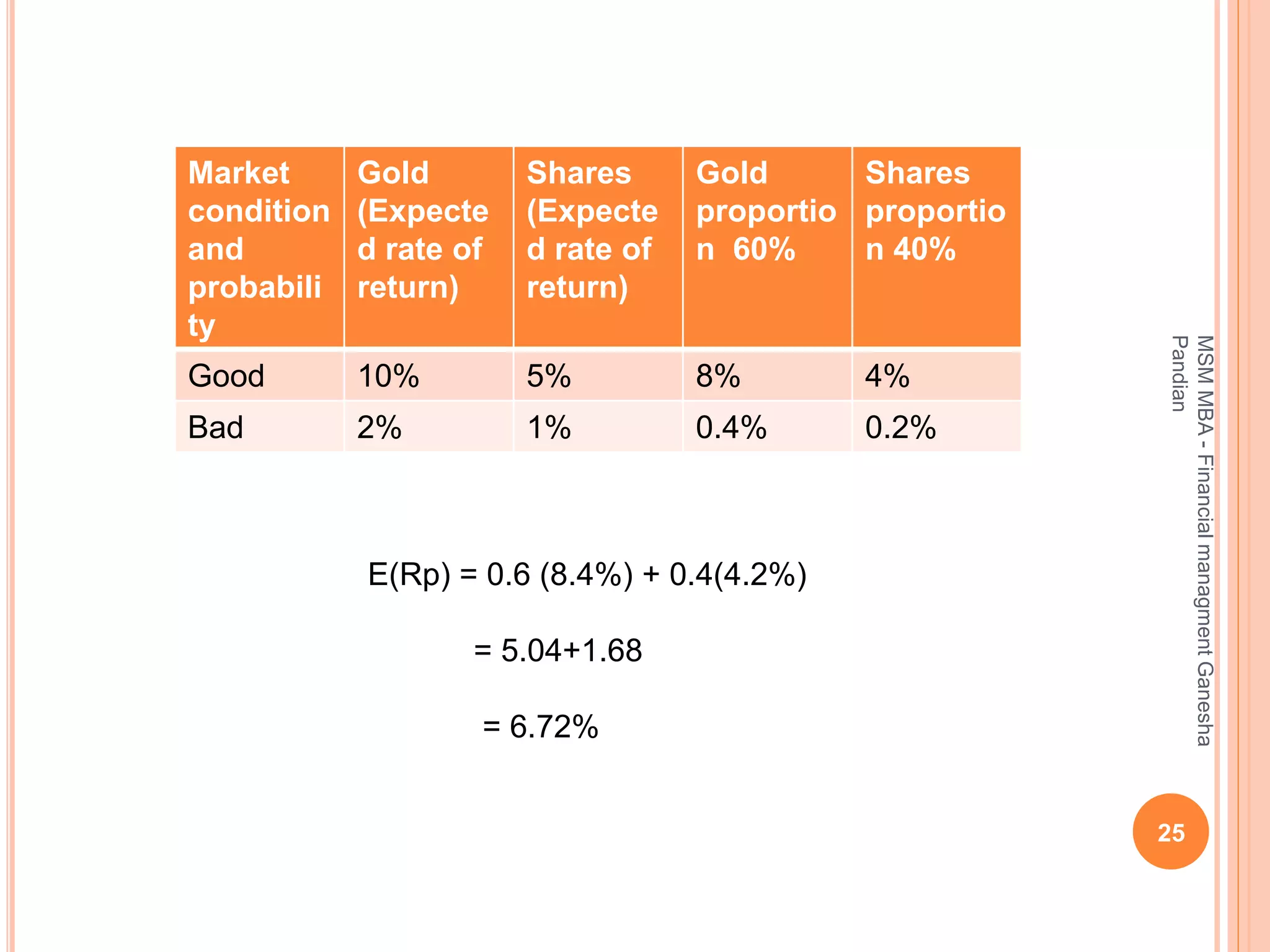
Market
condition
and
probabili
ty
Gold
(Expecte
d rate of
return)
Shares
(Expecte
d rate of
return)
Gold
proportio
n 60%
Shares
proportio
n 40%
Good 10% 5% 8% 4%
Bad 2% 1% 0.4% 0.2%
E(Rp) = 0.6 (8.4%) + 0.4(4.2%)
= 5.04+1.68
= 6.72%
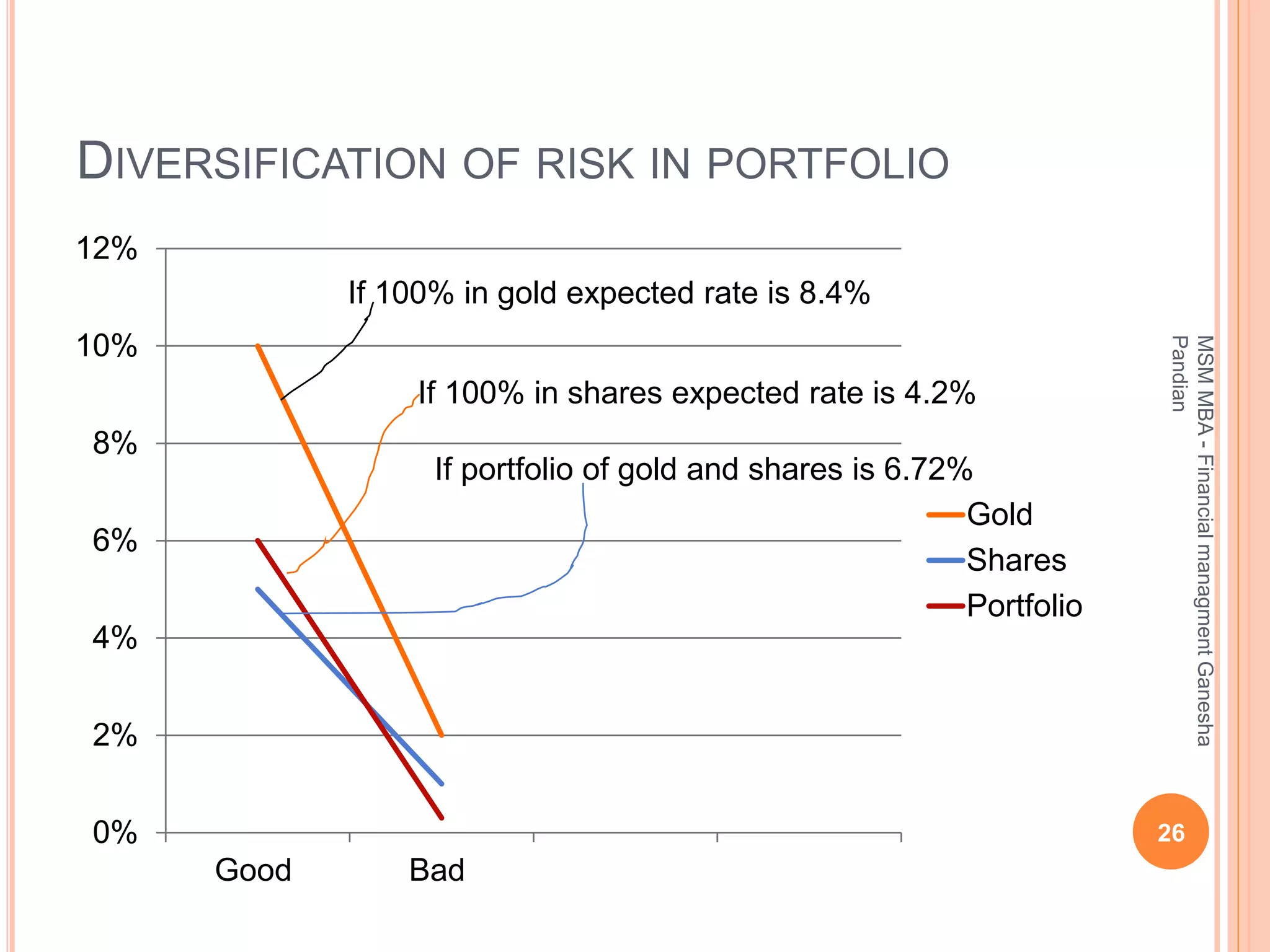
DIVERSIFICATION OF RISK IN PORTFOLIO
0%
2%
4%
6%
8%
10%
12%
Good Bad
Gold
Shares
Portfolio
26
MSMMBA-FinancialmanagmentGanesha
Pandian
If 100% in gold expected rate is 8.4%
If 100% in shares expected rate is 4.2%
If portfolio of gold and shares is 6.72%
FEATURES AND VALUATION OF EQUITY
SHARES AND BONDS
 Objective to maximize the market value of the firm’s
equity shares
 So we should know the value of bonds and shares
 Value of firm is the total sum of value of bonds and
shares
Basic discounted cash flow valuation model applied
to bonds and equity shares valuation.
27
MSMMBA-FinancialmanagmentGanesha
Pandian
FEATURES OF EQUITY SHARES
1. They are permanent in nature
2. Equity shareholders are the actual owners of the company
and they bear the highest risk.
3. Equity shares are transferable, i.e. ownership of equity
shares can be transferred with or without consideration to
other person.
4. Dividend payable to equity shareholders is an appropriation
of profit.
5. Equity shareholders do not get fixed rate of dividend.
6. Equity shareholders have the right to control the affairs of
the company.
7. The liability of equity shareholders is limited to the extent of
their investment. 28
MSMMBA-FinancialmanagmentGanesha
Pandian
FEATURES OF BONDS
 Interest rate or coupon rate payable to bond
holders
 Bond holders get equal amount of payment in every
installment
 Bond holders don’t have control over the affairs of
company
 Debt instrument issued by government or any
business firm.
 They hold liability to the extent they purchased the
bonds
 It is not permanent and ends in certain maturity
period
29
MSMMBA-FinancialmanagmentGanesha
Pandian
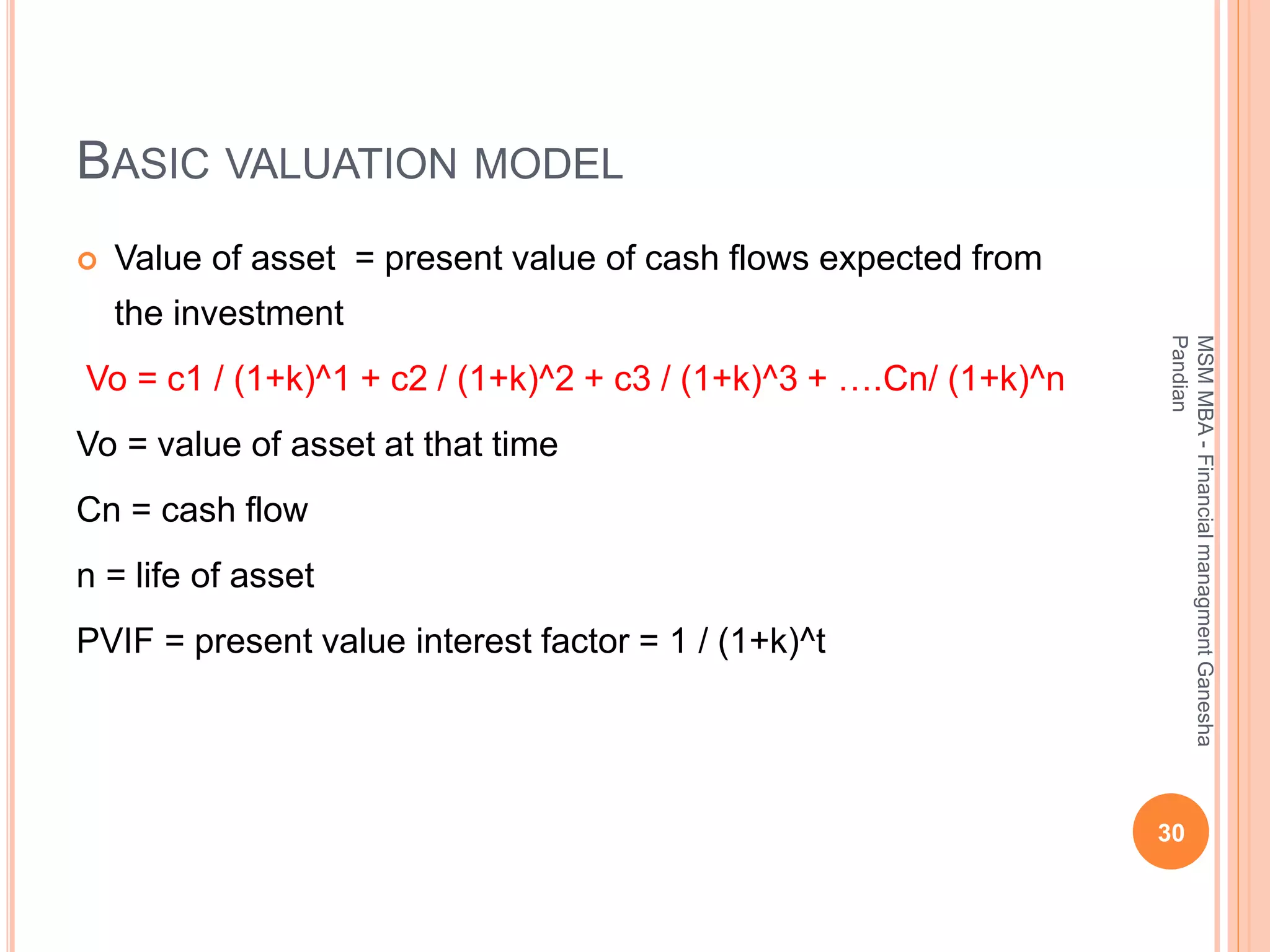
BASIC VALUATION MODEL
 Value of asset = present value of cash flows expected from
the investment
Vo = c1 / (1+k)^1 + c2 / (1+k)^2 + c3 / (1+k)^3 + ….Cn/ (1+k)^n
Vo = value of asset at that time
Cn = cash flow
n = life of asset
PVIF = present value interest factor = 1 / (1+k)^t
30
MSMMBA-FinancialmanagmentGanesha
Pandian
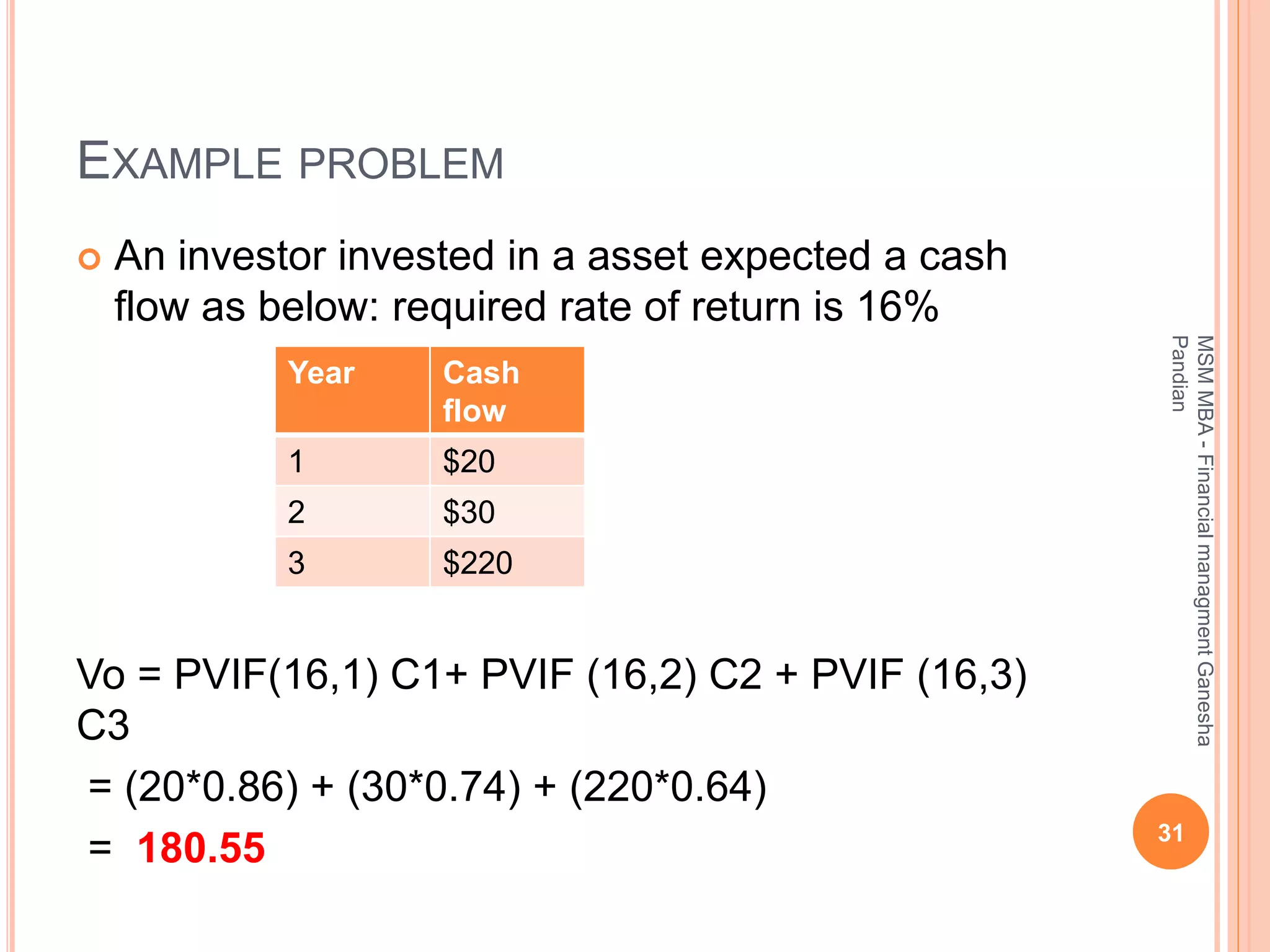
EXAMPLE PROBLEM
 An investor invested in a asset expected a cash
flow as below: required rate of return is 16%
Vo = PVIF(16,1) C1+ PVIF (16,2) C2 + PVIF (16,3)
C3
= (20*0.86) + (30*0.74) + (220*0.64)
= 180.55 31
MSMMBA-FinancialmanagmentGanesha
Pandian
Year Cash
flow
1 $20
2 $30
3 $220
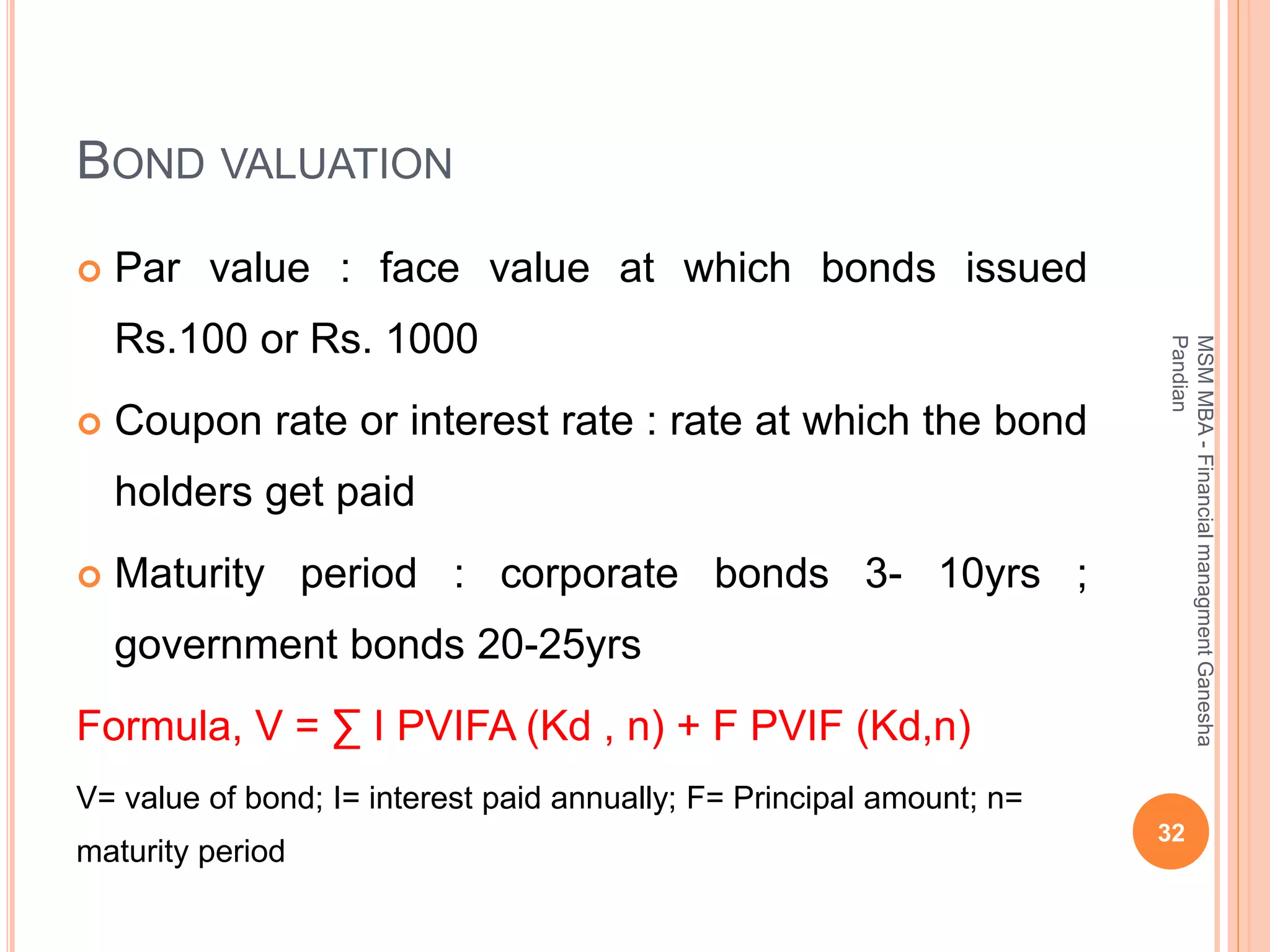
BOND VALUATION
 Par value : face value at which bonds issued
Rs.100 or Rs. 1000
 Coupon rate or interest rate : rate at which the bond
holders get paid
 Maturity period : corporate bonds 3- 10yrs ;
government bonds 20-25yrs
Formula, V = ∑ I PVIFA (Kd , n) + F PVIF (Kd,n)
V= value of bond; I= interest paid annually; F= Principal amount; n=
maturity period
32
MSMMBA-FinancialmanagmentGanesha
Pandian
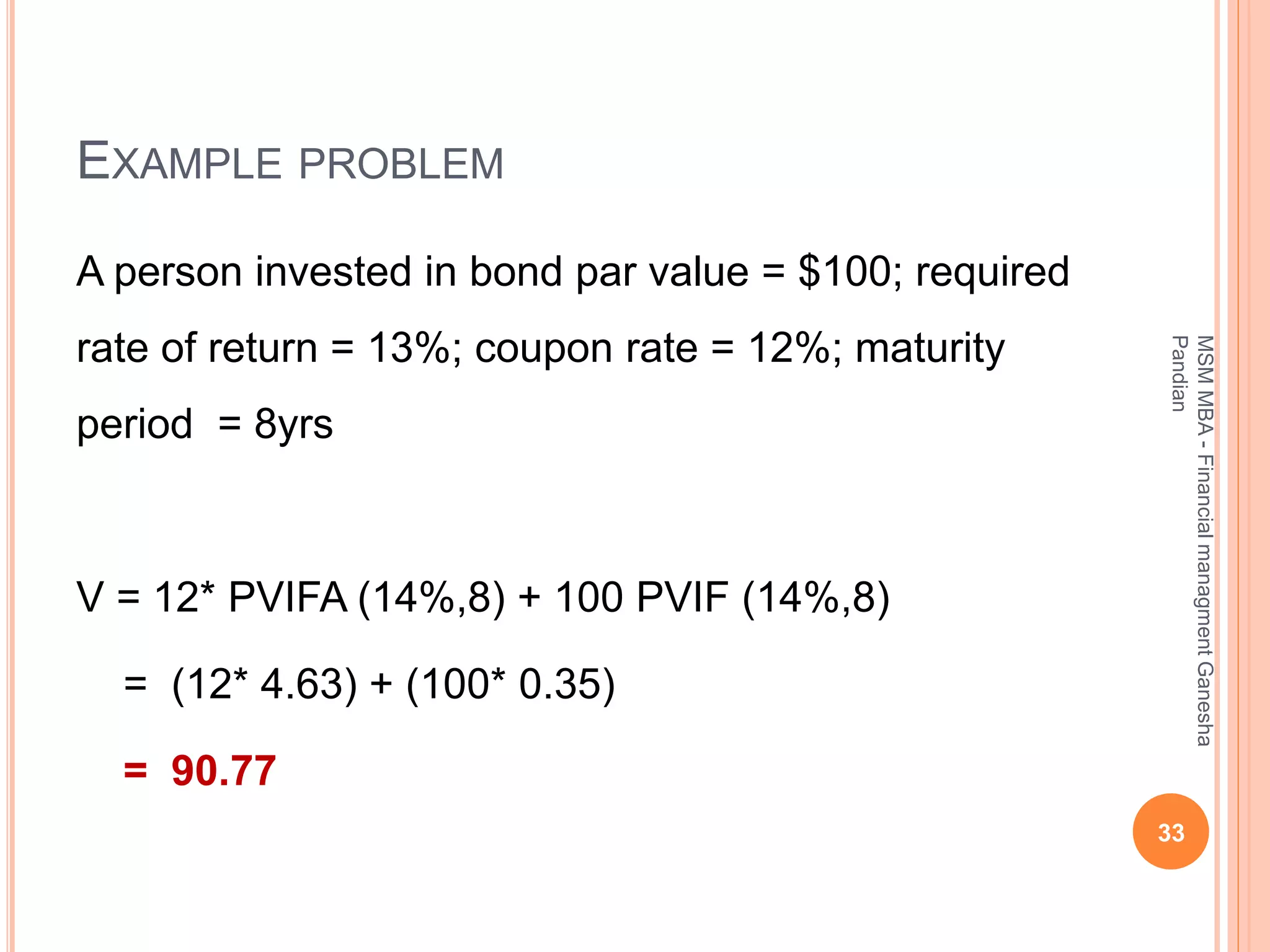
EXAMPLE PROBLEM
A person invested in bond par value = $100; required
rate of return = 13%; coupon rate = 12%; maturity
period = 8yrs
V = 12* PVIFA (14%,8) + 100 PVIF (14%,8)
= (12* 4.63) + (100* 0.35)
= 90.77
33
MSMMBA-FinancialmanagmentGanesha
Pandian
Yield to maturity:
 The rate of return which an investors earns from the
bond, if holds the bond for maturity period.
 It is also called as required rate of return
34
MSMMBA-FinancialmanagmentGanesha
Pandian
EQUITY VALUATION: DIVIDEND CAPITALIZATION
APPROACH
1. Single period valuation model
2. Multi period valuation model
Other approaches:
1. Earning capitalization approach
2. Book value approach
3. Liquidation approach
35
MSMMBA-FinancialmanagmentGanesha
Pandian
THE END
36
MSMMBA-FinancialmanagmentGanesha
Pandian

Financial management unit 1 Foundations of finance

  • 1.
    BA 5203 FINANCIALMANAGEMENT UNIT 1: FOUNDATIONS OF FINANCE Prepared and presented, N. Ganesha Pandian
  • 2.
    CONTENT – UNIT1 FOUNDATION OF FINANCE  Introduction to finance  Financial management – nature, scope and functions of finance  organization of financial functions  Objectives of financial management  Major financial decisions  Time value of money  Features and valuation of shares and bonds  Concept of risk and return  Single asset and a portfolio MSMMBA-FinancialmanagmentGanesha Pandian 2
  • 3.
    INTRODUCTION  Finance lifeblood of the organization Meaning of financial management: - Management of flow of funds within the organization - Effective utilization for the attainment of organizational objectives. 3 MSMMBA-FinancialmanagmentGanesha Pandian
  • 4.
    DEFINITIONS OF FINANCIALMANAGEMENT  According to Solomon: “Financial management is concerned with the efficient use of an important economic resource namely, capital funds.”  J.F Bradley : “ Financial management is the area of the business management devoted to the judicious use of capital in order to enable a business firm to move in the direction of reaching its goal.” 4 MSMMBA-FinancialmanagmentGanesha Pandian
  • 5.
    SCOPE OF FINANCIALMANAGEMENT 1. Traditional approach – raising funds for corporates (outside view) 2. Modern approach – optimum allocation inside the organization (inside view) 5 MSMMBA-FinancialmanagmentGanesha Pandian
  • 6.
    OBJECTIVES OF FINANCIALMANAGEMENT  Basic objectives - 1. Profit maximization 2. wealth maximization  Profit maximization – criticisms (ambiguity, time value of money and risk factors  Wealth maximization – maximizing the net present worth means maximizing the market price of shares 6 MSMMBA-FinancialmanagmentGanesha Pandian Contd…
  • 7.
    OTHER OBJECTIVES  Returnmaximization  Provide support for decision making  Manage risks  Use resource effectively, efficiently and economically  Provide a supportive control environment  Comply with authorities and safeguard assets 7 MSMMBA-FinancialmanagmentGanesha Pandian
  • 8.
    ROLE OF FINANCEMANAGER  Forecasting financial requirements  Financing decisions  Investment decisions – long term and short term  Dividend decisions  Deciding overall objectives  Supply of funds to all parts of organization  Evaluating financial performance  Financial negotiation  Stock exchange and share prices updates 8 MSMMBA-FinancialmanagmentGanesha Pandian
  • 9.
    LIQUIDITY VS. PROFITABILITY Liquidity – ability of the firm to pay its debt off  Profitability – ability to make profit from the investment Both are contradictory to one another 9 MSMMBA-FinancialmanagmentGanesha Pandian
  • 10.
    CONCEPT OF RISKAND RETURN  Risk – variability of the expected return from the investment made  Return – gain or profit expected from the investment  Risk associated return is given by: Return = risk free return + risk premium Risk – return trade off = optimization of risk and return 10 MSMMBA-FinancialmanagmentGanesha Pandian
  • 11.
    FINANCIAL MANAGEMENT ANDOTHER FUNCTIONAL AREAS  Financial management and production management  Financial management and marketing management  Financial management and personnel management  Financial management and material management  Financial management and accounting  Financial management and statistics  Financial management and economics 11 MSMMBA-FinancialmanagmentGanesha Pandian
  • 12.
    SIGNIFICANCE OF FINANCIALMANAGEMENT  Effective and optimum utilization of funds  Performance of organization finance  Co-ordination with other departments  Support decision making – minimizing the risk of profit plan  Also helps in profit planning, capital spending, measuring cost and account receivable and so on… 12 MSMMBA-FinancialmanagmentGanesha Pandian
  • 13.
    CONCEPT OF TIMEVALUE OF MONEY  A rupee worth today is more than a rupee available at future date Risk return trade off: Higher the risk then higher the return, lower the risk then lower the return Time value of money – the value of time derived from the use of money over the time as a result of investment and re- investment 13 MSMMBA-FinancialmanagmentGanesha Pandian
  • 14.
    REASONS FOR TIMEVALUE OF MONEY Risk Preference of present consumption Inflation Investment opportunity 14 MSMMBA-FinancialmanagmentGanesha Pandian
  • 15.
    METHODS FOR TIMEVALUE OF MONEY CALCULATION  Calculation of equivalent values from different points of time is converted into values at particular point of time (present or future)  2 techniques : 1. Compounding 2. Discounting 15 MSMMBA-FinancialmanagmentGanesha Pandian
  • 16.
    LIST OF COMPOUNDINGTECHNIQUES These techniques will ascertain the future value of the present money  Compounding of interest over ‘n’ years  Multiple compounding periods  Effective rate of interest  Doubling period  Compound value of a series of payments  Compound value of an annuity 16 MSMMBA-FinancialmanagmentGanesha Pandian
  • 17.
    LIST OF DISCOUNTINGTECHNIQUES  Present value of lump sum  Present value of series of cash flows  Present value of annuity  Present value of annuity due  Present value of perpetuity  Present value of growing perpetuity  Present value of growing annuity  Sinking fund 17 MSMMBA-FinancialmanagmentGanesha Pandian
  • 18.
    RISK AND RETURNOF SINGLE ASSET  For single asset: Rate of return = Annual income + (ending price – beginning price) Beginning price For example: price at beginning : $ 60.00 Price at end : $ 69.00 Dividend paid : $ 2.40 Rate of return = 2.4 + (69-60) / 60 = 0.19 = 19% 18 MSMMBA-FinancialmanagmentGanesha Pandian Contd…
  • 19.
    Formula may berefined as, Rate of return = Annual income + End price – begin price begin price begin price Now rate of return = [2.4/60]+[(69-60)/60] = 0.4+0.15 = 0.19 = 19 % 19 MSMMBA-FinancialmanagmentGanesha Pandian
  • 20.
    CALCULATION OF EXPECTEDRATE OF RETURN Economic condition Probability Pi Rate of return Ri Boom 0.3 16 Normal 0.5 11 Recession 0.2 6 20 MSMMBA-FinancialmanagmentGanesha Pandian Expected rate of return E(R) = ∑ Pi Ri Economic condition Probability Pi Rate of return Ri Pi Ri Boom 0.3 16 4.8 Normal 0.5 11 5.5 Recession 0.2 6 1.2 Contd…
  • 21.
     Expected rateof return E(R) = 11.5% Calculation of standard deviation of return: = root of [ ∑ Pi (Ri – E(R))^2 ] 21 MSMMBA-FinancialmanagmentGanesha Pandian Econo mic conditi on Proba bility Pi Rate of return Ri Pi Ri Ri – E(R) Ri – E(R)^2 Pi(Ri – E(R)^2 ) Boom 0.3 16 4.8 4.5 20.25 6.075 Normal 0.5 11 5.5 -0.5 0.25 0.125 Reces sion 0.2 6 1.2 -5.5 30.25 6.050 Contd…
  • 22.
    Answer is standard deviationof rate of return - 3.5% 22 MSMMBA-FinancialmanagmentGanesha Pandian
  • 23.
    PORTFOLIO OF ASSETS Portfolio means the combination of more than one assets Formula is E(Rp)= x1 E(R1) + x2 E(R2) E(Rp) – expected rate of return of portfolio X1 – Proportion of asset1 in portfolio E(R1) – expected rate of return of asset1 X2 – proportion of asset2 in portfolio E(R2) – expected rate of return of asset2 23 MSMMBA-FinancialmanagmentGanesha Pandian
  • 24.
    EXAMPLE FOR PORTFOLIOOF ASSETS  Assume $1, 00,000 invested in two assets gold and shares. Here 60% in gold and 40% in shares 24 MSMMBA-FinancialmanagmentGanesha Pandian Market condition and probability Gold (Expected rate of return) Shares (Expected rate of return) Good 10% 5% Bad 2% 1% Contd…
  • 25.
    25 MSMMBA-FinancialmanagmentGanesha Pandian Market condition and probabili ty Gold (Expecte d rate of return) Shares (Expecte drate of return) Gold proportio n 60% Shares proportio n 40% Good 10% 5% 8% 4% Bad 2% 1% 0.4% 0.2% E(Rp) = 0.6 (8.4%) + 0.4(4.2%) = 5.04+1.68 = 6.72%
  • 26.
    DIVERSIFICATION OF RISKIN PORTFOLIO 0% 2% 4% 6% 8% 10% 12% Good Bad Gold Shares Portfolio 26 MSMMBA-FinancialmanagmentGanesha Pandian If 100% in gold expected rate is 8.4% If 100% in shares expected rate is 4.2% If portfolio of gold and shares is 6.72%
  • 27.
    FEATURES AND VALUATIONOF EQUITY SHARES AND BONDS  Objective to maximize the market value of the firm’s equity shares  So we should know the value of bonds and shares  Value of firm is the total sum of value of bonds and shares Basic discounted cash flow valuation model applied to bonds and equity shares valuation. 27 MSMMBA-FinancialmanagmentGanesha Pandian
  • 28.
    FEATURES OF EQUITYSHARES 1. They are permanent in nature 2. Equity shareholders are the actual owners of the company and they bear the highest risk. 3. Equity shares are transferable, i.e. ownership of equity shares can be transferred with or without consideration to other person. 4. Dividend payable to equity shareholders is an appropriation of profit. 5. Equity shareholders do not get fixed rate of dividend. 6. Equity shareholders have the right to control the affairs of the company. 7. The liability of equity shareholders is limited to the extent of their investment. 28 MSMMBA-FinancialmanagmentGanesha Pandian
  • 29.
    FEATURES OF BONDS Interest rate or coupon rate payable to bond holders  Bond holders get equal amount of payment in every installment  Bond holders don’t have control over the affairs of company  Debt instrument issued by government or any business firm.  They hold liability to the extent they purchased the bonds  It is not permanent and ends in certain maturity period 29 MSMMBA-FinancialmanagmentGanesha Pandian
  • 30.
    BASIC VALUATION MODEL Value of asset = present value of cash flows expected from the investment Vo = c1 / (1+k)^1 + c2 / (1+k)^2 + c3 / (1+k)^3 + ….Cn/ (1+k)^n Vo = value of asset at that time Cn = cash flow n = life of asset PVIF = present value interest factor = 1 / (1+k)^t 30 MSMMBA-FinancialmanagmentGanesha Pandian
  • 31.
    EXAMPLE PROBLEM  Aninvestor invested in a asset expected a cash flow as below: required rate of return is 16% Vo = PVIF(16,1) C1+ PVIF (16,2) C2 + PVIF (16,3) C3 = (20*0.86) + (30*0.74) + (220*0.64) = 180.55 31 MSMMBA-FinancialmanagmentGanesha Pandian Year Cash flow 1 $20 2 $30 3 $220
  • 32.
    BOND VALUATION  Parvalue : face value at which bonds issued Rs.100 or Rs. 1000  Coupon rate or interest rate : rate at which the bond holders get paid  Maturity period : corporate bonds 3- 10yrs ; government bonds 20-25yrs Formula, V = ∑ I PVIFA (Kd , n) + F PVIF (Kd,n) V= value of bond; I= interest paid annually; F= Principal amount; n= maturity period 32 MSMMBA-FinancialmanagmentGanesha Pandian
  • 33.
    EXAMPLE PROBLEM A personinvested in bond par value = $100; required rate of return = 13%; coupon rate = 12%; maturity period = 8yrs V = 12* PVIFA (14%,8) + 100 PVIF (14%,8) = (12* 4.63) + (100* 0.35) = 90.77 33 MSMMBA-FinancialmanagmentGanesha Pandian
  • 34.
    Yield to maturity: The rate of return which an investors earns from the bond, if holds the bond for maturity period.  It is also called as required rate of return 34 MSMMBA-FinancialmanagmentGanesha Pandian
  • 35.
    EQUITY VALUATION: DIVIDENDCAPITALIZATION APPROACH 1. Single period valuation model 2. Multi period valuation model Other approaches: 1. Earning capitalization approach 2. Book value approach 3. Liquidation approach 35 MSMMBA-FinancialmanagmentGanesha Pandian
  • 36.