
Depository Institution:
Activities & Characteristics
Chapter 3
The Knowledge Hunters
DEPOSITORY INSTITUTIONS
• A financial institution that obtains its funds mainly
through deposits from the public.
This includes commercial banks, savings
and loan associations, savings banks and credit unions.
• Depository institutions which includes commercial banks,
savings and loans, and credit unions, receive money from
depositors to lend out to borrowers.
Their income derive from two sources:
• Interest from the loans made and securities invested in.
• Non-Interest Income (Fees)
Depository Institutions
 Types
 Commercial Banks (Check-writing Institutions)
 Savings and Loans (NOW accounts)
 Savings Banks (NOW accounts)
 Credit Units (Share Draft accounts)
 Basic Business
 Receive Deposits (Funds Borrowed from Customers) – Demand
Deposits
 Charge Fees for Services
 Invest: Loans to Customers or Securities
 Provide Conveniences (Checking or NOW Accounts)
Asset Liability Problem of
Depository Institution
 Spread income / Margin:A depository institution seeks to earn a
positive spread between the assets it invest in (loan and securities) and the cost
of its funds (deposit and other sources). The spread is referred to as spread
income or margin.
 The risks that a depository institution faces include:
 Credit Risk (Default Risk)
 Regulatory Risk
 Funding (Interest rate) Risk
 Liquidity Risk
Commercial Banks
 A commercial bank is a type of financial institution that accepts
deposits, offers checking account services, makes business, personal
and mortgage loans, and offers basic financial products like certificates
of deposit (CDs) and savings accounts to individuals and small
businesses.
Role of Commercial banks: The main role of the commercial banks
is taking deposits and making loans.
Others;
 Carrying out currency exchanges
 Providing credits by discounting commercial loans
 Safekeeping of customer valuables such as gold, securities etc.
 Supporting government activities with credit
 Purchasing government securities
Bank services
Individual Banking
Institutional Banking
Global Banking
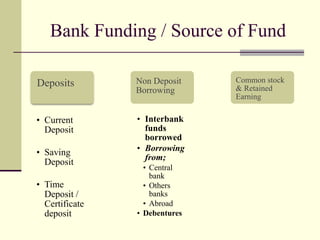
Bank Funding / Source of Fund
Deposits
• Current
Deposit
• Saving
Deposit
• Time
Deposit /
Certificate
deposit
Non Deposit
Borrowing
• Interbank
funds
borrowed
• Borrowing
from;
• Central
bank
• Others
banks
• Abroad
• Debentures
Common stock
& Retained
Earning
Capital Requirement for Banks
 Basel Agreement: What should be the capital of
the bank?
o Basel I Framework (Core Capital)
o Basel II Framework (Supplementary Capital)
Risk Weighted Asset
 0% - Risk free
 20% - Municipal general obligation
 50% - Municipal revenue bonds
 100% - Commercial Loan, mortgage and
corporate bonds.
Any Quarry?
Feel free to ask…

Depository institution activities & characteristics

  • 1.
    Depository Institution: Activities &Characteristics Chapter 3 The Knowledge Hunters
  • 2.
    DEPOSITORY INSTITUTIONS • Afinancial institution that obtains its funds mainly through deposits from the public. This includes commercial banks, savings and loan associations, savings banks and credit unions. • Depository institutions which includes commercial banks, savings and loans, and credit unions, receive money from depositors to lend out to borrowers. Their income derive from two sources: • Interest from the loans made and securities invested in. • Non-Interest Income (Fees)
  • 3.
    Depository Institutions  Types Commercial Banks (Check-writing Institutions)  Savings and Loans (NOW accounts)  Savings Banks (NOW accounts)  Credit Units (Share Draft accounts)  Basic Business  Receive Deposits (Funds Borrowed from Customers) – Demand Deposits  Charge Fees for Services  Invest: Loans to Customers or Securities  Provide Conveniences (Checking or NOW Accounts)
  • 4.
    Asset Liability Problemof Depository Institution  Spread income / Margin:A depository institution seeks to earn a positive spread between the assets it invest in (loan and securities) and the cost of its funds (deposit and other sources). The spread is referred to as spread income or margin.  The risks that a depository institution faces include:  Credit Risk (Default Risk)  Regulatory Risk  Funding (Interest rate) Risk  Liquidity Risk
  • 5.
    Commercial Banks  Acommercial bank is a type of financial institution that accepts deposits, offers checking account services, makes business, personal and mortgage loans, and offers basic financial products like certificates of deposit (CDs) and savings accounts to individuals and small businesses. Role of Commercial banks: The main role of the commercial banks is taking deposits and making loans. Others;  Carrying out currency exchanges  Providing credits by discounting commercial loans  Safekeeping of customer valuables such as gold, securities etc.  Supporting government activities with credit  Purchasing government securities
  • 6.
  • 7.
    Bank Funding /Source of Fund Deposits • Current Deposit • Saving Deposit • Time Deposit / Certificate deposit Non Deposit Borrowing • Interbank funds borrowed • Borrowing from; • Central bank • Others banks • Abroad • Debentures Common stock & Retained Earning
  • 8.
    Capital Requirement forBanks  Basel Agreement: What should be the capital of the bank? o Basel I Framework (Core Capital) o Basel II Framework (Supplementary Capital)
  • 9.
    Risk Weighted Asset 0% - Risk free  20% - Municipal general obligation  50% - Municipal revenue bonds  100% - Commercial Loan, mortgage and corporate bonds.
  • 10.