Financial Management
Ms.S.V.Mohana Sujana
Asst. Professor
Department of Commerce
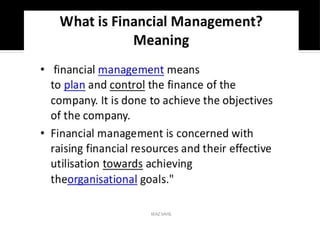
Finance is the life blood and nerve
centre of business. It is very essential
for smooth running of business
Definition:
 “Financial management is concerned with the
efficient use of an important economic resource,
namely capital funds”
– SOLOMON
 “Financial management deals with procurement
of funds and their effective utilisation in the
business”
– S.C.KUCHHAL
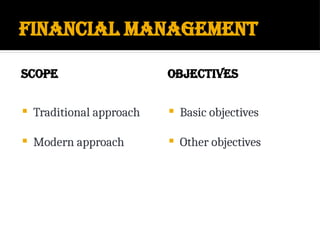
Financial Management
SCOPE
 Traditional approach
 Modern approach
OBJECTIVES
 Basic objectives
 Other objectives
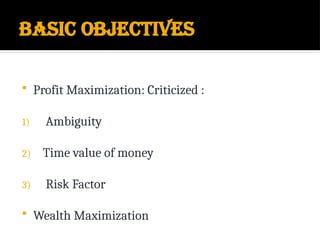
Basic objectives
 Profit Maximization: Criticized :
1) Ambiguity
2) Time value of money
3) Risk Factor
 Wealth Maximization
Other Objectives
 Return maximization
 Provide support for decision making
 Manage risks
 Use resources efficiently, effectively and
economically
 Provide supportive control environment
 Comply with authorities and safeguard assets
Role of finance manager
 Forecasting financial requirements
 Financing decision
 Investment decision
 Dividend decision
 Deciding overall objectives
 Supply of funds to all parts of organization
 Evaluating financial performance
 Financial negotiation
 Keeping in touch with stock exchange quotations and behavior of share
prices
Risk & Return
Risk : Risk is defined as the variability of the
expected return from
the investment.
Return : Return is measured as a
gain or profit expected to be made, over a
period, at the time of making the investment.

Financial Management-Over view and its introduction

  • 1.
    Financial Management Ms.S.V.Mohana Sujana Asst.Professor Department of Commerce
  • 3.
    Finance is thelife blood and nerve centre of business. It is very essential for smooth running of business
  • 5.
    Definition:  “Financial managementis concerned with the efficient use of an important economic resource, namely capital funds” – SOLOMON  “Financial management deals with procurement of funds and their effective utilisation in the business” – S.C.KUCHHAL
  • 6.
    Financial Management SCOPE  Traditionalapproach  Modern approach OBJECTIVES  Basic objectives  Other objectives
  • 7.
    Basic objectives  ProfitMaximization: Criticized : 1) Ambiguity 2) Time value of money 3) Risk Factor  Wealth Maximization
  • 8.
    Other Objectives  Returnmaximization  Provide support for decision making  Manage risks  Use resources efficiently, effectively and economically  Provide supportive control environment  Comply with authorities and safeguard assets
  • 9.
    Role of financemanager  Forecasting financial requirements  Financing decision  Investment decision  Dividend decision  Deciding overall objectives  Supply of funds to all parts of organization  Evaluating financial performance  Financial negotiation  Keeping in touch with stock exchange quotations and behavior of share prices
  • 10.
    Risk & Return Risk: Risk is defined as the variability of the expected return from the investment. Return : Return is measured as a gain or profit expected to be made, over a period, at the time of making the investment.