

Financial Controls
Financial Control
What is it?
Financial control is control of financial resources as they flow into the
organization (i.e., revenues, shareholders investments), are held by
organization (i.e., working capital, retained earnings), and flow out by the
organization (i.e., expenses). This type of control method aid managers in
acquiring, allocating, and evaluating the use of financial resource, such as:
cash, accounts receivable, accounts payable, inventories, and long-term
debt. These methods also enable managers to achieve acceptable liquidity,
solvency, and profitability standards.
Why do we need it?
Help align objectives of the business
Safeguard assets
Prevent and detect fraud and error
Encourage good management
Allow action to be taken against undesirable performance
Reduce exposure to risks
Ensuring proper financial reporting
Achieving control:
Financial control measures are those measures that is put in place to ensure
that financial related assets or properties of an organisation are safeguarded,
either from externals or employees of an organisation from any threat
whatsoever, whether by theft, loss or misappropriation (intentional or
otherwise).
Control measures can be broadly categorised into three:
•Preventive:
Detect problems before they arise
Monitor both operation and input
Attempt to predict potential problems before they occur and make adjustments
Prevent an error, omission or malicious act from occurring
•Detective:
Use controls that detect and report the occurrence of an error, omission or
malicious act
•Corrective:
Minimise the impact of threat
Remedy problems discovered by detective control
Identify the cause of a problem
Correct errors arising from a problem
Implementation
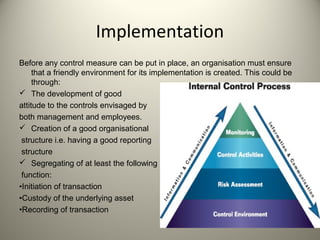
Before any control measure can be put in place, an organisation must ensure
that a friendly environment for its implementation is created. This could be
through:
 The development of good
attitude to the controls envisaged by
both management and employees.
 Creation of a good organisational
structure i.e. having a good reporting
structure
 Segregating of at least the following
function:
•Initiation of transaction
•Custody of the underlying asset
•Recording of transaction
Areas where Financial control can be applied
Financial control can be applied in virtually all aspect of any business. Some
examples are:
Bank account (Bank reconciliation statement preparation)
Sales
Purchases
Cash and cheques
Fixed Assets
Payroll – Salaries and wages
Stock , amongst others
Setting up controls
Sales: Accurate sales figures are important to correctly estimate stock and
revenue. You also want quick and reliable feedback of sales trends so you
can take action quickly to changing circumstances. Ensure you have written
procedures for cash, cheque and credit sales. Never ship goods out of your
business without an accompanying invoice.
• Check sales figures from their individual source – such as invoices
• If sales staff work on commission ensure that their sales figures are valid and
commissions are not paid until funds are received
• Reconcile sales register with takings and credit card receipts
• Make sure that goods are sent COD or with a tax invoice and obtain evidence
of delivery.
Setting up controls
Accounts receivable
Accounts receivable are an important asset of the business. Delays or failure to collect due
accounts can result in cash flow shortages and profit erosion.
• Ensure credit and collection policies are in writing
• Conduct credit checks on new credit customers
• Regularly age accounts and have an independent review of the report
• Ensure credit purchases are recorded as soon as the transaction occurs
• Separate the accounts receivable function and cash receipting
• Have transactions such as noncash credits and write off of bad debts cross checked
• Have a well documented and strict policy for the follow up of overdue accounts
• Review credit balances on a regular basis
• Have numerical or batch-processing controls over billing
• Ensure cross checking of early payment discounts and penalties on overdue accounts
• Ensure mailing of accounts cannot be tapered with
• Prepare trial balance of individual accounts receivable regularly
• Reconcile trial balances with general ledger control accounts.
Setting up Controls
Cash and bank accounts
Heavy cash businesses often fall victim to fraud or loss since cash is easy to
misappropriate, especially in a small business because controls are often weak.
• Never leave cheque books or blank cheques lying around
• Owners should review the cheques, cheque register, cash register totals and bank
statements regularly.
• Keep a tight rein on all cash, and balance tills daily or more regularly in businesses
handling lots of cash (such as clubs, news agencies or hotels)
• Have employees balance cash at the end of each shift if they are handing over to
another employee
• Reconcile bank accounts regularly
• Where possible, separate mail-opening from the writing of deposit slips, and banking
from bank statement reconciliation
• Separate responsibility for cash disbursement and purchases from the approval process
• Ensure the accountant does not forewarn staff before coming on the premises to
conduct an audit
• Don't reimburse petty cash or credit card receipts, ask for tax invoices only.
Setting up Controls
Find out more about your employees
When taking on a new employee, always take the
time to check out their employment record, ring the
referees and don't just rely on written references
• Check out any education credentials that are
essential to the operation of the business
• Undertake performance reviews with staff
• Ensure adequate training is provided
• Clearly outline responsibilities and expectations
• Keep lines of communication open with
employees
• Employee resentment increases, when the owner
enjoys success without passing it on to employees
• Be sensitive of employees hopes and expectations
• Don't misplace trust – one person in a small
business usually bears an inordinate amount of
financial responsibility. Review your office staff.
Payroll
Many payrolls, even small ones, are
now automated, so it is easier to
commit fraud or make mistakes if the
internal controls are not tight and
procedures are not set or followed.
• If an electronic payroll is used
ensure supervisors change their
password often
• Ensure passwords are not handed to
other staff members when the person
is on holiday or sick
• Ensure any payroll summaries are in
the same type face as the systems
printer to avoid possible fraud
• Review bank account deposits to
ensure that each pay goes to a
different bank account
• Where possible, segregate payroll
preparation, disbursement and
distribution functions
Summary
Controls
• Are needed to promote the efficient use of assets;
• Encompass the total business culture, structure and methods;
• Encourage positive behaviour;
• Protect staff and resources;
• Help promote the efficient use of the business's resources
• Communicate and educate
Valid controls have a positive and necessary place within a business and are
the responsibility of everyone.

Financial controls for Businesses

  • 1.
  • 2.
    Financial Control What isit? Financial control is control of financial resources as they flow into the organization (i.e., revenues, shareholders investments), are held by organization (i.e., working capital, retained earnings), and flow out by the organization (i.e., expenses). This type of control method aid managers in acquiring, allocating, and evaluating the use of financial resource, such as: cash, accounts receivable, accounts payable, inventories, and long-term debt. These methods also enable managers to achieve acceptable liquidity, solvency, and profitability standards. Why do we need it? Help align objectives of the business Safeguard assets Prevent and detect fraud and error Encourage good management Allow action to be taken against undesirable performance Reduce exposure to risks Ensuring proper financial reporting
  • 3.
    Achieving control: Financial controlmeasures are those measures that is put in place to ensure that financial related assets or properties of an organisation are safeguarded, either from externals or employees of an organisation from any threat whatsoever, whether by theft, loss or misappropriation (intentional or otherwise). Control measures can be broadly categorised into three: •Preventive: Detect problems before they arise Monitor both operation and input Attempt to predict potential problems before they occur and make adjustments Prevent an error, omission or malicious act from occurring •Detective: Use controls that detect and report the occurrence of an error, omission or malicious act •Corrective: Minimise the impact of threat Remedy problems discovered by detective control Identify the cause of a problem Correct errors arising from a problem
  • 4.
    Implementation Before any controlmeasure can be put in place, an organisation must ensure that a friendly environment for its implementation is created. This could be through:  The development of good attitude to the controls envisaged by both management and employees.  Creation of a good organisational structure i.e. having a good reporting structure  Segregating of at least the following function: •Initiation of transaction •Custody of the underlying asset •Recording of transaction
  • 5.
    Areas where Financialcontrol can be applied Financial control can be applied in virtually all aspect of any business. Some examples are: Bank account (Bank reconciliation statement preparation) Sales Purchases Cash and cheques Fixed Assets Payroll – Salaries and wages Stock , amongst others
  • 6.
    Setting up controls Sales:Accurate sales figures are important to correctly estimate stock and revenue. You also want quick and reliable feedback of sales trends so you can take action quickly to changing circumstances. Ensure you have written procedures for cash, cheque and credit sales. Never ship goods out of your business without an accompanying invoice. • Check sales figures from their individual source – such as invoices • If sales staff work on commission ensure that their sales figures are valid and commissions are not paid until funds are received • Reconcile sales register with takings and credit card receipts • Make sure that goods are sent COD or with a tax invoice and obtain evidence of delivery.
  • 7.
    Setting up controls Accountsreceivable Accounts receivable are an important asset of the business. Delays or failure to collect due accounts can result in cash flow shortages and profit erosion. • Ensure credit and collection policies are in writing • Conduct credit checks on new credit customers • Regularly age accounts and have an independent review of the report • Ensure credit purchases are recorded as soon as the transaction occurs • Separate the accounts receivable function and cash receipting • Have transactions such as noncash credits and write off of bad debts cross checked • Have a well documented and strict policy for the follow up of overdue accounts • Review credit balances on a regular basis • Have numerical or batch-processing controls over billing • Ensure cross checking of early payment discounts and penalties on overdue accounts • Ensure mailing of accounts cannot be tapered with • Prepare trial balance of individual accounts receivable regularly • Reconcile trial balances with general ledger control accounts.
  • 8.
    Setting up Controls Cashand bank accounts Heavy cash businesses often fall victim to fraud or loss since cash is easy to misappropriate, especially in a small business because controls are often weak. • Never leave cheque books or blank cheques lying around • Owners should review the cheques, cheque register, cash register totals and bank statements regularly. • Keep a tight rein on all cash, and balance tills daily or more regularly in businesses handling lots of cash (such as clubs, news agencies or hotels) • Have employees balance cash at the end of each shift if they are handing over to another employee • Reconcile bank accounts regularly • Where possible, separate mail-opening from the writing of deposit slips, and banking from bank statement reconciliation • Separate responsibility for cash disbursement and purchases from the approval process • Ensure the accountant does not forewarn staff before coming on the premises to conduct an audit • Don't reimburse petty cash or credit card receipts, ask for tax invoices only.
  • 9.
    Setting up Controls Findout more about your employees When taking on a new employee, always take the time to check out their employment record, ring the referees and don't just rely on written references • Check out any education credentials that are essential to the operation of the business • Undertake performance reviews with staff • Ensure adequate training is provided • Clearly outline responsibilities and expectations • Keep lines of communication open with employees • Employee resentment increases, when the owner enjoys success without passing it on to employees • Be sensitive of employees hopes and expectations • Don't misplace trust – one person in a small business usually bears an inordinate amount of financial responsibility. Review your office staff. Payroll Many payrolls, even small ones, are now automated, so it is easier to commit fraud or make mistakes if the internal controls are not tight and procedures are not set or followed. • If an electronic payroll is used ensure supervisors change their password often • Ensure passwords are not handed to other staff members when the person is on holiday or sick • Ensure any payroll summaries are in the same type face as the systems printer to avoid possible fraud • Review bank account deposits to ensure that each pay goes to a different bank account • Where possible, segregate payroll preparation, disbursement and distribution functions
  • 10.
    Summary Controls • Are neededto promote the efficient use of assets; • Encompass the total business culture, structure and methods; • Encourage positive behaviour; • Protect staff and resources; • Help promote the efficient use of the business's resources • Communicate and educate Valid controls have a positive and necessary place within a business and are the responsibility of everyone.