when you spend money, it’s a number when you quote, it’s a number your client’s budget is a number your new design proposal requires some numbers It’s in your best interest to understand the numbers. Why do you have to know the numbers?
But I will be working in cubeville! regardless of where you end up, having financial knowledge will help you people you work with or report to have to deal with numbers budgets income projection statements balance sheets cash flow
prepared when you are actually ready to open for business reflects your priorities in terms of how you spend your money, the expenses you will incur and how you will meet those expenses (income) should include money to cover the first three to six months of operation Operating Budget
Balance Sheet "snapshot" of the company's financial condition on a given date it is the theoretical value of your company if you were to liquidate the assets, shut the doors and sell the company main thing people look at is level of debt and how the debt is financed
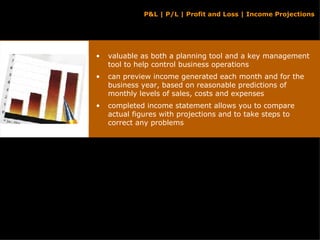
valuable as both a planning tool and a key management tool to help control business operations can preview income generated each month and for the business year, based on reasonable predictions of monthly levels of sales, costs and expenses completed income statement allows you to compare actual figures with projections and to take steps to correct any problems P&L | P/L | Profit and Loss | Income Projections
Cost of Sales do not overlook any costs that you have incurred calculate cost of sales of all services used to determine total net sales do not overlook transportation or travel costs if you’re working remotely include all direct labor
Controllable or Variable Expenses salary expenses  -  base pay plus overtime payroll expenses - include paid vacations, sick leave, health insurance, employment insurance (EI) and pension (CPP) outside services - include costs of subcontracts, overflow work and special or one – time services supplies - services and items purchased for use in the business repair and maintenance advertising expenses car delivery and travel - include charges if personal car is used in business, including parking, tools, buying trips, etc. accounting and legal - outside professional services
Fixed Expenses rent - list only real estate used in business depreciation - amortization of capital assets like computers utilities - water, heat, light, etc insurance - fire or liability on property or products loan repayments - interest on outstanding loans miscellaneous - unspecified; small expenditures without separate accounts
Go with the flow… how much cash do you need to run your business? how much cash is locked-up in other current assets? how long does it take to collect your cash from customers? how much cash should you hold? how do you cover cash deficits? how do you identify problems with cash flow?
cash is the most liquid of assets and it represents the lifeblood for growth and investment in order to generate cash, we must efficiently and effectively manage the activities that provide cash  these activities include billing customers as quickly as possible, disbursing payments only when they come due, collecting cash on overdue accounts, and investing idle cash managing cash flow involves several objectives: accelerating cash inflows wherever possible (receipts) delaying cash outflows until they come due (disbursements) investing surplus cash to earn a rate of return borrowing cash at the best possible terms maintaining an optimal level of cash that is neither excessive nor deficient Managing Cash Flow
overall objective is to delay making payments until they are due You can better manage cash flows by controlling float times: By increasing the float times within disbursements, you have the use of cash for several more days. Disbursements – paying for stuff Mail Float :  Time spent in the mail. Mail cheques from locations not close to customers. Clearance Float : Time spent trying to clear the bank. Disburse cheques from a remote bank. Processing Float :  Time required to process cash flow transactions. Pay by credit card.
Receipts - getting paid for stuff You can shorten the receipt time by: invoicing customers as quickly as possible. taking immediate action when a customer is late rewarding customers for making early payment by offering a discount imposing a finance charge on customers that are seriously late evaluating the financial soundness of customers before extending credit accepting credit cards for payment issuing monthly statements to remind customers of amounts owed placing collection centers near customers and/or having banks control deposits overall objective is to shorten the time it takes to get paid

Financial Management Overview

  • 1.
    when you spendmoney, it’s a number when you quote, it’s a number your client’s budget is a number your new design proposal requires some numbers It’s in your best interest to understand the numbers. Why do you have to know the numbers?
  • 2.
    But I willbe working in cubeville! regardless of where you end up, having financial knowledge will help you people you work with or report to have to deal with numbers budgets income projection statements balance sheets cash flow
  • 3.
    prepared when youare actually ready to open for business reflects your priorities in terms of how you spend your money, the expenses you will incur and how you will meet those expenses (income) should include money to cover the first three to six months of operation Operating Budget
  • 4.
    Balance Sheet "snapshot"of the company's financial condition on a given date it is the theoretical value of your company if you were to liquidate the assets, shut the doors and sell the company main thing people look at is level of debt and how the debt is financed
  • 5.
    valuable as botha planning tool and a key management tool to help control business operations can preview income generated each month and for the business year, based on reasonable predictions of monthly levels of sales, costs and expenses completed income statement allows you to compare actual figures with projections and to take steps to correct any problems P&L | P/L | Profit and Loss | Income Projections
  • 6.
    Cost of Salesdo not overlook any costs that you have incurred calculate cost of sales of all services used to determine total net sales do not overlook transportation or travel costs if you’re working remotely include all direct labor
  • 7.
    Controllable or VariableExpenses salary expenses - base pay plus overtime payroll expenses - include paid vacations, sick leave, health insurance, employment insurance (EI) and pension (CPP) outside services - include costs of subcontracts, overflow work and special or one – time services supplies - services and items purchased for use in the business repair and maintenance advertising expenses car delivery and travel - include charges if personal car is used in business, including parking, tools, buying trips, etc. accounting and legal - outside professional services
  • 8.
    Fixed Expenses rent- list only real estate used in business depreciation - amortization of capital assets like computers utilities - water, heat, light, etc insurance - fire or liability on property or products loan repayments - interest on outstanding loans miscellaneous - unspecified; small expenditures without separate accounts
  • 9.
    Go with theflow… how much cash do you need to run your business? how much cash is locked-up in other current assets? how long does it take to collect your cash from customers? how much cash should you hold? how do you cover cash deficits? how do you identify problems with cash flow?
  • 10.
    cash is themost liquid of assets and it represents the lifeblood for growth and investment in order to generate cash, we must efficiently and effectively manage the activities that provide cash these activities include billing customers as quickly as possible, disbursing payments only when they come due, collecting cash on overdue accounts, and investing idle cash managing cash flow involves several objectives: accelerating cash inflows wherever possible (receipts) delaying cash outflows until they come due (disbursements) investing surplus cash to earn a rate of return borrowing cash at the best possible terms maintaining an optimal level of cash that is neither excessive nor deficient Managing Cash Flow
  • 11.
    overall objective isto delay making payments until they are due You can better manage cash flows by controlling float times: By increasing the float times within disbursements, you have the use of cash for several more days. Disbursements – paying for stuff Mail Float : Time spent in the mail. Mail cheques from locations not close to customers. Clearance Float : Time spent trying to clear the bank. Disburse cheques from a remote bank. Processing Float : Time required to process cash flow transactions. Pay by credit card.
  • 12.
    Receipts - gettingpaid for stuff You can shorten the receipt time by: invoicing customers as quickly as possible. taking immediate action when a customer is late rewarding customers for making early payment by offering a discount imposing a finance charge on customers that are seriously late evaluating the financial soundness of customers before extending credit accepting credit cards for payment issuing monthly statements to remind customers of amounts owed placing collection centers near customers and/or having banks control deposits overall objective is to shorten the time it takes to get paid