Business Finance
Business FInance- is the cornerstone of every
organization.It refers to the corps of funds and
credit employed in a business. Business
Finance is required for purchasing
assets,goods,raw materials and for performing
all other economic activities. It is required for
running all business operations.
Importance of Business Finance
● Maximization of wealth - business
finance ensures that a shareholders
wealth is maximized. It is also important
to understand wealth maximization is
different from profit maximization.
Wealth maximization is holistic and
ensures the growth of an organization.
● Ensure constant availability of
money - for any business to survive, it
should be in optimum financial
condition. This includes the availability
of funds at the time they are needed (
Unless there are enough funds, the
business may not be able to function
properly.
● Attaining optimum capital structure -
This requires a perfect combination of
shares and debentures ( a long term
debt instrument issued by the
company/government ). This way the
organization will be able to maintain a
perfect balance and not give away too
much equity.
● Effective utilization of Funds - This is
another reason for the high importance
of business finance and its efficient
utilization. A business should be able to
cut down unnecessary costs and not
invest funds in assets that are not
required.
OVERVIEW OF FINANCIAL MANAGEMENT
What is FInancial Management?
- Financial management is about
controlling the flow of money in and out
of the organization.
- Every business needs to sell products
or services, pay expenses, balance the
book, and file taxes.
- Financial management encompasses all
of this, along with more complex
processes, such as paying employees,
buying supplies, and submitting reports
to government agencies to show they’re
obeying applicable laws and
regulations.
Importance of Financial Management
- The financial management of an
organization determines the objectives,
formulates the policies, lays out the
procedures, implements the
programmes, and allocates the budgets
related to all financial activities of a
business. Through a streamlined
financial management practice, it is
possible to ensure that there are
sufficient funds available for the
company at any stage of its operations
-
The importance of Financial Management
can be assessed by taking a look at this
core mandate:
1. Availability of sufficient funds
2. Maintaining a balance between income
and expenses to ensure financial
stability
3. Ensuring efficient and high ROI
4. Creating and executing business grown
and expansion plans
5. Safeguarding the organization against
market uncertainties through ensuring
buffer funds
Financial Management Scope
- Financial management in a company is
governed by the principle that it must
protect the financial interests of the
investors, shareholders, and ensure
business growth. Apart from securing
their interests, the financial managers
are also expected to ensure greater ROI
that generates more wealth for all
shareholders. There are certain
objectives of financial management
which are universally accepted by
experts and business leaders, and
these clearly outline the financial
management scope and functions.
Objectives of Financial Management
1. Assessing Capital Needs - Financial
managers need to evaluate factors such
as cost of current and fixed assets, cost
of marketing, need for buffer capital,
long-term operation and human
resources cost etc. Successful
2.
businesses have clearlydefined
short-term and long-term financial
requirement projections in place.
2. Determination of Capital Structure - A
company’s capital structure is the
framework that determines decisions
such as debt-equity ratio in the short as
well as long term.
3. Creation of effective financial
policies - There is a need to frame
efficient financial policies that govern
cash control, the lending and borrowing
processes and so on.
4. Resource Optimization - Great
financial managers are able to navigate
through
Function of Financial Managers and
advisors
- To achieve these objectives, the
financial managers and advisors must
perform certain functions. These
includes:
1. Fundraising - For any business to grow
confidently and have a good market
reputation, adequate amount of cash
and liquidity is critical. Therefore,
businesses raise funds by equity or debt
financing. Financial managers take
decisions on maintaining a healthy
balance between debt and equity to
ensure that the company’s financial
health is not impacted.
2. Fund allocation – Smart fund allocation
is as critical to a business’ financial
health as fund-raising itself. The funds
that a company has must be allocated in
the best way possible after due
diligence on:
● Business size and growth potential
● Whether the assets are short-term or
long-term before spending on them
● Mode of fund raising
3. Profit Planning – Unless it is a social
organization, earning more profits would
be among any business’s primary goals.
The profits a company makes,
determines its financial health and
future growth. Therefore, adequate
usage of the money generated as profit
is needed. Whether they have to be
ploughed back to acquire assets and
expand coverage, or to be spent on
marketing, acquiring other businesses
or invested to act as a buffer resource,
all these considerations are made by
financial leaders.
4. Understanding Capital Markets – A
company’s shares are publicly traded on
stock exchanges, and the transactions
as well as the change in a listed
company’s market capital is a constant
phenomenon. Good financial managers
have to be well-versed with the capital
market dynamics, and the risks
associated. Whether dividends are to be
given to the shareholders when
business generates profits or reinvested
into the business, is one of the crucial
decisions that can impact shareholders’
sentiments and company’s goodwill.
Understanding Financial Management
1.Invoicing and receivables: Money that
customers pay or have promised to pay to the
business. Finance teams are responsible for
sending out invoices and processing the
payments as they come in. Collections teams
are responsible for following up on overdue
accounts (this process is sometimes
outsourced to third parties).
2.Payables: Money that the company owes to
its vendors and suppliers. Finance teams are
responsible for paying these bills and recording
the payments.
3.Bank transactions and reconciliations
Finance teams work closely with their banks to
ensure that every bank transaction is
processed correctly. They must also make sure
that the bank’s statements match their own
records, which are kept in the company’s
general ledger and subledgers. The finance
team must follow up on, and correct, any
mismatches between bank statements and
ledgers—a process known as account
reconciliation.
HOW TO WORK IN FINANCE MANAGEMENT
- To work in finance management, you’ll
need a bachelor’s degree in business,
economics, finance, or a related field.
While there's no mandatory licensure for
careers in financial management,
3.
certification is highlyrecommended. In
many cases, employers like to see at
least five years of professional
experience before hiring into a financial
management position. Typical jobs that
individuals may pursue as an entry point
to finance management may include
loan officer,
Educational Requirements
- A bachelor’s degree in finance,
business management, or a related field
is the minimum requirement to work in
finance management. A master’s
degree may be required for senior-level
positions. Typical coursework for
bachelor’s degree programs in finance
or business management may include
accounting, economics, finance, and
human resources. Many master's
programs will offer internships, along
with some bachelor’s programs.
Internships are highly recommended
Certification
- Certification is optional but suggested if
you plan on a long-term career in
finance management. Professional
trade organizations typically offer
certification. The type of certification you
earn can be specialized to your job title
or role. Common certifications that
financial management professionals
hold include:
- Certified Management Account (CMA)
certification is offered by the Institute of
Management Accountants (IMA) and is
ideal for anyone wanting to work in
financial management. Requirements
include at least two years of
professional experience and a
bachelor’s degree.
- Chartered Financial Analyst (CFA)
certification offered by the CFA institute
focuses on investment analysis. This
certification is for financial management
professionals who want to work in
senior-level positions like CFO.
Educational and experiential
requirements are also necessary to
enroll in the CFA program.
Certified Government Financial Manager
(CGFM) certification
- offered by the Association of
Government Accountants (AGA) is for
professionals who work in government
financial management specifically. You’ll
need at least two years of professional
experience in government financial
management to earn certification.
Certified Treasury Professional (CTP)
certification
- offered by the Association of Financial
Professionals (AFP) can benefit anyone
who wants to work in corporate treasury.
This certification focuses on risk
management, corporate liquidity, and
ethics. You'll need to meet educational
and experiential requirements for this
certification, with several options
available for admittance into the CTP
program.
SKILLS
- Careers in finance management require
a mix of financial skills and business
skills. It’s essential to understand
business operations, but proficiency in
accounting, financial, and data analytics
is equally important. Finance
management merges management and
finance. You may find success working
in the field of finance management if
you hold these skills:
Workplace skills
•Good communication
•Problem-solving skills
•Organized
•Quality leader
•Proficiency in public speaking and
presentation
•Ability to manage a group of people
•Detail-oriented
•Analytical skills
•Strong decision-making skills
•Ethical
Technical skills
•Basic and advanced math skills (algebra,
statistics, basic computing)
4.
•Computer skills
•Proficiency infinancial management
systems
•Understanding of statistical modeling
software and spreadsheets
•Industry-specific knowledge
•Proficiency in accounting principles and
techniques
•Understanding investment principles
EXPERIENCE
- Professional experience in finance or
business management is key if you
want to advance into upper-level finance
management positions. Expect to work
at least five years in an entry to
mid-level finance position before being
eligible to work in finance management.
Remember, finance management
careers are managerial positions, so
requirements like experience and
education matter. It’s not just the
quantity of experience but also the
quality that matters. Try to find jobs in
finance or accounting. It’s also helpful to
find jobs that can help you move into the
specific industry that you want to work
in.
CAREERS IN FINANCE MANAGEMENT
- The scope of careers in the finance
management field is vast. From
entry-level positions in bookkeeping to
management positions like a financial
manager or management accountant,
you’ll have many career pathway
choices.The career you choose will
depend on factors like education,
certifications, professional experience,
industry, employer, and location.
Salaries among finance management
jobs will also differ based on these
factors. Individuals in senior-level
positions like CFO and vice president of
financial planning and analysis will be
among the top-tier earners in finance
management
FINANCIAL MANAGER
- Financial managers oversee a financial
department and may assist in creating
strategic financial plans for an
organization. Their duties include
preparing financial reports and
statements, forecasting, setting
budgets, analyzing financial markets for
trends and investment opportunities for
an organization, and seeking ways to
mitigate costs.
FINANCIAL ADVISOR
- Personal financial advisors assist
individuals in planning for their future by
helping them manage money and seek
out investments based on individual
situations. A personal financial advisor
meets with individuals to set financial
goals with short and long-term plans to
achieve those objectives. Some
financial aspects an advisor may handle
include taxes, retirement, college
savings, insurance, estate planning, and
more. Financial advisors may work for
an investment firm or on their own.
FINANCIAL ANALYST
- Financial analysts may work within a
large corporation or with individuals.
Their job is to analyze their client’s
financial situation and make financial
suggestions based on goals and
financial status. A financial suggestion
may include finding investment
opportunities. The goal of an analyst is
to evaluate market trends and position a
client in a secure financial standing
based on the analysis of trends and
related data.
MANAGEMENT ACCOUNTANT
- Management accountants work for
corporations or government agencies.
Their goal is to provide an in-depth
financial analysis of an organization’s
internal financial processes for strategic
financial decision-making. Key decision
makers in an organization use the
information gathered by management
accountants to aid in decision-making in
the long and short term.
Closing the books
- On a particular date, the company will
tally transactions from a given period so
it can reconcile its accounts and report
on its financial position. The close, as
this process is known, typically happens
at the end of a month, quarter, or year.
5.
Reporting
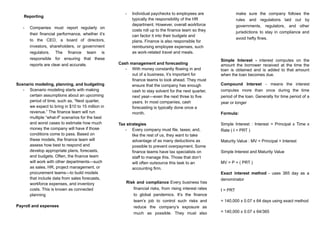
- Companies mustreport regularly on
their financial performance, whether it’s
to the CEO, a board of directors,
investors, shareholders, or government
regulators. The finance team is
responsible for ensuring that these
reports are clear and accurate.
Scenario modeling, planning, and budgeting
- Scenario modeling starts with making
certain assumptions about an upcoming
period of time, such as, “Next quarter,
we expect to bring in $10 to 15 million in
revenue.” The finance team will run
multiple “what-if” scenarios for the best
and worst cases to estimate how much
money the company will have if those
conditions come to pass. Based on
these models, the finance team will
assess how best to respond and
develop appropriate plans, forecasts,
and budgets. Often, the finance team
will work with other departments—such
as sales, HR, project management, or
procurement teams—to build models
that include data from sales forecasts,
workforce expenses, and inventory
costs. This is known as connected
planning
Payroll and expenses
- Individual paychecks to employees are
typically the responsibility of the HR
department. However, overall workforce
costs roll up to the finance team so they
can factor it into their budgets and
plans. Finance is also responsible for
reimbursing employee expenses, such
as work-related travel and meals.
Cash management and forecasting
- With money constantly flowing in and
out of a business, it’s important for
finance teams to look ahead. They must
ensure that the company has enough
cash to stay solvent for the next quarter,
next year—even the next three to five
years. In most companies, cash
forecasting is typically done once a
month.
Tax strategies
- Every company must file. taxes; and,
like the rest of us, they want to take
advantage of as many deductions as
possible to prevent overpayment. Some
finance teams have tax specialists on
staff to manage this. Those that don’t
will often outsource this task to an
accounting firm.
Risk and compliance Every business has
financial risks, from rising interest rates
to global pandemics. It’s the finance
team’s job to control such risks and
reduce the company’s exposure as
much as possible. They must also
make sure the company follows the
rules and regulations laid out by
governments, regulators, and other
jurisdictions to stay in compliance and
avoid hefty fines.
Simple Interest - interest computes on the
amount the borrower received at the time the
loan is obtained and is added to that amount
when the loan becomes due.
Compound Interest - means the interest
computes more than once during the time
period of the loan. Generally for time period of a
year or longer
Formula:
Simple Interest : Interest = Principal x Time x
Rate ( I = PRT )
Maturity Value : MV = Principal + Interest
Simple Interest and Maturity Value
MV = P + ( PRT )
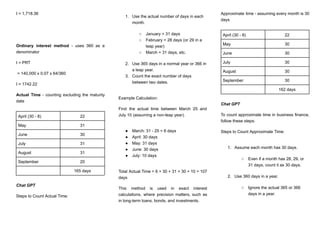
Exact interest method - uses 365 day as a
denominator
I = PRT
= 140,000 x 0.07 x 64 days using exact method
= 140,000 x 0.07 x 64/365
6.
I = 1,718.36
Ordinaryinterest method - uses 360 as a
denominator
I = PRT
= 140,000 x 0.07 x 64/360
I = 1742.22
Actual Time - counting excluding the maturity
date
April (30 - 8) 22
May 31
June 30
July 31
August 31
September 20
165 days
Chat GPT
Steps to Count Actual Time:
1. Use the actual number of days in each
month.
○ January = 31 days
○ February = 28 days (or 29 in a
leap year)
○ March = 31 days, etc.
2. Use 365 days in a normal year or 366 in
a leap year.
3. Count the exact number of days
between two dates.
Example Calculation:
Find the actual time between March 25 and
July 10 (assuming a non-leap year).
● March: 31 - 25 = 6 days
● April: 30 days
● May: 31 days
● June: 30 days
● July: 10 days
Total Actual Time = 6 + 30 + 31 + 30 + 10 = 107
days
This method is used in exact interest
calculations, where precision matters, such as
in long-term loans, bonds, and investments.
Approximate time - assuming every month is 30
days
April (30 - 8) 22
May 30
June 30
July 30
August 30
September 30
162 days
Chat GPT
To count approximate time in business finance,
follow these steps:
Steps to Count Approximate Time:
1. Assume each month has 30 days.
○ Even if a month has 28, 29, or
31 days, count it as 30 days.
2. Use 360 days in a year.
○ Ignore the actual 365 or 366
days in a year.
7.
3. Count thenumber of days between two
dates.
○ Count only the days between the
two dates using the 30-day per
month assumption.
○ If the starting date is on the 31st,
adjust it to the 30th.
Example Calculation:
Find the approximate time between March 25
and July 10.
● March: 30 - 25 = 5 days
● April: 30 days
● May: 30 days
● June: 30 days
● July: 10 days
Total Approximate Time = 5 + 30 + 30 + 30 + 10
= 105 days
This method simplifies interest calculations,
especially for ordinary interest calculations
using a 360-day year.
—-----------------------------------------------------------
Actual time (exact I. Method)
165 / 365
Approximate time (exact I. Method)
162 / 365
Actual time (ordinary I. Method)
165 / 360
Actual time (ordinary I. Method
162 / 360
Formula:
If R is not present
R = I / PxT
R= 5,810 / 175,000 x 125/360
= 5,810 / 60,763.8888
= 0.095616 (do not round off if it’s now final.
Convert to percentage, divide 100)
R=9.56%
If T is not present
T = I / PxR
If P is not present
P = I / RxT