FOREIGN DIRECT INVESTMENT
Presented to:
Sir Ahmed Ghazali
GROUP MEMBERS
 Muhammad Mansha 13024854-001
 Hassam Khalid 13024854-009
 Hafeez Ur Rahman 13024854-036
 Faisal Naseer 13024854-048
 Muhammad Waqas 13024854-050
 Atif Afzal 13024854-064
CONTENTS
 Introduction
 Types of FDI
 Forms of FDI
 Source of FDI
 Theories of FDI
 Stages of FDI
 Decision Framework for FDI
INTRODUCTION
Foreign Direct Investment mean an
individual, a group of individuals, an
incorporated or un- incorporated entity or a
public or private company investing his money
in other country.
CONTINUE
Increasing foreign direct investment is
usually used as one indicator of growing
economy. Foreign direct investment (FDI)
plays a positive role in the process of
economic growth.
TYPES OF FDI
1) Inward Foreign Direct Investment:
Inward FDI for an economy can be
defined as the capital provided from a
foreign direct investor (i.e. the coca cola
company) residing in a country, to that
economy, which is residing in another
country.
EXAMPLE
Procter & Gamble (P &G) decides to
open a factory in Pakistan. They are
going to need some capital. That capital
is inward FDI for Pakistan.
TYPES OF FDI
2) Outward Foreign Direct Investment:
Foreign direct investment by a domestic
firm establishing a facility abroad. Contrasts
with outward FDI.
Example:
Q mobile wants to establish a new
facility in UAE. Q mobile needs capital to
establish new facility in UAE. It is outward
FDI for Pakistan.
Muhmmad Mansha
13024854-001
FORMS OF FDI
Two main forms of FDI:
1) Greenfield Investment
2) Merger & Acquisition
FORMS OF FDI
Greenfield Investment:
A green field investment is a form of
foreign direct investment where a parent
company builds its operations in a foreign
country from the ground up. In addition to
building new facilities, most parent companies
also create new long-term jobs in the foreign
country by hiring new employees.
EXAMPLE
A company start its operations in new
country from the ground up that is Greenfield
investment.
FORMS OF FDI
Merger & Acquisitions:
Mergers and acquisitions (M&A) is a
general term that refers to the consolidation of
companies or assets. While there are several
types of transactions classified under the notion
of M&A, a merger means a combination of two
companies to form a new company, while an
acquisition is the purchase of one company by
another in which no new company is formed.
EXAMPLE
Pakistani operation of America and
emirates banks were sold to union bank.
Later on Union Bank and Standard
Charted Bank merge and new name is
Standard Charted Bank.
Faisal Naseer
13024854-048
GREENFIELD VS MERGER &
ACQUISITION
Greenfield: M & A:
 You will have control
over your staff
 you will have control
over your brand.
 It is likely to cost more.
 The entry process may
take years.
 You gain access to an
established market.
 You have skilled
workers
 Easy and Less Risky
 A merger can lead to
less choice
for consumers
WHY FDI?
There is a strong relationship between
foreign investment and economic growth.
Larger inflows of foreign investments are
needed for the country to achieve a sustainable
high trajectory of economic growth.
Exporting
Licensing
CONTINUE
Exporting:
Exporting is a function of international
trade whereby goods produced in one country are
shipped to another country for future sale or
trade.
Licensing:
A business arrangement in which one
company gives another company permission to
manufacture its product for a specified payment .
CONTINUE
Draw backs of Licensing:
 Valuable Technology/Formula
 Strategies no given
 Management
Hafeez Ur Rahman
13024854-036
THEORIES OF FDI
 MAC Dougall-Kemp Theory
 Industrial Organization Theory (Hymer)
 Location Specific Theory (Hood & Young)
 Product Cycle Theory
MAC DOUGALL-KEMP THEORY
A two-country model – one being the
investing country and the other being the host
country – and the price of capital being equal
to its marginal productivity, they explain that
capital moves freely from a capital abundant
country to a capital scarce country and in this
way the marginal productivity of capital tends
to equalize between the two countries.
INDUSTRIAL ORGANIZATION THEORY
(HYMER)
The industrial organization theory is based
on an oligopolistic or imperfect market in which
the investing firm operates. Market imperfections
arise in many cases, such as product
differentiation, marketing skills, proprietary
technology, managerial skills, better access to
capital, economies of scale, government-imposed
market distortions, and so on.
LOCATION SPECIFIC THEORY
(HOOD & YOUNG)
Hood and Young (1979) stress upon the
location-specific advantages. They argue that
since real wage cost varies among countries,
firms with low cost technology move to low
wage countries. Again, in some countries, trade
barriers are created to restrict import. MNCs
invest in such countries in order to start
manufacturing there and evade trade barriers.
Muhammad Waqas
13024854-050
STAGES OF FDI
 Innovation stage.
 Industrialization stage.
 Standardization stage.
INNOVATION STAGE
Exports
Develop Countries
INDUSTRIALIZATION STAGE
Imports
Consumption
Production
Exports
Industrial Counties
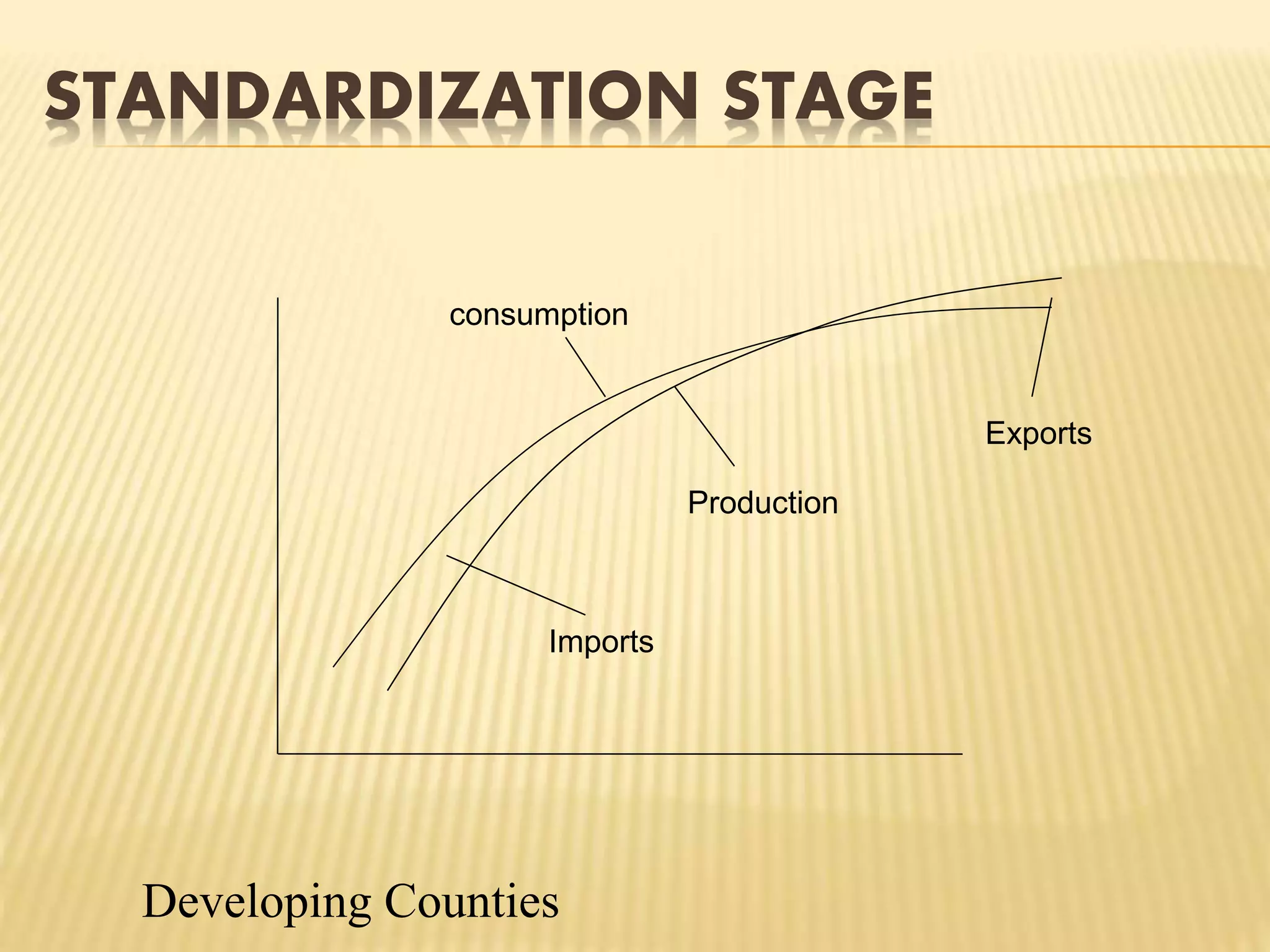
STANDARDIZATION STAGE
consumption
Exports
Imports
Production
Developing Counties
Presented By
Atif Afzal
13024854-064
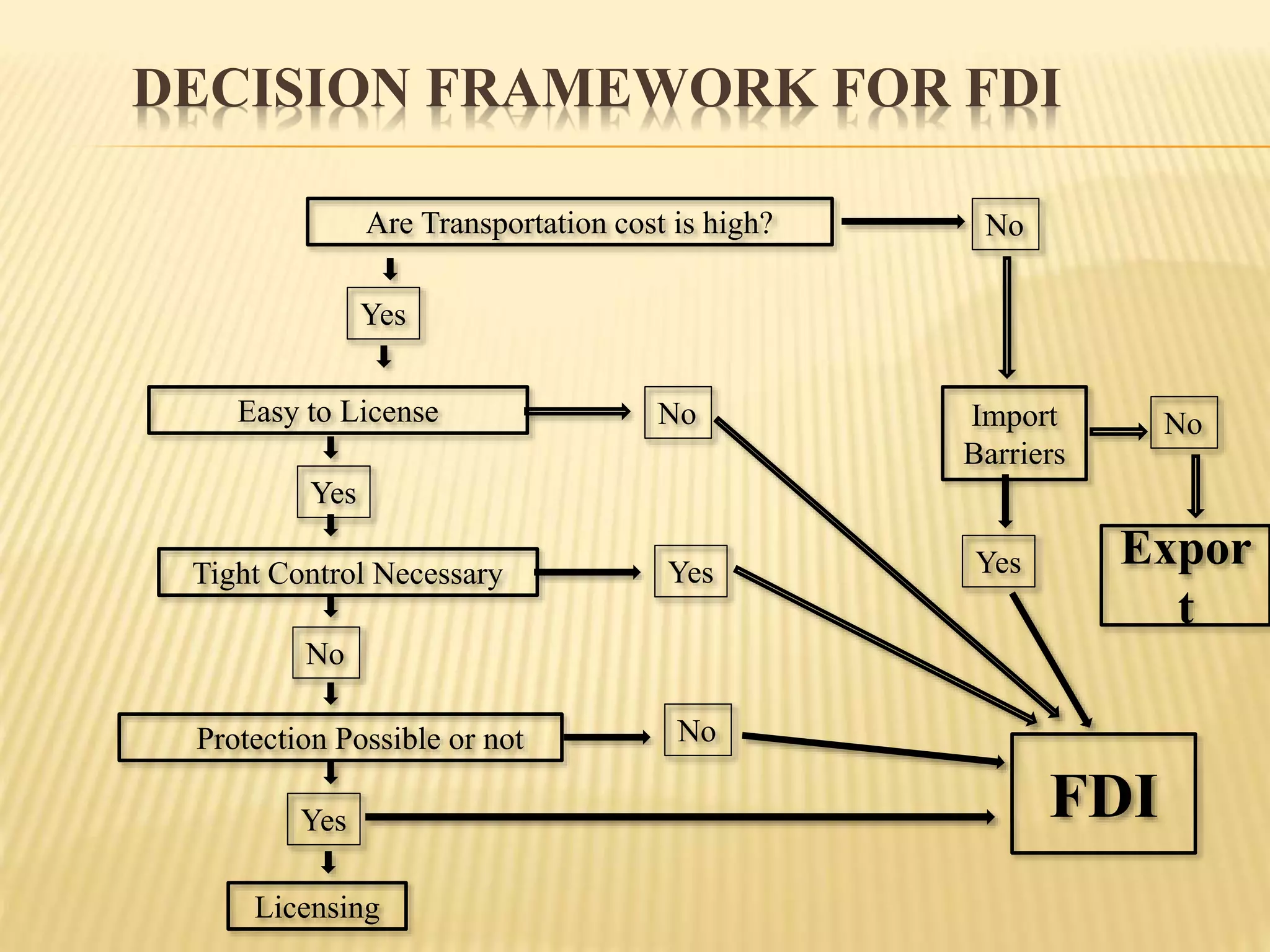
DECISION FRAMEWORK FOR FDI
Are Transportation cost is high? No
Import
Barriers
No
Expor
t
Yes
FDI
Yes
Easy to License
Tight Control Necessary
Protection Possible or not
Licensing
Yes
No
Yes
No
Yes
No
BENEFITS FOR HOST COUNTRY
 Inflow of equipment and technology
 Increase Employment
 Contribution to export growth
 Improved consumer welfare through reduced
cost, wider choice & improved quality.
 BOP Surplus
DRAWBACKS FOR HOST COUNTRY
 Crowing of local industry
 Effect on national environment
 Effect on culture
 BOP deficit in form of currency outflow
Benefits for Home Country
 BOP Surplus (Foreign earning)
 Variable Skill
Drawbacks for Home Country
 Employment
FDI presentation

FDI presentation

  • 1.
  • 2.
    GROUP MEMBERS  MuhammadMansha 13024854-001  Hassam Khalid 13024854-009  Hafeez Ur Rahman 13024854-036  Faisal Naseer 13024854-048  Muhammad Waqas 13024854-050  Atif Afzal 13024854-064
  • 3.
    CONTENTS  Introduction  Typesof FDI  Forms of FDI  Source of FDI  Theories of FDI  Stages of FDI  Decision Framework for FDI
  • 4.
    INTRODUCTION Foreign Direct Investmentmean an individual, a group of individuals, an incorporated or un- incorporated entity or a public or private company investing his money in other country.
  • 5.
    CONTINUE Increasing foreign directinvestment is usually used as one indicator of growing economy. Foreign direct investment (FDI) plays a positive role in the process of economic growth.
  • 6.
    TYPES OF FDI 1)Inward Foreign Direct Investment: Inward FDI for an economy can be defined as the capital provided from a foreign direct investor (i.e. the coca cola company) residing in a country, to that economy, which is residing in another country.
  • 7.
    EXAMPLE Procter & Gamble(P &G) decides to open a factory in Pakistan. They are going to need some capital. That capital is inward FDI for Pakistan.
  • 8.
    TYPES OF FDI 2)Outward Foreign Direct Investment: Foreign direct investment by a domestic firm establishing a facility abroad. Contrasts with outward FDI. Example: Q mobile wants to establish a new facility in UAE. Q mobile needs capital to establish new facility in UAE. It is outward FDI for Pakistan.
  • 9.
  • 10.
    FORMS OF FDI Twomain forms of FDI: 1) Greenfield Investment 2) Merger & Acquisition
  • 11.
    FORMS OF FDI GreenfieldInvestment: A green field investment is a form of foreign direct investment where a parent company builds its operations in a foreign country from the ground up. In addition to building new facilities, most parent companies also create new long-term jobs in the foreign country by hiring new employees.
  • 12.
    EXAMPLE A company startits operations in new country from the ground up that is Greenfield investment.
  • 13.
    FORMS OF FDI Merger& Acquisitions: Mergers and acquisitions (M&A) is a general term that refers to the consolidation of companies or assets. While there are several types of transactions classified under the notion of M&A, a merger means a combination of two companies to form a new company, while an acquisition is the purchase of one company by another in which no new company is formed.
  • 14.
    EXAMPLE Pakistani operation ofAmerica and emirates banks were sold to union bank. Later on Union Bank and Standard Charted Bank merge and new name is Standard Charted Bank.
  • 15.
  • 16.
    GREENFIELD VS MERGER& ACQUISITION Greenfield: M & A:  You will have control over your staff  you will have control over your brand.  It is likely to cost more.  The entry process may take years.  You gain access to an established market.  You have skilled workers  Easy and Less Risky  A merger can lead to less choice for consumers
  • 17.
    WHY FDI? There isa strong relationship between foreign investment and economic growth. Larger inflows of foreign investments are needed for the country to achieve a sustainable high trajectory of economic growth. Exporting Licensing
  • 18.
    CONTINUE Exporting: Exporting is afunction of international trade whereby goods produced in one country are shipped to another country for future sale or trade. Licensing: A business arrangement in which one company gives another company permission to manufacture its product for a specified payment .
  • 19.
    CONTINUE Draw backs ofLicensing:  Valuable Technology/Formula  Strategies no given  Management
  • 20.
  • 21.
    THEORIES OF FDI MAC Dougall-Kemp Theory  Industrial Organization Theory (Hymer)  Location Specific Theory (Hood & Young)  Product Cycle Theory
  • 22.
    MAC DOUGALL-KEMP THEORY Atwo-country model – one being the investing country and the other being the host country – and the price of capital being equal to its marginal productivity, they explain that capital moves freely from a capital abundant country to a capital scarce country and in this way the marginal productivity of capital tends to equalize between the two countries.
  • 23.
    INDUSTRIAL ORGANIZATION THEORY (HYMER) Theindustrial organization theory is based on an oligopolistic or imperfect market in which the investing firm operates. Market imperfections arise in many cases, such as product differentiation, marketing skills, proprietary technology, managerial skills, better access to capital, economies of scale, government-imposed market distortions, and so on.
  • 24.
    LOCATION SPECIFIC THEORY (HOOD& YOUNG) Hood and Young (1979) stress upon the location-specific advantages. They argue that since real wage cost varies among countries, firms with low cost technology move to low wage countries. Again, in some countries, trade barriers are created to restrict import. MNCs invest in such countries in order to start manufacturing there and evade trade barriers.
  • 25.
  • 26.
    STAGES OF FDI Innovation stage.  Industrialization stage.  Standardization stage.
  • 27.
  • 28.
  • 29.
  • 30.
  • 31.
    DECISION FRAMEWORK FORFDI Are Transportation cost is high? No Import Barriers No Expor t Yes FDI Yes Easy to License Tight Control Necessary Protection Possible or not Licensing Yes No Yes No Yes No
  • 32.
    BENEFITS FOR HOSTCOUNTRY  Inflow of equipment and technology  Increase Employment  Contribution to export growth  Improved consumer welfare through reduced cost, wider choice & improved quality.  BOP Surplus
  • 33.
    DRAWBACKS FOR HOSTCOUNTRY  Crowing of local industry  Effect on national environment  Effect on culture  BOP deficit in form of currency outflow
  • 34.
    Benefits for HomeCountry  BOP Surplus (Foreign earning)  Variable Skill Drawbacks for Home Country  Employment