Session Frame
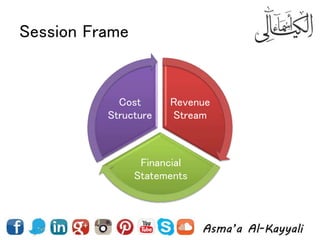
Revenue
Stream
Financial
Statements
Cost
Structure
Introduction
• 90% of new businesses fail in the first 3 years because they
fail to understand their costs or what it will take to create
the goods and services they have promised in their value
propositions.
• Describes the most important costs incurred while
operating under a particular business model. Creating and
delivering value, maintaining Customer Relationships, and
generating revenue all incur costs.
Key Questions
• What are the fundamental costs derived from my business
model?
• Which Key Resources represent a significant expense to the
business?
• Which Key Activities represent a significant expense to the
business?
• How do your Key activities drive costs?
• Are the above mentioned activities matched to the Value
Propositions for your business?
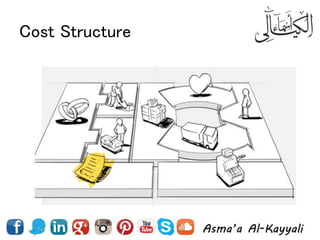
Cost Structure
Cost Structure
• When an entrepreneur has effectively figured out their key
resources, key activities and key partnerships the
aforementioned costs become easier to calculate.
• Must evaluate the cost of creating and delivering the value
proposition, creating revenue streams and focus on long-
term customer relationships.
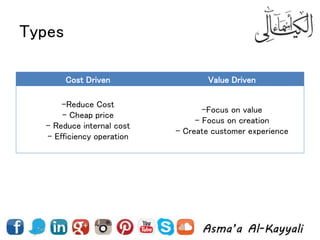
Types
Cost Driven Value Driven
-Reduce Cost
- Cheap price
- Reduce internal cost
- Efficiency operation
-Focus on value
- Focus on creation
- Create customer experience
Characteristics
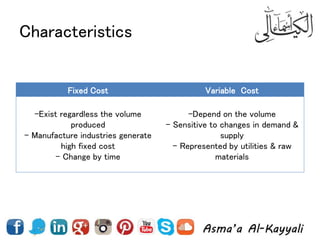
Fixed Cost Variable Cost
-Exist regardless the volume
produced
- Manufacture industries generate
high fixed cost
- Change by time
-Depend on the volume
- Sensitive to changes in demand &
supply
- Represented by utilities & raw
materials
Characteristics
Revenue Stream
Revenue Stream
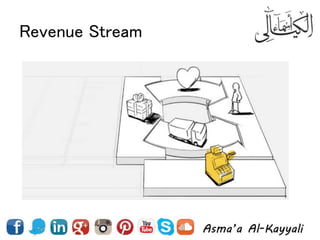
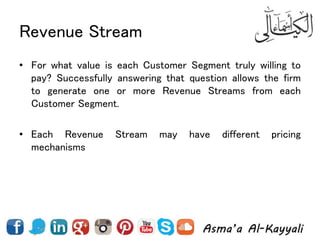
• For what value is each Customer Segment truly willing to
pay? Successfully answering that question allows the firm
to generate one or more Revenue Streams from each
Customer Segment.
• Each Revenue Stream may have different pricing
mechanisms
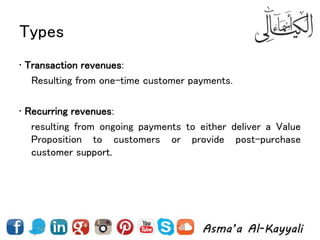
• Transaction revenues:
Resulting from one-time customer payments.
• Recurring revenues:
resulting from ongoing payments to either deliver a Value
Proposition to customers or provide post-purchase
customer support.
Types
Pricing Strategy
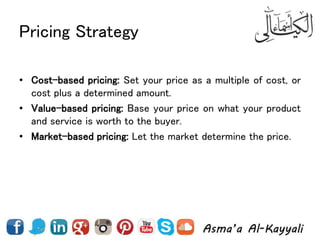
• Cost-based pricing: Set your price as a multiple of cost, or
cost plus a determined amount.
• Value-based pricing: Base your price on what your product
and service is worth to the buyer.
• Market-based pricing: Let the market determine the price.
Revenue Generation
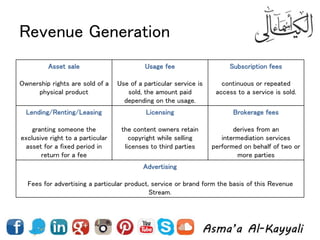
Asset sale
Ownership rights are sold of a
physical product
Usage fee
Use of a particular service is
sold, the amount paid
depending on the usage.
Subscription fees
continuous or repeated
access to a service is sold.
Lending/Renting/Leasing
granting someone the
exclusive right to a particular
asset for a fixed period in
return for a fee
Licensing
the content owners retain
copyright while selling
licenses to third parties
Brokerage fees
derives from an
intermediation services
performed on behalf of two or
more parties
Advertising
Fees for advertising a particular product, service or brand form the basis of this Revenue
Stream.
Financial Statement
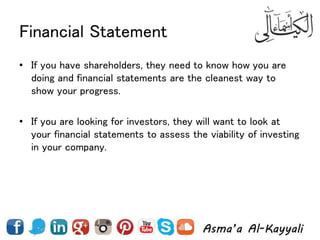
• If you have shareholders, they need to know how you are
doing and financial statements are the cleanest way to
show your progress.
• If you are looking for investors, they will want to look at
your financial statements to assess the viability of investing
in your company.
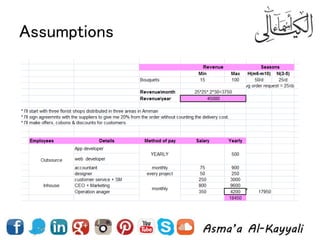
Assumptions
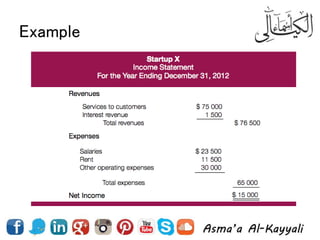
Example
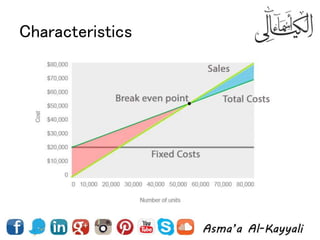
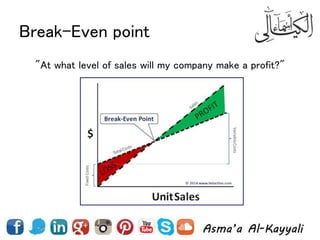
Break-Even point
"At what level of sales will my company make a profit?"
Financial Blocks - Business Model Generation

Financial Blocks - Business Model Generation

  • 2.
  • 3.
    Introduction • 90% ofnew businesses fail in the first 3 years because they fail to understand their costs or what it will take to create the goods and services they have promised in their value propositions. • Describes the most important costs incurred while operating under a particular business model. Creating and delivering value, maintaining Customer Relationships, and generating revenue all incur costs.
  • 4.
    Key Questions • Whatare the fundamental costs derived from my business model? • Which Key Resources represent a significant expense to the business? • Which Key Activities represent a significant expense to the business? • How do your Key activities drive costs? • Are the above mentioned activities matched to the Value Propositions for your business?
  • 5.
  • 6.
    Cost Structure • Whenan entrepreneur has effectively figured out their key resources, key activities and key partnerships the aforementioned costs become easier to calculate. • Must evaluate the cost of creating and delivering the value proposition, creating revenue streams and focus on long- term customer relationships.
  • 7.
    Types Cost Driven ValueDriven -Reduce Cost - Cheap price - Reduce internal cost - Efficiency operation -Focus on value - Focus on creation - Create customer experience
  • 8.
    Characteristics Fixed Cost VariableCost -Exist regardless the volume produced - Manufacture industries generate high fixed cost - Change by time -Depend on the volume - Sensitive to changes in demand & supply - Represented by utilities & raw materials
  • 9.
  • 10.
  • 11.
    Revenue Stream • Forwhat value is each Customer Segment truly willing to pay? Successfully answering that question allows the firm to generate one or more Revenue Streams from each Customer Segment. • Each Revenue Stream may have different pricing mechanisms
  • 12.
    • Transaction revenues: Resultingfrom one-time customer payments. • Recurring revenues: resulting from ongoing payments to either deliver a Value Proposition to customers or provide post-purchase customer support. Types
  • 13.
    Pricing Strategy • Cost-basedpricing: Set your price as a multiple of cost, or cost plus a determined amount. • Value-based pricing: Base your price on what your product and service is worth to the buyer. • Market-based pricing: Let the market determine the price.
  • 14.
    Revenue Generation Asset sale Ownershiprights are sold of a physical product Usage fee Use of a particular service is sold, the amount paid depending on the usage. Subscription fees continuous or repeated access to a service is sold. Lending/Renting/Leasing granting someone the exclusive right to a particular asset for a fixed period in return for a fee Licensing the content owners retain copyright while selling licenses to third parties Brokerage fees derives from an intermediation services performed on behalf of two or more parties Advertising Fees for advertising a particular product, service or brand form the basis of this Revenue Stream.
  • 15.
    Financial Statement • Ifyou have shareholders, they need to know how you are doing and financial statements are the cleanest way to show your progress. • If you are looking for investors, they will want to look at your financial statements to assess the viability of investing in your company.
  • 16.
  • 17.
  • 18.
    Break-Even point "At whatlevel of sales will my company make a profit?"

Editor's Notes

  • #14 Pricing may be Fixed or Dynamic. The first is based on static variables. A List Price is as stated in the brochure etc., but may be subject to discounts depending on the number of items purchased or service required. Price may also be tailored to characteristics of the particular Customer Segment. Dynamic Pricing, by contrast, depends on market conditions, and is subject to the power and negotiating skill of the purchaser. In Yield Management the price depends on the inventory and time of purchase (as in airline seats or hotel rooms). Price in real-time markets is dynamically established by supply and demands conditions. Prices at auction result from competitive bidding.