FINANCIAL PLAN
       HENDRY HARTONO, SE.,MM.


                                 1
The financial plan is critical to the success of your business
plan – especially if it is for the purpose of getting a bank loan.
The Cash Flow Forecast is arguably the most important part
of the plan, but each of the other documents is important from
a planning perspective. There are three sections in a financial
plan:
1. The Starting Balance Sheet
2. The Pro-Forma (or Forecast) Income Statement
3. The Cash Flow Forecast


                                                                     2
To assist you in this process, we have
created a template written for MS/Excel.

Tips :
1. Be patient
2. Get help
3. Be consistent
4. Use the simple template provided


                                           3
   Starting Costs
    ◦ Estimate Current Assets
    ◦ Estimate Capital Assets
    ◦ Estimate Start-up Expenses
   Starting Balance Sheet
    ◦   Total Assets (from above)
    ◦   Planned Investment (Equity)
    ◦   Planned Loans (Liabilities)
    ◦   Balance Sheet Formula
    ◦   Assets = Liabilities + Equity


                                        4
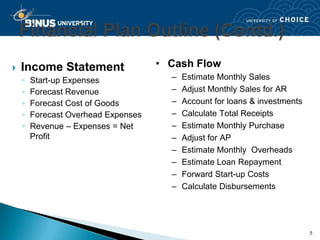
   Income Statement                 • Cash Flow
    ◦   Start-up Expenses              –   Estimate Monthly Sales
    ◦   Forecast Revenue               –   Adjust Monthly Sales for AR
    ◦   Forecast Cost of Goods         –   Account for loans & investments
    ◦   Forecast Overhead Expenses     –   Calculate Total Receipts
    ◦   Revenue – Expenses = Net       –   Estimate Monthly Purchase
        Profit                         –   Adjust for AP
                                       –   Estimate Monthly Overheads
                                       –   Estimate Loan Repayment
                                       –   Forward Start-up Costs
                                       –   Calculate Disbursements


                                                                             5
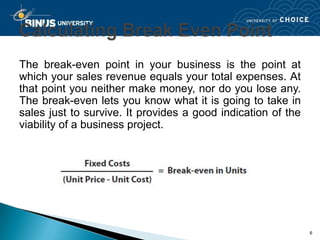
The break-even point in your business is the point at
which your sales revenue equals your total expenses. At
that point you neither make money, nor do you lose any.
The break-even lets you know what it is going to take in
sales just to survive. It provides a good indication of the
viability of a business project.


                                                              6
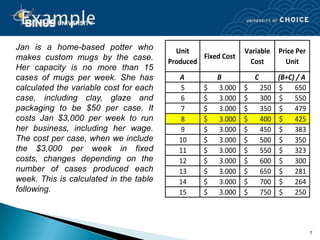
Jan is a home-based potter who            Unit                Variable      Price Per
makes custom mugs by the case.                   Fixed Cost
                                        Produced               Cost           Unit
Her capacity is no more than 15
cases of mugs per week. She has            A          B           C         (B+C) / A
calculated the variable cost for each      5      $   3.000   $       250   $    650
case, including clay, glaze and            6      $   3.000   $       300   $    550
packaging to be $50 per case. It           7      $   3.000   $       350   $    479
costs Jan $3,000 per week to run           8      $   3.000   $       400   $    425
her business, including her wage.          9      $   3.000   $       450   $    383
The cost per case, when we include         10     $   3.000   $       500   $    350
the $3,000 per week in fixed               11     $   3.000   $       550   $    323
costs, changes depending on the            12     $   3.000   $       600   $    300
number of cases produced each              13     $   3.000   $       650   $    281
week. This is calculated in the table      14     $   3.000   $       700   $    264
following.                                 15     $   3.000   $       750   $    250


                                                                                        7
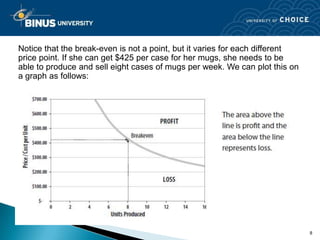
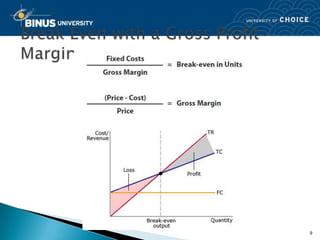
Notice that the break-even is not a point, but it varies for each different
price point. If she can get $425 per case for her mugs, she needs to be
able to produce and sell eight cases of mugs per week. We can plot this on
a graph as follows:


                                                                              8
9
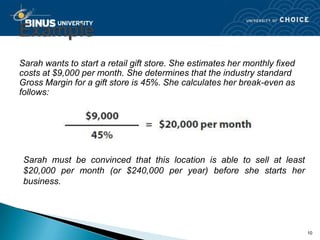
Sarah wants to start a retail gift store. She estimates her monthly fixed
costs at $9,000 per month. She determines that the industry standard
Gross Margin for a gift store is 45%. She calculates her break-even as
follows:


 Sarah must be convinced that this location is able to sell at least
 $20,000 per month (or $240,000 per year) before she starts her
 business.


                                                                            10
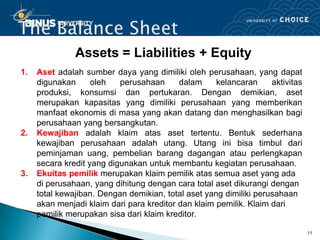
Assets = Liabilities + Equity
1.   Aset adalah sumber daya yang dimiliki oleh perusahaan, yang dapat
     digunakan      oleh   perusahaan      dalam     kelancaran     aktivitas
     produksi, konsumsi dan pertukaran. Dengan demikian, aset
     merupakan kapasitas yang dimiliki perusahaan yang memberikan
     manfaat ekonomis di masa yang akan datang dan menghasilkan bagi
     perusahaan yang bersangkutan.
2.   Kewajiban adalah klaim atas aset tertentu. Bentuk sederhana
     kewajiban perusahaan adalah utang. Utang ini bisa timbul dari
     peminjaman uang, pembelian barang dagangan atau perlengkapan
     secara kredit yang digunakan untuk membantu kegiatan perusahaan.
3.   Ekuitas pemilik merupakan klaim pemilik atas semua aset yang ada
     di perusahaan, yang dihitung dengan cara total aset dikurangi dengan
     total kewajiban. Dengan demikian, total aset yang dimiliki perusahaan
     akan menjadi klaim dari para kreditor dan klaim pemilik. Klaim dari
     pemilik merupakan sisa dari klaim kreditor.

                                                                                11
The first “Current Assets”.
These are assets (things your business owns) which will be used up
within the first year of doing business. Typically they include
cash, inventory and pre-paid expenses (such as pre-paid insurance).
Although Accounts Receivable is another example of a current
asset, there are no accounts receivables in a business start-up.
The second “Capital Assets”.
These are items you purchase with the intention of keeping them and
using them to run the business. For example, if you purchase a vehicle
to use in the business, it is a capital asset. If you purchase a vehicle to
re-sell it, however, then that vehicle is inventory.


                                                                              12
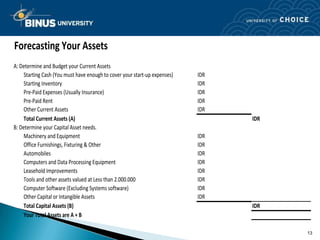
Forecasting Your Assets
A: Determine and Budget your Current Assets
    Starting Cash (You must have enough to cover your start-up expenses)   IDR
    Starting Inventory                                                     IDR
    Pre-Paid Expenses (Usually Insurance)                                  IDR
    Pre-Paid Rent                                                          IDR
    Other Current Assets                                                   IDR
    Total Current Assets (A)                                                     IDR
B: Determine your Capital Asset needs.
    Machinery and Equipment                                                IDR
    Office Furnishings, Fixturing & Other                                  IDR
    Automobiles                                                            IDR
    Computers and Data Processing Equipment                                IDR
    Leasehold Improvements                                                 IDR
    Tools and other assets valued at Less than 2.000.000                   IDR
    Computer Software (Excluding Systems software)                         IDR
    Other Capital or Intangible Assets                                     IDR
    Total Capital Assets (B)                                                     IDR
    Your Total Assets are A + B

                                                                                       13
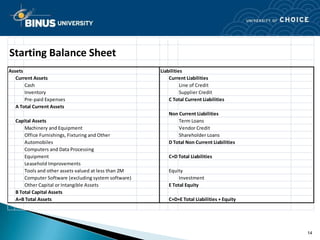
Starting Balance Sheet
Assets                                                 Liabilities
   Current Assets                                          Current Liabilities
       Cash                                                      Line of Credit
       Inventory                                                 Supplier Credit
       Pre-paid Expenses                                   C Total Current Liabilities
   A Total Current Assets
                                                           Non Current Liabilities
   Capital Assets                                              Term Loans
       Machinery and Equipment                                 Vendor Credit
       Office Furnishings, Fixturing and Other                 Shareholder Loans
       Automobiles                                         D Total Non Current Liabilities
       Computers and Data Processing
       Equipment                                           C+D Total Liabilities
       Leasehold Improvements
       Tools and other assets valued at less than 2M       Equity
       Computer Software (excluding system software)            Investment
       Other Capital or Intangible Assets                  E Total Equity
   B Total Capital Assets
   A+B Total Assets                                        C+D+E Total Liabilities + Equity


                                                                                              14
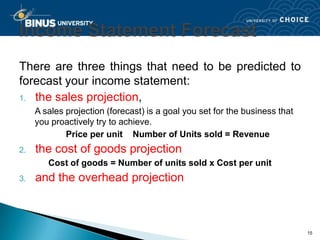
There are three things that need to be predicted to
forecast your income statement:
1. the sales projection,
     A sales projection (forecast) is a goal you set for the business that
     you proactively try to achieve.
             Price per unit Number of Units sold = Revenue
2.   the cost of goods projection
        Cost of goods = Number of units sold x Cost per unit
3.   and the overhead projection


                                                                             15
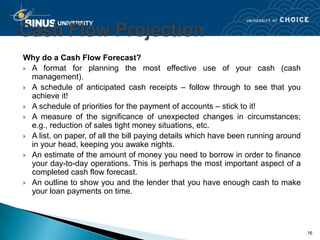
Why do a Cash Flow Forecast?
 A format for planning the most effective use of your cash (cash
  management).
 A schedule of anticipated cash receipts – follow through to see that you
  achieve it!
 A schedule of priorities for the payment of accounts – stick to it!
 A measure of the significance of unexpected changes in circumstances;
  e.g., reduction of sales tight money situations, etc.
 A list, on paper, of all the bill paying details which have been running around
  in your head, keeping you awake nights.
 An estimate of the amount of money you need to borrow in order to finance
  your day-to-day operations. This is perhaps the most important aspect of a
  completed cash flow forecast.
 An outline to show you and the lender that you have enough cash to make
  your loan payments on time.


                                                                                    16
1.   Receipts
     ◦ Receipts from Operations
     ◦ Receipts from Loan Proceeds
     ◦ Receipts from Investments
2.   Disbursements
     ◦ Disbursements of Purchases / Sub Contracting / Piecework
       Labour
     ◦ Disbursement of Administrative Expenses
     ◦ Disbursements for Capital Purchases
     ◦ Disbursements for Debt Repayment or Dividends
 Calculation of Cash Flow


                                                                  17
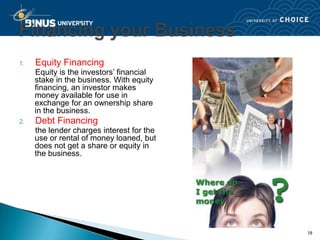
1.   Equity Financing
     Equity is the investors’ financial
     stake in the business. With equity
     financing, an investor makes
     money available for use in
     exchange for an ownership share
     in the business.
2.   Debt Financing
     the lender charges interest for the
     use or rental of money loaned, but
     does not get a share or equity in
     the business.


                                           18
Many banks use the four C’s to evaluate loan proposals. They
represent:
  Capacity / Cash Flow: ability to pay the loan, ability to generate
   revenues
  Collateral: The value of internal and external security that may be
   liquidated
  Character: personal history to determine attitudes towards credit

  Commitment: measure your capital to see the owner commitment
   in this business


                                                                         19
1.   Check your financial plant every month. Check against actual. This
     will help you anticipate problems before they arise
2.   Finance is difficult for most entrepreneurs. Use professionals such
     as accountants or consultants (or BINUS Entrepreneurship Center)
     to help you make sense of your financial statements. Financial
     plans and financial statements are a critical part of managing your
     business.


     Good luck with your planning
        and with your business.

                                                                           20

Finance2

  • 1.
    FINANCIAL PLAN HENDRY HARTONO, SE.,MM. 1
  • 2.
    The financial planis critical to the success of your business plan – especially if it is for the purpose of getting a bank loan. The Cash Flow Forecast is arguably the most important part of the plan, but each of the other documents is important from a planning perspective. There are three sections in a financial plan: 1. The Starting Balance Sheet 2. The Pro-Forma (or Forecast) Income Statement 3. The Cash Flow Forecast 2
  • 3.
    To assist youin this process, we have created a template written for MS/Excel. Tips : 1. Be patient 2. Get help 3. Be consistent 4. Use the simple template provided 3
  • 4.
    Starting Costs ◦ Estimate Current Assets ◦ Estimate Capital Assets ◦ Estimate Start-up Expenses  Starting Balance Sheet ◦ Total Assets (from above) ◦ Planned Investment (Equity) ◦ Planned Loans (Liabilities) ◦ Balance Sheet Formula ◦ Assets = Liabilities + Equity 4
  • 5.
    Income Statement • Cash Flow ◦ Start-up Expenses – Estimate Monthly Sales ◦ Forecast Revenue – Adjust Monthly Sales for AR ◦ Forecast Cost of Goods – Account for loans & investments ◦ Forecast Overhead Expenses – Calculate Total Receipts ◦ Revenue – Expenses = Net – Estimate Monthly Purchase Profit – Adjust for AP – Estimate Monthly Overheads – Estimate Loan Repayment – Forward Start-up Costs – Calculate Disbursements 5
  • 6.
    The break-even pointin your business is the point at which your sales revenue equals your total expenses. At that point you neither make money, nor do you lose any. The break-even lets you know what it is going to take in sales just to survive. It provides a good indication of the viability of a business project. 6
  • 7.
    Jan is ahome-based potter who Unit Variable Price Per makes custom mugs by the case. Fixed Cost Produced Cost Unit Her capacity is no more than 15 cases of mugs per week. She has A B C (B+C) / A calculated the variable cost for each 5 $ 3.000 $ 250 $ 650 case, including clay, glaze and 6 $ 3.000 $ 300 $ 550 packaging to be $50 per case. It 7 $ 3.000 $ 350 $ 479 costs Jan $3,000 per week to run 8 $ 3.000 $ 400 $ 425 her business, including her wage. 9 $ 3.000 $ 450 $ 383 The cost per case, when we include 10 $ 3.000 $ 500 $ 350 the $3,000 per week in fixed 11 $ 3.000 $ 550 $ 323 costs, changes depending on the 12 $ 3.000 $ 600 $ 300 number of cases produced each 13 $ 3.000 $ 650 $ 281 week. This is calculated in the table 14 $ 3.000 $ 700 $ 264 following. 15 $ 3.000 $ 750 $ 250 7
  • 8.
    Notice that thebreak-even is not a point, but it varies for each different price point. If she can get $425 per case for her mugs, she needs to be able to produce and sell eight cases of mugs per week. We can plot this on a graph as follows: 8
  • 9.
  • 10.
    Sarah wants tostart a retail gift store. She estimates her monthly fixed costs at $9,000 per month. She determines that the industry standard Gross Margin for a gift store is 45%. She calculates her break-even as follows: Sarah must be convinced that this location is able to sell at least $20,000 per month (or $240,000 per year) before she starts her business. 10
  • 11.
    Assets = Liabilities+ Equity 1. Aset adalah sumber daya yang dimiliki oleh perusahaan, yang dapat digunakan oleh perusahaan dalam kelancaran aktivitas produksi, konsumsi dan pertukaran. Dengan demikian, aset merupakan kapasitas yang dimiliki perusahaan yang memberikan manfaat ekonomis di masa yang akan datang dan menghasilkan bagi perusahaan yang bersangkutan. 2. Kewajiban adalah klaim atas aset tertentu. Bentuk sederhana kewajiban perusahaan adalah utang. Utang ini bisa timbul dari peminjaman uang, pembelian barang dagangan atau perlengkapan secara kredit yang digunakan untuk membantu kegiatan perusahaan. 3. Ekuitas pemilik merupakan klaim pemilik atas semua aset yang ada di perusahaan, yang dihitung dengan cara total aset dikurangi dengan total kewajiban. Dengan demikian, total aset yang dimiliki perusahaan akan menjadi klaim dari para kreditor dan klaim pemilik. Klaim dari pemilik merupakan sisa dari klaim kreditor. 11
  • 12.
    The first “CurrentAssets”. These are assets (things your business owns) which will be used up within the first year of doing business. Typically they include cash, inventory and pre-paid expenses (such as pre-paid insurance). Although Accounts Receivable is another example of a current asset, there are no accounts receivables in a business start-up. The second “Capital Assets”. These are items you purchase with the intention of keeping them and using them to run the business. For example, if you purchase a vehicle to use in the business, it is a capital asset. If you purchase a vehicle to re-sell it, however, then that vehicle is inventory. 12
  • 13.
    Forecasting Your Assets A:Determine and Budget your Current Assets Starting Cash (You must have enough to cover your start-up expenses) IDR Starting Inventory IDR Pre-Paid Expenses (Usually Insurance) IDR Pre-Paid Rent IDR Other Current Assets IDR Total Current Assets (A) IDR B: Determine your Capital Asset needs. Machinery and Equipment IDR Office Furnishings, Fixturing & Other IDR Automobiles IDR Computers and Data Processing Equipment IDR Leasehold Improvements IDR Tools and other assets valued at Less than 2.000.000 IDR Computer Software (Excluding Systems software) IDR Other Capital or Intangible Assets IDR Total Capital Assets (B) IDR Your Total Assets are A + B 13
  • 14.
    Starting Balance Sheet Assets Liabilities Current Assets Current Liabilities Cash Line of Credit Inventory Supplier Credit Pre-paid Expenses C Total Current Liabilities A Total Current Assets Non Current Liabilities Capital Assets Term Loans Machinery and Equipment Vendor Credit Office Furnishings, Fixturing and Other Shareholder Loans Automobiles D Total Non Current Liabilities Computers and Data Processing Equipment C+D Total Liabilities Leasehold Improvements Tools and other assets valued at less than 2M Equity Computer Software (excluding system software) Investment Other Capital or Intangible Assets E Total Equity B Total Capital Assets A+B Total Assets C+D+E Total Liabilities + Equity 14
  • 15.
    There are threethings that need to be predicted to forecast your income statement: 1. the sales projection, A sales projection (forecast) is a goal you set for the business that you proactively try to achieve. Price per unit Number of Units sold = Revenue 2. the cost of goods projection Cost of goods = Number of units sold x Cost per unit 3. and the overhead projection 15
  • 16.
    Why do aCash Flow Forecast?  A format for planning the most effective use of your cash (cash management).  A schedule of anticipated cash receipts – follow through to see that you achieve it!  A schedule of priorities for the payment of accounts – stick to it!  A measure of the significance of unexpected changes in circumstances; e.g., reduction of sales tight money situations, etc.  A list, on paper, of all the bill paying details which have been running around in your head, keeping you awake nights.  An estimate of the amount of money you need to borrow in order to finance your day-to-day operations. This is perhaps the most important aspect of a completed cash flow forecast.  An outline to show you and the lender that you have enough cash to make your loan payments on time. 16
  • 17.
    1. Receipts ◦ Receipts from Operations ◦ Receipts from Loan Proceeds ◦ Receipts from Investments 2. Disbursements ◦ Disbursements of Purchases / Sub Contracting / Piecework Labour ◦ Disbursement of Administrative Expenses ◦ Disbursements for Capital Purchases ◦ Disbursements for Debt Repayment or Dividends Calculation of Cash Flow 17
  • 18.
    1. Equity Financing Equity is the investors’ financial stake in the business. With equity financing, an investor makes money available for use in exchange for an ownership share in the business. 2. Debt Financing the lender charges interest for the use or rental of money loaned, but does not get a share or equity in the business. 18
  • 19.
    Many banks usethe four C’s to evaluate loan proposals. They represent:  Capacity / Cash Flow: ability to pay the loan, ability to generate revenues  Collateral: The value of internal and external security that may be liquidated  Character: personal history to determine attitudes towards credit  Commitment: measure your capital to see the owner commitment in this business 19
  • 20.
    1. Check your financial plant every month. Check against actual. This will help you anticipate problems before they arise 2. Finance is difficult for most entrepreneurs. Use professionals such as accountants or consultants (or BINUS Entrepreneurship Center) to help you make sense of your financial statements. Financial plans and financial statements are a critical part of managing your business. Good luck with your planning and with your business. 20