Seat No.: __________                               Enrolment No._____________

            GUJARAT TECHNOLOGICAL UNIVERSITY
                   MBA Semester –II Examination Dec. - 2011

Subject code: 820003                                                Date: 12/12/2011
Subject Name: Financial Management
Time: 10.30 am – 01.30 pm                                           Total Marks: 70

Instructions:
          1. Attempt all questions.
          2. Make suitable assumptions wherever necessary.
          3. Figures to the right indicate full marks.

Q.1 (a) E Co. is contemplating a debenture issue on the following terms:                  07
        Face Value = Rs 100 per debenture
        Term to maturity = 7 years
        Coupon rate of interest:
        1 – 2 years = 8% p.a.
        3 – 4 tears = 12% p.a.
        5 – 7 years = 15% p.a.
        The current market rate of interest on similar debentures is 15% p.a. The
        company proposes to price the issue so as to yield (compounded) return of
        16% p.a. to the investors. Determine the issue price. Assume the redemption
        on debentures at a premium of 5%.
    (b) A real estate firm has rented out one of their apartment for 5 years at an annual 07
        rent of Rs. 6,00,000 with the stipulation that rent will increase by 5% in every
        year. If the firm’s required rate of return is 14%, what is the present value of
        the expected rent?

Q.2 (a) Discuss the various sources of working capital finance.                          07
    (b) From the following particulars with respect to a particular item of materials of 07
        a manufacturing company, calculate the best quantity to order.
         Ordering quantity (Kg)      Price per Kg (Rs)
         Less than 250                      6.00
         250 but less than 800              5.90
         800 but less than 2,000            5.80
         2,000 but less than 4,000          5.70
         4,000 and above                    5.60

           The annual demand for the material is 4,000 kg. Stock holding costs are 20%
           of material cost p.a. The delivery cost per order is Rs. 6.00.

                                               OR


                                                                                           1
(b) The following forecasts have been made for ABC Ltd for the period January to 07
         April 2010.
                                                                  (Rs ‘ 00)
                                     Jan      Feb       March      April
          Sales                    75,000 1,05,000 1,80,000 1,05,000
          Raw Material             70,000 1,00,000 80,000        85,000
          Manufacturing Exps 10,000 20,000            29,000     16,000
          Loan Instalment          1,000 11,000       21,000     21,000
         Additional Information
          (i) All sales are made on credit basis. 2/3 of debtors are collected in the
                same month and balance in the next month. There is no expected bad
                debt. The debtors on January 1, 2010 were Rs. 30,00,000.
          (ii) The minimum cash balance, the firm must have is estimated to be Rs.
                5,00,000, however, the cash balance on January 1 was Rs. 6,50,000.
          (iii) Borrowing if any, can be made in multiple of Rs.10,000 only.
                Prepare the cash budget for the period of four months. (ignore interest
                on borrowings)

Q.3 (a) A firm whose cost of capital is 10% is considering two mutually exclusive 07
        projects X and Y, the details of which are:
                          Year Project X (Rs) Project Y (Rs)
         Cost                0          70,000           70,000
                             1          10,000           50,000
                             2          20,000           40,000
          Cash Inflows       3          30,000           20,000
                             4          45,000           10,000
                             5          60,000           10,000
        Compute the Net present Value at 10%, Profitability Index at 10% and
        Internal Rate of Return for the two projects and suggest which project should
        be selected & Why ?
    (b) The capital structure of B Ltd. as on 31-03-2007 is as follows:                 07
                                                           (Rs. Crores)
         Equity Capital 100 lakhs equity shares of Rs 10 each 10
         Reserves                                                  2
         14%debentures of Rs. 100 each                             3
         For the year ended 31-03-2007 the company has paid equity dividend at 20%.
        As the company is a market leader with good future, dividend is likely to grow
        by 5% every year. The equity shares are now traded at Rs. 80 per share in the
        stock exchange. Income tax rate applicable to the company is 50%
        Required :
          (i) The current weighted cost of capital
          (ii) The company has plans to raise a further Rs. 5 crores by way of long
               term loan at 16% interest. When this takes place the market value of the
               equity shares is expected to fall to Rs. 50 per share. What will be the
               new weighted average cost of capital of the company?
                                               OR


                                                                                         2
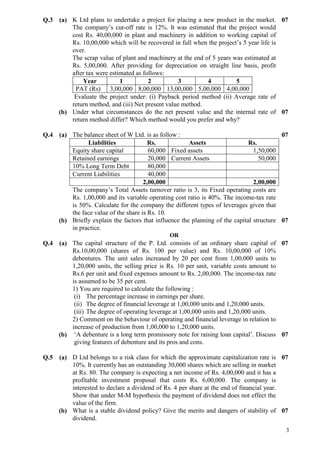
Q.3 (a) K Ltd plans to undertake a project for placing a new product in the market. 07
        The company’s cut-off rate is 12%. It was estimated that the project would
        cost Rs. 40,00,000 in plant and machinery in addition to working capital of
        Rs. 10,00,000 which will be recovered in full when the project’s 5 year life is
        over.
        The scrap value of plant and machinery at the end of 5 years was estimated at
        Rs. 5,00,000. After providing for depreciation on straight line basis, profit
        after tax were estimated as follows:
            Year           1          2           3        4          5
         PAT (Rs) 3,00,000 8,00,000 13,00,000 5,00,000 4,00,000
         Evaluate the project under: (i) Payback period method (ii) Average rate of
        return method, and (iii) Net present value method.
    (b) Under what circumstances do the net present value and the internal rate of 07
        return method differ? Which method would you prefer and why?

Q.4 (a) The balance sheet of W Ltd. is as follow :                                       07
              Liabilities              Rs.            Assets                 Rs.
        Equity share capital           60,000 Fixed assets                     1,50,000
        Retained earnings              20,000 Current Assets                     50,000
        10% Long Term Debt             80,000
        Current Liabilities            40,000
                                     2,00,000                                  2,00,000
        The company’s Total Assets turnover ratio is 3, its Fixed operating costs are
        Rs. 1,00,000 and its variable operating cost ratio is 40%. The income-tax rate
        is 50%. Calculate for the company the different types of leverages given that
        the face value of the share is Rs. 10.
    (b) Briefly explain the factors that influence the planning of the capital structure 07
        in practice.
                                               OR
Q.4 (a) The capital structure of the P. Ltd. consists of an ordinary share capital of 07
        Rs.10,00,000 (shares of Rs. 100 per value) and Rs. 10,00,000 of 10%
        debentures. The unit sales increased by 20 per cent from 1,00,000 units to
        1,20,000 units, the selling price is Rs. 10 per unit, variable costs amount to
        Rs.6 per unit and fixed expenses amount to Rs. 2,00,000. The income-tax rate
        is assumed to be 35 per cent.
        1) You are required to calculate the following :
         (i) The percentage increase in earnings per share.
         (ii) The degree of financial leverage at 1,00,000 units and 1,20,000 units.
         (iii) The degree of operating leverage at 1,00,000 units and 1,20,000 units.
        2) Comment on the behaviour of operating and financial leverage in relation to
        increase of production from 1,00,000 to 1,20,000 units.
    (b) ‘A debenture is a long term promissory note for raising loan capital’. Discuss 07
         giving features of debenture and its pros and cons.

Q.5 (a) D Ltd belongs to a risk class for which the approximate capitalization rate is 07
        10%. It currently has an outstanding 30,000 shares which are selling in market
        at Rs. 80. The company is expecting a net income of Rs. 4,00,000 and it has a
        profitable investment proposal that costs Rs. 6,00,000. The company is
        interested to declare a dividend of Rs. 4 per share at the end of financial year.
        Show that under M-M hypothesis the payment of dividend does not effect the
        value of the firm.
    (b) What is a stable dividend policy? Give the merits and dangers of stability of 07
        dividend.
                                                                                          3
OR
Q.5 (a) Determine the market value of equity shares of the company from the 07
        following information:
        Earnings of the company = Rs. 5,00,000
        Dividend paid = Rs. 3,00,000
        Number of shares outstanding = 1,00,000
        Price – earning ratio = 8
        Rate of return on investment = 15%
        Are you satisfied with the current dividend policy of the firm? If not, what
        should be the optimal dividend payout ratio? Use Walter’s model
    (b) Critically evaluate the assumptions underlying M-M’s dividend irrelevance 07
        hypothesis.

                                   *************


                                                                                   4

Financial management dec. 2011

  • 1.
    Seat No.: __________ Enrolment No._____________ GUJARAT TECHNOLOGICAL UNIVERSITY MBA Semester –II Examination Dec. - 2011 Subject code: 820003 Date: 12/12/2011 Subject Name: Financial Management Time: 10.30 am – 01.30 pm Total Marks: 70 Instructions: 1. Attempt all questions. 2. Make suitable assumptions wherever necessary. 3. Figures to the right indicate full marks. Q.1 (a) E Co. is contemplating a debenture issue on the following terms: 07 Face Value = Rs 100 per debenture Term to maturity = 7 years Coupon rate of interest: 1 – 2 years = 8% p.a. 3 – 4 tears = 12% p.a. 5 – 7 years = 15% p.a. The current market rate of interest on similar debentures is 15% p.a. The company proposes to price the issue so as to yield (compounded) return of 16% p.a. to the investors. Determine the issue price. Assume the redemption on debentures at a premium of 5%. (b) A real estate firm has rented out one of their apartment for 5 years at an annual 07 rent of Rs. 6,00,000 with the stipulation that rent will increase by 5% in every year. If the firm’s required rate of return is 14%, what is the present value of the expected rent? Q.2 (a) Discuss the various sources of working capital finance. 07 (b) From the following particulars with respect to a particular item of materials of 07 a manufacturing company, calculate the best quantity to order. Ordering quantity (Kg) Price per Kg (Rs) Less than 250 6.00 250 but less than 800 5.90 800 but less than 2,000 5.80 2,000 but less than 4,000 5.70 4,000 and above 5.60 The annual demand for the material is 4,000 kg. Stock holding costs are 20% of material cost p.a. The delivery cost per order is Rs. 6.00. OR 1
  • 2.
    (b) The followingforecasts have been made for ABC Ltd for the period January to 07 April 2010. (Rs ‘ 00) Jan Feb March April Sales 75,000 1,05,000 1,80,000 1,05,000 Raw Material 70,000 1,00,000 80,000 85,000 Manufacturing Exps 10,000 20,000 29,000 16,000 Loan Instalment 1,000 11,000 21,000 21,000 Additional Information (i) All sales are made on credit basis. 2/3 of debtors are collected in the same month and balance in the next month. There is no expected bad debt. The debtors on January 1, 2010 were Rs. 30,00,000. (ii) The minimum cash balance, the firm must have is estimated to be Rs. 5,00,000, however, the cash balance on January 1 was Rs. 6,50,000. (iii) Borrowing if any, can be made in multiple of Rs.10,000 only. Prepare the cash budget for the period of four months. (ignore interest on borrowings) Q.3 (a) A firm whose cost of capital is 10% is considering two mutually exclusive 07 projects X and Y, the details of which are: Year Project X (Rs) Project Y (Rs) Cost 0 70,000 70,000 1 10,000 50,000 2 20,000 40,000 Cash Inflows 3 30,000 20,000 4 45,000 10,000 5 60,000 10,000 Compute the Net present Value at 10%, Profitability Index at 10% and Internal Rate of Return for the two projects and suggest which project should be selected & Why ? (b) The capital structure of B Ltd. as on 31-03-2007 is as follows: 07 (Rs. Crores) Equity Capital 100 lakhs equity shares of Rs 10 each 10 Reserves 2 14%debentures of Rs. 100 each 3 For the year ended 31-03-2007 the company has paid equity dividend at 20%. As the company is a market leader with good future, dividend is likely to grow by 5% every year. The equity shares are now traded at Rs. 80 per share in the stock exchange. Income tax rate applicable to the company is 50% Required : (i) The current weighted cost of capital (ii) The company has plans to raise a further Rs. 5 crores by way of long term loan at 16% interest. When this takes place the market value of the equity shares is expected to fall to Rs. 50 per share. What will be the new weighted average cost of capital of the company? OR 2
  • 3.
    Q.3 (a) KLtd plans to undertake a project for placing a new product in the market. 07 The company’s cut-off rate is 12%. It was estimated that the project would cost Rs. 40,00,000 in plant and machinery in addition to working capital of Rs. 10,00,000 which will be recovered in full when the project’s 5 year life is over. The scrap value of plant and machinery at the end of 5 years was estimated at Rs. 5,00,000. After providing for depreciation on straight line basis, profit after tax were estimated as follows: Year 1 2 3 4 5 PAT (Rs) 3,00,000 8,00,000 13,00,000 5,00,000 4,00,000 Evaluate the project under: (i) Payback period method (ii) Average rate of return method, and (iii) Net present value method. (b) Under what circumstances do the net present value and the internal rate of 07 return method differ? Which method would you prefer and why? Q.4 (a) The balance sheet of W Ltd. is as follow : 07 Liabilities Rs. Assets Rs. Equity share capital 60,000 Fixed assets 1,50,000 Retained earnings 20,000 Current Assets 50,000 10% Long Term Debt 80,000 Current Liabilities 40,000 2,00,000 2,00,000 The company’s Total Assets turnover ratio is 3, its Fixed operating costs are Rs. 1,00,000 and its variable operating cost ratio is 40%. The income-tax rate is 50%. Calculate for the company the different types of leverages given that the face value of the share is Rs. 10. (b) Briefly explain the factors that influence the planning of the capital structure 07 in practice. OR Q.4 (a) The capital structure of the P. Ltd. consists of an ordinary share capital of 07 Rs.10,00,000 (shares of Rs. 100 per value) and Rs. 10,00,000 of 10% debentures. The unit sales increased by 20 per cent from 1,00,000 units to 1,20,000 units, the selling price is Rs. 10 per unit, variable costs amount to Rs.6 per unit and fixed expenses amount to Rs. 2,00,000. The income-tax rate is assumed to be 35 per cent. 1) You are required to calculate the following : (i) The percentage increase in earnings per share. (ii) The degree of financial leverage at 1,00,000 units and 1,20,000 units. (iii) The degree of operating leverage at 1,00,000 units and 1,20,000 units. 2) Comment on the behaviour of operating and financial leverage in relation to increase of production from 1,00,000 to 1,20,000 units. (b) ‘A debenture is a long term promissory note for raising loan capital’. Discuss 07 giving features of debenture and its pros and cons. Q.5 (a) D Ltd belongs to a risk class for which the approximate capitalization rate is 07 10%. It currently has an outstanding 30,000 shares which are selling in market at Rs. 80. The company is expecting a net income of Rs. 4,00,000 and it has a profitable investment proposal that costs Rs. 6,00,000. The company is interested to declare a dividend of Rs. 4 per share at the end of financial year. Show that under M-M hypothesis the payment of dividend does not effect the value of the firm. (b) What is a stable dividend policy? Give the merits and dangers of stability of 07 dividend. 3
  • 4.
    OR Q.5 (a) Determinethe market value of equity shares of the company from the 07 following information: Earnings of the company = Rs. 5,00,000 Dividend paid = Rs. 3,00,000 Number of shares outstanding = 1,00,000 Price – earning ratio = 8 Rate of return on investment = 15% Are you satisfied with the current dividend policy of the firm? If not, what should be the optimal dividend payout ratio? Use Walter’s model (b) Critically evaluate the assumptions underlying M-M’s dividend irrelevance 07 hypothesis. ************* 4