Submitted By-
Rupam Hazarika
Roll No- 24
 Library are spending institutions and normally theses do not make
profit. Funds are required to establish these. Once a library has
been established then funds would be required on recurring basis to
maintain in proper order and shape. In addition, it may be kept in
view that libraries are growing institutions. Larger a library grows,
more money it might require to maintain it. However this is not true
for all libraries.
The following can be possible source of revenue:
 Subscription from the members.
 Library tax/rate. Library rate is levied by a local
authority but tax is levied by central or state
government.
 Government grants/grants from parents body.
 Library fines and fees.
 Endowment and private domination
 Gifts (cash or kind).
 Sale of publications.
 Income from reprographic services, translation
services, compilation of bibliographies etc.
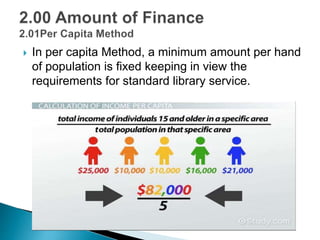
 In per capita Method, a minimum amount per hand
of population is fixed keeping in view the
requirements for standard library service.
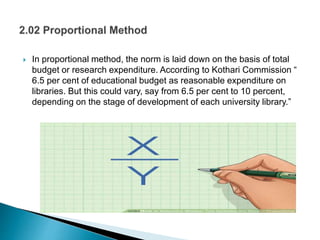
 In proportional method, the norm is laid down on the basis of total
budget or research expenditure. According to Kothari Commission “
6.5 per cent of educational budget as reasonable expenditure on
libraries. But this could vary, say from 6.5 per cent to 10 percent,
depending on the stage of development of each university library.”
UGC (India) has laid down the following standards for university and college
libraries:
 UGC staff formula enables the calculation of staff required and their pay
scales have also been laid down.
 Cost of books and other reading materials have been based on number of
students and teachers. ( Rs 15 per student and Rs 200 per teacher.)
 5% of cost of books is allocated for stacking, storing, and servicing of
books.
 Additional initial grants required to build up initial stock of reading materials
for libraries of newly stared university libraries have been fixed.
 Finance is essential for running a library. The
amount of funds made available towards library
resource and personnel would determine to a
large extend the quality of library resources and
services provided by it.
 Kumar, Krishan. Library Mannual, 4th ed.,New
Delhi,Vikas Publication House PVT LTD, 1991
 Guy R. Lyle, Administration of the college library,
4th Ed.,New York, Wilson, 1974
 Louus Round Wilson And Maurice F. Tauber, The
university Library, 2nd ed.,New York, Columbia
University Press, 1964, chap. 3
 S. Seetharama, “Budgeting in Specialist Libraries”,
Annual Seminar (DRTC),11,1974, Paper B.
Topic library finance

Topic library finance

  • 1.
  • 2.
     Library arespending institutions and normally theses do not make profit. Funds are required to establish these. Once a library has been established then funds would be required on recurring basis to maintain in proper order and shape. In addition, it may be kept in view that libraries are growing institutions. Larger a library grows, more money it might require to maintain it. However this is not true for all libraries.
  • 3.
    The following canbe possible source of revenue:  Subscription from the members.  Library tax/rate. Library rate is levied by a local authority but tax is levied by central or state government.  Government grants/grants from parents body.  Library fines and fees.  Endowment and private domination  Gifts (cash or kind).  Sale of publications.  Income from reprographic services, translation services, compilation of bibliographies etc.
  • 4.
     In percapita Method, a minimum amount per hand of population is fixed keeping in view the requirements for standard library service.
  • 5.
     In proportionalmethod, the norm is laid down on the basis of total budget or research expenditure. According to Kothari Commission “ 6.5 per cent of educational budget as reasonable expenditure on libraries. But this could vary, say from 6.5 per cent to 10 percent, depending on the stage of development of each university library.”
  • 6.
    UGC (India) haslaid down the following standards for university and college libraries:  UGC staff formula enables the calculation of staff required and their pay scales have also been laid down.  Cost of books and other reading materials have been based on number of students and teachers. ( Rs 15 per student and Rs 200 per teacher.)  5% of cost of books is allocated for stacking, storing, and servicing of books.  Additional initial grants required to build up initial stock of reading materials for libraries of newly stared university libraries have been fixed.
  • 7.
     Finance isessential for running a library. The amount of funds made available towards library resource and personnel would determine to a large extend the quality of library resources and services provided by it.
  • 8.
     Kumar, Krishan.Library Mannual, 4th ed.,New Delhi,Vikas Publication House PVT LTD, 1991  Guy R. Lyle, Administration of the college library, 4th Ed.,New York, Wilson, 1974  Louus Round Wilson And Maurice F. Tauber, The university Library, 2nd ed.,New York, Columbia University Press, 1964, chap. 3  S. Seetharama, “Budgeting in Specialist Libraries”, Annual Seminar (DRTC),11,1974, Paper B.