PRESENTED BY
ANKIT
M.LIB.I.SC
1st Semester
Under the supervision of
All teachers
CONTENT
 INTRODUCTION
 DEFINITION
 PRINCIPLES OF FINANCIAL MANAGEMENT
 DETERMINATION OF FINANCE
 SOURCE OF FINANCE
 METHOD OF FINANCIAL ESTIMATION
 CONCLUSION
 REFEREBCE
INTRODUCTION
Finance is like lifeblood of the library, the important of
funding in providing quality library service cannot be
overemphasized . Without a strong financial support, one
cannot imagine state-of-the art library building, well
developed collection, well trained staff, modern
information storage and retrieval system and value added
services. In general, libraries are not revenue earning
institutions. Most of them are service components of
academic and other institutional bodies. Hence, they have
a special obligation to manage their finance with great care
and judiciousness.
DEFINITION
According to Weston and Brigham
“Finance management is an area of finance decision making
harmonising individual motives and enterprise goals”.
According to J.L.massie
“Financial management is the operational activity of a
business that is responsible for obtaining and effective utilization
the funds necessary for efficient operations”.
PRINCIPLES OF FINANCIAL MANAGEMENT
Financial resource management helps in, financial
planning, acquisition of funds, proper utilization of
funds, financial decisions. In nutshell ,major
components of financial management are
 Financial planning
 Realisation of funds and revenues
 Allocation of funds
 Financial accounting
 Financial control
DETERMINATION OF FINANCE
Libraries finance estimation depends upon the age,
jurisdiction, quality and quality of reading material,
number of readers, and other factors relating to that
particular library. Some important bases for financial
estimation for library are :
 User population and its composition.
 Material to be acquired (media, nature and type of
information source).
 Hardware and software requirement.
 Service to be provided vis-à-vis objective.
SOURCE OF FINANCE
University library in India receive fund in
various proportions from the following
sources:
1. Grants allocated from the university budget.
2. Grants from the university Grants commission.
3. Grants from central and state government.
4. Endowment and gifts.
5. Library Fee (such as development fee, security, etc)
6. Fines and miscellaneous sources.
Cont.
1. Grants allocated from the university budget:-
An important part of university library budget is funds
from university budget. Allocations are made normally
directly to the library. There are two types of grant.
a. Recurring:- The recurring grants are given generally for
the purchase a book and periodicals, salaries of staff,
maintenance of regular service and for anticipated
contingent expenditure.
b. Non-recurring:- The non-recurring grants are for specific
purpose such as construction of library building, purchase
of furniture, equipment, computer, other paraphernalia
and at times for the development of special collections, in
university libraries. These are also known as ad-hoc
grants.
Cont.
2. Grants from the university Grants
commission:-
The university also gets special grants from the UGC which
are passed on the library for various purposes such as
buildings, furniture, equipment’s purpose of books etc.
State government also provides matching grant sometimes
as per requirements of the UGC. It comes under university
budget.
3. Grants from central and state government:-
It is very clear that central government funds mainly
central universities and state universities are funded by the
state government. Agriculture universities get funding from
Indian council of Agricultural Research (ICAR) etc.
Cont.
4. Endowments and gifts:-
In India endowments and gifts are a rare phenomenon as
Indians believe in doing charity in the name of religion
and lastly for education. In the early sixties, the Indian
universities were benefited by the endowment grants given
by Ford Foundation, PL 480 funds and the Rockefeller
Foundation and many individuals who donated money for
building libraries.
5. Library Fee (such as development fee, security, etc.):-
This does not constitute library income in the real sense as
the library fee is very nominal and security is refundable.
Cont.
6. Fines and miscellaneous sources:-
Overdue fines comprise a meager income of the
university library, as in many university libraries in
India there is no fine for faculty and as such no
uniformity for overdue charges. Sale of publications or
information products, sale of waste paper, charges for
photocopying, micrographic, computer laboratory
usage and other such services fall under miscellaneous
sources.
METHOD OF FINANCIAL ESTIMATION
Dr. Ranganathan suggested almost the same methods
under different names:
 Per capita method
 Proportional methods
 Methods of details
PER CAPITA METHOD
 In this method, a minimum amount per head is fixed
which is considered essential for providing standard
library needs, average cost of reading material etc.
 Radhakrishnan commission, Ranganathan committee
and Kothari commission have recommended in this
method.
RADHAKRISHNA COMMISSION (1948-49)
 Suggested that we can calculate the annual grant of a
library at Rs.40 per student
 A special non-recurring grant, once in five years, was
also recommend so that the library may purchase
books which it could not acquire within the recurring
budget allowed to it.
UGC LIBRARY COMMITTEE UNDER THE ABLE
CHAIRMANSHIP OF S.R. RANGANATHAN (1957)
 Suggested that Rs. 15 per student in a university and
Rs.200 per teacher may be given to university library as
a grant.
 These are very low norms that those suggested by the
1948-49 education commission.
 This allocation rate was raised slightly by the kothari
commission.
KOTHARI COMMISSION (1964-66)
 Recommended that “-as a norm, a university should
spend each year about Rs.25 per student and Rs.300
per teacher’ on its library.
DR.RANGANATHAN
 According to Dr. Ranganathan per capita expenditure
of university library should be at Rs. 20 student and
Rs. 300 per teacher, or 50 per student for purchase of
books and reading material.
 An equal amount be paid for expenditure on staff and
other recurring items.
 Thus in total provision for student community other
than research community would be Rs.100 per student.
PROPORTIONAL METHOD
 In this method a particular minimum limit of library
budget is fixed and some adequate percentage of the
institutional budget is allocated for library purpose.
 Various norms has been suggested for deciding the
limite.
Cont….
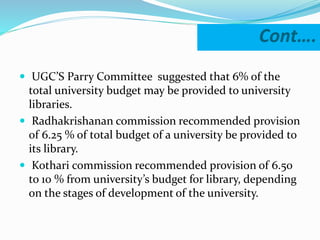
 UGC’S Parry Committee suggested that 6% of the
total university budget may be provided to university
libraries.
 Radhakrishanan commission recommended provision
of 6.25 % of total budget of a university be provided to
its library.
 Kothari commission recommended provision of 6.50
to 10 % from university’s budget for library, depending
on the stages of development of the university.
METHOD OF DETAILS
Another method of finding out the financial
requirements of a library is called the ‘Method of
Details ‘. It simples that all item of expenditure are
accounted for a library . These items, beside others,
include salaries/wages, reading materials- books,
periodical and newspapers and other kindred
materials; binding and repairing , heating, cooling and
lighting, rents and interest; posts, telegraphs and
telephones; and stationery and other contingent and
miscellaneous items.
CONCLUSION
 Finance is essential for running a library a. the
amount of funds made available towards library
resource and personnel would determine to a large
extend the quality of library resources and services
provided by it.
REFERENCE
 https://epgp.inflibnrt.ac.in/
 http://egyankosh.ac.in/
 www.igniue.in
FINANCIAL MANAGEMENT.pptx

FINANCIAL MANAGEMENT.pptx

  • 1.
    PRESENTED BY ANKIT M.LIB.I.SC 1st Semester Underthe supervision of All teachers
  • 2.
    CONTENT  INTRODUCTION  DEFINITION PRINCIPLES OF FINANCIAL MANAGEMENT  DETERMINATION OF FINANCE  SOURCE OF FINANCE  METHOD OF FINANCIAL ESTIMATION  CONCLUSION  REFEREBCE
  • 3.
    INTRODUCTION Finance is likelifeblood of the library, the important of funding in providing quality library service cannot be overemphasized . Without a strong financial support, one cannot imagine state-of-the art library building, well developed collection, well trained staff, modern information storage and retrieval system and value added services. In general, libraries are not revenue earning institutions. Most of them are service components of academic and other institutional bodies. Hence, they have a special obligation to manage their finance with great care and judiciousness.
  • 4.
    DEFINITION According to Westonand Brigham “Finance management is an area of finance decision making harmonising individual motives and enterprise goals”. According to J.L.massie “Financial management is the operational activity of a business that is responsible for obtaining and effective utilization the funds necessary for efficient operations”.
  • 5.
    PRINCIPLES OF FINANCIALMANAGEMENT Financial resource management helps in, financial planning, acquisition of funds, proper utilization of funds, financial decisions. In nutshell ,major components of financial management are  Financial planning  Realisation of funds and revenues  Allocation of funds  Financial accounting  Financial control
  • 6.
    DETERMINATION OF FINANCE Librariesfinance estimation depends upon the age, jurisdiction, quality and quality of reading material, number of readers, and other factors relating to that particular library. Some important bases for financial estimation for library are :  User population and its composition.  Material to be acquired (media, nature and type of information source).  Hardware and software requirement.  Service to be provided vis-à-vis objective.
  • 7.
    SOURCE OF FINANCE Universitylibrary in India receive fund in various proportions from the following sources: 1. Grants allocated from the university budget. 2. Grants from the university Grants commission. 3. Grants from central and state government. 4. Endowment and gifts. 5. Library Fee (such as development fee, security, etc) 6. Fines and miscellaneous sources.
  • 8.
    Cont. 1. Grants allocatedfrom the university budget:- An important part of university library budget is funds from university budget. Allocations are made normally directly to the library. There are two types of grant. a. Recurring:- The recurring grants are given generally for the purchase a book and periodicals, salaries of staff, maintenance of regular service and for anticipated contingent expenditure. b. Non-recurring:- The non-recurring grants are for specific purpose such as construction of library building, purchase of furniture, equipment, computer, other paraphernalia and at times for the development of special collections, in university libraries. These are also known as ad-hoc grants.
  • 9.
    Cont. 2. Grants fromthe university Grants commission:- The university also gets special grants from the UGC which are passed on the library for various purposes such as buildings, furniture, equipment’s purpose of books etc. State government also provides matching grant sometimes as per requirements of the UGC. It comes under university budget. 3. Grants from central and state government:- It is very clear that central government funds mainly central universities and state universities are funded by the state government. Agriculture universities get funding from Indian council of Agricultural Research (ICAR) etc.
  • 10.
    Cont. 4. Endowments andgifts:- In India endowments and gifts are a rare phenomenon as Indians believe in doing charity in the name of religion and lastly for education. In the early sixties, the Indian universities were benefited by the endowment grants given by Ford Foundation, PL 480 funds and the Rockefeller Foundation and many individuals who donated money for building libraries. 5. Library Fee (such as development fee, security, etc.):- This does not constitute library income in the real sense as the library fee is very nominal and security is refundable.
  • 11.
    Cont. 6. Fines andmiscellaneous sources:- Overdue fines comprise a meager income of the university library, as in many university libraries in India there is no fine for faculty and as such no uniformity for overdue charges. Sale of publications or information products, sale of waste paper, charges for photocopying, micrographic, computer laboratory usage and other such services fall under miscellaneous sources.
  • 12.
    METHOD OF FINANCIALESTIMATION Dr. Ranganathan suggested almost the same methods under different names:  Per capita method  Proportional methods  Methods of details
  • 13.
    PER CAPITA METHOD In this method, a minimum amount per head is fixed which is considered essential for providing standard library needs, average cost of reading material etc.  Radhakrishnan commission, Ranganathan committee and Kothari commission have recommended in this method.
  • 14.
    RADHAKRISHNA COMMISSION (1948-49) Suggested that we can calculate the annual grant of a library at Rs.40 per student  A special non-recurring grant, once in five years, was also recommend so that the library may purchase books which it could not acquire within the recurring budget allowed to it.
  • 15.
    UGC LIBRARY COMMITTEEUNDER THE ABLE CHAIRMANSHIP OF S.R. RANGANATHAN (1957)  Suggested that Rs. 15 per student in a university and Rs.200 per teacher may be given to university library as a grant.  These are very low norms that those suggested by the 1948-49 education commission.  This allocation rate was raised slightly by the kothari commission.
  • 16.
    KOTHARI COMMISSION (1964-66) Recommended that “-as a norm, a university should spend each year about Rs.25 per student and Rs.300 per teacher’ on its library.
  • 17.
    DR.RANGANATHAN  According toDr. Ranganathan per capita expenditure of university library should be at Rs. 20 student and Rs. 300 per teacher, or 50 per student for purchase of books and reading material.  An equal amount be paid for expenditure on staff and other recurring items.  Thus in total provision for student community other than research community would be Rs.100 per student.
  • 18.
    PROPORTIONAL METHOD  Inthis method a particular minimum limit of library budget is fixed and some adequate percentage of the institutional budget is allocated for library purpose.  Various norms has been suggested for deciding the limite.
  • 19.
    Cont….  UGC’S ParryCommittee suggested that 6% of the total university budget may be provided to university libraries.  Radhakrishanan commission recommended provision of 6.25 % of total budget of a university be provided to its library.  Kothari commission recommended provision of 6.50 to 10 % from university’s budget for library, depending on the stages of development of the university.
  • 20.
    METHOD OF DETAILS Anothermethod of finding out the financial requirements of a library is called the ‘Method of Details ‘. It simples that all item of expenditure are accounted for a library . These items, beside others, include salaries/wages, reading materials- books, periodical and newspapers and other kindred materials; binding and repairing , heating, cooling and lighting, rents and interest; posts, telegraphs and telephones; and stationery and other contingent and miscellaneous items.
  • 21.
    CONCLUSION  Finance isessential for running a library a. the amount of funds made available towards library resource and personnel would determine to a large extend the quality of library resources and services provided by it.
  • 22.