Concept of InformationProducts
Information products are the final outputs derived from the
process of collecting, analyzing, processing, and presenting
information in an organized manner.
Unlike raw data, which may be scattered and unstructured,
information products are created with a purpose and a target
audience in mind.
For example, A raw research paper contains valuable data, but
when the same data is summarized in the form of an abstract,
index, or review, it becomes an information product that is
easier to use. Thus, they serve as bridges between knowledge
sources and knowledge seekers.
3.
Nature of InformationProducts
Dynamic- Continuously updated to reflect new research and
knowledge.
User-Oriented-Designed to meet the specific needs of
different groups such as students, teachers, researchers, and
policymakers.
Value-Added-Provide refined, filtered, and structured
information rather than raw data.
Multi-Format-Available in print, CD/DVDs, online platforms,
mobile applications, and even AI-driven knowledge tools.
4.
Subject-Specific or Multidisciplinary-Someproducts are highly specialized (e.g.,
Index Medicus in medicine), while others cover multiple disciplines (e.g.,
Encyclopaedia Britannica).
Regularly Updated-Most information products are periodic or continuous in nature
(e.g., annual yearbooks, monthly newsletters, weekly current awareness
bulletins).This ensures the information remains current and reliable.
Structured and Organized-They follow a logical arrangement such as alphabetical,
chronological, subject-wise, or keyword-based, which makes them easy to use.
Accessibility-Oriented-Information products are designed for easy access and quick
retrieval, whether in libraries, online platforms, or mobile apps.Modern products
ensure 24/7 global access through the internet.
5.
Definition
Any structured, processed,and value-added
presentation of information prepared to satisfy the
information needs of a particular group of users.
UNESCO (2002) Information for All Programme
(IFAP) Report- “any information-based content,
whether in print, electronic, or digital form, designed
for dissemination to a target audience”
6.
Ranganathan, S. R.(1961) Reference Service. Asia Publishing House.
Information products indirectly as “tools of service to channelize
knowledge to its seeker in the most accessible form.”
Katz, W. A. (1982) Introduction to Reference Work. McGraw-Hill.
Information products as “organized outputs of processed information,
designed to meet the specific needs of users in a usable format.”
IFLA, (1998)
Information products as “knowledge outputs or services developed to
provide users with reliable, relevant, and timely information.”
7.
In order tocreate an information product, the product developer needs to
know the following aspects in their right context:
Demand: There is need to know the demand, and create the product that
people want to use.
Quality: People believe that there is only one kind of product, and it is high
quality product.
Presentation: The presentation of the product does matter to the customers.
Follow-ups Information product should not be very expensive.
Therefore, create an information product that can be upgraded and
follow-ups can be offered.
8.
Types of InformationProducts
Reviews: These include critical and state-of-the-art reports.
Reports: These include assessment, technical reports, market
reports, alerting bulletins, newsletters, and house journals.
Data: This category includes data compilations and tables,
statistical abstracts, correlations, composites, and critical data.
Databases: These include expert databases and subject
knowledge bases.
9.
Technical Writings: Thistype has in its fold guides, manuals, instruction
sheets, explanations on a complex subject provided in a style and
language geared toward a given audience level, popular articles on a
scientific or technical topic.
Handbooks: These include compilations of essential data, and
information on a subject.
Critical Studies: This type includes comparison of different practices or
policies, or studies, and impact and future studies.
Requests: These include briefings, evaluative on-demand studies, and
compilations.
Content of InformationProducts
Content Extent
Technical Sophistication
Temporal Aspect
Information Quality and Accuracy
Degree of Invariability or Value Added
Editorial Qualities
12.
Design of InformationProduct
Conduct research
Set objectives
Identify audience / users (Background, Literacy level, Need,
Economic status)
Financial decision – Setting budget, source of finance, expenditure –
cost benefit approach (MCLP – More Copies Less Price)
Select / Identify appropriate physical form of product
Design – size, shape, layout, cover page, title, reasonable amount of
text and visuals
13.
Meaning ofInformation Products
Information products are tangible or intangible outputs created by libraries or information centers to
serve users' information needs.
Examples: bibliographies, databases, newsletters, information alerts, subject guides, indexes,
repositories, research digests, etc.
Steps in the Design of Information Products
(i) User Need Analysis
Identify target users (researchers, students, policymakers, professionals).
Understand their information-seeking behavior, preferences, and levels of expertise.
(ii) Content Selection
Collect relevant, reliable, and authentic information from primary, secondary, and tertiary sources.
Evaluate and filter out irrelevant data.
14.
(iii) Organization ofInformation
• Use bibliographic standards (AACR2, RDA, MARC).
• Apply classification and indexing (DDC, UDC, LCSH) for easy retrieval.
• Structure content logically (chronological, thematic, alphabetical, subject-wise).
(iv) Format and Design
• Choose the medium: print, electronic, or digital.
• Ensure clarity, conciseness, and proper layout.
• Include visuals (charts, infographics, tables) if necessary.
• Use metadata and hyperlinks in digital formats.
15.
(v) Technical Considerations
•For digital products: use databases, OPACs, web portals, repositories, and discovery tools.
(vi) Testing and Feedback
• Pilot test with a small group of users.
• Collect feedback and improve the product.
(vii) Dissemination
• Deliver through multiple channels (websites, social media, mailing lists, library portals).
• Provide personalized services (SDI – Selective Dissemination of Information, CAS – Current
Awareness Service).
(viii) Evaluation and Updating
• Measure usage, impact, and user satisfaction.
• Keep content updated to maintain relevance.
16.
Example
Newsletters
Seetharama defines anewsletter “as a serial consisting of one or few
pages, usually printed, and containing nascent information or news
which is of interest to a special or particular group of users and which is
published periodically.”
Newsletters are, therefore, periodical publications issued by various
organizations, institutions, government departments, professional
societies, trade and industry associations, etc. for providing speedy
information to their members and subscribers.
Example – IFLA Newsletter
17.
Types of Newsletters
a.Research and Development Organizations
b. Associations
c. Government Organizations
d. Public Sector Undertakings
e. Private Institutions
f. Academic Institutions
g. International Organizations
h. Autonomous Institutions, etc.
18.
House Journals
House journalsare serial publications like the newsletters, published by
industrial and commercial organizations, corporations, business houses,
public sector undertakings, and similar other organizations. These are
meant for circulation among their customers, shareholders, employees,
dealers, retailers, etc. to inform them about their products,
performance, and other activities.
19.
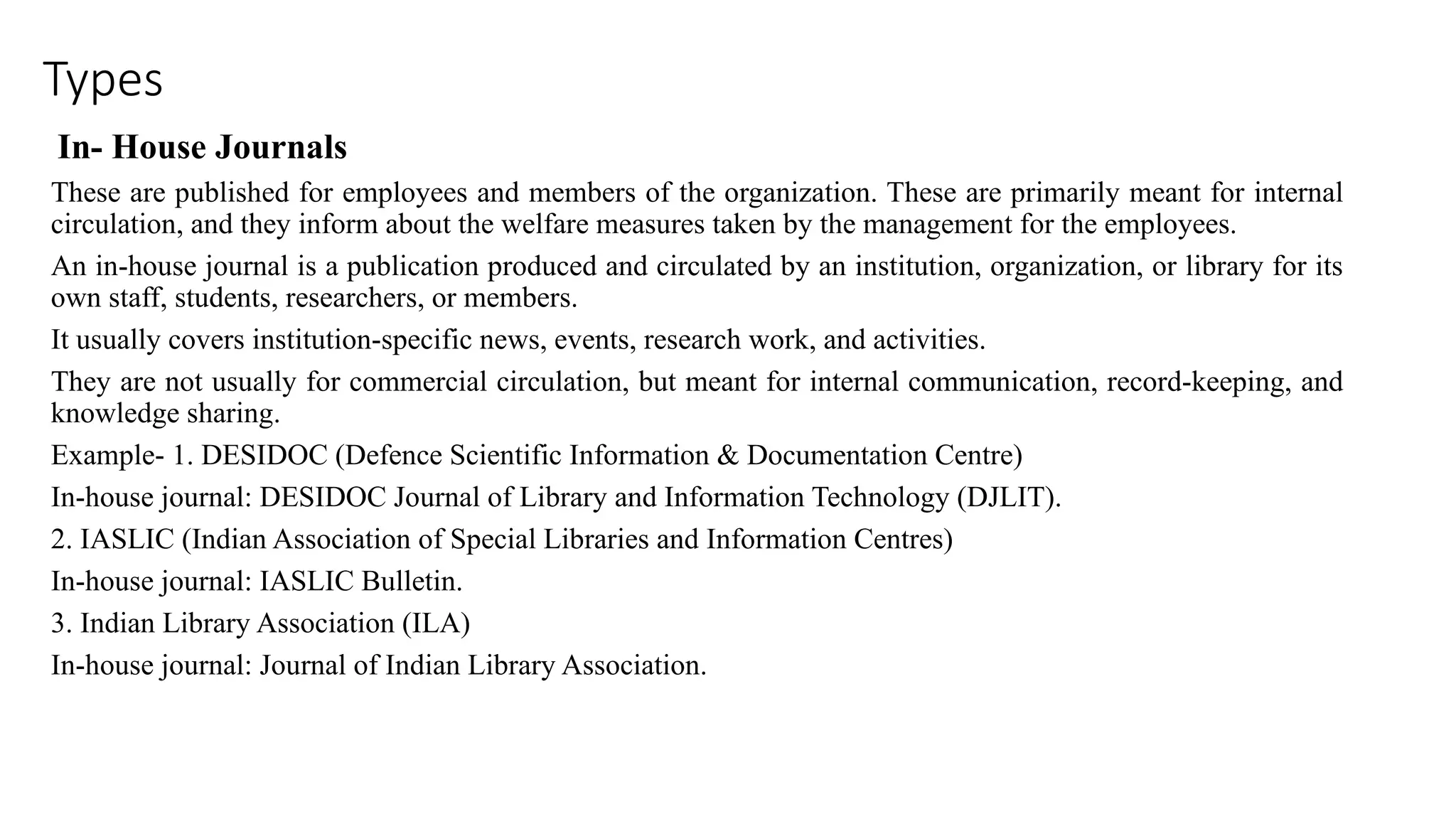
Types
In- House Journals
Theseare published for employees and members of the organization. These are primarily meant for internal
circulation, and they inform about the welfare measures taken by the management for the employees.
An in-house journal is a publication produced and circulated by an institution, organization, or library for its
own staff, students, researchers, or members.
It usually covers institution-specific news, events, research work, and activities.
They are not usually for commercial circulation, but meant for internal communication, record-keeping, and
knowledge sharing.
Example- 1. DESIDOC (Defence Scientific Information & Documentation Centre)
In-house journal: DESIDOC Journal of Library and Information Technology (DJLIT).
2. IASLIC (Indian Association of Special Libraries and Information Centres)
In-house journal: IASLIC Bulletin.
3. Indian Library Association (ILA)
In-house journal: Journal of Indian Library Association.
20.
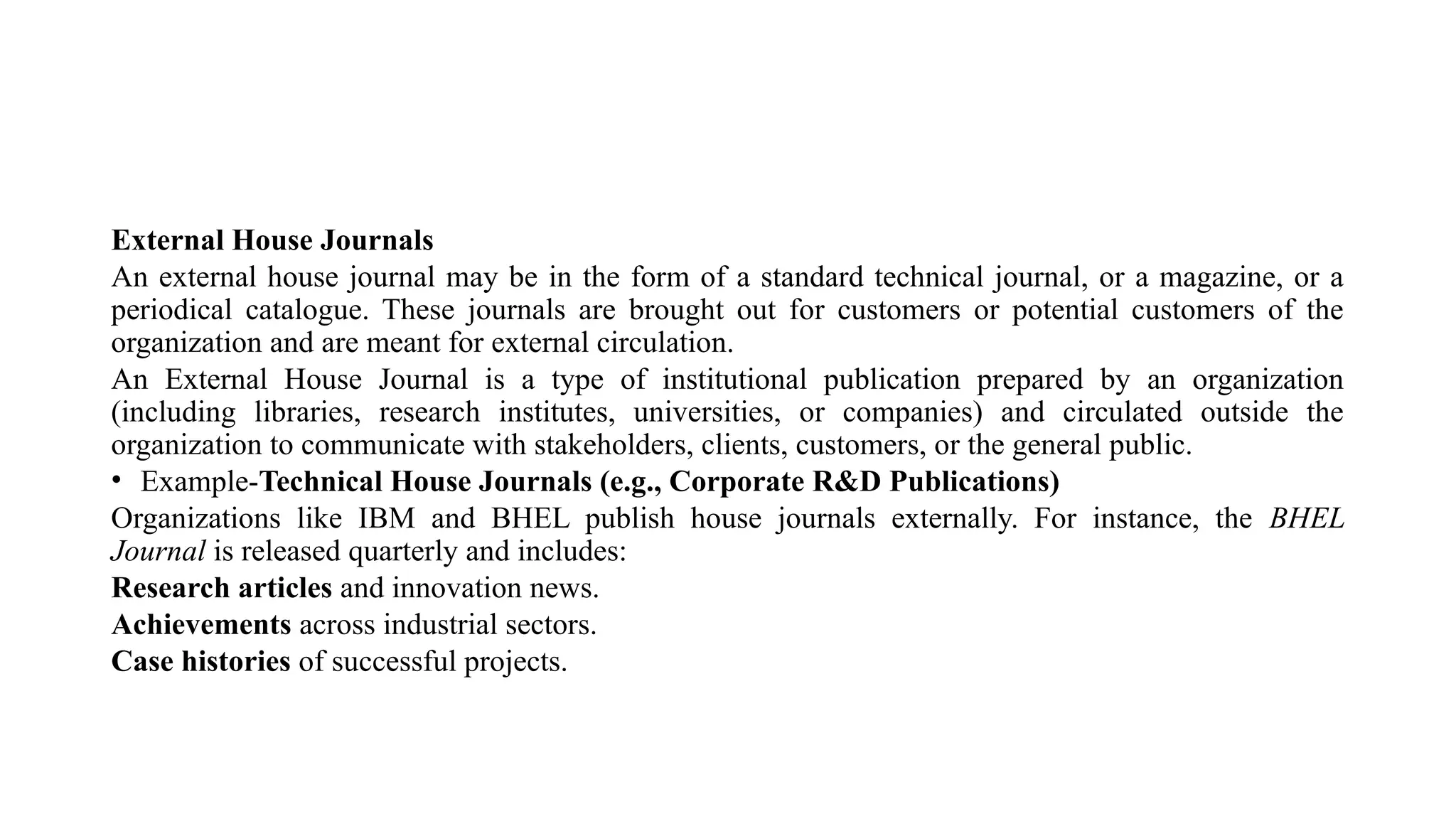
External House Journals
Anexternal house journal may be in the form of a standard technical journal, or a magazine, or a
periodical catalogue. These journals are brought out for customers or potential customers of the
organization and are meant for external circulation.
An External House Journal is a type of institutional publication prepared by an organization
(including libraries, research institutes, universities, or companies) and circulated outside the
organization to communicate with stakeholders, clients, customers, or the general public.
• Example-Technical House Journals (e.g., Corporate R&D Publications)
Organizations like IBM and BHEL publish house journals externally. For instance, the BHEL
Journal is released quarterly and includes:
Research articles and innovation news.
Achievements across industrial sectors.
Case histories of successful projects.
21.
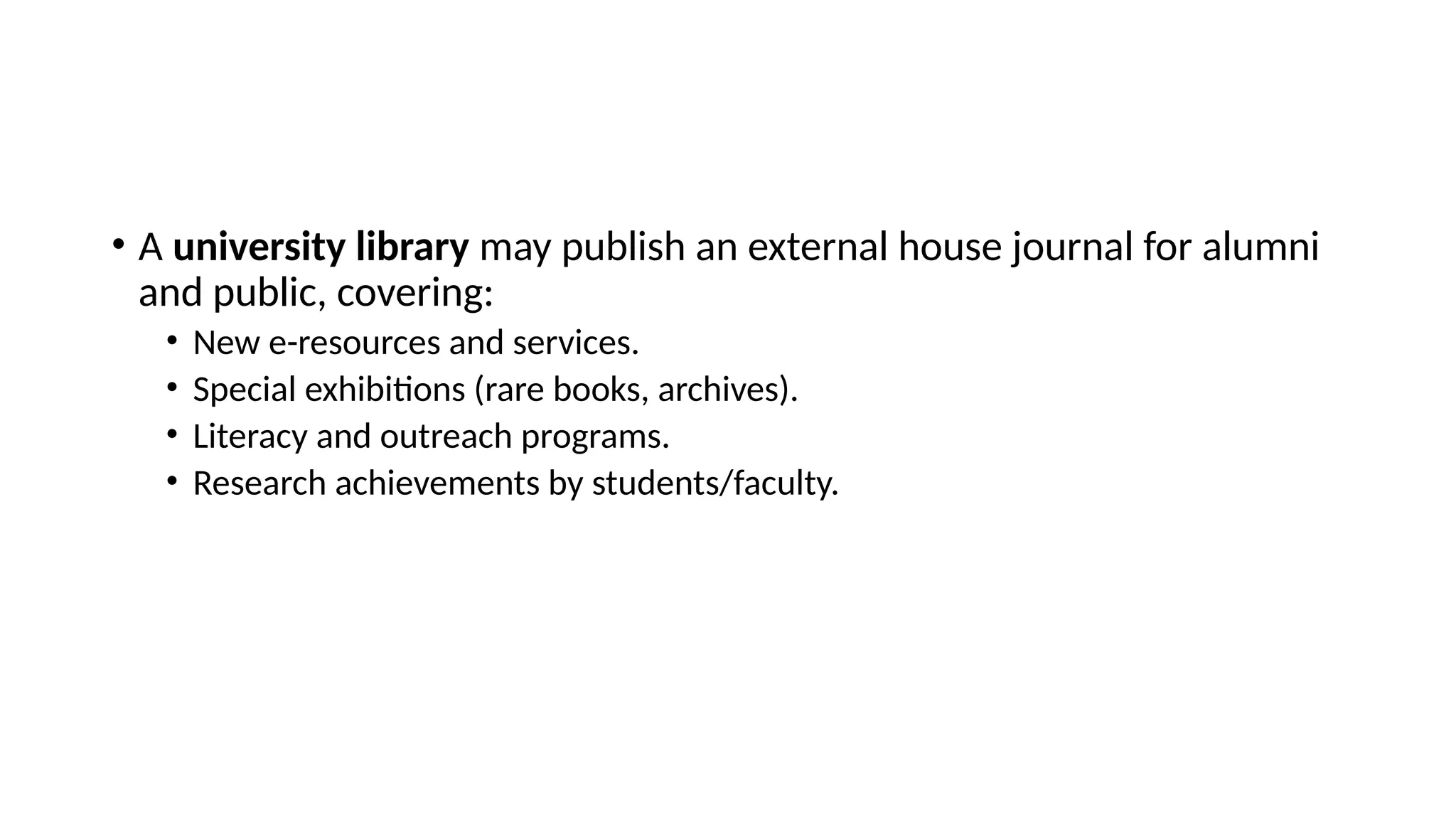
• A universitylibrary may publish an external house journal for alumni
and public, covering:
• New e-resources and services.
• Special exhibitions (rare books, archives).
• Literacy and outreach programs.
• Research achievements by students/faculty.
22.
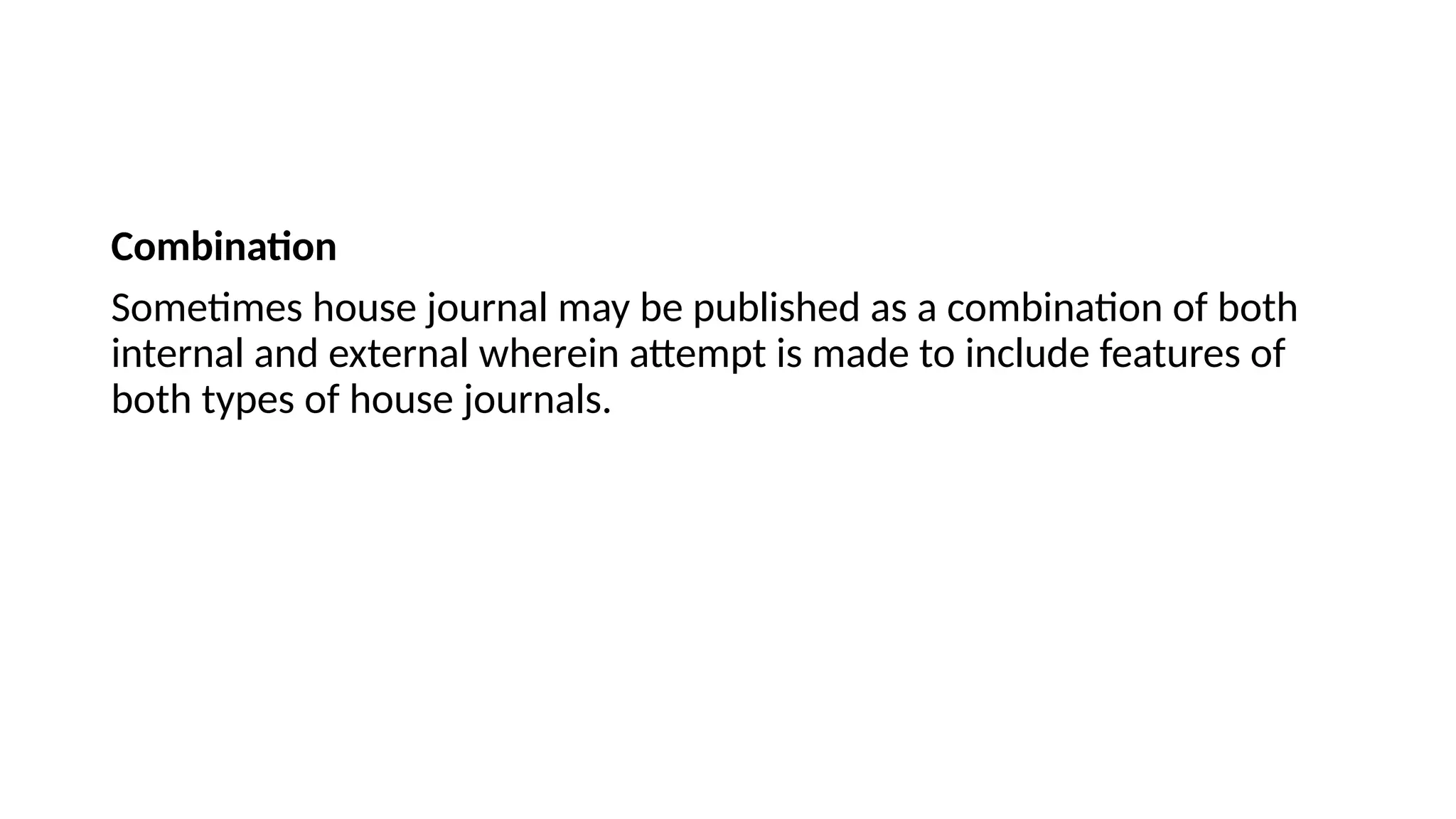
Combination
Sometimes house journalmay be published as a combination of both
internal and external wherein attempt is made to include features of
both types of house journals.
23.
Handbook
A handbook isa book giving information such as facts on a particular
subject, or instructions for operating a machine. It is a comprehensive
and handy work on a particular topic for practitioners, structured for
quick reference. The term ‘handbook’ is derived from the German word
‘handbach’ meaning a small book or a treatise giving useful facts.
24.
Types of Handbook
GeneralHandbooks
General handbooks include information to satisfy the interests of
people at large. These handbooks are arranged subject wise with a
detailed index for easy location of various topics and sub-topics.
Example –
Guinness World Records, 2014. London: Guinness World Record.
Annual since 1955.
It provides ultimate record-breading facts and includes new and
updated records with new photographs.
25.
Statistical Handbooks
Statistical handbooksare generally published by government
departments of various countries. These provide information on every
aspect in statistical form, hence useful source of information for social
scientists, researchers, and academicians.
Examples:
Statistical Yearbook of the United Nations. New York: United Nations
Statistical Office.
26.
Manuals
A manual isa brief reference book dealing with a particular process,
operation, mechanism, job instruction, etc. It is regarded as a
comprehensive step-by-step guide to a particular topic both for
beginners and practitioners. It is essentially an instruction book which
instructs how to do something with clear directions.
27.
Technical Digest
A compilationand condensation of technical information on a specific
subject, presenting summaries of articles, research papers, and other technical
publications for quick reference by managers, engineers, and other
professionals in science, technology, and management.
A Technical Digest is a concise , structured publication that provides
summaries of recent technical developments, research findings, method and
innovations.
Example – DESIDOC Technical Digest ( DRDO libraries network)
FAO technical digests on Information Systems
28.
STATE-OF-THE-ART REPORT
A product,system, or design that represents the most advanced degree if
technical achievement in its field at the present time. In the construction of new
facilities, libraries typically strive for state-of-the-art design and technology but
must often settle fir what is financially feasible.
The main purpose is to present consolidated information available in various
forms and to repackage the same in a condensed form for the users. The state-of-
the-art reports can be grouped into three categories (for the sake of convenience).
Reviews and Surveys
Advances and Progresses
Trend Reports.
29.
Review and Survey
Areview is a survey of primary literature. It aim to digest and correlate the
literature over a given period. It also indicates the developments and trends in
the field concerned. It may appear as a collection of papers on regular basis
(annual or quarterly or monthly) or in the form of an article in the periodical. A
review provides background information to a new problem in a suitable form
and serves as a key to literature.
Example – Library Trends (University of Illinois) Publishes thematic issues with review type
articles on specific area of librarianship
Annual Review of Information Science and Technology (ARIST).
Cancer Surveys : Advances and Prospects in Clinical, Epidemiological and Laboratory
Oncology/edited by John Tooze New York : Cold Spring Harbor, 1982.
30.
• A reviewis a survey of the primary literature in a specific subject field
covering specific period. It may be considered as a critical synthesis of
the state of knowledge or advances in a given subject or its sub-
discipline, In other words, reviews and surveys are critical
examination of information and literature on a particular subject or
topic.
• A critical or an evaluative review or survey done by a specialist often
highlights gaps in the research field and suggests new avenues for
research. They not only cover what has been published but also
stimulate thinking.
31.
Advance and Progresses
•These categories of reference sources are generally serials, but they differ in
format and frequency rather than in content from `Reviews' and `Surveys’.
• The use of these terminologies, therefore, causes considerable confusion. By
and large, it is noticed that the tittles used are Advances in ..., Progress in.......
Recent Progress in ...............................Report on Progress in..., Survey of
Progress in .............................................................. and so on.
Example - Advances in Librarians. New York: Seminar Press, 1971-
Advances in Biophysics. Biophysical Society of Japan (Published by Elsevier
Science Ireland Ltd., Ireland). 1968 -. Annual. .
32.
Trend Report
• Atrend Report is one such tool which is designed to help the specialist reader
by acquainting them with the recent developments and research conducted in
the particular subject. So they can utilize their time more effectively in
research.
• According to M.A. Gopinath, “a trend report is an exposition of a subject,
giving an account of general directions of research in the subject based on the
review of the documents on current developments. The trend report helps the
specialist reader in productive utilization of his time and in conversation of the
research potential.”
Example - Trends in Banking in OECD Countries. (1985). Paris : OECD.
IFLA trend Report 2024: facing the future with confidence
Library perceptions 2025: International survey of library automation
33.
Indexing and AbstractingPeriodicals
An Indexing Periodical is a regularly issued compilation of titles of articles that appear
in current primary source journals of new books, pamphlets, etc. are also included.
Ex. Applied science and technology index, New York, Wilson, 1913-, Monthly.
An Abstracting Periodicals “ is a regularly issued compilation of concise summaries of -
(1) significant articles that appear in current primary source journals and
(2) important new research monograph, reports, patents, and other primary source
publications in that field.
An Abstracting Periodical serves as an index, a tool for retrieval of information on a
specific subject and provides survey of information on a specific subject and provide
survey of current state of the art about the subject.
Ex. Indian science abstract, Delhi, Indian National Scientific Documentation Centre
Vol.1, 1965-, Monthly.
34.
Bibliography of bibliographies
ABibliography of bibliographies lists of bibliographies which direct readers
to useful bibliographies through subject, name of an individual place,
institutions etc.
The bibliographies referred to may be in the form of a separately published
book or part of the book or part of a periodical article or some other type of
document.
As the Bibliographies of bibliographies published every year is large,
therefore, number of bibliographies are highly selective in nature.
Ex. Bibliographic index, cumulative Bibliography of bibliographies, 1937-,
New York, Wilson, 1938.
35.
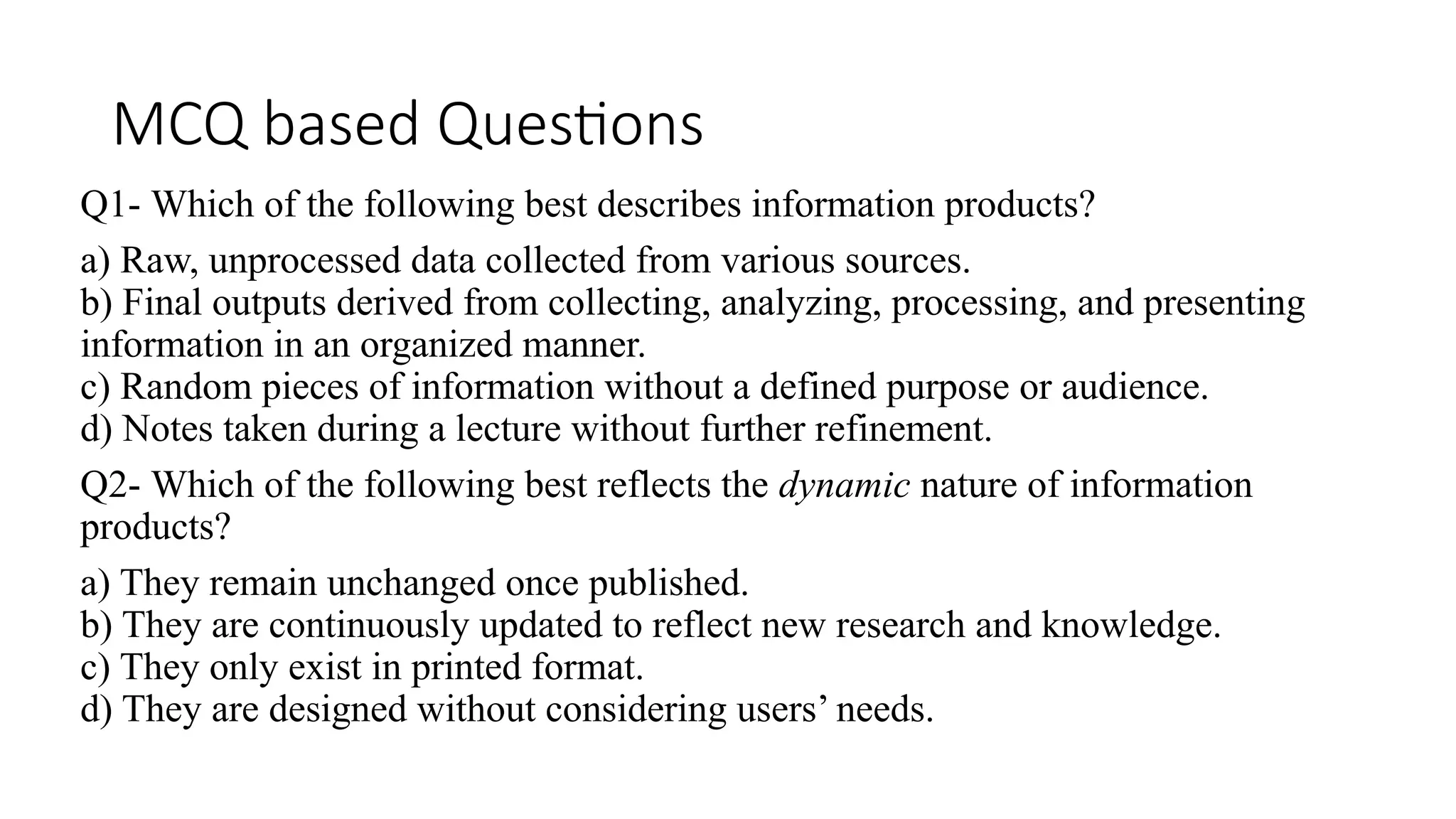
MCQ based Questions
Q1-Which of the following best describes information products?
a) Raw, unprocessed data collected from various sources.
b) Final outputs derived from collecting, analyzing, processing, and presenting
information in an organized manner.
c) Random pieces of information without a defined purpose or audience.
d) Notes taken during a lecture without further refinement.
Q2- Which of the following best reflects the dynamic nature of information
products?
a) They remain unchanged once published.
b) They are continuously updated to reflect new research and knowledge.
c) They only exist in printed format.
d) They are designed without considering users’ needs.
36.
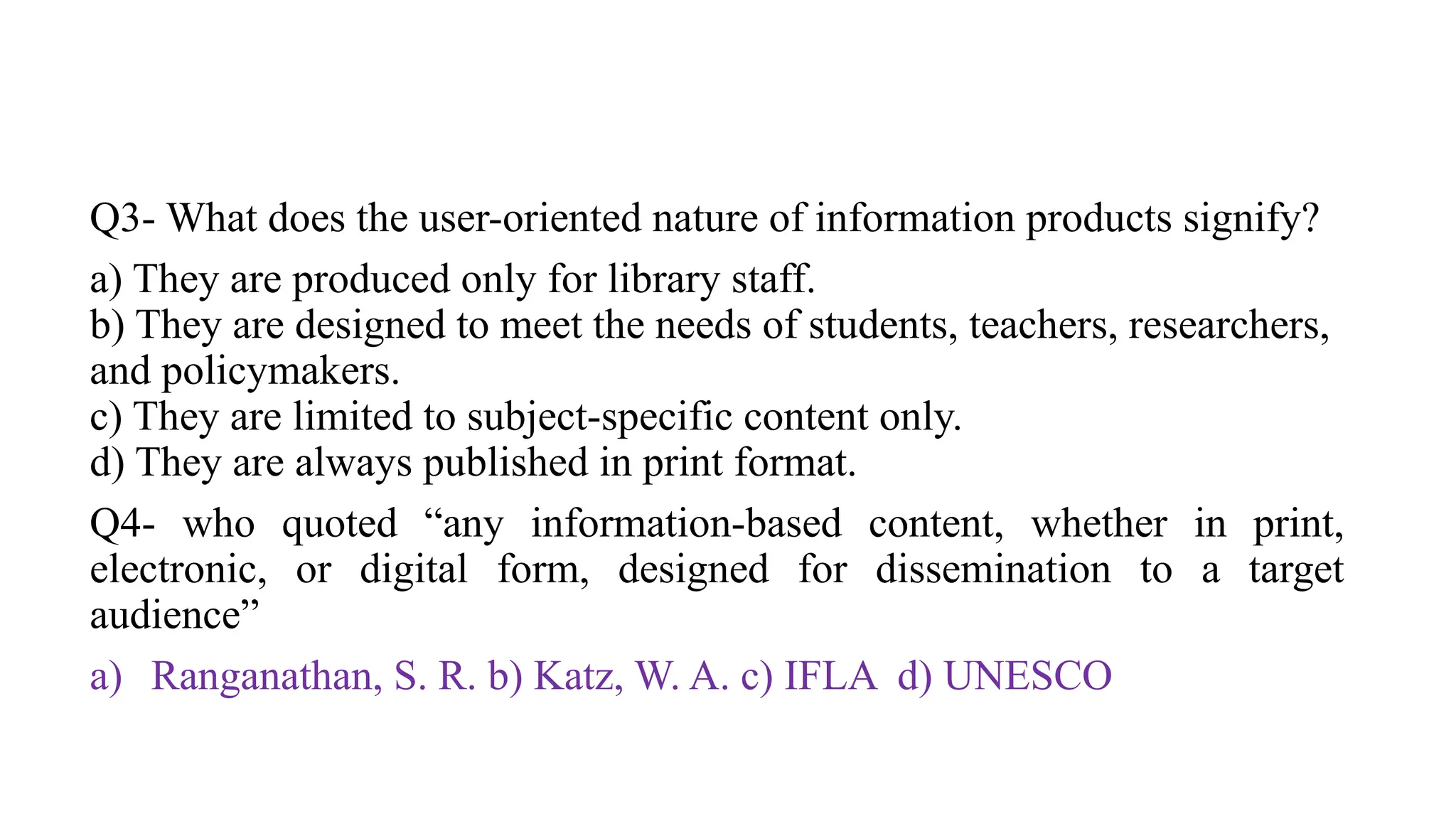
Q3- What doesthe user-oriented nature of information products signify?
a) They are produced only for library staff.
b) They are designed to meet the needs of students, teachers, researchers,
and policymakers.
c) They are limited to subject-specific content only.
d) They are always published in print format.
Q4- who quoted “any information-based content, whether in print,
electronic, or digital form, designed for dissemination to a target
audience”
a) Ranganathan, S. R. b) Katz, W. A. c) IFLA d) UNESCO
37.
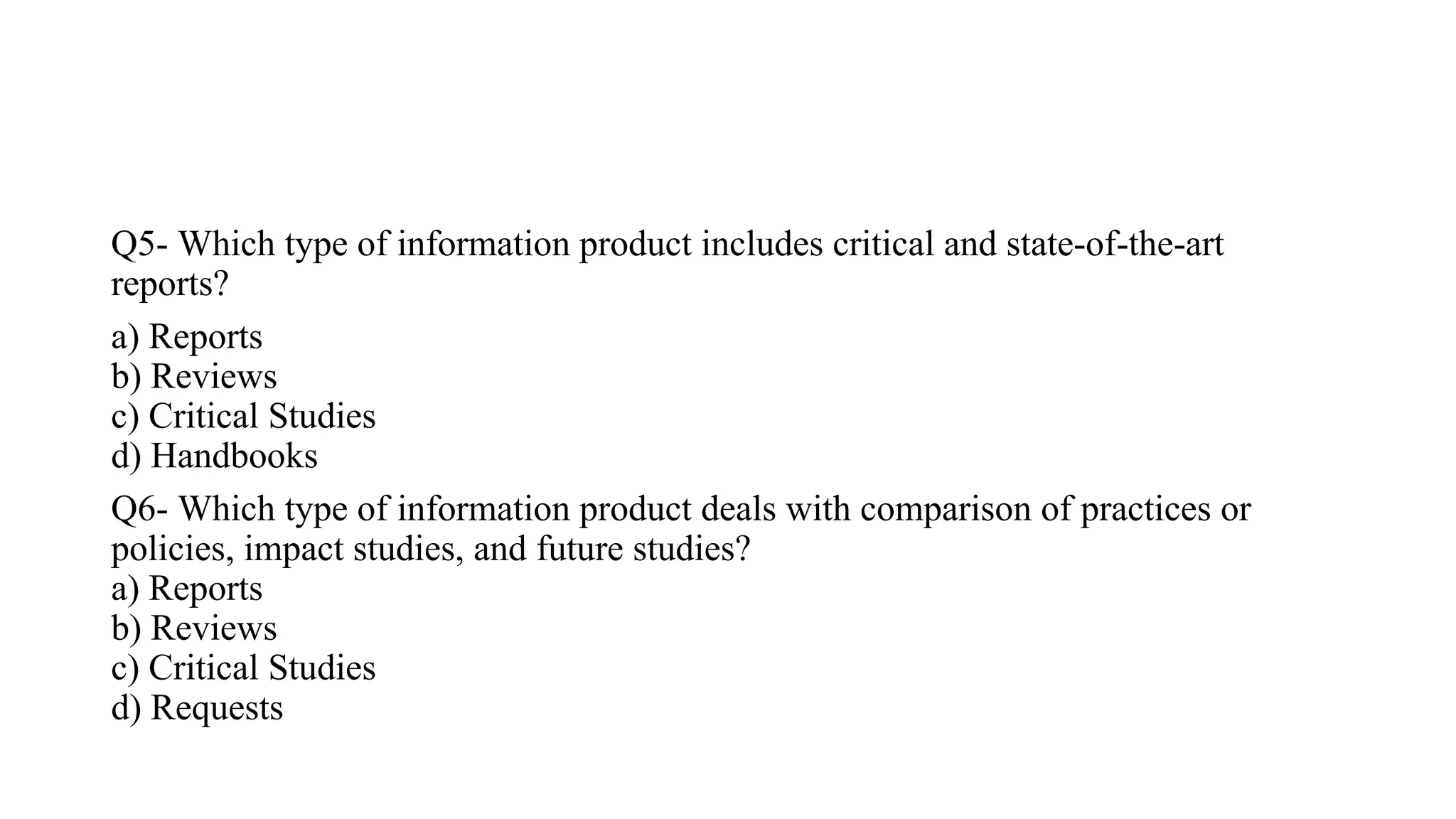
Q5- Which typeof information product includes critical and state-of-the-art
reports?
a) Reports
b) Reviews
c) Critical Studies
d) Handbooks
Q6- Which type of information product deals with comparison of practices or
policies, impact studies, and future studies?
a) Reports
b) Reviews
c) Critical Studies
d) Requests
38.
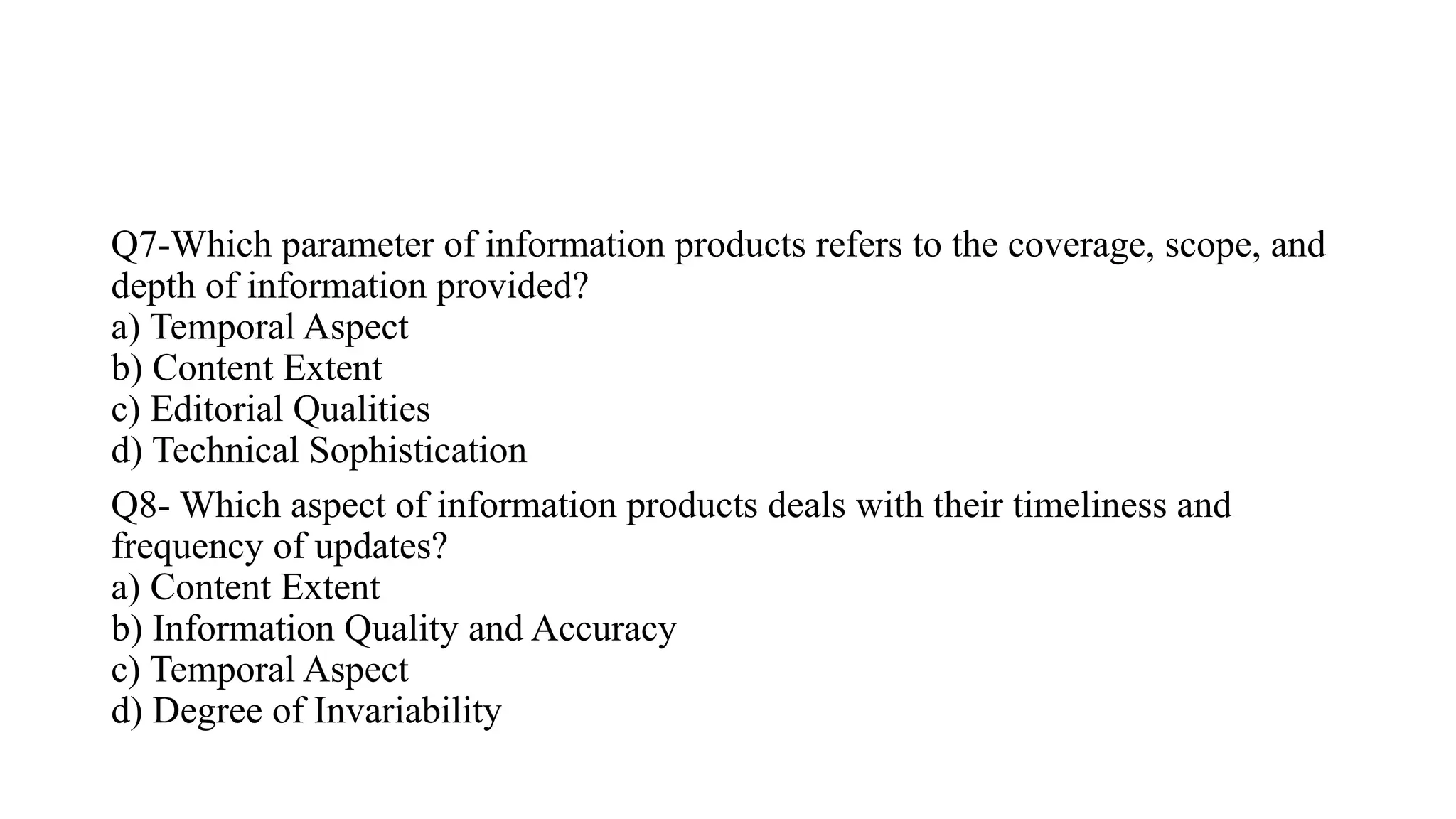
Q7-Which parameter ofinformation products refers to the coverage, scope, and
depth of information provided?
a) Temporal Aspect
b) Content Extent
c) Editorial Qualities
d) Technical Sophistication
Q8- Which aspect of information products deals with their timeliness and
frequency of updates?
a) Content Extent
b) Information Quality and Accuracy
c) Temporal Aspect
d) Degree of Invariability
39.
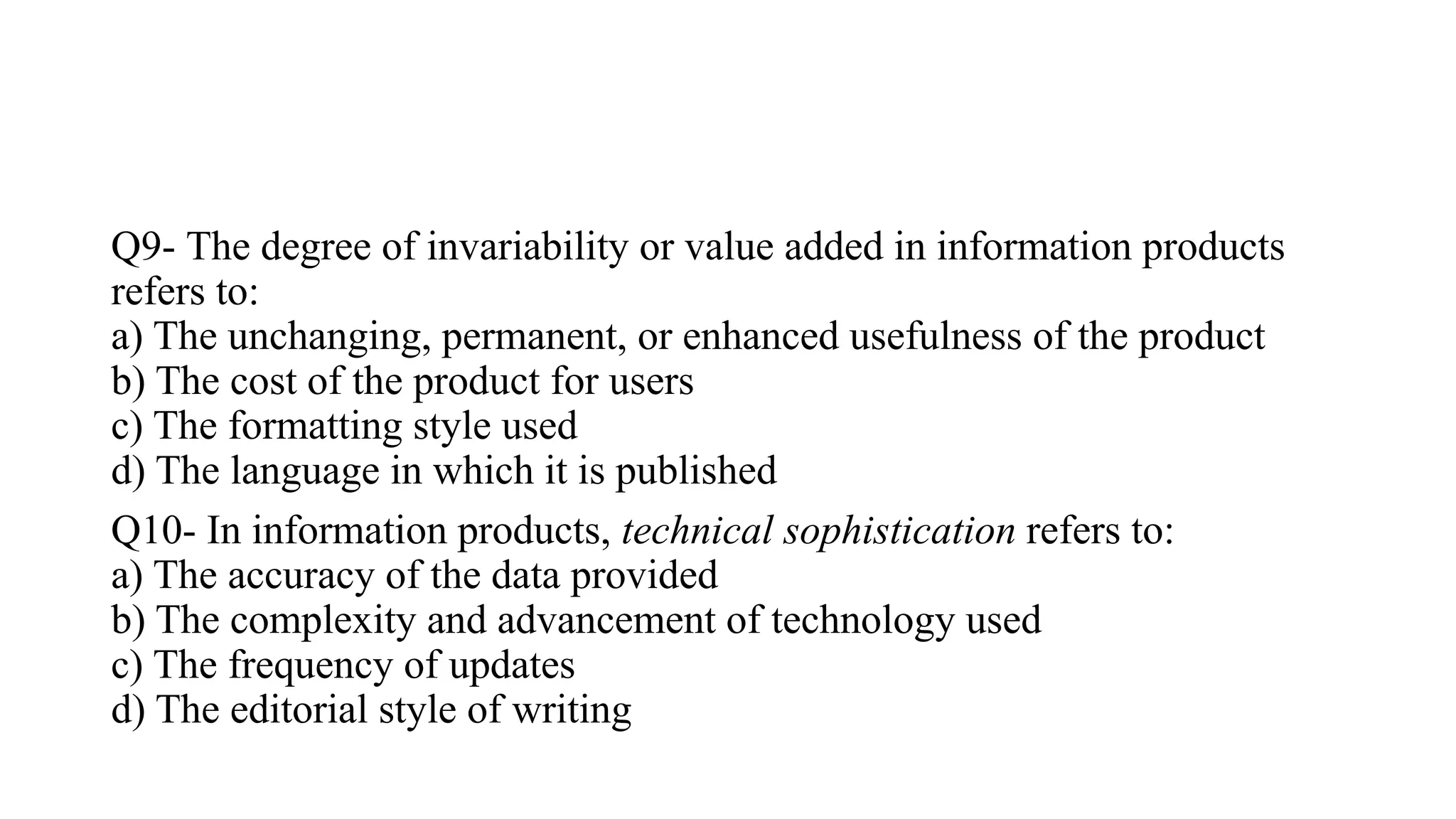
Q9- The degreeof invariability or value added in information products
refers to:
a) The unchanging, permanent, or enhanced usefulness of the product
b) The cost of the product for users
c) The formatting style used
d) The language in which it is published
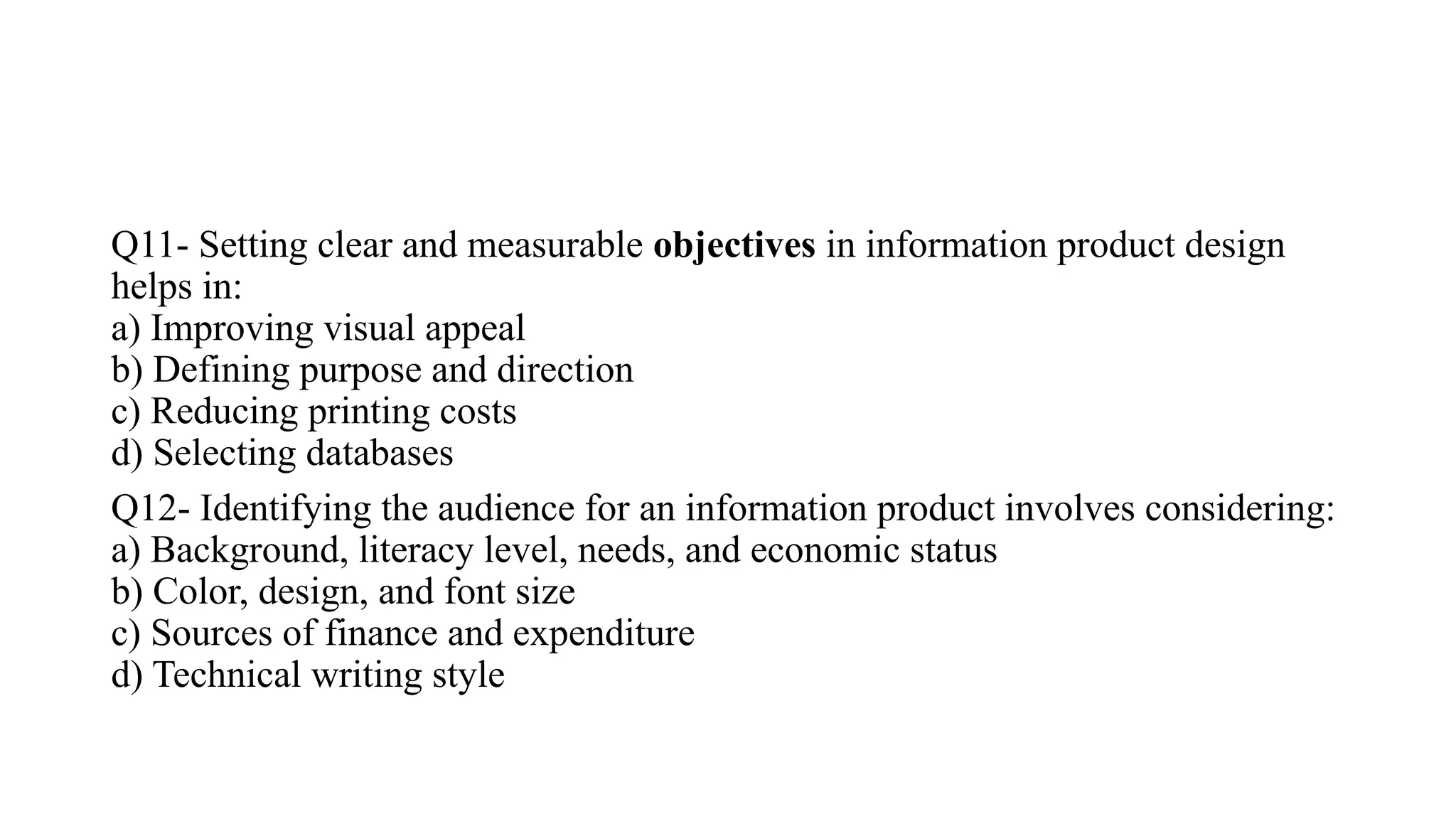
Q10- In information products, technical sophistication refers to:
a) The accuracy of the data provided
b) The complexity and advancement of technology used
c) The frequency of updates
d) The editorial style of writing
40.
Q11- Setting clearand measurable objectives in information product design
helps in:
a) Improving visual appeal
b) Defining purpose and direction
c) Reducing printing costs
d) Selecting databases
Q12- Identifying the audience for an information product involves considering:
a) Background, literacy level, needs, and economic status
b) Color, design, and font size
c) Sources of finance and expenditure
d) Technical writing style
41.
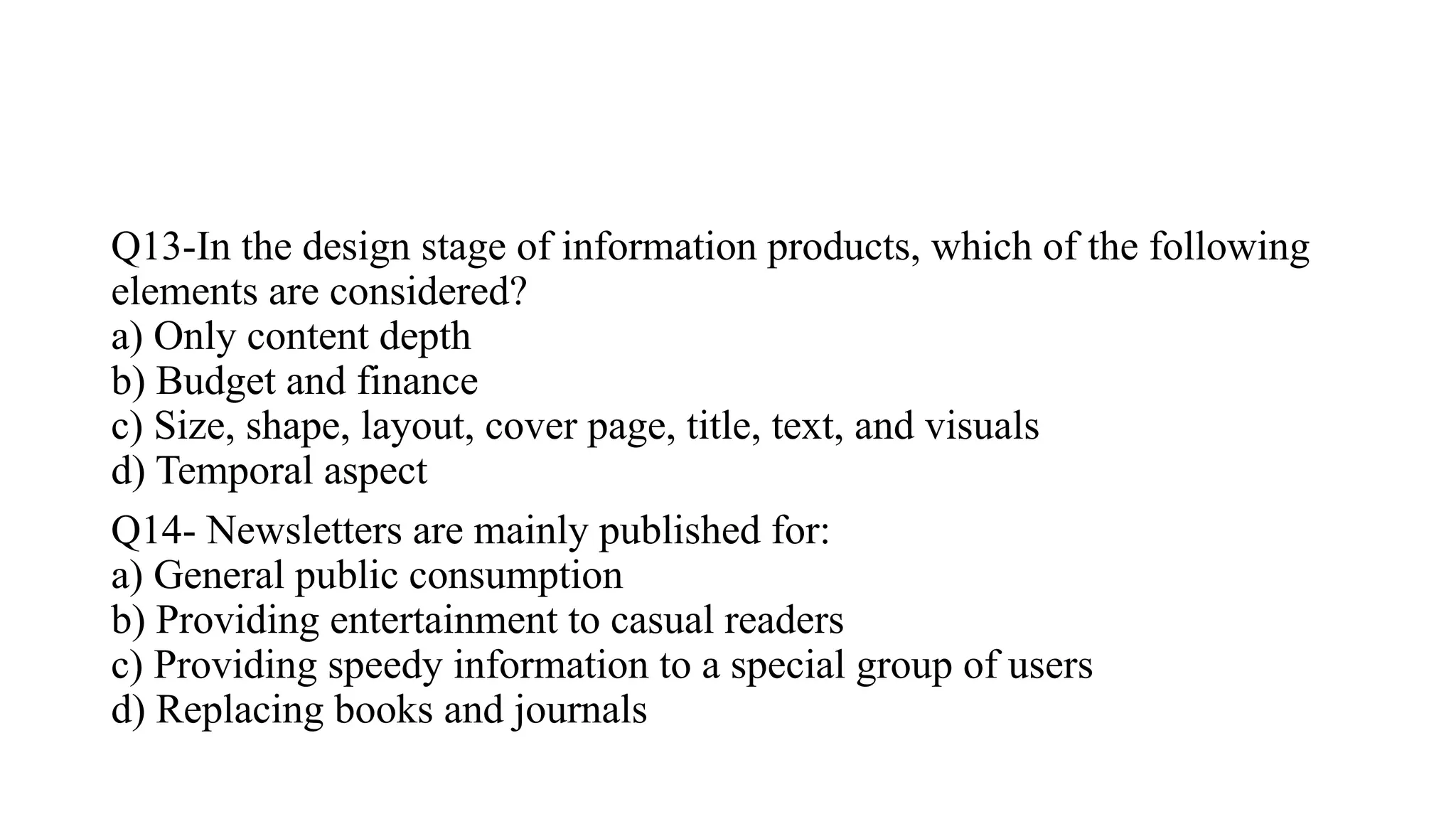
Q13-In the designstage of information products, which of the following
elements are considered?
a) Only content depth
b) Budget and finance
c) Size, shape, layout, cover page, title, text, and visuals
d) Temporal aspect
Q14- Newsletters are mainly published for:
a) General public consumption
b) Providing entertainment to casual readers
c) Providing speedy information to a special group of users
d) Replacing books and journals
42.
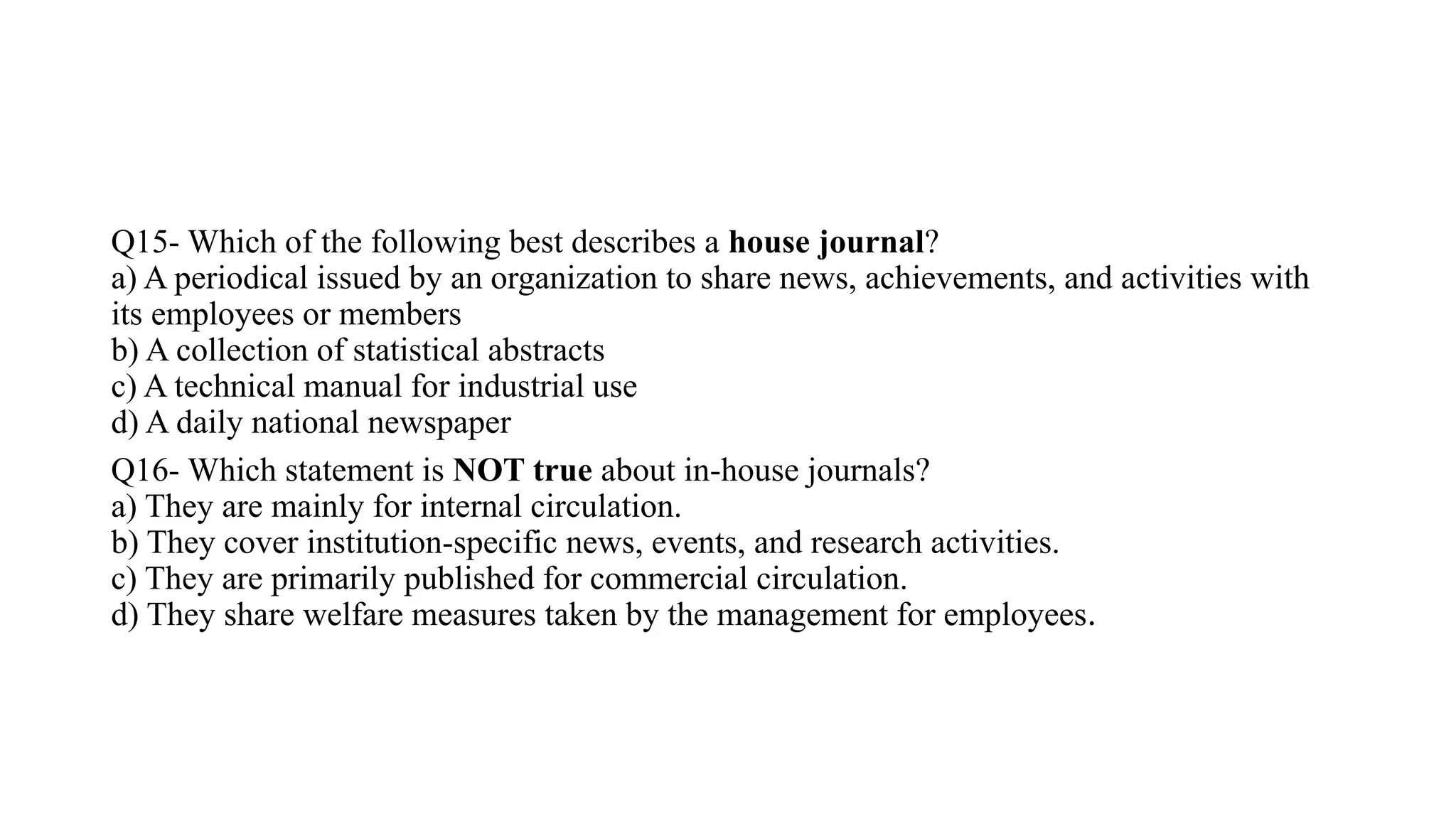
Q15- Which ofthe following best describes a house journal?
a) A periodical issued by an organization to share news, achievements, and activities with
its employees or members
b) A collection of statistical abstracts
c) A technical manual for industrial use
d) A daily national newspaper
Q16- Which statement is NOT true about in-house journals?
a) They are mainly for internal circulation.
b) They cover institution-specific news, events, and research activities.
c) They are primarily published for commercial circulation.
d) They share welfare measures taken by the management for employees.