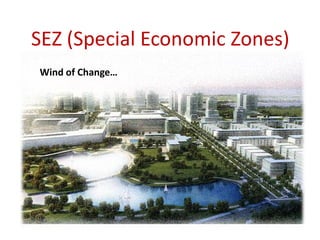
SEZ (Special Economic Zones)
Wind of Change…
Introduction
•   Special Economic Zone (SEZ) is defined as "a specifically delineated duty free
    enclave and shall be deemed to be foreign territory for the purposes of trade
    operations and duties and tariffs".
•   SEZs
      an engine for economic growth
      supported by quality infrastructure
      complemented by an attractive fiscal package
      with the minimum possible regulations.
•   Government of India have notified Special Economic Zones (SEZs) Act 2005 and
    notified Special Economic Zone Rules 2006 with a view to augmenting infrastructure
    facilities for export.
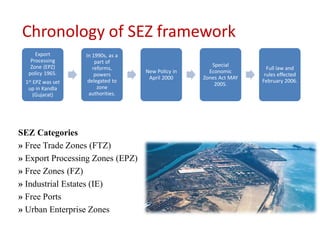
Chronology of SEZ framework
     Export        In 1990s, as a
   Processing          part of
   Zone (EPZ)                                          Special
                      reforms,                                        Full law and
  policy 1965.                      New Policy in     Economic
                       powers                                        rules effected
                                     April 2000     Zones Act MAY
 1st EPZ was set    delegated to                                    February 2006.
                                                        2005.
  up in Kandla          zone
     (Gujarat)      authorities.


SEZ Categories
» Free Trade Zones (FTZ)
» Export Processing Zones (EPZ)
» Free Zones (FZ)
» Industrial Estates (IE)
» Free Ports
» Urban Enterprise Zones
History of SEZ’s in India
•   During the past four decades many developing countries have been
    creating special zones to promote their exports and earn foreign
    exchange.
•   The term Export Processing Zone (EPZ) was first coined to identify the
    Shannon zone set up in Ireland in 1958.
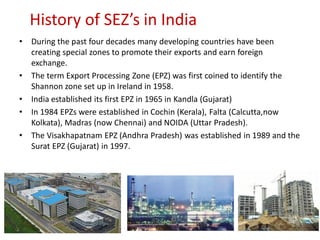
•   India established its first EPZ in 1965 in Kandla (Gujarat)
•   In 1984 EPZs were established in Cochin (Kerala), Falta (Calcutta,now
    Kolkata), Madras (now Chennai) and NOIDA (Uttar Pradesh).
•   The Visakhapatnam EPZ (Andhra Pradesh) was established in 1989 and the
    Surat EPZ (Gujarat) in 1997.
SEZ Act, 2005
With a view to overcome the shortcomings experienced on
account of the multiplicity of controls and clearances; absence of
world class infrastructure, and an unstable fiscal regime and a
view to attract larger foreign investments in India,
the Special Economic Zones (SEZs) Policy was announced in
April 2006.

• The main objectives of the SEZ Act are:
      generation of additional economic activity
      promotion of exports of goods and services
      promotion of investment from domestic and foreign sources
      creation of employment opportunities
      development of infrastructure facilities
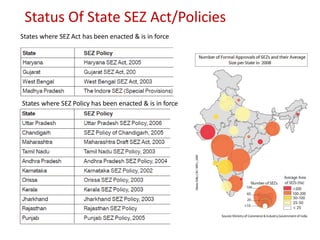
Status Of State SEZ Act/Policies
States where SEZ Act has been enacted & is in force


States where SEZ Policy has been enacted & is in force
Economic Benefits
SEZ policy has directly benefited economy in following ways:

1. Employment Generation : SEZs generate direct employment for skilled and unskilled labour ;
indirect employment and employment for women workers.

2. Skill Formation: Formation of SEZs and new job requirements increase firm level activity whereby
the labour force acquires skills from within the firm through training and learning.

3. Attract investors:: SEZs offer a highly conducive investment scenario for developers. No tax
during development and operational stage. At profit stage 100% income tax exemption for Ist 5 yrs,
50% for next 5 yrs.

4. Technology Upgrading: SEZs attract export-oriented FDI and promote other forms of
collaboration between local firms and MNCs.

5. Exports: EPZ exports registered an impressive growth rate over the period 1966 to 2002. EPZ
exports increased in India from less than Rs.1 million in 1966 to over Rs. 97727 million in 2002.

6. Manufacturing Sector: Share of manufacturing industry in the exports grew from negligible
percentage in 1970 to above 6 % in 2005.

(Sources: Ministry of Commerce, Economic Survey)
SEZs as vehicle for Job Creation
 Reaping the demographic dividend

India’s demographic profile is a boon for creating
productive jobs for rising work force with higher
savings and eventually investments for economic
growth.
 India’s median age is just under 25 years with
over 500 million people below 25 years of age.
Two-thirds of these are supported by the
agricultural sector which contributes just 21
percent to the GDP.
These people have rising aspirations and must
find jobs in manufacturing and services sectors,
failing which there would be serious social and
economic implications for the country.
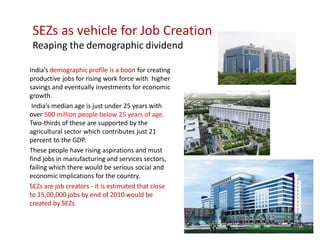
SEZs are job creators - it is estimated that close
to 15,00,000 jobs by end of 2010 would be
created by SEZs.
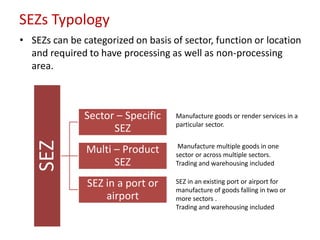
SEZs Typology
• SEZs can be categorized on basis of sector, function or location
  and required to have processing as well as non-processing
  area.


               Sector – Specific    Manufacture goods or render services in a
                                    particular sector.
                     SEZ
    SEZ


                                     Manufacture multiple goods in one
               Multi – Product      sector or across multiple sectors.
                     SEZ            Trading and warehousing included

               SEZ in a port or     SEZ in an existing port or airport for
                                    manufacture of goods falling in two or
                   airport          more sectors .
                                    Trading and warehousing included
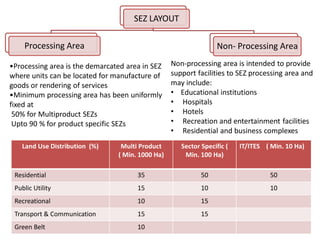
SEZ LAYOUT

    Processing Area                                              Non- Processing Area

•Processing area is the demarcated area in SEZ    Non-processing area is intended to provide
where units can be located for manufacture of     support facilities to SEZ processing area and
goods or rendering of services                    may include:
•Minimum processing area has been uniformly       • Educational institutions
fixed at                                          • Hospitals
 50% for Multiproduct SEZs                        • Hotels
 Upto 90 % for product specific SEZs              • Recreation and entertainment facilities
                                                  • Residential and business complexes
   Land Use Distribution (%)     Multi Product       Sector Specific (   IT/ITES ( Min. 10 Ha)
                                ( Min. 1000 Ha)       Min. 100 Ha)

 Residential                          35                    50                    50
 Public Utility                       15                    10                    10
 Recreational                         10                    15
 Transport & Communication            15                    15
 Green Belt                           10
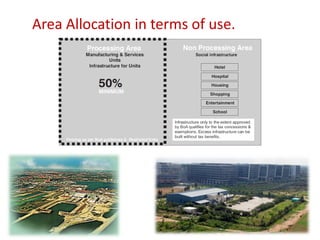
Area Allocation in terms of use.
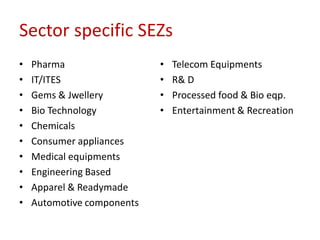
Sector specific SEZs
•   Pharma                  •   Telecom Equipments
•   IT/ITES                 •   R& D
•   Gems & Jwellery         •   Processed food & Bio eqp.
•   Bio Technology          •   Entertainment & Recreation
•   Chemicals
•   Consumer appliances
•   Medical equipments
•   Engineering Based
•   Apparel & Readymade
•   Automotive components
Development Norms for Non Processing
Areas in SEZs.

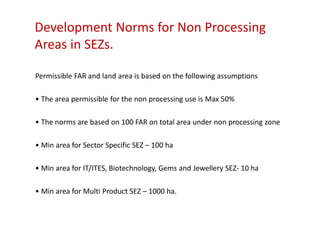
Permissible FAR and land area is based on the following assumptions

• The area permissible for the non processing use is Max 50%

• The norms are based on 100 FAR on total area under non processing zone

• Min area for Sector Specific SEZ – 100 ha

• Min area for IT/ITES, Biotechnology, Gems and Jewellery SEZ- 10 ha

• Min area for Multi Product SEZ – 1000 ha.
Development Norms for Non Processing Areas in SEZs.
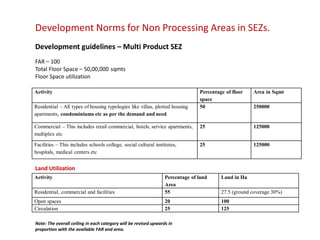
Development guidelines – Multi Product SEZ
FAR – 100
Total Floor Space – 50,00,000 sqmts
Floor Space utilization

Activity                                                                       Percentage of floor   Area in Sqmt
                                                                               space
Residential – All types of housing typologies like villas, plotted housing     50                    250000
apartments, condominiums etc as per the demand and need

Commercial – This includes retail commercial, hotels, service apartments,      25                    125000
multiplex etc

Facilities – This includes schools college, social cultural institutes,        25                    125000
hospitals, medical centers etc


Land Utilization
Activity                                                         Percentage of land     Land in Ha
                                                                 Area
Residential, commercial and facilities                           55                     27.5 (ground coverage 30%)
Open spaces                                                      20                     100
Circulation                                                      25                     125

Note: The overall ceiling in each category will be revised upwards in
proportion with the available FAR and area.
Development Norms for Non Processing Areas in SEZs.
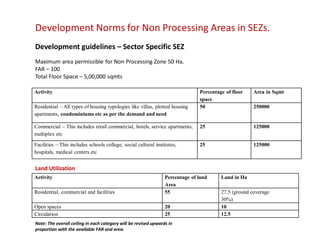
Development guidelines – Sector Specific SEZ
Maximum area permissible for Non Processing Zone 50 Ha.
FAR – 100
Total Floor Space – 5,00,000 sqmts

Activity                                                                       Percentage of floor    Area in Sqmt
                                                                               space
Residential – All types of housing typologies like villas, plotted housing     50                     250000
apartments, condominiums etc as per the demand and need

Commercial – This includes retail commercial, hotels, service apartments,      25                     125000
multiplex etc

Facilities – This includes schools college, social cultural institutes,        25                     125000
hospitals, medical centers etc


Land Utilization
Activity                                                         Percentage of land     Land in Ha
                                                                 Area
Residential, commercial and facilities                           55                     27.5 (ground coverage
                                                                                        30%)
Open spaces                                                      20                     10
Circulation                                                      25                     12.5
Note: The overall ceiling in each category will be revised upwards in
proportion with the available FAR and area.
Development Norms for Non Processing Areas in SEZs.
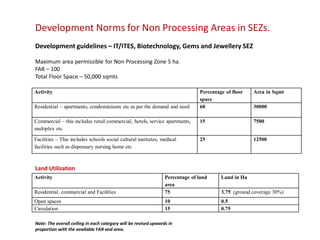
Development guidelines – IT/ITES, Biotechnology, Gems and Jewellery SEZ

Maximum area permissible for Non Processing Zone 5 ha.
FAR – 100
Total Floor Space – 50,000 sqmts

Activity                                                                       Percentage of floor   Area in Sqmt
                                                                               space
Residential – apartments, condominiums etc as per the demand and need          60                    30000

Commercial – this includes retail commercial, hotels, service apartments,      15                    7500
multiplex etc

Facilities – This includes schools social cultural institutes, medical         25                    12500
facilities such as dispensary nursing home etc


Land Utilization
Activity                                                         Percentage of land     Land in Ha
                                                                 area
Residential, commercial and Facilities                           75                     3.75 (ground coverage 30%)
Open spaces                                                      10                     0.5
Circulation                                                      15                     0.75

Note: The overall ceiling in each category will be revised upwards in
proportion with the available FAR and area.
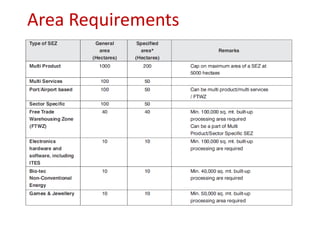
Area Requirements
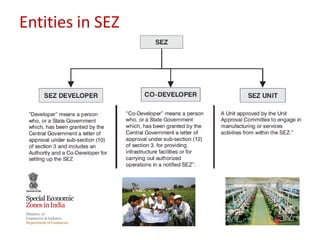
Entities in SEZ
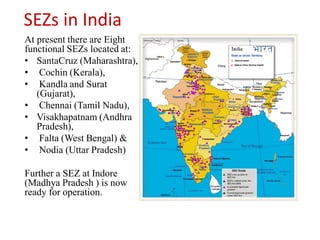
SEZs in India
At present there are Eight
functional SEZs located at:
• SantaCruz (Maharashtra),
• Cochin (Kerala),
• Kandla and Surat
   (Gujarat),
• Chennai (Tamil Nadu),
• Visakhapatnam (Andhra
   Pradesh),
• Falta (West Bengal) &
• Nodia (Uttar Pradesh)

Further a SEZ at Indore
(Madhya Pradesh ) is now
ready for operation.
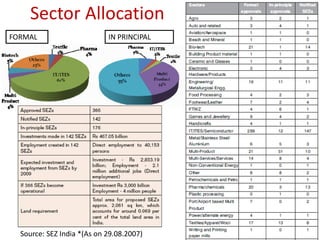
Sector Allocation
FORMAL                      IN PRINCIPAL


  Source: SEZ India *(As on 29.08.2007)
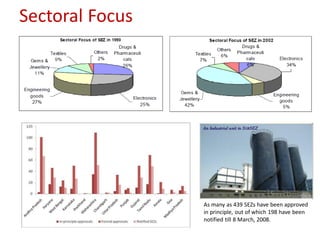
Sectoral Focus


                 As many as 439 SEZs have been approved
                 in principle, out of which 198 have been
                 notified till 8 March, 2008.
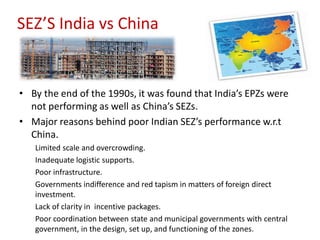
SEZ’S India vs China


• By the end of the 1990s, it was found that India’s EPZs were
  not performing as well as China’s SEZs.
• Major reasons behind poor Indian SEZ’s performance w.r.t
  China.
   Limited scale and overcrowding.
   Inadequate logistic supports.
   Poor infrastructure.
   Governments indifference and red tapism in matters of foreign direct
   investment.
   Lack of clarity in incentive packages.
   Poor coordination between state and municipal governments with central
   government, in the design, set up, and functioning of the zones.
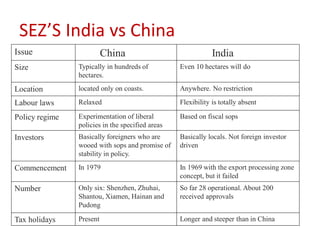
SEZ’S India vs China
Issue                     China                               India
Size            Typically in hundreds of          Even 10 hectares will do
                hectares.
Location        located only on coasts.           Anywhere. No restriction

Labour laws     Relaxed                           Flexibility is totally absent

Policy regime   Experimentation of liberal        Based on fiscal sops
                policies in the specified areas
Investors       Basically foreigners who are      Basically locals. Not foreign investor
                wooed with sops and promise of    driven
                stability in policy.

Commencement    In 1979                           In 1969 with the export processing zone
                                                  concept, but it failed
Number          Only six: Shenzhen, Zhuhai,       So far 28 operational. About 200
                Shantou, Xiamen, Hainan and       received approvals
                Pudong

Tax holidays    Present                           Longer and steeper than in China
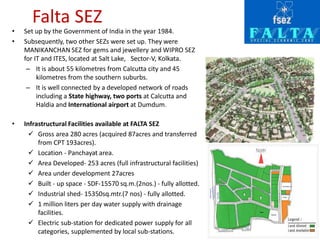
Falta SEZ
•   Set up by the Government of India in the year 1984.
•   Subsequently, two other SEZs were set up. They were
    MANIKANCHAN SEZ for gems and jewellery and WIPRO SEZ
    for IT and ITES, located at Salt Lake, Sector-V, Kolkata.
     – It is about 55 kilometres from Calcutta city and 45
         kilometres from the southern suburbs.
     – It is well connected by a developed network of roads
         including a State highway, two ports at Calcutta and
         Haldia and International airport at Dumdum.

•   Infrastructural Facilities available at FALTA SEZ
       Gross area 280 acres (acquired 87acres and transferred
         from CPT 193acres).
       Location - Panchayat area.
       Area Developed- 253 acres (full infrastructural facilities)
       Area under development 27acres
       Built - up space - SDF-15570 sq.m.(2nos.) - fully allotted.
       Industrial shed- 15350sq.mtr.(7 nos) - fully allotted.
       1 million liters per day water supply with drainage
         facilities.
       Electric sub-station for dedicated power supply for all
         categories, supplemented by local sub-stations.
Falta SEZ
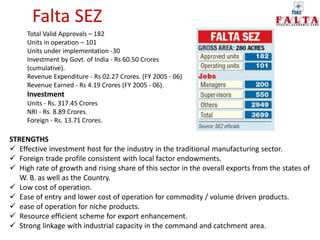
     Total Valid Approvals – 182
     Units in operation – 101
     Units under implementation -30
     Investment by Govt. of India - Rs 60.50 Crores
     (cumulative).
     Revenue Expenditure - Rs 02.27 Crores. (FY 2005 - 06)
     Revenue Earned - Rs 4.19 Crores (FY 2005 - 06).
     Investment
     Units - Rs. 317.45 Crores
     NRI - Rs. 8.89 Crores.
     Foreign - Rs. 13.71 Crores.

STRENGTHS
 Effective investment host for the industry in the traditional manufacturing sector.
 Foreign trade profile consistent with local factor endowments.
 High rate of growth and rising share of this sector in the overall exports from the states of
   W. B. as well as the Country.
 Low cost of operation.
 Ease of entry and lower cost of operation for commodity / volume driven products.
 ease of operation for niche products.
 Resource efficient scheme for export enhancement.
 Strong linkage with industrial capacity in the command and catchment area.
Falta SEZ
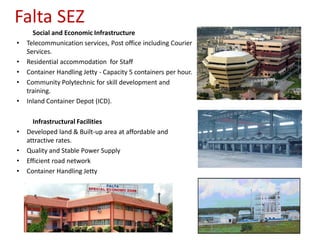
      Social and Economic Infrastructure
•   Telecommunication services, Post office including Courier
    Services.
•   Residential accommodation for Staff
•   Container Handling Jetty - Capacity 5 containers per hour.
•   Community Polytechnic for skill development and
    training.
•   Inland Container Depot (ICD).

      Infrastructural Facilities
•   Developed land & Built-up area at affordable and
    attractive rates.
•   Quality and Stable Power Supply
•   Efficient road network
•   Container Handling Jetty
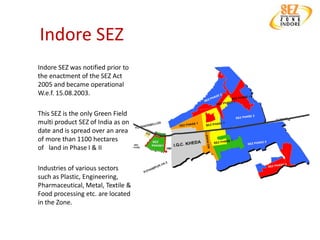
Indore SEZ
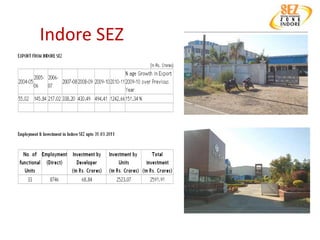
Indore SEZ was notified prior to
the enactment of the SEZ Act
2005 and became operational
W.e.f. 15.08.2003.

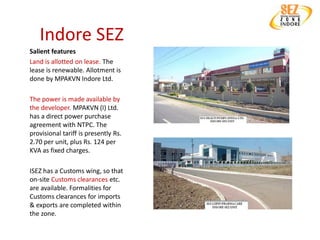
This SEZ is the only Green Field
multi product SEZ of India as on
date and is spread over an area
of more than 1100 hectares
of land in Phase I & II

Industries of various sectors
such as Plastic, Engineering,
Pharmaceutical, Metal, Textile &
Food processing etc. are located
in the Zone.
Indore SEZ


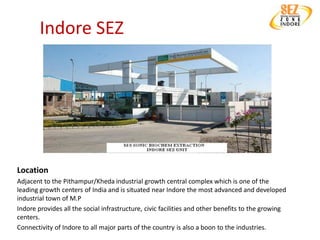
Location
Adjacent to the Pithampur/Kheda industrial growth central complex which is one of the
leading growth centers of India and is situated near Indore the most advanced and developed
industrial town of M.P
Indore provides all the social infrastructure, civic facilities and other benefits to the growing
centers.
Connectivity of Indore to all major parts of the country is also a boon to the industries.
Indore SEZ
Salient features
Land is allotted on lease. The
lease is renewable. Allotment is
done by MPAKVN Indore Ltd.

The power is made available by
the developer. MPAKVN (I) Ltd.
has a direct power purchase
agreement with NTPC. The
provisional tariff is presently Rs.
2.70 per unit, plus Rs. 124 per
KVA as fixed charges.

ISEZ has a Customs wing, so that
on-site Customs clearances etc.
are available. Formalities for
Customs clearances for imports
& exports are completed within
the zone.
Indore SEZ
Conclusion
•   SEZ policy has no doubt given a boost to the Indian Economy but comparison of implementation
    with other countries brings out lacunas in India’s SEZ Policy.

•   The reasons for disparities can be attributed to many reasons as listed below.
           Improper SEZ policy
           Irresponsible planning while locating SEZ
           Ineffective Land Acquisition Policies
           Improper Rehabilitation Policy

•   Key challenges in the SEZs programme will be
     • Due exercise of control while approving and locating SEZ’s.
     • Compensation for acquisition shall be on the basis of market prices .
     • Give share of acquired land in the developed area to the owners.
     • Provision of employment for Landless labourers .
     • Provision of revenue for ULBs on sharing basis to compensate their withdrawal once the area
         is notified as SEZ.
     • Development of SEZs needs to be integrated with existing Master Plans and Regional Plans.
     • There is need to develop regional/sub regional plan around the SEZ areas.

Sez in india

  • 1.
    SEZ (Special EconomicZones) Wind of Change…
  • 2.
    Introduction • Special Economic Zone (SEZ) is defined as "a specifically delineated duty free enclave and shall be deemed to be foreign territory for the purposes of trade operations and duties and tariffs". • SEZs  an engine for economic growth  supported by quality infrastructure  complemented by an attractive fiscal package  with the minimum possible regulations. • Government of India have notified Special Economic Zones (SEZs) Act 2005 and notified Special Economic Zone Rules 2006 with a view to augmenting infrastructure facilities for export.
  • 3.
    Chronology of SEZframework Export In 1990s, as a Processing part of Zone (EPZ) Special reforms, Full law and policy 1965. New Policy in Economic powers rules effected April 2000 Zones Act MAY 1st EPZ was set delegated to February 2006. 2005. up in Kandla zone (Gujarat) authorities. SEZ Categories » Free Trade Zones (FTZ) » Export Processing Zones (EPZ) » Free Zones (FZ) » Industrial Estates (IE) » Free Ports » Urban Enterprise Zones
  • 4.
    History of SEZ’sin India • During the past four decades many developing countries have been creating special zones to promote their exports and earn foreign exchange. • The term Export Processing Zone (EPZ) was first coined to identify the Shannon zone set up in Ireland in 1958. • India established its first EPZ in 1965 in Kandla (Gujarat) • In 1984 EPZs were established in Cochin (Kerala), Falta (Calcutta,now Kolkata), Madras (now Chennai) and NOIDA (Uttar Pradesh). • The Visakhapatnam EPZ (Andhra Pradesh) was established in 1989 and the Surat EPZ (Gujarat) in 1997.
  • 5.
    SEZ Act, 2005 Witha view to overcome the shortcomings experienced on account of the multiplicity of controls and clearances; absence of world class infrastructure, and an unstable fiscal regime and a view to attract larger foreign investments in India, the Special Economic Zones (SEZs) Policy was announced in April 2006. • The main objectives of the SEZ Act are:  generation of additional economic activity  promotion of exports of goods and services  promotion of investment from domestic and foreign sources  creation of employment opportunities  development of infrastructure facilities
  • 6.
    Status Of StateSEZ Act/Policies States where SEZ Act has been enacted & is in force States where SEZ Policy has been enacted & is in force
  • 7.
    Economic Benefits SEZ policyhas directly benefited economy in following ways: 1. Employment Generation : SEZs generate direct employment for skilled and unskilled labour ; indirect employment and employment for women workers. 2. Skill Formation: Formation of SEZs and new job requirements increase firm level activity whereby the labour force acquires skills from within the firm through training and learning. 3. Attract investors:: SEZs offer a highly conducive investment scenario for developers. No tax during development and operational stage. At profit stage 100% income tax exemption for Ist 5 yrs, 50% for next 5 yrs. 4. Technology Upgrading: SEZs attract export-oriented FDI and promote other forms of collaboration between local firms and MNCs. 5. Exports: EPZ exports registered an impressive growth rate over the period 1966 to 2002. EPZ exports increased in India from less than Rs.1 million in 1966 to over Rs. 97727 million in 2002. 6. Manufacturing Sector: Share of manufacturing industry in the exports grew from negligible percentage in 1970 to above 6 % in 2005. (Sources: Ministry of Commerce, Economic Survey)
  • 8.
    SEZs as vehiclefor Job Creation Reaping the demographic dividend India’s demographic profile is a boon for creating productive jobs for rising work force with higher savings and eventually investments for economic growth. India’s median age is just under 25 years with over 500 million people below 25 years of age. Two-thirds of these are supported by the agricultural sector which contributes just 21 percent to the GDP. These people have rising aspirations and must find jobs in manufacturing and services sectors, failing which there would be serious social and economic implications for the country. SEZs are job creators - it is estimated that close to 15,00,000 jobs by end of 2010 would be created by SEZs.
  • 9.
    SEZs Typology • SEZscan be categorized on basis of sector, function or location and required to have processing as well as non-processing area. Sector – Specific Manufacture goods or render services in a particular sector. SEZ SEZ Manufacture multiple goods in one Multi – Product sector or across multiple sectors. SEZ Trading and warehousing included SEZ in a port or SEZ in an existing port or airport for manufacture of goods falling in two or airport more sectors . Trading and warehousing included
  • 10.
    SEZ LAYOUT Processing Area Non- Processing Area •Processing area is the demarcated area in SEZ Non-processing area is intended to provide where units can be located for manufacture of support facilities to SEZ processing area and goods or rendering of services may include: •Minimum processing area has been uniformly • Educational institutions fixed at • Hospitals 50% for Multiproduct SEZs • Hotels Upto 90 % for product specific SEZs • Recreation and entertainment facilities • Residential and business complexes Land Use Distribution (%) Multi Product Sector Specific ( IT/ITES ( Min. 10 Ha) ( Min. 1000 Ha) Min. 100 Ha) Residential 35 50 50 Public Utility 15 10 10 Recreational 10 15 Transport & Communication 15 15 Green Belt 10
  • 11.
    Area Allocation interms of use.
  • 12.
    Sector specific SEZs • Pharma • Telecom Equipments • IT/ITES • R& D • Gems & Jwellery • Processed food & Bio eqp. • Bio Technology • Entertainment & Recreation • Chemicals • Consumer appliances • Medical equipments • Engineering Based • Apparel & Readymade • Automotive components
  • 13.
    Development Norms forNon Processing Areas in SEZs. Permissible FAR and land area is based on the following assumptions • The area permissible for the non processing use is Max 50% • The norms are based on 100 FAR on total area under non processing zone • Min area for Sector Specific SEZ – 100 ha • Min area for IT/ITES, Biotechnology, Gems and Jewellery SEZ- 10 ha • Min area for Multi Product SEZ – 1000 ha.
  • 14.
    Development Norms forNon Processing Areas in SEZs. Development guidelines – Multi Product SEZ FAR – 100 Total Floor Space – 50,00,000 sqmts Floor Space utilization Activity Percentage of floor Area in Sqmt space Residential – All types of housing typologies like villas, plotted housing 50 250000 apartments, condominiums etc as per the demand and need Commercial – This includes retail commercial, hotels, service apartments, 25 125000 multiplex etc Facilities – This includes schools college, social cultural institutes, 25 125000 hospitals, medical centers etc Land Utilization Activity Percentage of land Land in Ha Area Residential, commercial and facilities 55 27.5 (ground coverage 30%) Open spaces 20 100 Circulation 25 125 Note: The overall ceiling in each category will be revised upwards in proportion with the available FAR and area.
  • 15.
    Development Norms forNon Processing Areas in SEZs. Development guidelines – Sector Specific SEZ Maximum area permissible for Non Processing Zone 50 Ha. FAR – 100 Total Floor Space – 5,00,000 sqmts Activity Percentage of floor Area in Sqmt space Residential – All types of housing typologies like villas, plotted housing 50 250000 apartments, condominiums etc as per the demand and need Commercial – This includes retail commercial, hotels, service apartments, 25 125000 multiplex etc Facilities – This includes schools college, social cultural institutes, 25 125000 hospitals, medical centers etc Land Utilization Activity Percentage of land Land in Ha Area Residential, commercial and facilities 55 27.5 (ground coverage 30%) Open spaces 20 10 Circulation 25 12.5 Note: The overall ceiling in each category will be revised upwards in proportion with the available FAR and area.
  • 16.
    Development Norms forNon Processing Areas in SEZs. Development guidelines – IT/ITES, Biotechnology, Gems and Jewellery SEZ Maximum area permissible for Non Processing Zone 5 ha. FAR – 100 Total Floor Space – 50,000 sqmts Activity Percentage of floor Area in Sqmt space Residential – apartments, condominiums etc as per the demand and need 60 30000 Commercial – this includes retail commercial, hotels, service apartments, 15 7500 multiplex etc Facilities – This includes schools social cultural institutes, medical 25 12500 facilities such as dispensary nursing home etc Land Utilization Activity Percentage of land Land in Ha area Residential, commercial and Facilities 75 3.75 (ground coverage 30%) Open spaces 10 0.5 Circulation 15 0.75 Note: The overall ceiling in each category will be revised upwards in proportion with the available FAR and area.
  • 17.
  • 18.
  • 19.
    SEZs in India Atpresent there are Eight functional SEZs located at: • SantaCruz (Maharashtra), • Cochin (Kerala), • Kandla and Surat (Gujarat), • Chennai (Tamil Nadu), • Visakhapatnam (Andhra Pradesh), • Falta (West Bengal) & • Nodia (Uttar Pradesh) Further a SEZ at Indore (Madhya Pradesh ) is now ready for operation.
  • 20.
    Sector Allocation FORMAL IN PRINCIPAL Source: SEZ India *(As on 29.08.2007)
  • 21.
    Sectoral Focus As many as 439 SEZs have been approved in principle, out of which 198 have been notified till 8 March, 2008.
  • 22.
    SEZ’S India vsChina • By the end of the 1990s, it was found that India’s EPZs were not performing as well as China’s SEZs. • Major reasons behind poor Indian SEZ’s performance w.r.t China. Limited scale and overcrowding. Inadequate logistic supports. Poor infrastructure. Governments indifference and red tapism in matters of foreign direct investment. Lack of clarity in incentive packages. Poor coordination between state and municipal governments with central government, in the design, set up, and functioning of the zones.
  • 23.
    SEZ’S India vsChina Issue China India Size Typically in hundreds of Even 10 hectares will do hectares. Location located only on coasts. Anywhere. No restriction Labour laws Relaxed Flexibility is totally absent Policy regime Experimentation of liberal Based on fiscal sops policies in the specified areas Investors Basically foreigners who are Basically locals. Not foreign investor wooed with sops and promise of driven stability in policy. Commencement In 1979 In 1969 with the export processing zone concept, but it failed Number Only six: Shenzhen, Zhuhai, So far 28 operational. About 200 Shantou, Xiamen, Hainan and received approvals Pudong Tax holidays Present Longer and steeper than in China
  • 24.
    Falta SEZ • Set up by the Government of India in the year 1984. • Subsequently, two other SEZs were set up. They were MANIKANCHAN SEZ for gems and jewellery and WIPRO SEZ for IT and ITES, located at Salt Lake, Sector-V, Kolkata. – It is about 55 kilometres from Calcutta city and 45 kilometres from the southern suburbs. – It is well connected by a developed network of roads including a State highway, two ports at Calcutta and Haldia and International airport at Dumdum. • Infrastructural Facilities available at FALTA SEZ  Gross area 280 acres (acquired 87acres and transferred from CPT 193acres).  Location - Panchayat area.  Area Developed- 253 acres (full infrastructural facilities)  Area under development 27acres  Built - up space - SDF-15570 sq.m.(2nos.) - fully allotted.  Industrial shed- 15350sq.mtr.(7 nos) - fully allotted.  1 million liters per day water supply with drainage facilities.  Electric sub-station for dedicated power supply for all categories, supplemented by local sub-stations.
  • 25.
    Falta SEZ Total Valid Approvals – 182 Units in operation – 101 Units under implementation -30 Investment by Govt. of India - Rs 60.50 Crores (cumulative). Revenue Expenditure - Rs 02.27 Crores. (FY 2005 - 06) Revenue Earned - Rs 4.19 Crores (FY 2005 - 06). Investment Units - Rs. 317.45 Crores NRI - Rs. 8.89 Crores. Foreign - Rs. 13.71 Crores. STRENGTHS  Effective investment host for the industry in the traditional manufacturing sector.  Foreign trade profile consistent with local factor endowments.  High rate of growth and rising share of this sector in the overall exports from the states of W. B. as well as the Country.  Low cost of operation.  Ease of entry and lower cost of operation for commodity / volume driven products.  ease of operation for niche products.  Resource efficient scheme for export enhancement.  Strong linkage with industrial capacity in the command and catchment area.
  • 26.
    Falta SEZ Social and Economic Infrastructure • Telecommunication services, Post office including Courier Services. • Residential accommodation for Staff • Container Handling Jetty - Capacity 5 containers per hour. • Community Polytechnic for skill development and training. • Inland Container Depot (ICD). Infrastructural Facilities • Developed land & Built-up area at affordable and attractive rates. • Quality and Stable Power Supply • Efficient road network • Container Handling Jetty
  • 27.
    Indore SEZ Indore SEZwas notified prior to the enactment of the SEZ Act 2005 and became operational W.e.f. 15.08.2003. This SEZ is the only Green Field multi product SEZ of India as on date and is spread over an area of more than 1100 hectares of land in Phase I & II Industries of various sectors such as Plastic, Engineering, Pharmaceutical, Metal, Textile & Food processing etc. are located in the Zone.
  • 28.
    Indore SEZ Location Adjacent tothe Pithampur/Kheda industrial growth central complex which is one of the leading growth centers of India and is situated near Indore the most advanced and developed industrial town of M.P Indore provides all the social infrastructure, civic facilities and other benefits to the growing centers. Connectivity of Indore to all major parts of the country is also a boon to the industries.
  • 29.
    Indore SEZ Salient features Landis allotted on lease. The lease is renewable. Allotment is done by MPAKVN Indore Ltd. The power is made available by the developer. MPAKVN (I) Ltd. has a direct power purchase agreement with NTPC. The provisional tariff is presently Rs. 2.70 per unit, plus Rs. 124 per KVA as fixed charges. ISEZ has a Customs wing, so that on-site Customs clearances etc. are available. Formalities for Customs clearances for imports & exports are completed within the zone.
  • 30.
  • 31.
    Conclusion • SEZ policy has no doubt given a boost to the Indian Economy but comparison of implementation with other countries brings out lacunas in India’s SEZ Policy. • The reasons for disparities can be attributed to many reasons as listed below. Improper SEZ policy Irresponsible planning while locating SEZ Ineffective Land Acquisition Policies Improper Rehabilitation Policy • Key challenges in the SEZs programme will be • Due exercise of control while approving and locating SEZ’s. • Compensation for acquisition shall be on the basis of market prices . • Give share of acquired land in the developed area to the owners. • Provision of employment for Landless labourers . • Provision of revenue for ULBs on sharing basis to compensate their withdrawal once the area is notified as SEZ. • Development of SEZs needs to be integrated with existing Master Plans and Regional Plans. • There is need to develop regional/sub regional plan around the SEZ areas.