SPECIAL ECONOMIC ZONE
NAME – PRAVEEN KUMAR YADAV
ENROLL. NO. – 04113403818
CLASS – 3RD A
What is a SEZ ?
 Special Economic Zone (SEZ) is defined as "a specifically delineated duty
free enclave and shall be deemed to be foreign territory for the purposes of
trade operations and duties and tariffs.
 Special Economic Zone is one or more areas of a country where the tariffs
and quotas are eliminated and bureaucratic requirements are lowered so that
more companies are attracted to the area. The companies establishing in the
area also get extra incentives for doing business.
 SEZs are an acknowledgement of the potential of export-led development
strategy in accelerating economic growth.
 Setting up of Special Economic Zones are permitted in the public, private,
joint sector or by the State Governments
History of Special Economic Zones
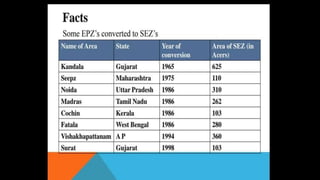
 From 1965 onwards, India experimented with the
concept of such units in the form of Export
Processing Zones (EPZ).
 But a revolution came in 2000, when Murlisone
Maran, then Commerce Minister, made a tour to the
southern provinces of China. After returning from the
visit, he incorporated the SEZs into the EXIM Policy
of India. Five year later, SEZ Act (2005) was also
introduced and in 2006 SEZ Rules were formulated.
SEZ in India
 India was one of the first in Asia to recognize the effectiveness
of the Export Processing Zone (EPZ) model in promoting
exports, with Asia’s first EPZ set up in Kandla in 1965.
 With a view to overcome the shortcomings experienced on
account of the multiplicity of controls and clearances; absence
of world-class infrastructure, and an unstable fiscal regime and
with a view to attract larger foreign investments in India, the
Special Economic Zones (SEZs) Policy was announced in
April 2000.
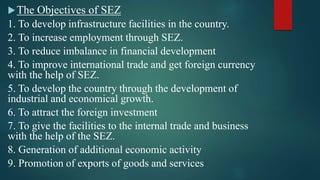
The Objectives of SEZ
1. To develop infrastructure facilities in the country.
2. To increase employment through SEZ.
3. To reduce imbalance in financial development
4. To improve international trade and get foreign currency
with the help of SEZ.
5. To develop the country through the development of
industrial and economical growth.
6. To attract the foreign investment
7. To give the facilities to the internal trade and business
with the help of the SEZ.
8. Generation of additional economic activity
9. Promotion of exports of goods and services
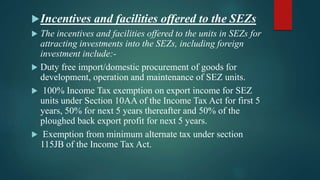
Incentives and facilities offered to the SEZs
 The incentives and facilities offered to the units in SEZs for
attracting investments into the SEZs, including foreign
investment include:-
 Duty free import/domestic procurement of goods for
development, operation and maintenance of SEZ units.
 100% Income Tax exemption on export income for SEZ
units under Section 10AA of the Income Tax Act for first 5
years, 50% for next 5 years thereafter and 50% of the
ploughed back export profit for next 5 years.
 Exemption from minimum alternate tax under section
115JB of the Income Tax Act.
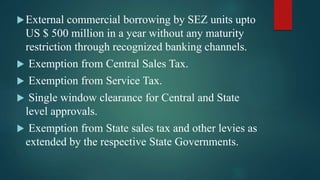
External commercial borrowing by SEZ units upto
US $ 500 million in a year without any maturity
restriction through recognized banking channels.
 Exemption from Central Sales Tax.
 Exemption from Service Tax.
 Single window clearance for Central and State
level approvals.
 Exemption from State sales tax and other levies as
extended by the respective State Governments.
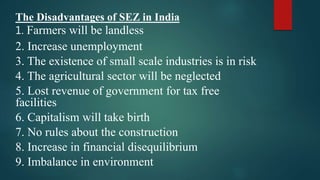
The Disadvantages of SEZ in India
1. Farmers will be landless
2. Increase unemployment
3. The existence of small scale industries is in risk
4. The agricultural sector will be neglected
5. Lost revenue of government for tax free
facilities
6. Capitalism will take birth
7. No rules about the construction
8. Increase in financial disequilibrium
9. Imbalance in environment
SEZ in India
SEZ in India
SEZ in India

SEZ in India

  • 1.
    SPECIAL ECONOMIC ZONE NAME– PRAVEEN KUMAR YADAV ENROLL. NO. – 04113403818 CLASS – 3RD A
  • 2.
    What is aSEZ ?  Special Economic Zone (SEZ) is defined as "a specifically delineated duty free enclave and shall be deemed to be foreign territory for the purposes of trade operations and duties and tariffs.  Special Economic Zone is one or more areas of a country where the tariffs and quotas are eliminated and bureaucratic requirements are lowered so that more companies are attracted to the area. The companies establishing in the area also get extra incentives for doing business.  SEZs are an acknowledgement of the potential of export-led development strategy in accelerating economic growth.  Setting up of Special Economic Zones are permitted in the public, private, joint sector or by the State Governments
  • 3.
    History of SpecialEconomic Zones  From 1965 onwards, India experimented with the concept of such units in the form of Export Processing Zones (EPZ).  But a revolution came in 2000, when Murlisone Maran, then Commerce Minister, made a tour to the southern provinces of China. After returning from the visit, he incorporated the SEZs into the EXIM Policy of India. Five year later, SEZ Act (2005) was also introduced and in 2006 SEZ Rules were formulated.
  • 4.
    SEZ in India India was one of the first in Asia to recognize the effectiveness of the Export Processing Zone (EPZ) model in promoting exports, with Asia’s first EPZ set up in Kandla in 1965.  With a view to overcome the shortcomings experienced on account of the multiplicity of controls and clearances; absence of world-class infrastructure, and an unstable fiscal regime and with a view to attract larger foreign investments in India, the Special Economic Zones (SEZs) Policy was announced in April 2000.
  • 6.
    The Objectives ofSEZ 1. To develop infrastructure facilities in the country. 2. To increase employment through SEZ. 3. To reduce imbalance in financial development 4. To improve international trade and get foreign currency with the help of SEZ. 5. To develop the country through the development of industrial and economical growth. 6. To attract the foreign investment 7. To give the facilities to the internal trade and business with the help of the SEZ. 8. Generation of additional economic activity 9. Promotion of exports of goods and services
  • 7.
    Incentives and facilitiesoffered to the SEZs  The incentives and facilities offered to the units in SEZs for attracting investments into the SEZs, including foreign investment include:-  Duty free import/domestic procurement of goods for development, operation and maintenance of SEZ units.  100% Income Tax exemption on export income for SEZ units under Section 10AA of the Income Tax Act for first 5 years, 50% for next 5 years thereafter and 50% of the ploughed back export profit for next 5 years.  Exemption from minimum alternate tax under section 115JB of the Income Tax Act.
  • 8.
    External commercial borrowingby SEZ units upto US $ 500 million in a year without any maturity restriction through recognized banking channels.  Exemption from Central Sales Tax.  Exemption from Service Tax.  Single window clearance for Central and State level approvals.  Exemption from State sales tax and other levies as extended by the respective State Governments.
  • 9.
    The Disadvantages ofSEZ in India 1. Farmers will be landless 2. Increase unemployment 3. The existence of small scale industries is in risk 4. The agricultural sector will be neglected 5. Lost revenue of government for tax free facilities 6. Capitalism will take birth 7. No rules about the construction 8. Increase in financial disequilibrium 9. Imbalance in environment