SPECIAL ECONOMIC
ZONE’S IN INDIA
SEJAL VISAWADIA
WHAT IS A SEZ ?
 The concept of SEZ is expected to bring large
dividends to the State in terms of economic and
industrial development and the generation of new
employment opportunities.
 The SEZs are expected to be engines for economic
growth.
 Special Economic Zone (SEZ) is defined as "a
specifically delineated duty free enclave and shall be
deemed to be foreign territory for the purposes of
trade operations and duties and tariffs".
SEZ: A BRIEF REVIEW
It covers a broad range of more specific zones
including :•
•
•
•
•
•

Free Trade Zones (FTZ)
Export Processing Zones (EPZ)
Free Zones (FZ)
Industrial Estates (IE)
Free Ports (FP)
Urban Enterprise Zones and others
History of Free Trade Zones
• First Free Trade Zone in the world had started on 1st
January 1965 at Kandla Port , Kutch, India.
• By 1978 India had another four free trade zones at
Mumbai , Chennai , Noida and Falta.
• In 1978 China had gone through major economic
make over and they had realized power in concept of
Free Trade Zone’s.
Cont..
• First Chinese Free Trade Zone became operational in
1984 – Shenzhen
• In year 2000 one zone of Shenzhen was Exporting
thrice of India.
• As on today there are about 2000 operation free
trade zones spread over 150 countries in world
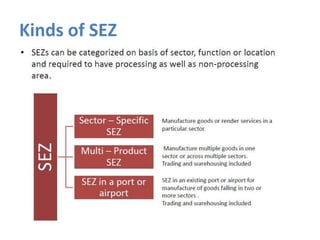
Kinds of SEZ
Fundamentals of SEZs
 SEZs (special economic zones) are fundamentally
different from the traditional free zones.
 They are much larger in size; offer broader range of
activities such as
 a single-window management,
 streamlined procedures,
 duty-free privileges,
 also access to the domestic market on a dutypaid basis.
Cont..
 Whether the enclave is termed an EPZ, FTZ or
SEZ, the cardinal factors are
 appropriate infrastructure and transport facilities,
 low factor cost,
 flexible labour laws,
 convertibility of currency,
 stable legal and administrative regime, and
 a commitment to the canons of an open economy
OBJECTIVES OF SEZ ACT
Generation of additional economic activity
Promotion of exports of goods and services
Promotion of investment from domestic and
foreign sources
Creation of employment opportunities
Development of infrastructure facilities
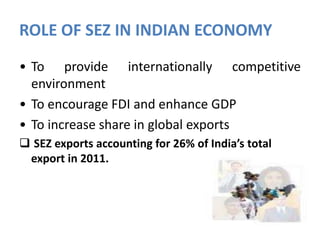
ROLE OF SEZ IN INDIAN ECONOMY
• To provide internationally competitive
environment
• To encourage FDI and enhance GDP
• To increase share in global exports
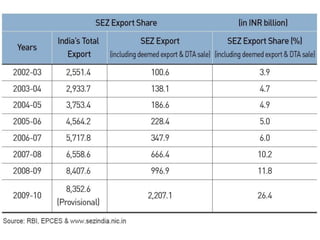
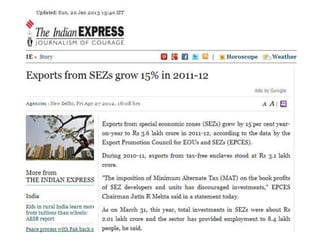
 SEZ exports accounting for 26% of India’s total
export in 2011.
SALIENT FEATURES OF SEZ
• Self certification for export and import
 Import and export movements of goods are based on
self declaration
 No routine examination is made unless specific order
from

Development Commissioner or authority.

• Sub contracting
 A SEZ unit may sub contract a part of it’s product or

production process to different units, even in abroad.
• Fiscal incentives-Tax
 Exemption from excise

and customers duty on

procurement of capital assets, consumable stores, rawmaterials from domestic market
 Exemption from sales tax, import duty, Income

tax, minimum alternative tax and dividend distribution
tax
• Single Window Clearance

 Submit regularity documents at single locations
 Less proceedings and save time
SOME OF IMPORTANT SEZ IN INDIA


INDIA

• Karnataka Biotechnology and Information Technology
Services - SEZ on biotechnology sector in Bangalore's
Electronics City, over an area of 43 acres
• Shree Renuka Sugars Limited - SEZ on sugarcane
processing complex covering 100 hectares, comprising a
sugar plant, power station and distillery, at Burlatti in
Belgaum district
Ittina Properties Private Limited and three other - SEZs
in IT sector, covering electronics, hardware and
software sectors in Bangalore, over an area of 15.732
hectares
 Wipro Infotech - SEZ on IT / ITES at Electronics City,
Sarajpur Bangalore
 Hewlett Packard India Software Operation Pvt. Ltd. SEZ on IT
• Food processing and related SEZ services in
Hassan, over an area of 157.91 hectares
• SEZs on pharmaceuticals, biotechnology and chemical
sectors in Hassan, covering of 281.21 hectares
•
•
•
•
•
•
•

SEEPZ - Andheri (East), Mumbai
Khopata - Multi-product, Mumbai
Navi Mumbai - Multi-product, Mumbai
Salt Lake Electronic City, West Bengal
Manikanchan - Jems and jewelery, West Bengal
Calcutta Leather Complex, West Bengal
Falta food processing unit, West Bengal
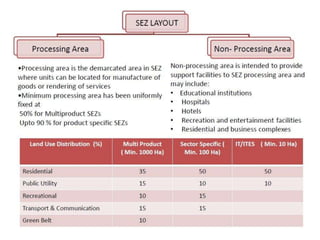
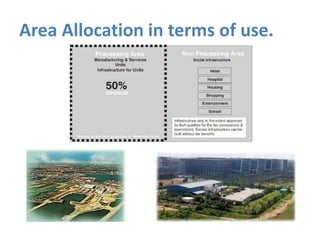
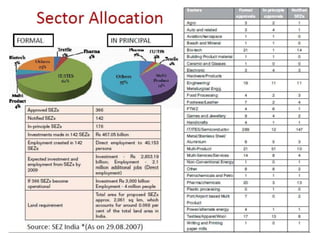
Area Allocation in terms of use.
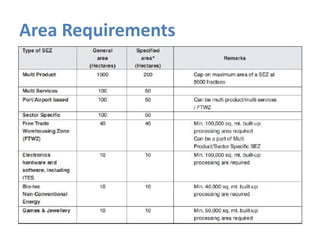
Area Requirements
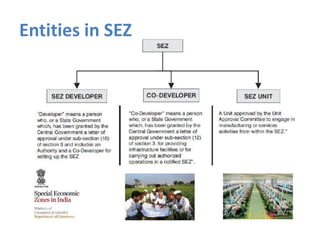
Entities in SEZ
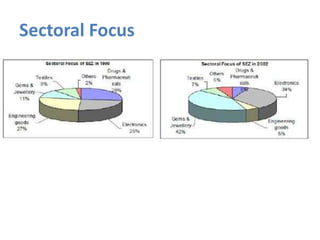
Sectoral Focus
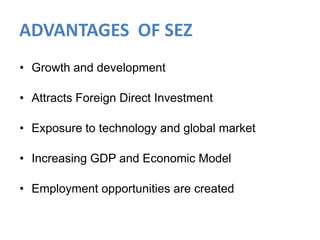
ADVANTAGES OF SEZ
• Growth and development
• Attracts Foreign Direct Investment
• Exposure to technology and global market
• Increasing GDP and Economic Model
• Employment opportunities are created
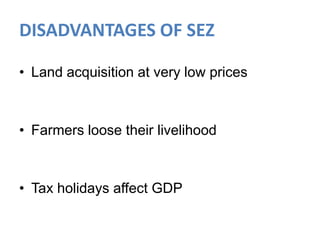
DISADVANTAGES OF SEZ
• Land acquisition at very low prices

• Farmers loose their livelihood

• Tax holidays affect GDP
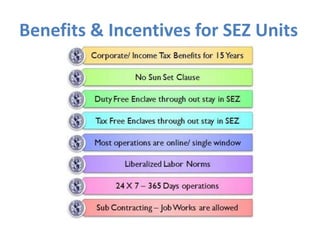
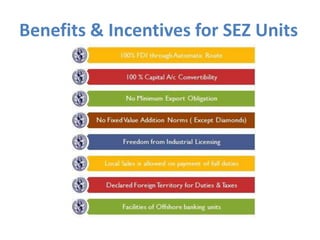
Benefits & Incentives for SEZ Units
SEZ Policy of 2000
 New Policy in April 2000. SEZs permitted to be set
up in the public, private, joint sector or by the State
Governments
 Minimum size of 1000 hectares (4 sq. miles)
 Simplified procedures and more incentives
 Main measures were:
 Conditions for automatic approval relaxed
considerably
 Customs procedures simplified
 Units could produce items reserved for SSI units in
domestic market
 100% FDI investment for manufacturing
 Profits could be repatriated fully
 Freedom for sub-contracting
 100% I.T. exemption for five years
 Exemption from Central Excise Duty on capital
goods, raw materials, consumable spares from
domestic market
 Reimbursement of CST paid on domestic
purchases
Positive Impacts
• To Nation
– World class business environment
– Increased FDI
– Higher economic growth
– Infrastructural development
– Export growth
– Employment Opportunities
– Exposure to technology and global markets
Positive Impacts
• TO Business houses
– Hassle free operating environment
– Single window clearance
– Simplified procedure for setting up
business, compliance proc with with self
certification
– Duty free import
– Tax exemption- VAT, CST, ST, other levies
– External commercial borrowings
– 100% profit reptriation from export earnings
Positive Impacts
• To People
– Employment opportunities
– Impact on lifestyle and standard of living
– Business infrastructure combined with social
facilities
– Better work culture , good education, leadership
vision
Hurdles
• To Nation
– Loss of revenue

• To Business
– Land acquisition
– Single window actually is not
– No strategic planning for electicity, water
Hurdles
• To People
– Grabbing of fertile land
– Water scarcity- Threat to access
– Food scarcity
– Exploitation of labour
– Landless farmers
• To Environment
 Mangrove destruction
 Destruction of ground water recharge system
 Pollution
SWOT ANALYSIS OF INDIAN SEZ
 STRENGTH
• Based on Western model or SEZ in China
• An established legal redress system
• Relatively low labour costs
• Employment opportunities
• India’s large English speaking and skilled
workforce
• Exposure to technology and global market
• Worldwide acceptance of capabilities in fields
like
•
•
•
•
•
•

Pharmaceutical manufacturing & research
Clinical trials
Manufacturing auto parts
Engineering designing & consultancy, IT & ITES
Malls and hotels
Hospital

• Financial & other institutional Networks like
Insurance Companies
 WEAKNESS
• Poor infrastructure and transport facilities

• High cost of capital
• Inadequate institutional support
• Political changes
• Inappropriate locations
 OPPORTUNITIES
• An alternative manufacturing base, particularly compared to Chinese

SEZs
• Investments in core strength areas like IT and software products and
services.
• New small ports & airports are also being developed keeping SEZ
concept in mind
• A large NRI base who have traditionally invested less in Greenfield
development in India
 THREATS
• The pattern of buying & selling may not continue.
With relocations of industries in other third world
countries, new competitors will emerge
• opposing interests
• Prospect of even more restrictive labour laws being
introduced
• Increasing rejection rate for proposals to establish
SEZs
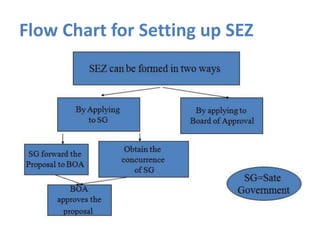
Flow Chart for Setting up SEZ
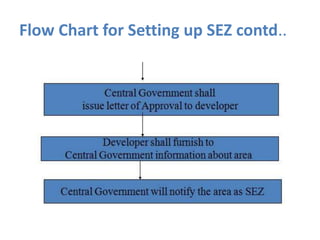
Flow Chart for Setting up SEZ contd..
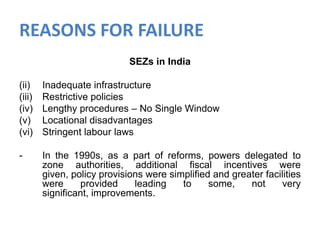
REASONS FOR FAILURE
SEZs in India

(ii)
(iii)
(iv)
(v)
(vi)

Inadequate infrastructure
Restrictive policies
Lengthy procedures – No Single Window
Locational disadvantages
Stringent labour laws

-

In the 1990s, as a part of reforms, powers delegated to
zone authorities, additional fiscal incentives were
given, policy provisions were simplified and greater facilities
were
provided
leading
to
some,
not
very
significant, improvements.
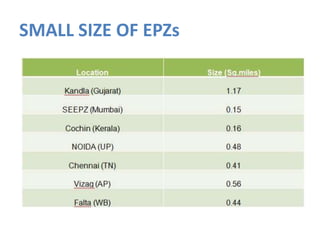
SMALL SIZE OF EPZs
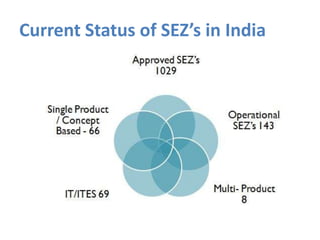
Current Status of SEZ’s in India
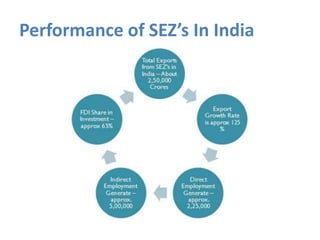
Performance of SEZ’s In India
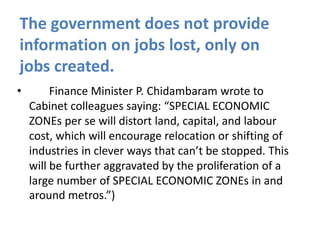
The government does not provide
information on jobs lost, only on
jobs created.
•

Finance Minister P. Chidambaram wrote to
Cabinet colleagues saying: “SPECIAL ECONOMIC
ZONEs per se will distort land, capital, and labour
cost, which will encourage relocation or shifting of
industries in clever ways that can’t be stopped. This
will be further aggravated by the proliferation of a
large number of SPECIAL ECONOMIC ZONEs in and
around metros.”)
Impact of the Special Economic Zone
•

•
•

•
•
•
•

Affluent of the industry will deteriorate physical
condition of soil.
The chemical affluents from the industries will also
effect the bio-resources.
The sub-surface and under ground water quality will
be impaired, because of heavy metals etc., through
the contaminated water from the surface.
The fertile land will become unproductive for the
agriculture.
The environment will be affected by such pollution.
The land value will be decreased.
The Socio-economic conditions of the people in the
area will be effected.
• Environment (Protection) Act is inapplicable to
SPECIAL ECONOMIC ZONEs. No environmental
clearance needed.
• Violates Panchayat Raj Act (1996) for local self
government.
• Violates laws granting rights and control to Adivasi
communities over their land.
• Violates many international conventions on human
rights.
CONCLUSION
• SEZ policy has no doubt given a boost to the Indian
Economy but comparison of implementation with
other countries brings out lacunas in India’s SEZ Policy.
• The reasons for disparities can be attributed to many
reasons as listed below.
 Improper SEZ policy
 Irresponsible planning while locating SEZ
 Ineffective Land Acquisition Policies
 Improper Rehabilitation Policy
CONCLUSION
• Key challenges in the SEZs programme will be
•Due exercise of control while approving and locating SEZ’s.
•Compensation for acquisition shall be on the basis of market prices .
•Give share of acquired land in the developed area to the owners.
•Provision of employment for Landless labourers .
•Provision of revenue for ULBs on sharing basis to compensate their
withdrawal once the area is notified as SEZ.
•Development of SEZs needs to be integrated with existing Master
Plans and Regional Plans.
•There is need to develop regional/sub regional plan around the SEZ
areas.
Thank you

Sez india

  • 1.
    SPECIAL ECONOMIC ZONE’S ININDIA SEJAL VISAWADIA
  • 2.
    WHAT IS ASEZ ?  The concept of SEZ is expected to bring large dividends to the State in terms of economic and industrial development and the generation of new employment opportunities.  The SEZs are expected to be engines for economic growth.  Special Economic Zone (SEZ) is defined as "a specifically delineated duty free enclave and shall be deemed to be foreign territory for the purposes of trade operations and duties and tariffs".
  • 3.
    SEZ: A BRIEFREVIEW It covers a broad range of more specific zones including :• • • • • • Free Trade Zones (FTZ) Export Processing Zones (EPZ) Free Zones (FZ) Industrial Estates (IE) Free Ports (FP) Urban Enterprise Zones and others
  • 4.
    History of FreeTrade Zones • First Free Trade Zone in the world had started on 1st January 1965 at Kandla Port , Kutch, India. • By 1978 India had another four free trade zones at Mumbai , Chennai , Noida and Falta. • In 1978 China had gone through major economic make over and they had realized power in concept of Free Trade Zone’s.
  • 5.
    Cont.. • First ChineseFree Trade Zone became operational in 1984 – Shenzhen • In year 2000 one zone of Shenzhen was Exporting thrice of India. • As on today there are about 2000 operation free trade zones spread over 150 countries in world
  • 6.
  • 7.
    Fundamentals of SEZs SEZs (special economic zones) are fundamentally different from the traditional free zones.  They are much larger in size; offer broader range of activities such as  a single-window management,  streamlined procedures,  duty-free privileges,  also access to the domestic market on a dutypaid basis.
  • 8.
    Cont..  Whether theenclave is termed an EPZ, FTZ or SEZ, the cardinal factors are  appropriate infrastructure and transport facilities,  low factor cost,  flexible labour laws,  convertibility of currency,  stable legal and administrative regime, and  a commitment to the canons of an open economy
  • 9.
    OBJECTIVES OF SEZACT Generation of additional economic activity Promotion of exports of goods and services Promotion of investment from domestic and foreign sources Creation of employment opportunities Development of infrastructure facilities
  • 10.
    ROLE OF SEZIN INDIAN ECONOMY • To provide internationally competitive environment • To encourage FDI and enhance GDP • To increase share in global exports  SEZ exports accounting for 26% of India’s total export in 2011.
  • 11.
    SALIENT FEATURES OFSEZ • Self certification for export and import  Import and export movements of goods are based on self declaration  No routine examination is made unless specific order from Development Commissioner or authority. • Sub contracting  A SEZ unit may sub contract a part of it’s product or production process to different units, even in abroad.
  • 12.
    • Fiscal incentives-Tax Exemption from excise and customers duty on procurement of capital assets, consumable stores, rawmaterials from domestic market  Exemption from sales tax, import duty, Income tax, minimum alternative tax and dividend distribution tax • Single Window Clearance  Submit regularity documents at single locations  Less proceedings and save time
  • 13.
    SOME OF IMPORTANTSEZ IN INDIA  INDIA • Karnataka Biotechnology and Information Technology Services - SEZ on biotechnology sector in Bangalore's Electronics City, over an area of 43 acres • Shree Renuka Sugars Limited - SEZ on sugarcane processing complex covering 100 hectares, comprising a sugar plant, power station and distillery, at Burlatti in Belgaum district
  • 14.
    Ittina Properties PrivateLimited and three other - SEZs in IT sector, covering electronics, hardware and software sectors in Bangalore, over an area of 15.732 hectares  Wipro Infotech - SEZ on IT / ITES at Electronics City, Sarajpur Bangalore  Hewlett Packard India Software Operation Pvt. Ltd. SEZ on IT
  • 15.
    • Food processingand related SEZ services in Hassan, over an area of 157.91 hectares • SEZs on pharmaceuticals, biotechnology and chemical sectors in Hassan, covering of 281.21 hectares • • • • • • • SEEPZ - Andheri (East), Mumbai Khopata - Multi-product, Mumbai Navi Mumbai - Multi-product, Mumbai Salt Lake Electronic City, West Bengal Manikanchan - Jems and jewelery, West Bengal Calcutta Leather Complex, West Bengal Falta food processing unit, West Bengal
  • 17.
    Area Allocation interms of use.
  • 18.
  • 19.
  • 21.
  • 24.
    ADVANTAGES OF SEZ •Growth and development • Attracts Foreign Direct Investment • Exposure to technology and global market • Increasing GDP and Economic Model • Employment opportunities are created
  • 25.
    DISADVANTAGES OF SEZ •Land acquisition at very low prices • Farmers loose their livelihood • Tax holidays affect GDP
  • 26.
    Benefits & Incentivesfor SEZ Units
  • 27.
    Benefits & Incentivesfor SEZ Units
  • 28.
    SEZ Policy of2000  New Policy in April 2000. SEZs permitted to be set up in the public, private, joint sector or by the State Governments  Minimum size of 1000 hectares (4 sq. miles)  Simplified procedures and more incentives
  • 29.
     Main measureswere:  Conditions for automatic approval relaxed considerably  Customs procedures simplified  Units could produce items reserved for SSI units in domestic market  100% FDI investment for manufacturing  Profits could be repatriated fully  Freedom for sub-contracting  100% I.T. exemption for five years  Exemption from Central Excise Duty on capital goods, raw materials, consumable spares from domestic market  Reimbursement of CST paid on domestic purchases
  • 30.
    Positive Impacts • ToNation – World class business environment – Increased FDI – Higher economic growth – Infrastructural development – Export growth – Employment Opportunities – Exposure to technology and global markets
  • 31.
    Positive Impacts • TOBusiness houses – Hassle free operating environment – Single window clearance – Simplified procedure for setting up business, compliance proc with with self certification – Duty free import – Tax exemption- VAT, CST, ST, other levies – External commercial borrowings – 100% profit reptriation from export earnings
  • 32.
    Positive Impacts • ToPeople – Employment opportunities – Impact on lifestyle and standard of living – Business infrastructure combined with social facilities – Better work culture , good education, leadership vision
  • 33.
    Hurdles • To Nation –Loss of revenue • To Business – Land acquisition – Single window actually is not – No strategic planning for electicity, water
  • 34.
    Hurdles • To People –Grabbing of fertile land – Water scarcity- Threat to access – Food scarcity – Exploitation of labour – Landless farmers • To Environment  Mangrove destruction  Destruction of ground water recharge system  Pollution
  • 35.
    SWOT ANALYSIS OFINDIAN SEZ  STRENGTH • Based on Western model or SEZ in China • An established legal redress system • Relatively low labour costs • Employment opportunities • India’s large English speaking and skilled workforce • Exposure to technology and global market
  • 36.
    • Worldwide acceptanceof capabilities in fields like • • • • • • Pharmaceutical manufacturing & research Clinical trials Manufacturing auto parts Engineering designing & consultancy, IT & ITES Malls and hotels Hospital • Financial & other institutional Networks like Insurance Companies
  • 37.
     WEAKNESS • Poorinfrastructure and transport facilities • High cost of capital • Inadequate institutional support • Political changes • Inappropriate locations
  • 38.
     OPPORTUNITIES • Analternative manufacturing base, particularly compared to Chinese SEZs • Investments in core strength areas like IT and software products and services. • New small ports & airports are also being developed keeping SEZ concept in mind • A large NRI base who have traditionally invested less in Greenfield development in India
  • 39.
     THREATS • Thepattern of buying & selling may not continue. With relocations of industries in other third world countries, new competitors will emerge • opposing interests • Prospect of even more restrictive labour laws being introduced • Increasing rejection rate for proposals to establish SEZs
  • 40.
    Flow Chart forSetting up SEZ
  • 41.
    Flow Chart forSetting up SEZ contd..
  • 42.
    REASONS FOR FAILURE SEZsin India (ii) (iii) (iv) (v) (vi) Inadequate infrastructure Restrictive policies Lengthy procedures – No Single Window Locational disadvantages Stringent labour laws - In the 1990s, as a part of reforms, powers delegated to zone authorities, additional fiscal incentives were given, policy provisions were simplified and greater facilities were provided leading to some, not very significant, improvements.
  • 43.
  • 44.
    Current Status ofSEZ’s in India
  • 45.
  • 47.
    The government doesnot provide information on jobs lost, only on jobs created. • Finance Minister P. Chidambaram wrote to Cabinet colleagues saying: “SPECIAL ECONOMIC ZONEs per se will distort land, capital, and labour cost, which will encourage relocation or shifting of industries in clever ways that can’t be stopped. This will be further aggravated by the proliferation of a large number of SPECIAL ECONOMIC ZONEs in and around metros.”)
  • 48.
    Impact of theSpecial Economic Zone • • • • • • • Affluent of the industry will deteriorate physical condition of soil. The chemical affluents from the industries will also effect the bio-resources. The sub-surface and under ground water quality will be impaired, because of heavy metals etc., through the contaminated water from the surface. The fertile land will become unproductive for the agriculture. The environment will be affected by such pollution. The land value will be decreased. The Socio-economic conditions of the people in the area will be effected.
  • 49.
    • Environment (Protection)Act is inapplicable to SPECIAL ECONOMIC ZONEs. No environmental clearance needed. • Violates Panchayat Raj Act (1996) for local self government. • Violates laws granting rights and control to Adivasi communities over their land. • Violates many international conventions on human rights.
  • 50.
    CONCLUSION • SEZ policyhas no doubt given a boost to the Indian Economy but comparison of implementation with other countries brings out lacunas in India’s SEZ Policy. • The reasons for disparities can be attributed to many reasons as listed below.  Improper SEZ policy  Irresponsible planning while locating SEZ  Ineffective Land Acquisition Policies  Improper Rehabilitation Policy
  • 51.
    CONCLUSION • Key challengesin the SEZs programme will be •Due exercise of control while approving and locating SEZ’s. •Compensation for acquisition shall be on the basis of market prices . •Give share of acquired land in the developed area to the owners. •Provision of employment for Landless labourers . •Provision of revenue for ULBs on sharing basis to compensate their withdrawal once the area is notified as SEZ. •Development of SEZs needs to be integrated with existing Master Plans and Regional Plans. •There is need to develop regional/sub regional plan around the SEZ areas.
  • 52.