SPECIAL ECONOMIC ZONE
(SEZ)
PERSPECTIVE OF DVELOPMENT IN INDIA
BY SUVANKAR DAS
PG SEM 4 (CGC)
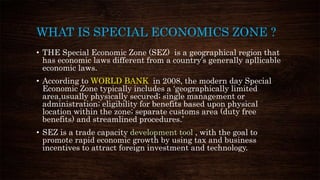
WHAT IS SPECIAL ECONOMICS ZONE ?
• THE Special Economic Zone (SEZ) is a geographical region that
has economic laws different from a country’s generally apllicable
economic laws.
• According to WORLD BANK in 2008, the modern day Special
Economic Zone typically includes a ‘geographically limited
area,usually physically secured; single management or
administration; eligibility for benefits based upon physical
location within the zone; separate customs area (duty free
benefits) and streamlined procedures.’
• SEZ is a trade capacity development tool , with the goal to
promote rapid economic growth by using tax and business
incentives to attract foreign investment and technology.
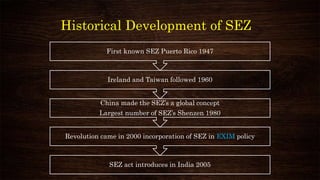
Historical Development of SEZ
SEZ act introduces in India 2005
Revolution came in 2000 incorporation of SEZ in EXIM policy
China made the SEZ’s a global concept
Largest number of SEZ’s Shenzen 1980
Ireland and Taiwan followed 1960
First known SEZ Puerto Rico 1947
To be continued…
Establishing SEZs is also recognized as communications
development methods.
• Full law and rules effected Feb 2006.
• Special Economic Zones Act may 2005.
• New Policy in April 2000.
• Export.
• Processing Zone (EPZ policy 1965)
• 1st EPZ was setup in Kandla(Gujrat).
• In 1900’s as a part reforms powers delegated to zone authorities
Chronology of SEZ framework.
Categories that SEZ includes
Free Trade Zones (FTZ) ;-Also known as export processing
zone. It is an area within which goods may be landed, handled,
manufactured or reconfigured, and re exported without the
intervention of the custom authorities. The world’s first Free
Trade Zone was established in Shannon, Ireland.
Free Port Or Free Zones (FZ):-Most commonly a free port is a
special customs regulations.
Industrial Parks Or Industrial Estates (IE):-It is an area zoned
and planned for the purpose of industrial development. An
example can be large number of industrial Estates located
along the river Thames in the Thames Gateway area of
London.
To be continued …
Free Economic Zones:-Free economics zones or free zones refer to
designated area in which companies are taxed very lightly or not at
all in order to encourage economic activity.
Urban Enterprise Zones:-It is an area in which policies to
encourage economic growth and development are implemented.
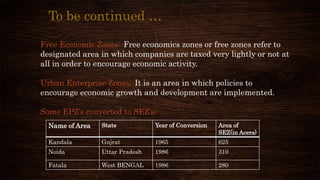
Some EPZ’s converted to SEZ’s:-
Name of Area State Year of Conversion Area of
SEZ(in Acers)
Kandala Gujrat 1965 625
Noida Uttar Pradesh 1986 310
Fatala West BENGAL 1986 280
What is actually meant by Development of a country?
Perspective of Development in INDIA
The term ‘ECONOMIC DEVELOPMENT” has been used
frequently in the 20th and 21st centuries, but the concept has
existed in the West for far longer. "Modernization",
"Westernization", and especially "industrialization" are other
terms often used while discussing economic development
Whereas economic development is a policy intervention aiming to improve the
well-being of people, economic growth is a phenomenon of market productivity
and increases in GDP; economist Amartya Sen describes economic growth as
but "one aspect of the process of economic development". Economists primarily
focus on the growth aspect and the economy at large, whereas researchers of
community economic development concern themselves with
socioeconomic development as well.
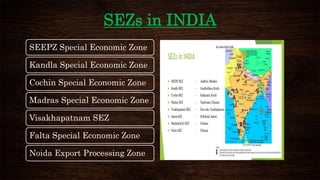
SEZs in INDIA
SEEPZ Special Economic Zone
Kandla Special Economic Zone
Cochin Special Economic Zone
Madras Special Economic Zone
Visakhapatnam SEZ
Falta Special Economic Zone
Noida Export Processing Zone
Objectives of SEZ in INDIA
The main objectives of SEZ Scheme is
• Generation of additional economic activity.
• Promotion of exports of goods and services.
• Promotion of investment from domestic and
foreign sources.
• Creation of employment opportunities along
with the development of infrastructure
facilities.
Major incentives offered to firms under SEZ in INDIA
• Duty free import / domestic procurement of
goods for development ,operation and
maintenance of SEZ units.
• 100% Income tax exemption on export income foe
SEZ units under section 10AA of the income Tax
Act for first 5years , 50% for next five years .
• Exemption from central / state sales Taxes and
other levies.
• Exemption from service tax.
• Single window clearance for central and sate
level approvals.
Role of SEZ in INDIAN Economy
• To provide internationally competitive
environment .
• To increase share in global exports.
• To encourages FDI and enhance GDP.
• To act as laboratories for changes in our
polices.
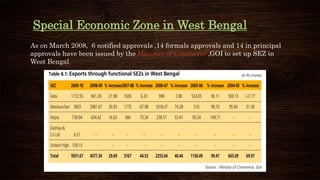
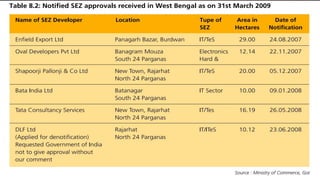
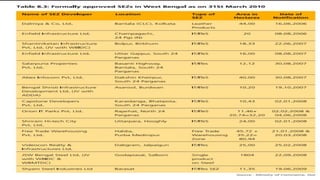
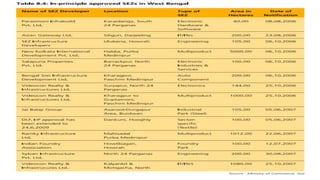
Special Economic Zone in West Bengal
As on March 2008, 6 notified approvals ,14 formals approvals and 14 in principal
approvals have been issued by the Ministry of Commerce ,GOI to set up SEZ in
West Bengal.
Analysis of INDIAN SEZ Policy
STRENGTH:-
• Based on western model or SEZ in Chaina.
• An established legal redress system
• Relatively low labour costs.
• Employment opportunities .
• India’s large English speaking and skilled
work force.
Analysis of INDIAN SEZ Policy
WEAKNESS:-
• Poor infrastructures and transport facility .
• High cost of capitals.
• Inadequate institutional support
• Political charges.
• Inappropriate location.
OPPORTUNITIES:-
• Investment in core strength areas like it AND Software products
and services.
• New small ports and airports are also being developed keeping SEZ
concept in mind.
• A large NRI base who have traditionally invested less in Greenfield
development in India.
THREATS
• Opposing interests.
• Prospect of even more restrictive labour laws being
introduced.
• Increasing rejection rate.
Reasons for failure in INDIA
•Inadequate infrastructure.
•Restrictive policies.
•Lengthy procedures.
• Locational disadvantage
•Stringent labour laws.
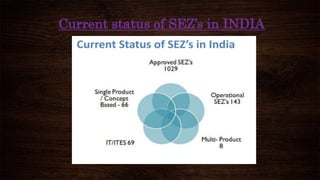
Current status of SEZ’s in INDIA
Conclusion
Definitely, SEZ policy has no doubtly boosted Indian economy.But comparition of
implementation with other countries brings out lacunas in India’s SEZ policy.
The reasons for disparities can be attributed to many reasons
as listed below…
• Improper SEZ policy
• Irresponssible planning.
• Ineffective land acquisition policies .
• Improper rehabilitation policy..
So,SEZ policy is a very good policy to boosted up indian economy,but due
to lack of proper planning and infrasturucture and lack of other thing the
out come of SEZ policy in India is not 100%.So,we can hope in future in
the help of proper technique and planning the result will be came 100%.
THANK YOU

Special economic zone (SEZ ) Indian Perspective.

  • 1.
    SPECIAL ECONOMIC ZONE (SEZ) PERSPECTIVEOF DVELOPMENT IN INDIA BY SUVANKAR DAS PG SEM 4 (CGC)
  • 2.
    WHAT IS SPECIALECONOMICS ZONE ? • THE Special Economic Zone (SEZ) is a geographical region that has economic laws different from a country’s generally apllicable economic laws. • According to WORLD BANK in 2008, the modern day Special Economic Zone typically includes a ‘geographically limited area,usually physically secured; single management or administration; eligibility for benefits based upon physical location within the zone; separate customs area (duty free benefits) and streamlined procedures.’ • SEZ is a trade capacity development tool , with the goal to promote rapid economic growth by using tax and business incentives to attract foreign investment and technology.
  • 3.
    Historical Development ofSEZ SEZ act introduces in India 2005 Revolution came in 2000 incorporation of SEZ in EXIM policy China made the SEZ’s a global concept Largest number of SEZ’s Shenzen 1980 Ireland and Taiwan followed 1960 First known SEZ Puerto Rico 1947
  • 4.
    To be continued… EstablishingSEZs is also recognized as communications development methods. • Full law and rules effected Feb 2006. • Special Economic Zones Act may 2005. • New Policy in April 2000. • Export. • Processing Zone (EPZ policy 1965) • 1st EPZ was setup in Kandla(Gujrat). • In 1900’s as a part reforms powers delegated to zone authorities Chronology of SEZ framework.
  • 5.
    Categories that SEZincludes Free Trade Zones (FTZ) ;-Also known as export processing zone. It is an area within which goods may be landed, handled, manufactured or reconfigured, and re exported without the intervention of the custom authorities. The world’s first Free Trade Zone was established in Shannon, Ireland. Free Port Or Free Zones (FZ):-Most commonly a free port is a special customs regulations. Industrial Parks Or Industrial Estates (IE):-It is an area zoned and planned for the purpose of industrial development. An example can be large number of industrial Estates located along the river Thames in the Thames Gateway area of London.
  • 6.
    To be continued… Free Economic Zones:-Free economics zones or free zones refer to designated area in which companies are taxed very lightly or not at all in order to encourage economic activity. Urban Enterprise Zones:-It is an area in which policies to encourage economic growth and development are implemented. Some EPZ’s converted to SEZ’s:- Name of Area State Year of Conversion Area of SEZ(in Acers) Kandala Gujrat 1965 625 Noida Uttar Pradesh 1986 310 Fatala West BENGAL 1986 280
  • 7.
    What is actuallymeant by Development of a country? Perspective of Development in INDIA The term ‘ECONOMIC DEVELOPMENT” has been used frequently in the 20th and 21st centuries, but the concept has existed in the West for far longer. "Modernization", "Westernization", and especially "industrialization" are other terms often used while discussing economic development Whereas economic development is a policy intervention aiming to improve the well-being of people, economic growth is a phenomenon of market productivity and increases in GDP; economist Amartya Sen describes economic growth as but "one aspect of the process of economic development". Economists primarily focus on the growth aspect and the economy at large, whereas researchers of community economic development concern themselves with socioeconomic development as well.
  • 8.
    SEZs in INDIA SEEPZSpecial Economic Zone Kandla Special Economic Zone Cochin Special Economic Zone Madras Special Economic Zone Visakhapatnam SEZ Falta Special Economic Zone Noida Export Processing Zone
  • 9.
    Objectives of SEZin INDIA The main objectives of SEZ Scheme is • Generation of additional economic activity. • Promotion of exports of goods and services. • Promotion of investment from domestic and foreign sources. • Creation of employment opportunities along with the development of infrastructure facilities.
  • 10.
    Major incentives offeredto firms under SEZ in INDIA • Duty free import / domestic procurement of goods for development ,operation and maintenance of SEZ units. • 100% Income tax exemption on export income foe SEZ units under section 10AA of the income Tax Act for first 5years , 50% for next five years . • Exemption from central / state sales Taxes and other levies. • Exemption from service tax. • Single window clearance for central and sate level approvals.
  • 11.
    Role of SEZin INDIAN Economy • To provide internationally competitive environment . • To increase share in global exports. • To encourages FDI and enhance GDP. • To act as laboratories for changes in our polices.
  • 12.
    Special Economic Zonein West Bengal As on March 2008, 6 notified approvals ,14 formals approvals and 14 in principal approvals have been issued by the Ministry of Commerce ,GOI to set up SEZ in West Bengal.
  • 16.
    Analysis of INDIANSEZ Policy STRENGTH:- • Based on western model or SEZ in Chaina. • An established legal redress system • Relatively low labour costs. • Employment opportunities . • India’s large English speaking and skilled work force.
  • 17.
    Analysis of INDIANSEZ Policy WEAKNESS:- • Poor infrastructures and transport facility . • High cost of capitals. • Inadequate institutional support • Political charges. • Inappropriate location.
  • 18.
    OPPORTUNITIES:- • Investment incore strength areas like it AND Software products and services. • New small ports and airports are also being developed keeping SEZ concept in mind. • A large NRI base who have traditionally invested less in Greenfield development in India. THREATS • Opposing interests. • Prospect of even more restrictive labour laws being introduced. • Increasing rejection rate.
  • 19.
    Reasons for failurein INDIA •Inadequate infrastructure. •Restrictive policies. •Lengthy procedures. • Locational disadvantage •Stringent labour laws.
  • 20.
    Current status ofSEZ’s in INDIA
  • 24.
    Conclusion Definitely, SEZ policyhas no doubtly boosted Indian economy.But comparition of implementation with other countries brings out lacunas in India’s SEZ policy. The reasons for disparities can be attributed to many reasons as listed below… • Improper SEZ policy • Irresponssible planning. • Ineffective land acquisition policies . • Improper rehabilitation policy.. So,SEZ policy is a very good policy to boosted up indian economy,but due to lack of proper planning and infrasturucture and lack of other thing the out come of SEZ policy in India is not 100%.So,we can hope in future in the help of proper technique and planning the result will be came 100%.
  • 25.