Ethical Dilemma Case Study:
The Case of the Pressuring Parents
Deb Bishop
Quin Gonell
Angel Seto
Salem State University
EDU803B Helping Skills for Student Affairs Professionals II
Fall 2014
Dr. Randi Korn
Setting:
Grantland University, a large, public research institution in
the Southeast
Characters:
Phil, Academic Advisor for undecided students
Ross, first-semester student
Ross’ family
Background Information
Who is Phil?
Who is Ross?
What major is Ross currently studying and what major
does he want to study?
What happened to Ross’s sister when she declared
Philosophy?
Pop Quiz!
Concerns:
 Potential for the development of a Dual Relationship
 Confidentiality (FERPA)
 Conflicting Ethical Standards
 Ethical standards (CAS, ACPA, and NASPA) reflect
different points of view in emphasis
 Potential for the development of a Dual Relationship
 Phil is Ross’s advisor not his lawyer, therapist or guardian
 If Phil does not make this boundary clear Ross could grow too
dependent
Analyzing the Case Study
Confidentiality:
 FERPA: Family Education Rights and Privacy Act
(1974)
 Purpose: to protect the student, more specifically, to
protect the rights of students’ education records to
remain private (p.65, Reynolds, 2009)
 This privacy does not exclude parents
Analyzing the Case Study
Confidentiality, continued
FERPA Limitations:
Some schools have disclosed student records to:
 Other academic institutions
 Family members of students who are in crisis or engaging in self-
destructive behavior
Ambiguity remains with regard to interpretation and application in
different cases:
 Reynolds recommends seeking assistance from legal counsel
whenever expectations are not clear
Analyzing the Case Study
Conflicting Ethical Standards:
 “Autonomy” merits encouraging Ross to pursue an
education plan that interests him.
 “Justice” merits advising Ross that his parents don’t need
to be aware of his student records
On the other hand…
 “Do No Harm” merits advising caution in deciding to
switch out of engineering due to risk of losing parent’s
financial support.
Analyzing the Case Study
Conflicting Ethical Standards, continued
Solution:
Reference CAS Advising Standards:
 “Advisers should craft a coherent educational plan based on
assessment of abilities, aspirations, interests, and values of the
student.”
Reference CAS Ethics Principle III, Beneficence Standard:
 “We consider the thoughts and feelings of others”
Questions:
 Do these standards outweigh the conflicting ethical standards?
If the answer is yes, then…
 According to these standards: What should matter most to Phil?
Analyzing the Case Study
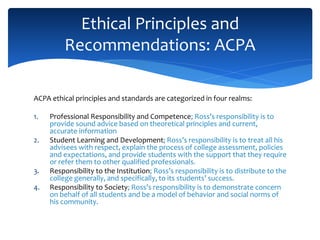
ACPA ethical principles and standards are categorized in four realms:
1. Professional Responsibility and Competence; Ross’s responsibility is to
provide sound advice based on theoretical principles and current,
accurate information
2. Student Learning and Development; Ross’s responsibility is to treat all his
advisees with respect, explain the process of college assessment, policies
and expectations, and provide students with the support that they require
or refer them to other qualified professionals.
3. Responsibility to the Institution; Ross’s responsibility is to distribute to the
college generally, and specifically, to its students’ success.
4. Responsibility to Society; Ross’s responsibility is to demonstrate concern
on behalf of all students and be a model of behavior and social norms of
his community.
Ethical Principles and
Recommendations: ACPA
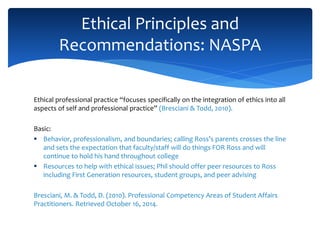
Ethical professional practice “focuses specifically on the integration of ethics into all
aspects of self and professional practice” (Bresciani & Todd, 2010).
Basic:
 Behavior, professionalism, and boundaries; calling Ross’s parents crosses the line
and sets the expectation that faculty/staff will do things FOR Ross and will
continue to hold his hand throughout college
 Resources to help with ethical issues; Phil should offer peer resources to Ross
including First Generation resources, student groups, and peer advising
Bresciani, M. & Todd, D. (2010). Professional Competency Areas of Student Affairs
Practitioners. Retrieved October 16, 2014.
Ethical Principles and
Recommendations: NASPA
Intermediate:
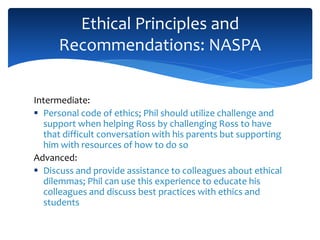
 Personal code of ethics; Phil should utilize challenge and
support when helping Ross by challenging Ross to have
that difficult conversation with his parents but supporting
him with resources of how to do so
Advanced:
 Discuss and provide assistance to colleagues about ethical
dilemmas; Phil can use this experience to educate his
colleagues and discuss best practices with ethics and
students
Ethical Principles and
Recommendations: NASPA
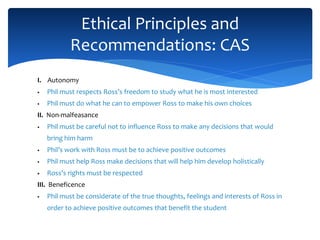
I. Autonomy
 Phil must respects Ross’s freedom to study what he is most interested
 Phil must do what he can to empower Ross to make his own choices
II. Non-malfeasance
 Phil must be careful not to influence Ross to make any decisions that would
bring him harm
 Phil’s work with Ross must be to achieve positive outcomes
 Phil must help Ross make decisions that will help him develop holistically
 Ross’s rights must be respected
III. Beneficence
 Phil must be considerate of the true thoughts, feelings and interests of Ross in
order to achieve positive outcomes that benefit the student
Ethical Principles and
Recommendations: CAS
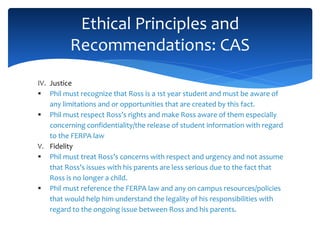
IV. Justice
 Phil must recognize that Ross is a 1st year student and must be aware of
any limitations and or opportunities that are created by this fact.
 Phil must respect Ross’s rights and make Ross aware of them especially
concerning confidentiality/the release of student information with regard
to the FERPA law
V. Fidelity
 Phil must treat Ross’s concerns with respect and urgency and not assume
that Ross’s issues with his parents are less serious due to the fact that
Ross is no longer a child.
 Phil must reference the FERPA law and any on campus resources/policies
that would help him understand the legality of his responsibilities with
regard to the ongoing issue between Ross and his parents.
Ethical Principles and
Recommendations: CAS
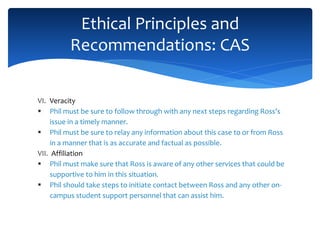
VI. Veracity
 Phil must be sure to follow through with any next steps regarding Ross’s
issue in a timely manner.
 Phil must be sure to relay any information about this case to or from Ross
in a manner that is as accurate and factual as possible.
VII. Affiliation
 Phil must make sure that Ross is aware of any other services that could be
supportive to him in this situation.
 Phil should take steps to initiate contact between Ross and any other on-
campus student support personnel that can assist him.
Ethical Principles and
Recommendations: CAS
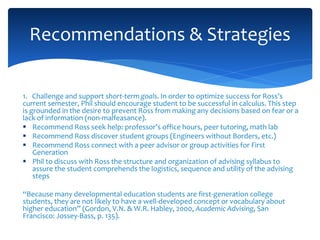
1. Challenge and support short-term goals. In order to optimize success for Ross’s
current semester, Phil should encourage student to be successful in calculus. This step
is grounded in the desire to prevent Ross from making any decisions based on fear or a
lack of information (non-malfeasance).
 Recommend Ross seek help: professor’s office hours, peer tutoring, math lab
 Recommend Ross discover student groups (Engineers without Borders, etc.)
 Recommend Ross connect with a peer advisor or group activities for First
Generation
 Phil to discuss with Ross the structure and organization of advising syllabus to
assure the student comprehends the logistics, sequence and utility of the advising
steps
“Because many developmental education students are first-generation college
students, they are not likely to have a well-developed concept or vocabulary about
higher education” (Gordon, V.N. & W.R. Habley, 2000, Academic Advising, San
Francisco: Jossey-Bass, p. 135).
Recommendations & Strategies
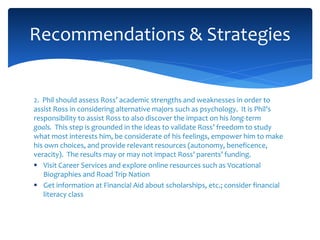
2. Phil should assess Ross’ academic strengths and weaknesses in order to
assist Ross in considering alternative majors such as psychology. It is Phil’s
responsibility to assist Ross to also discover the impact on his long-term
goals. This step is grounded in the ideas to validate Ross’ freedom to study
what most interests him, be considerate of his feelings, empower him to make
his own choices, and provide relevant resources (autonomy, beneficence,
veracity). The results may or may not impact Ross’ parents’ funding.
 Visit Career Services and explore online resources such as Vocational
Biographies and Road Trip Nation
 Get information at Financial Aid about scholarships, etc.; consider financial
literacy class
Recommendations & Strategies
3. Phil should support Ross’ efforts to inform and educate parents about
decisions he is making about his academic, career and life plans. This step is
based on Phil’s obligations according to FERPA, as well as serving Ross’ special
circumstances as a first generation student (justice, fidelity, affiliation).
 Assist student with communication skills, including role-playing
 Visit Counseling Services
4. Phil should assist Ross to make an outline of next steps and schedule a
follow-up appointment. This step is based on the goals to follow through
(veracity and affiliation).
Recommendations & Strategies
Questions?

Ethical Dilemma Case Study: The Case of the Pressuring Parents

  • 1.
    Ethical Dilemma CaseStudy: The Case of the Pressuring Parents Deb Bishop Quin Gonell Angel Seto Salem State University EDU803B Helping Skills for Student Affairs Professionals II Fall 2014 Dr. Randi Korn
  • 2.
    Setting: Grantland University, alarge, public research institution in the Southeast Characters: Phil, Academic Advisor for undecided students Ross, first-semester student Ross’ family Background Information
  • 3.
    Who is Phil? Whois Ross? What major is Ross currently studying and what major does he want to study? What happened to Ross’s sister when she declared Philosophy? Pop Quiz!
  • 4.
    Concerns:  Potential forthe development of a Dual Relationship  Confidentiality (FERPA)  Conflicting Ethical Standards  Ethical standards (CAS, ACPA, and NASPA) reflect different points of view in emphasis  Potential for the development of a Dual Relationship  Phil is Ross’s advisor not his lawyer, therapist or guardian  If Phil does not make this boundary clear Ross could grow too dependent Analyzing the Case Study
  • 5.
    Confidentiality:  FERPA: FamilyEducation Rights and Privacy Act (1974)  Purpose: to protect the student, more specifically, to protect the rights of students’ education records to remain private (p.65, Reynolds, 2009)  This privacy does not exclude parents Analyzing the Case Study
  • 6.
    Confidentiality, continued FERPA Limitations: Someschools have disclosed student records to:  Other academic institutions  Family members of students who are in crisis or engaging in self- destructive behavior Ambiguity remains with regard to interpretation and application in different cases:  Reynolds recommends seeking assistance from legal counsel whenever expectations are not clear Analyzing the Case Study
  • 7.
    Conflicting Ethical Standards: “Autonomy” merits encouraging Ross to pursue an education plan that interests him.  “Justice” merits advising Ross that his parents don’t need to be aware of his student records On the other hand…  “Do No Harm” merits advising caution in deciding to switch out of engineering due to risk of losing parent’s financial support. Analyzing the Case Study
  • 8.
    Conflicting Ethical Standards,continued Solution: Reference CAS Advising Standards:  “Advisers should craft a coherent educational plan based on assessment of abilities, aspirations, interests, and values of the student.” Reference CAS Ethics Principle III, Beneficence Standard:  “We consider the thoughts and feelings of others” Questions:  Do these standards outweigh the conflicting ethical standards? If the answer is yes, then…  According to these standards: What should matter most to Phil? Analyzing the Case Study
  • 9.
    ACPA ethical principlesand standards are categorized in four realms: 1. Professional Responsibility and Competence; Ross’s responsibility is to provide sound advice based on theoretical principles and current, accurate information 2. Student Learning and Development; Ross’s responsibility is to treat all his advisees with respect, explain the process of college assessment, policies and expectations, and provide students with the support that they require or refer them to other qualified professionals. 3. Responsibility to the Institution; Ross’s responsibility is to distribute to the college generally, and specifically, to its students’ success. 4. Responsibility to Society; Ross’s responsibility is to demonstrate concern on behalf of all students and be a model of behavior and social norms of his community. Ethical Principles and Recommendations: ACPA
  • 10.
    Ethical professional practice“focuses specifically on the integration of ethics into all aspects of self and professional practice” (Bresciani & Todd, 2010). Basic:  Behavior, professionalism, and boundaries; calling Ross’s parents crosses the line and sets the expectation that faculty/staff will do things FOR Ross and will continue to hold his hand throughout college  Resources to help with ethical issues; Phil should offer peer resources to Ross including First Generation resources, student groups, and peer advising Bresciani, M. & Todd, D. (2010). Professional Competency Areas of Student Affairs Practitioners. Retrieved October 16, 2014. Ethical Principles and Recommendations: NASPA
  • 11.
    Intermediate:  Personal codeof ethics; Phil should utilize challenge and support when helping Ross by challenging Ross to have that difficult conversation with his parents but supporting him with resources of how to do so Advanced:  Discuss and provide assistance to colleagues about ethical dilemmas; Phil can use this experience to educate his colleagues and discuss best practices with ethics and students Ethical Principles and Recommendations: NASPA
  • 12.
    I. Autonomy  Philmust respects Ross’s freedom to study what he is most interested  Phil must do what he can to empower Ross to make his own choices II. Non-malfeasance  Phil must be careful not to influence Ross to make any decisions that would bring him harm  Phil’s work with Ross must be to achieve positive outcomes  Phil must help Ross make decisions that will help him develop holistically  Ross’s rights must be respected III. Beneficence  Phil must be considerate of the true thoughts, feelings and interests of Ross in order to achieve positive outcomes that benefit the student Ethical Principles and Recommendations: CAS
  • 13.
    IV. Justice  Philmust recognize that Ross is a 1st year student and must be aware of any limitations and or opportunities that are created by this fact.  Phil must respect Ross’s rights and make Ross aware of them especially concerning confidentiality/the release of student information with regard to the FERPA law V. Fidelity  Phil must treat Ross’s concerns with respect and urgency and not assume that Ross’s issues with his parents are less serious due to the fact that Ross is no longer a child.  Phil must reference the FERPA law and any on campus resources/policies that would help him understand the legality of his responsibilities with regard to the ongoing issue between Ross and his parents. Ethical Principles and Recommendations: CAS
  • 14.
    VI. Veracity  Philmust be sure to follow through with any next steps regarding Ross’s issue in a timely manner.  Phil must be sure to relay any information about this case to or from Ross in a manner that is as accurate and factual as possible. VII. Affiliation  Phil must make sure that Ross is aware of any other services that could be supportive to him in this situation.  Phil should take steps to initiate contact between Ross and any other on- campus student support personnel that can assist him. Ethical Principles and Recommendations: CAS
  • 15.
    1. Challenge andsupport short-term goals. In order to optimize success for Ross’s current semester, Phil should encourage student to be successful in calculus. This step is grounded in the desire to prevent Ross from making any decisions based on fear or a lack of information (non-malfeasance).  Recommend Ross seek help: professor’s office hours, peer tutoring, math lab  Recommend Ross discover student groups (Engineers without Borders, etc.)  Recommend Ross connect with a peer advisor or group activities for First Generation  Phil to discuss with Ross the structure and organization of advising syllabus to assure the student comprehends the logistics, sequence and utility of the advising steps “Because many developmental education students are first-generation college students, they are not likely to have a well-developed concept or vocabulary about higher education” (Gordon, V.N. & W.R. Habley, 2000, Academic Advising, San Francisco: Jossey-Bass, p. 135). Recommendations & Strategies
  • 16.
    2. Phil shouldassess Ross’ academic strengths and weaknesses in order to assist Ross in considering alternative majors such as psychology. It is Phil’s responsibility to assist Ross to also discover the impact on his long-term goals. This step is grounded in the ideas to validate Ross’ freedom to study what most interests him, be considerate of his feelings, empower him to make his own choices, and provide relevant resources (autonomy, beneficence, veracity). The results may or may not impact Ross’ parents’ funding.  Visit Career Services and explore online resources such as Vocational Biographies and Road Trip Nation  Get information at Financial Aid about scholarships, etc.; consider financial literacy class Recommendations & Strategies
  • 17.
    3. Phil shouldsupport Ross’ efforts to inform and educate parents about decisions he is making about his academic, career and life plans. This step is based on Phil’s obligations according to FERPA, as well as serving Ross’ special circumstances as a first generation student (justice, fidelity, affiliation).  Assist student with communication skills, including role-playing  Visit Counseling Services 4. Phil should assist Ross to make an outline of next steps and schedule a follow-up appointment. This step is based on the goals to follow through (veracity and affiliation). Recommendations & Strategies
  • 18.

Editor's Notes