1
Chapter 1
Introduction
Background of the Study
Education is essential for the development of society. The more educated the people of a
society are, the more civilized and well disciplined the society will be (Chowa, G., Masa, R., &
Tucker, J., 2013). Mainly, family has a responsibility to socialize children for making them
productive members of a society. The more the parents involve in the process of imparting
education to their children, the more the children might excel in their academic career and to
become productive and responsible members of society. The academic achievement of students
may not only depend on the quality of schools and the teacher, rather on the extent of parent
involvement has a vital role to play in it.
According to Adewumiet.al.(2012) that parent has vital roles to play in the life of a child.
Parenting involvement is a catch-all term for many different activities including home, good
parenting, helping home work, talking to teachers, attending school functions, through taking
part in school governance. When schools work together with families to support learning,
children tend to succeed not just in schools but throughout their lives. According to these
researchers, the most accurate prediction of a students’ achievement in school is not the income
nor the social status, but the extent to which the students’ parent is able to create a home
environment that encourages learning and to express high expectations for their children’s
achievement and future careers.
Parental involvement in school has been linked with academic achievement. Previous
researchers stated that parental involvement has a powerful impact on the children’s attainment.
The impact of parental involvement arises from parental values and educational aspirations and
that these are exhibited continuously through parental enthusiasm and positive parenting style. In
this new study, the researchers will determine the level of influence of family-related factors.
This study will also determine if there is a significant difference between the levels of influence
of family-related factors in terms of sex and the curriculum in which the a student belongs.
Tangub City National High School is a school that has a large number of student
population. Each year level consists of Science Curriculum, Regular Curriculum and Sports
Curriculum. This study will investigate the level of influence of family-related factor to the
2
fourth year students in Sports section and in Science curriculum. This study will also investigate
if there is a significant difference of the level of influence of family-related factor between male
students and female students, as well as the sports curriculum and Science curriculum.
Theoretical Framework
The level of parental involvement has an important implication for children’s academic
performance. Social Cognitive theory suggests that youth absorb messages about appropriate
behavior in their lives (Bandura, 1977) as cited by Chowa, G. N., Masa, R. D., & Tucker J., in
2013. Based on this assumption, parents have the potential to model positive attitudes and
behaviors toward school, and researches in developed countries such as United States have
shown that parental involvement contributes to youth academic success (Fan & Chen, 2001;
Houltenville& Conway, 2008; Jeynes, 2003, 2007) as cited by Khan, R. M., &Chohan, B. I., in
2010. In fact, children are more likely to perform better in school when their parents show an
interest in their school work. Particularly, when their parents are willing to assist them with their
homework, and are willing to hold their children accountable for completion of school
assignments. Youth who are not working hard at school may begin to perceive as valuable when
parents actively demonstrate that they value school through involvement.
As cited by Berthelsen D. & Walker S. in 2008 (Henderson &Mapp, 2002) added that
when schools and families work together, children have higher achievement in school and stay in
school longer. Engaging families in the education of their children at home and in school is
increasingly viewed as an important means to support better learning outcomes for children.
As cited by Khan, R. M., &Chohan, B. I., in 2010 (Fan, 2001) mentioned that parent’s
educational aspiration for their children proved to be strongly related to students’ growth.
Research studies have found that parental educational level has a significant impact on child’s
learning. (Khan & Malik, 1999). Similarly, Schneider and Lee (1990) linked the academic
success of the East Asian students to the values and aspirations they share with their parents, and
to the home learning activities in which their parents involve with them. In fact, all parents have
desired to do something better for their children according to their available resources.
Gonzalez-Pienda et al. (2002) as cited by Khan, R. M., &Chohan, B. I., in 2010 stated
that parental support criteria were developed according to six dimensions that are strongly
associated to students’ behaviors at school and the attitude towards learning.
3
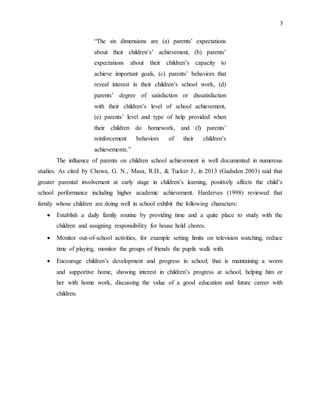
“The six dimensions are (a) parents’ expectations
about their children’s’ achievement, (b) parents’
expectations about their children’s capacity to
achieve important goals, (c) parents’ behaviors that
reveal interest in their children’s school work, (d)
parents’ degree of satisfaction or dissatisfaction
with their children’s level of school achievement,
(e) parents’ level and type of help provided when
their children do homework, and (f) parents’
reinforcement behaviors of their children’s
achievements.”
The influence of parents on children school achievement is well documented in numerous
studies. As cited by Chowa, G. N., Masa, R.D., & Tucker J., in 2013 (Gadsden 2003) said that
greater parental involvement at early stage in children’s learning, positively affects the child’s
school performance including higher academic achievement. Harderves (1998) reviewed that
family whose children are doing well in school exhibit the following characters:
 Establish a daily family routine by providing time and a quite place to study with the
children and assigning responsibility for house hold chores.
 Monitor out-of-school activities, for example setting limits on television watching, reduce
time of playing, monitor the groups of friends the pupils walk with.
 Encourage children’s development and progress in school; that is maintaining a worm
and supportive home, showing interest in children’s progress at school, helping him or
her with home work, discussing the value of a good education and future career with
children.
4
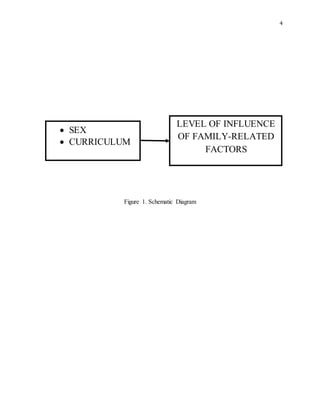
Figure 1. Schematic Diagram
LEVEL OF INFLUENCE
OF FAMILY-RELATED
FACTORS
 SEX
 CURRICULUM
5
Statement of the Problem
This study aims to determine the level of influence of family related factors on selected
Tangub City National High School students during the school year 2014-2015.
Specifically, it seeks to answer the following questions:
1. What is the profile of the respondents in terms of:
a. Sex;
b. Curriculum?
2. What are the family related factors that influence the academic performance of
respondents?
3. What is the level of influence of the family related factors?
4. Is there a significant difference between the levels of influence family-related
factors of male and female students?
5. Is there a significant difference between the levels of influence of family-
related factors of Science and Sports curricula?
ResearchMethodology
This section discusses the research design, research respondents, research setting,
research instrument, and validation of instrument, data gathering procedure, and statistical
treatment of data to be used in the study.
Research Design.This study will utilize the descriptive design which, specifically, the
descriptive-comparative method. Comparative Method will be used in getting the
difference of the level of influence of family-related factors in terms of their sex
and their curriculum.
Research Respondents.The respondents of this study will be the students in fourth year
sports section under the Special Program in Sports Curriculum and the fourth year
students under the Science Technology in Engineering and Mathematics.
Research Setting.This study will be conducted in Tangub City National High School.
This is located at Tangub City particularly in Barangay Mantic. This school offers
the following curricula: Regular Curriculum, Science Technology in Engineering
and Mathematics, Open High School Curriculum, and Special Program in Sports
6
Curriculum. Specifically, this study will focus on the Special Program in Sports
Curriculum and Science Technology in Engineering and Mathematics in fourth
year level.
Research Instrument.The main tool which will be used in this study is a researcher-
made questionnaire with ten statements about the family-related factors.
It will obtain the family-related factors. Each statement will be given one set of
four boxes. The four boxes will be coded as follows:
Validation of Instrument. The questionnaire will be first presented to the research
adviser for checking. Before the distribution if the questioners, the researchers
will conduct a pilot testing to the non respondents to test the validity and
reliability of the questionnaire.
Data Gathering Procedure.The questionnaire in this study will aim to draw out
appropriate responses on the objectives on this study. To ensure the validation of
responses, the questionnaire that will be made by the researchers will be
presented, analyzed, and will be checked by the researchers’ adviser.
A letter requesting permission to conduct a research will be secured. This
will be given to the principal of Tangub City National High School.
With the used of Microsoft Excel, the data will be gathered from answered
questionnaires will be checked, classified, tabulated and will be analyzed
according to the research design described in this chapter and will be performed
for final presentation to the experts of different fields specialization.
4 ------ Most Influential
3 ------Moderately Influential
2 ------Less Influential
1 ----- Not Influential
7
Statistical Treatment
The gathered data will be presented, analyzed, and interpreted using the following statistical
formulas:
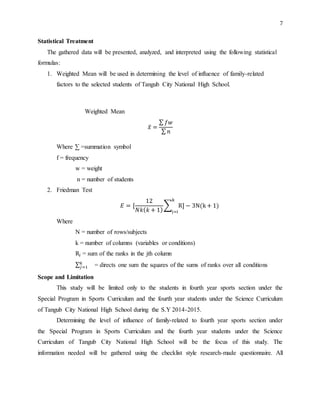
1. Weighted Mean will be used in determining the level of influence of family-related
factors to the selected students of Tangub City National High School.
Weighted Mean
𝑥̅ =
∑ 𝑓𝑤
∑ 𝑛
Where ∑ =summation symbol
f = frequency
w = weight
n = number of students
2. Friedman Test
𝐸 = 〔
12
𝑁𝑘( 𝑘 + 1)
∑ R
k
j=i
〕 − 3N(k + 1)
Where
N = number of rows/subjects
k = number of columns (variables or conditions)
Rj = sum of the ranks in the jth column
∑ 𝑘
𝑗=1 = directs one sum the squares of the sums of ranks over all conditions
Scope and Limitation
This study will be limited only to the students in fourth year sports section under the
Special Program in Sports Curriculum and the fourth year students under the Science Curriculum
of Tangub City National High School during the S.Y 2014-2015.
Determining the level of influence of family-related to fourth year sports section under
the Special Program in Sports Curriculum and the fourth year students under the Science
Curriculum of Tangub City National High School will be the focus of this study. The
information needed will be gathered using the checklist style research-made questionnaire. All
8
information and conclusion that will be drawn from this study will be obtained only to these
particular groups of students
Significance of the Study
The result of the study will merit the following:
School Administrator.The results of this study could serve as a standard data to improve
programs for school advancement.
Curriculum Planner.The results of this study will help the curriculum planner evaluate
the existing programs in terms of students’ needs and abilities and make changes
as required.
Guidance Counselor.This study will help develop the guidance program in line with
individual needs and abilities of the students.
Students.This study will help the students to develop their interest towards Mathematics
and appreciate the importance of Mathematics in their daily lives.
Parents. The results of this study will help the parents to give a proper guidance, enough
support, and help their children’s school performance in Mathematics.
Definition of terms
Curriculum – is broadly defined as the totality of student experiences that occur in the
educational process. The term often refers especially to a planned sequence of instruction, or to a
view of the student’s experiences in terms of the educator’s or school’s instructionalgoals.
Factor–is a circumstance, fact, or influence that contributes to a result or outcome.
Family - defined as a specific group of people that may be made up of partners, children,
parents, aunts, uncles, cousins and grandparents.
Influence- is the power to have an important effect on someone or something. If someone
influences someone else, they are changing a person or thing in an indirect but important way.
Parents - are not only that who give birth for us but they teach us how to live in these world they
also teach us to respect elders and to obey them and they also teach importance of life these is
the not end
Sex- refers to the biological and physiological characteristics that define men and women
Support - is defined as to provide comfort, encouragement or financial assistance to someone.
9
Appendix A
Request Letter
January 14, 2015
Myrna T. Barbon
School Principal
Tangub City National High School
Mantic, Tangub City
Madam:
The undersigned are Third Year BSEd students of Gov. Alfonso D. Tan College who are
currently conducting a thesis entitled, “THE LEVEL OF INFLUENCE OF FAMILY-RELATED
FACTORS ON SELECTED TANGUB CITY NATIONAL HIGH SCHOOL STUDENTS”. This
study will investigate the level of influence of family-related factors to the students’ academic
performance of fourth year students under Sports Curriculum and Science Curriculum. In
connection to this, we would like to humbly request your permission to conduct this study to the
Fourth Year Sports Curriculum and Science Curriculum Students in your school.
We are hoping for your positive response on this matter.
Respectfully yours,
VINCENT S. MONTEBON ELTON JOHN B. EMBODO JACKIE LOU C. ABISO
APPROVED:
MYRNA T. BARBON
TCNHS School Principal
10
Appendix B
Questionnaire
The Level of Influence of Family-related factors on the Selected Tangub City
National High School
S.Y. 2014-2015
Sex Curriculum
[ ] Male [ ] Science Curriculum
[ ] Female [ ] Sports Curriculum
Directions: The following statements below are the situations that usually done by the parents in
showing supports for their children’s studies. Rank the following statements according to the
extent of their influence. Put a check mark on the box that corresponds to your answers. Refer
your answers on the scale given below.
1 – Most Influential
2 – Moderately Influential
3 – Less Influential
4 – Not Influential
Family-related factors 4 3 2 1
1. Establishing a daily family routine.
2. Monitoring out of school activities.
3. Modelling the value of learning, self discipline, and hard work.
4. Expression of high but realistic expectation for your achievements.
5. Encouragement in school development of the children.
6. Encouraging discussion among family members.
7. Monitoring on the learning progress of the children in school.
8. Encouraging and nurturing the creativity of the children.
9. Modelling good behaviours and attitudes expected from the
children.
10. Constant check up on the homework, classroom activities and
events of the children
11
Working Bibliography
Adwuni, G. M., Olojo, J. O., &Falemu, A. F., (2012).Roles of Parent on the Academic
Performance of Pupils in Elementary Schools.International Journal of Academic Research
in Business and social Sciences, 02(01), 001-006. ISSN: 2222-6990
Bandura (1977) as cited by Berthelsen D. & Walker S. (2008) from
http://www.aifs.gov.au/institute/pubs/from2008/fm79/bw.pdf
Berthelsen D. & Walker S. (2008).Parents Involvement in their Chidren’s Education.Australian
Institute of Family Studies.Retrieved on February 09, 2015 from
http://www.aifs.gov.au/institute/pubs/from2008/fm79/bw.pdf
Chowa, G. N., Masa, R. D., & Tucker J., (2013). The Effects of Parental Involvement on
Academic Performance of Ghanaian Youth: Testing Measurement and Relationship using
Structural Equation Modeling. Children and Youth Services Review, 35(12), 2020-2030.
doi: 10.1016/j.childyouth.3013.09.009
Fan (2001) as cited by Khan, R. M., &Chohan, B. I., (2010) from http://www.edu.pk/jrre
Gonzalez (2002) as cited by Khan, R. M., &Chohan, B. I., (2010) from http://www.edu.pk/jrre
Herderson&Mapp (2002) as cited by Berthelsen D. & Walkers S. (2008) from
http://www.aifs.gov.au/institute/pubs/from2008/fm79/bw.pdf
Khan, R. M., &Chohan, B. I., (2010).Impact of Parental Support on the Academic Performance
and Self-Concept of the School.Journal of Research and Reflection in
Education.Retrieved on February 09, 2015 from http://www.edu.pk/jrre
Rafiq, H. M., Khan, A. M., &Sohail, M., (2013). Parent Involvement and Academic
Achievement: A Study on Secondary Shool Students of Lahore, Pakistan. Internal Journal
of Humanities and Social Science.Retrieved on February 09, 2015 from
http://www.ijhssnet.com/journal/Vol_3_No_8_Special_Issue_April_2013/22.pdf

Final edited thesis proposal

  • 1.
    1 Chapter 1 Introduction Background ofthe Study Education is essential for the development of society. The more educated the people of a society are, the more civilized and well disciplined the society will be (Chowa, G., Masa, R., & Tucker, J., 2013). Mainly, family has a responsibility to socialize children for making them productive members of a society. The more the parents involve in the process of imparting education to their children, the more the children might excel in their academic career and to become productive and responsible members of society. The academic achievement of students may not only depend on the quality of schools and the teacher, rather on the extent of parent involvement has a vital role to play in it. According to Adewumiet.al.(2012) that parent has vital roles to play in the life of a child. Parenting involvement is a catch-all term for many different activities including home, good parenting, helping home work, talking to teachers, attending school functions, through taking part in school governance. When schools work together with families to support learning, children tend to succeed not just in schools but throughout their lives. According to these researchers, the most accurate prediction of a students’ achievement in school is not the income nor the social status, but the extent to which the students’ parent is able to create a home environment that encourages learning and to express high expectations for their children’s achievement and future careers. Parental involvement in school has been linked with academic achievement. Previous researchers stated that parental involvement has a powerful impact on the children’s attainment. The impact of parental involvement arises from parental values and educational aspirations and that these are exhibited continuously through parental enthusiasm and positive parenting style. In this new study, the researchers will determine the level of influence of family-related factors. This study will also determine if there is a significant difference between the levels of influence of family-related factors in terms of sex and the curriculum in which the a student belongs. Tangub City National High School is a school that has a large number of student population. Each year level consists of Science Curriculum, Regular Curriculum and Sports Curriculum. This study will investigate the level of influence of family-related factor to the
  • 2.
    2 fourth year studentsin Sports section and in Science curriculum. This study will also investigate if there is a significant difference of the level of influence of family-related factor between male students and female students, as well as the sports curriculum and Science curriculum. Theoretical Framework The level of parental involvement has an important implication for children’s academic performance. Social Cognitive theory suggests that youth absorb messages about appropriate behavior in their lives (Bandura, 1977) as cited by Chowa, G. N., Masa, R. D., & Tucker J., in 2013. Based on this assumption, parents have the potential to model positive attitudes and behaviors toward school, and researches in developed countries such as United States have shown that parental involvement contributes to youth academic success (Fan & Chen, 2001; Houltenville& Conway, 2008; Jeynes, 2003, 2007) as cited by Khan, R. M., &Chohan, B. I., in 2010. In fact, children are more likely to perform better in school when their parents show an interest in their school work. Particularly, when their parents are willing to assist them with their homework, and are willing to hold their children accountable for completion of school assignments. Youth who are not working hard at school may begin to perceive as valuable when parents actively demonstrate that they value school through involvement. As cited by Berthelsen D. & Walker S. in 2008 (Henderson &Mapp, 2002) added that when schools and families work together, children have higher achievement in school and stay in school longer. Engaging families in the education of their children at home and in school is increasingly viewed as an important means to support better learning outcomes for children. As cited by Khan, R. M., &Chohan, B. I., in 2010 (Fan, 2001) mentioned that parent’s educational aspiration for their children proved to be strongly related to students’ growth. Research studies have found that parental educational level has a significant impact on child’s learning. (Khan & Malik, 1999). Similarly, Schneider and Lee (1990) linked the academic success of the East Asian students to the values and aspirations they share with their parents, and to the home learning activities in which their parents involve with them. In fact, all parents have desired to do something better for their children according to their available resources. Gonzalez-Pienda et al. (2002) as cited by Khan, R. M., &Chohan, B. I., in 2010 stated that parental support criteria were developed according to six dimensions that are strongly associated to students’ behaviors at school and the attitude towards learning.
  • 3.
    3 “The six dimensionsare (a) parents’ expectations about their children’s’ achievement, (b) parents’ expectations about their children’s capacity to achieve important goals, (c) parents’ behaviors that reveal interest in their children’s school work, (d) parents’ degree of satisfaction or dissatisfaction with their children’s level of school achievement, (e) parents’ level and type of help provided when their children do homework, and (f) parents’ reinforcement behaviors of their children’s achievements.” The influence of parents on children school achievement is well documented in numerous studies. As cited by Chowa, G. N., Masa, R.D., & Tucker J., in 2013 (Gadsden 2003) said that greater parental involvement at early stage in children’s learning, positively affects the child’s school performance including higher academic achievement. Harderves (1998) reviewed that family whose children are doing well in school exhibit the following characters:  Establish a daily family routine by providing time and a quite place to study with the children and assigning responsibility for house hold chores.  Monitor out-of-school activities, for example setting limits on television watching, reduce time of playing, monitor the groups of friends the pupils walk with.  Encourage children’s development and progress in school; that is maintaining a worm and supportive home, showing interest in children’s progress at school, helping him or her with home work, discussing the value of a good education and future career with children.
  • 4.
    4 Figure 1. SchematicDiagram LEVEL OF INFLUENCE OF FAMILY-RELATED FACTORS  SEX  CURRICULUM
  • 5.
    5 Statement of theProblem This study aims to determine the level of influence of family related factors on selected Tangub City National High School students during the school year 2014-2015. Specifically, it seeks to answer the following questions: 1. What is the profile of the respondents in terms of: a. Sex; b. Curriculum? 2. What are the family related factors that influence the academic performance of respondents? 3. What is the level of influence of the family related factors? 4. Is there a significant difference between the levels of influence family-related factors of male and female students? 5. Is there a significant difference between the levels of influence of family- related factors of Science and Sports curricula? ResearchMethodology This section discusses the research design, research respondents, research setting, research instrument, and validation of instrument, data gathering procedure, and statistical treatment of data to be used in the study. Research Design.This study will utilize the descriptive design which, specifically, the descriptive-comparative method. Comparative Method will be used in getting the difference of the level of influence of family-related factors in terms of their sex and their curriculum. Research Respondents.The respondents of this study will be the students in fourth year sports section under the Special Program in Sports Curriculum and the fourth year students under the Science Technology in Engineering and Mathematics. Research Setting.This study will be conducted in Tangub City National High School. This is located at Tangub City particularly in Barangay Mantic. This school offers the following curricula: Regular Curriculum, Science Technology in Engineering and Mathematics, Open High School Curriculum, and Special Program in Sports
  • 6.
    6 Curriculum. Specifically, thisstudy will focus on the Special Program in Sports Curriculum and Science Technology in Engineering and Mathematics in fourth year level. Research Instrument.The main tool which will be used in this study is a researcher- made questionnaire with ten statements about the family-related factors. It will obtain the family-related factors. Each statement will be given one set of four boxes. The four boxes will be coded as follows: Validation of Instrument. The questionnaire will be first presented to the research adviser for checking. Before the distribution if the questioners, the researchers will conduct a pilot testing to the non respondents to test the validity and reliability of the questionnaire. Data Gathering Procedure.The questionnaire in this study will aim to draw out appropriate responses on the objectives on this study. To ensure the validation of responses, the questionnaire that will be made by the researchers will be presented, analyzed, and will be checked by the researchers’ adviser. A letter requesting permission to conduct a research will be secured. This will be given to the principal of Tangub City National High School. With the used of Microsoft Excel, the data will be gathered from answered questionnaires will be checked, classified, tabulated and will be analyzed according to the research design described in this chapter and will be performed for final presentation to the experts of different fields specialization. 4 ------ Most Influential 3 ------Moderately Influential 2 ------Less Influential 1 ----- Not Influential
  • 7.
    7 Statistical Treatment The gathereddata will be presented, analyzed, and interpreted using the following statistical formulas: 1. Weighted Mean will be used in determining the level of influence of family-related factors to the selected students of Tangub City National High School. Weighted Mean 𝑥̅ = ∑ 𝑓𝑤 ∑ 𝑛 Where ∑ =summation symbol f = frequency w = weight n = number of students 2. Friedman Test 𝐸 = 〔 12 𝑁𝑘( 𝑘 + 1) ∑ R k j=i 〕 − 3N(k + 1) Where N = number of rows/subjects k = number of columns (variables or conditions) Rj = sum of the ranks in the jth column ∑ 𝑘 𝑗=1 = directs one sum the squares of the sums of ranks over all conditions Scope and Limitation This study will be limited only to the students in fourth year sports section under the Special Program in Sports Curriculum and the fourth year students under the Science Curriculum of Tangub City National High School during the S.Y 2014-2015. Determining the level of influence of family-related to fourth year sports section under the Special Program in Sports Curriculum and the fourth year students under the Science Curriculum of Tangub City National High School will be the focus of this study. The information needed will be gathered using the checklist style research-made questionnaire. All
  • 8.
    8 information and conclusionthat will be drawn from this study will be obtained only to these particular groups of students Significance of the Study The result of the study will merit the following: School Administrator.The results of this study could serve as a standard data to improve programs for school advancement. Curriculum Planner.The results of this study will help the curriculum planner evaluate the existing programs in terms of students’ needs and abilities and make changes as required. Guidance Counselor.This study will help develop the guidance program in line with individual needs and abilities of the students. Students.This study will help the students to develop their interest towards Mathematics and appreciate the importance of Mathematics in their daily lives. Parents. The results of this study will help the parents to give a proper guidance, enough support, and help their children’s school performance in Mathematics. Definition of terms Curriculum – is broadly defined as the totality of student experiences that occur in the educational process. The term often refers especially to a planned sequence of instruction, or to a view of the student’s experiences in terms of the educator’s or school’s instructionalgoals. Factor–is a circumstance, fact, or influence that contributes to a result or outcome. Family - defined as a specific group of people that may be made up of partners, children, parents, aunts, uncles, cousins and grandparents. Influence- is the power to have an important effect on someone or something. If someone influences someone else, they are changing a person or thing in an indirect but important way. Parents - are not only that who give birth for us but they teach us how to live in these world they also teach us to respect elders and to obey them and they also teach importance of life these is the not end Sex- refers to the biological and physiological characteristics that define men and women Support - is defined as to provide comfort, encouragement or financial assistance to someone.
  • 9.
    9 Appendix A Request Letter January14, 2015 Myrna T. Barbon School Principal Tangub City National High School Mantic, Tangub City Madam: The undersigned are Third Year BSEd students of Gov. Alfonso D. Tan College who are currently conducting a thesis entitled, “THE LEVEL OF INFLUENCE OF FAMILY-RELATED FACTORS ON SELECTED TANGUB CITY NATIONAL HIGH SCHOOL STUDENTS”. This study will investigate the level of influence of family-related factors to the students’ academic performance of fourth year students under Sports Curriculum and Science Curriculum. In connection to this, we would like to humbly request your permission to conduct this study to the Fourth Year Sports Curriculum and Science Curriculum Students in your school. We are hoping for your positive response on this matter. Respectfully yours, VINCENT S. MONTEBON ELTON JOHN B. EMBODO JACKIE LOU C. ABISO APPROVED: MYRNA T. BARBON TCNHS School Principal
  • 10.
    10 Appendix B Questionnaire The Levelof Influence of Family-related factors on the Selected Tangub City National High School S.Y. 2014-2015 Sex Curriculum [ ] Male [ ] Science Curriculum [ ] Female [ ] Sports Curriculum Directions: The following statements below are the situations that usually done by the parents in showing supports for their children’s studies. Rank the following statements according to the extent of their influence. Put a check mark on the box that corresponds to your answers. Refer your answers on the scale given below. 1 – Most Influential 2 – Moderately Influential 3 – Less Influential 4 – Not Influential Family-related factors 4 3 2 1 1. Establishing a daily family routine. 2. Monitoring out of school activities. 3. Modelling the value of learning, self discipline, and hard work. 4. Expression of high but realistic expectation for your achievements. 5. Encouragement in school development of the children. 6. Encouraging discussion among family members. 7. Monitoring on the learning progress of the children in school. 8. Encouraging and nurturing the creativity of the children. 9. Modelling good behaviours and attitudes expected from the children. 10. Constant check up on the homework, classroom activities and events of the children
  • 11.
    11 Working Bibliography Adwuni, G.M., Olojo, J. O., &Falemu, A. F., (2012).Roles of Parent on the Academic Performance of Pupils in Elementary Schools.International Journal of Academic Research in Business and social Sciences, 02(01), 001-006. ISSN: 2222-6990 Bandura (1977) as cited by Berthelsen D. & Walker S. (2008) from http://www.aifs.gov.au/institute/pubs/from2008/fm79/bw.pdf Berthelsen D. & Walker S. (2008).Parents Involvement in their Chidren’s Education.Australian Institute of Family Studies.Retrieved on February 09, 2015 from http://www.aifs.gov.au/institute/pubs/from2008/fm79/bw.pdf Chowa, G. N., Masa, R. D., & Tucker J., (2013). The Effects of Parental Involvement on Academic Performance of Ghanaian Youth: Testing Measurement and Relationship using Structural Equation Modeling. Children and Youth Services Review, 35(12), 2020-2030. doi: 10.1016/j.childyouth.3013.09.009 Fan (2001) as cited by Khan, R. M., &Chohan, B. I., (2010) from http://www.edu.pk/jrre Gonzalez (2002) as cited by Khan, R. M., &Chohan, B. I., (2010) from http://www.edu.pk/jrre Herderson&Mapp (2002) as cited by Berthelsen D. & Walkers S. (2008) from http://www.aifs.gov.au/institute/pubs/from2008/fm79/bw.pdf Khan, R. M., &Chohan, B. I., (2010).Impact of Parental Support on the Academic Performance and Self-Concept of the School.Journal of Research and Reflection in Education.Retrieved on February 09, 2015 from http://www.edu.pk/jrre Rafiq, H. M., Khan, A. M., &Sohail, M., (2013). Parent Involvement and Academic Achievement: A Study on Secondary Shool Students of Lahore, Pakistan. Internal Journal of Humanities and Social Science.Retrieved on February 09, 2015 from http://www.ijhssnet.com/journal/Vol_3_No_8_Special_Issue_April_2013/22.pdf