IV THERAPY: NURSE’S ROLE


      Nutcharee Jungvanichar RN, MBA
ความปลอดภัยในการบริหารสารน้ า


         particulate contamination and
     Free from
     micro-organisms including pyrogens.

    Thefluids and the accessories must be
     sterile and free of micro-organisms.

    Microbial contamination can cause serious
     impact (local infection, septic thrombophlebitis or primary
     bloodstream infection).
Infusion Equipment
Infusion Equipment
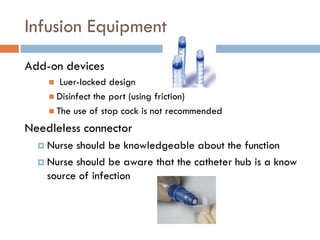
Add-on devices
      Luer-locked design
     Disinfect the port (using friction)
     The use of stop cock is not recommended

Needleless connector
   Nurse should be knowledgeable about the function
   Nurse should be aware that the catheter hub is a know
    source of infection
Infusion Equipment
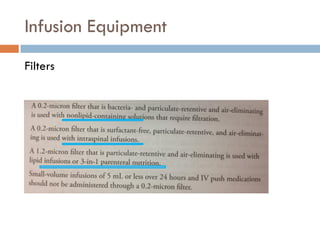
Filters
Infusion Equipment

Flow - control device

   Electronic infusion device with administration based ,
    anti free flow mechanisms shall be used
   Dose –error reduction system shall be considered in
    selection and use of electronic infusion devices
   The nurse should be involved in the evaluation and
    selection of flow –control devices
Infusion Equipment

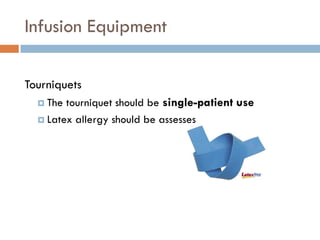
Tourniquets
   The tourniquet should be single-patient use
   Latex allergy should be assesses
Hand Hygiene
Site Care And Maintenance

Set change:
    IV: No more frequency than 96 hrs.
   Parenteral Nutrition : should be routine change every
    24 hrs
   Blood and blood product: should be replace every 4
    hrs
Site Care And Maintenance

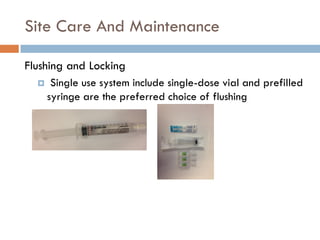
Flushing and Locking
      Single use system include single-dose vial and prefilled
      syringe are the preferred choice of flushing
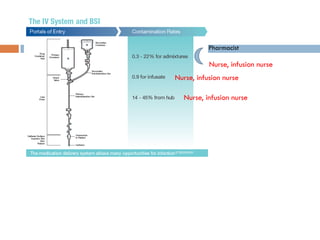
Infusion Therapy
Pharmacist

           Nurse, infusion nurse
Nurse, infusion nurse

  Nurse, infusion nurse
Types of IV Fluid Containers


 There are generally three types of IV fluid
 containers in use globally.
  Rigid containers which are made of glass,
   High Density Polyethylene (HDPE) or
   Polypropylene (PP)
  Semi-rigid containers which are made of
   Polyethylene (PE) or Polypropylene (PP)
  Flexible bags which are made of polyvinyl
   chloride (PVC), or Polyolefin laminate
Open Infusion System


   Open Infusion Container –            Open Infusion Container –
  Glass container with air filter.   Semi-rigid container with air filter.
Open Infusion System

    The chance of contamination in an open
     system is 10 times more than the closed
     system.
    Any device which has tubes with one end
     inside the body and one outside can
     cause contamination. These include
     urinary catheters, IV fluid bags,
     endotracheal tube, etc. These should be
     closed systems so as to prevent
     contamination.
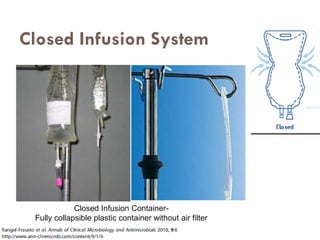
Closed Infusion System


             Closed Infusion Container-
 Fully collapsible plastic container without air filter
Acceptance of closed Infusion System

    In North America, Europe and Australia,
     a closed IV system is the minimum
     acceptable standard.
    It is dependent on the understanding of
     the inherent risks associated with open
     IV systems and the risks can be
     avoided by using a closed IV system.
Acceptance of closed Infusion System

    The main reasons for acceptance of the closed IV
     system are:
       a) Patient safety and reduce infection risk.
       b) Reduce costs of treatment as a result of patients
          not prolonging their stay in hospitals.
       c) Improved quality care delivery in hospitals.
       d) Meeting regulatory authorities to ensure best
          practices.
Should we use closed or open infusion containers
for prevention of bloodstream infections?


  Results
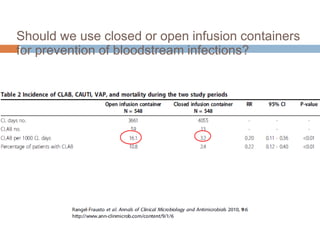
   CLABSI was significantly decreased

    (81%) in the closed container
Should we use closed or open infusion containers
for prevention of bloodstream infections?
Central line Bundle
   Hand Hygiene
   Maximal Barrier Precautions
   Chlorhexidine Skin Antisepsis
   Optimal Catheter Site Selection
   Assessment of Central Line Necessity
2012 Highlight


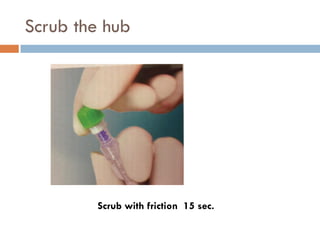
   • Scrub the hub 15 seconds prior accessing the line
   • Daily assessment
Scrub the hub


        Scrub with friction 15 sec.
…We can not predict the
future but we can create it…

                   from INS 2012
Thank You for Your Attention

IV therapy, Nurse's role

  • 1.
    IV THERAPY: NURSE’SROLE Nutcharee Jungvanichar RN, MBA
  • 2.
    ความปลอดภัยในการบริหารสารน้ า  particulate contamination and Free from micro-organisms including pyrogens.  Thefluids and the accessories must be sterile and free of micro-organisms.  Microbial contamination can cause serious impact (local infection, septic thrombophlebitis or primary bloodstream infection).
  • 3.
  • 4.
    Infusion Equipment Add-on devices  Luer-locked design  Disinfect the port (using friction)  The use of stop cock is not recommended Needleless connector  Nurse should be knowledgeable about the function  Nurse should be aware that the catheter hub is a know source of infection
  • 5.
  • 6.
    Infusion Equipment Flow -control device  Electronic infusion device with administration based , anti free flow mechanisms shall be used  Dose –error reduction system shall be considered in selection and use of electronic infusion devices  The nurse should be involved in the evaluation and selection of flow –control devices
  • 7.
    Infusion Equipment Tourniquets  The tourniquet should be single-patient use  Latex allergy should be assesses
  • 8.
  • 9.
    Site Care AndMaintenance
  • 10.
    Site Care AndMaintenance Set change:  IV: No more frequency than 96 hrs.  Parenteral Nutrition : should be routine change every 24 hrs  Blood and blood product: should be replace every 4 hrs
  • 11.
    Site Care AndMaintenance Flushing and Locking  Single use system include single-dose vial and prefilled syringe are the preferred choice of flushing
  • 12.
  • 13.
    Pharmacist Nurse, infusion nurse Nurse, infusion nurse Nurse, infusion nurse
  • 14.
    Types of IVFluid Containers There are generally three types of IV fluid containers in use globally.  Rigid containers which are made of glass, High Density Polyethylene (HDPE) or Polypropylene (PP)  Semi-rigid containers which are made of Polyethylene (PE) or Polypropylene (PP)  Flexible bags which are made of polyvinyl chloride (PVC), or Polyolefin laminate
  • 15.
    Open Infusion System Open Infusion Container – Open Infusion Container – Glass container with air filter. Semi-rigid container with air filter.
  • 16.
    Open Infusion System  The chance of contamination in an open system is 10 times more than the closed system.  Any device which has tubes with one end inside the body and one outside can cause contamination. These include urinary catheters, IV fluid bags, endotracheal tube, etc. These should be closed systems so as to prevent contamination.
  • 17.
    Closed Infusion System Closed Infusion Container- Fully collapsible plastic container without air filter
  • 18.
    Acceptance of closedInfusion System  In North America, Europe and Australia, a closed IV system is the minimum acceptable standard.  It is dependent on the understanding of the inherent risks associated with open IV systems and the risks can be avoided by using a closed IV system.
  • 19.
    Acceptance of closedInfusion System  The main reasons for acceptance of the closed IV system are: a) Patient safety and reduce infection risk. b) Reduce costs of treatment as a result of patients not prolonging their stay in hospitals. c) Improved quality care delivery in hospitals. d) Meeting regulatory authorities to ensure best practices.
  • 21.
    Should we useclosed or open infusion containers for prevention of bloodstream infections? Results  CLABSI was significantly decreased (81%) in the closed container
  • 22.
    Should we useclosed or open infusion containers for prevention of bloodstream infections?
  • 23.
    Central line Bundle  Hand Hygiene  Maximal Barrier Precautions  Chlorhexidine Skin Antisepsis  Optimal Catheter Site Selection  Assessment of Central Line Necessity
  • 24.
    2012 Highlight • Scrub the hub 15 seconds prior accessing the line • Daily assessment
  • 26.
    Scrub the hub Scrub with friction 15 sec.
  • 27.
    …We can notpredict the future but we can create it… from INS 2012
  • 28.
    Thank You forYour Attention