ANATOMY OF VENOUS
SYSTEM
anatom
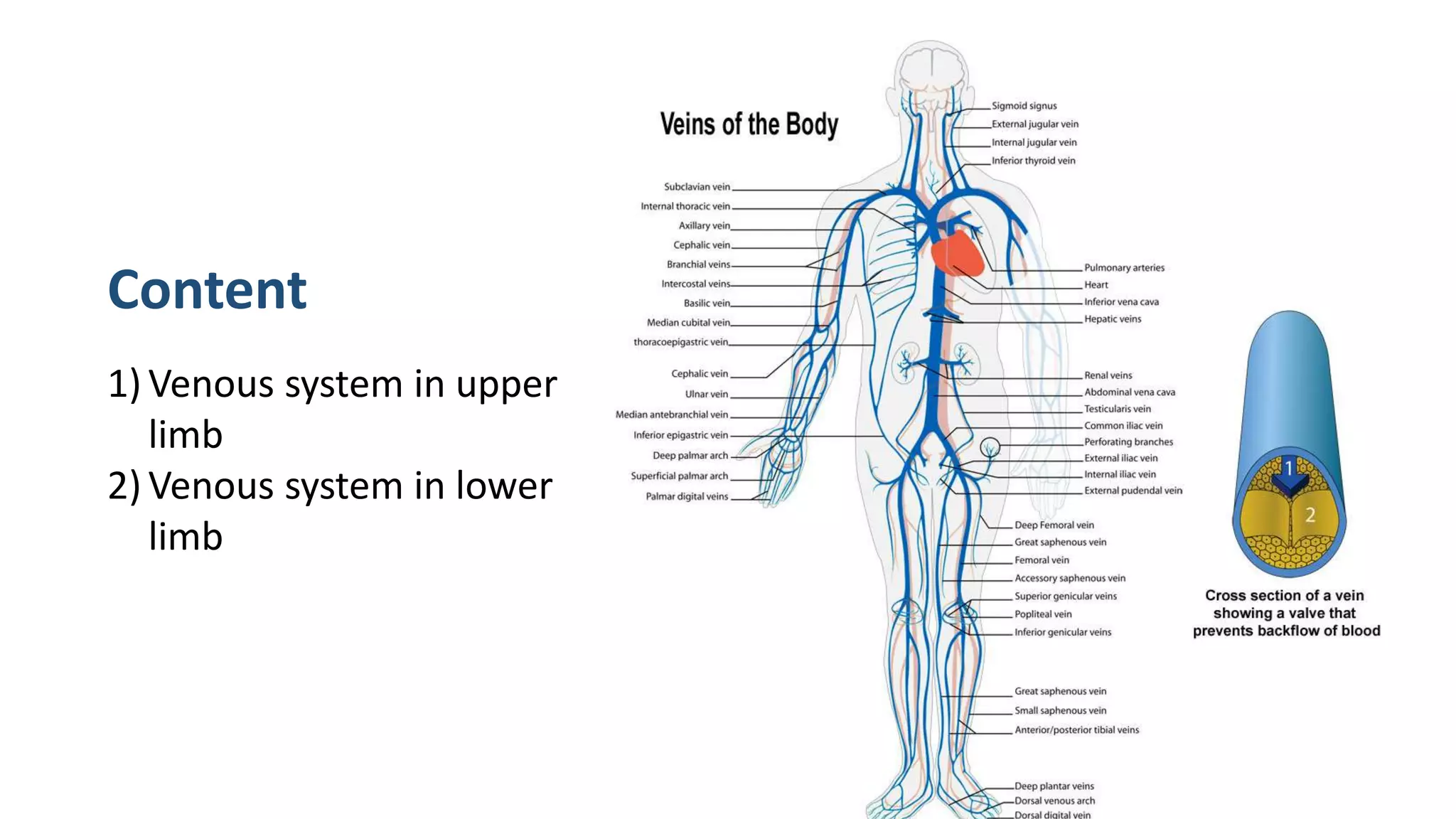
Content
1) Venous system in upper
limb
2) Venous system in lower
limb
Venous System In Upper Limbs
Superficial veins
- Cephalic vein (preaxial)
- Basilic vein (postaxial)
- Median cubital veins
 Deep veins
- Brachial veins
- Ulnar veins
- Radial Veins
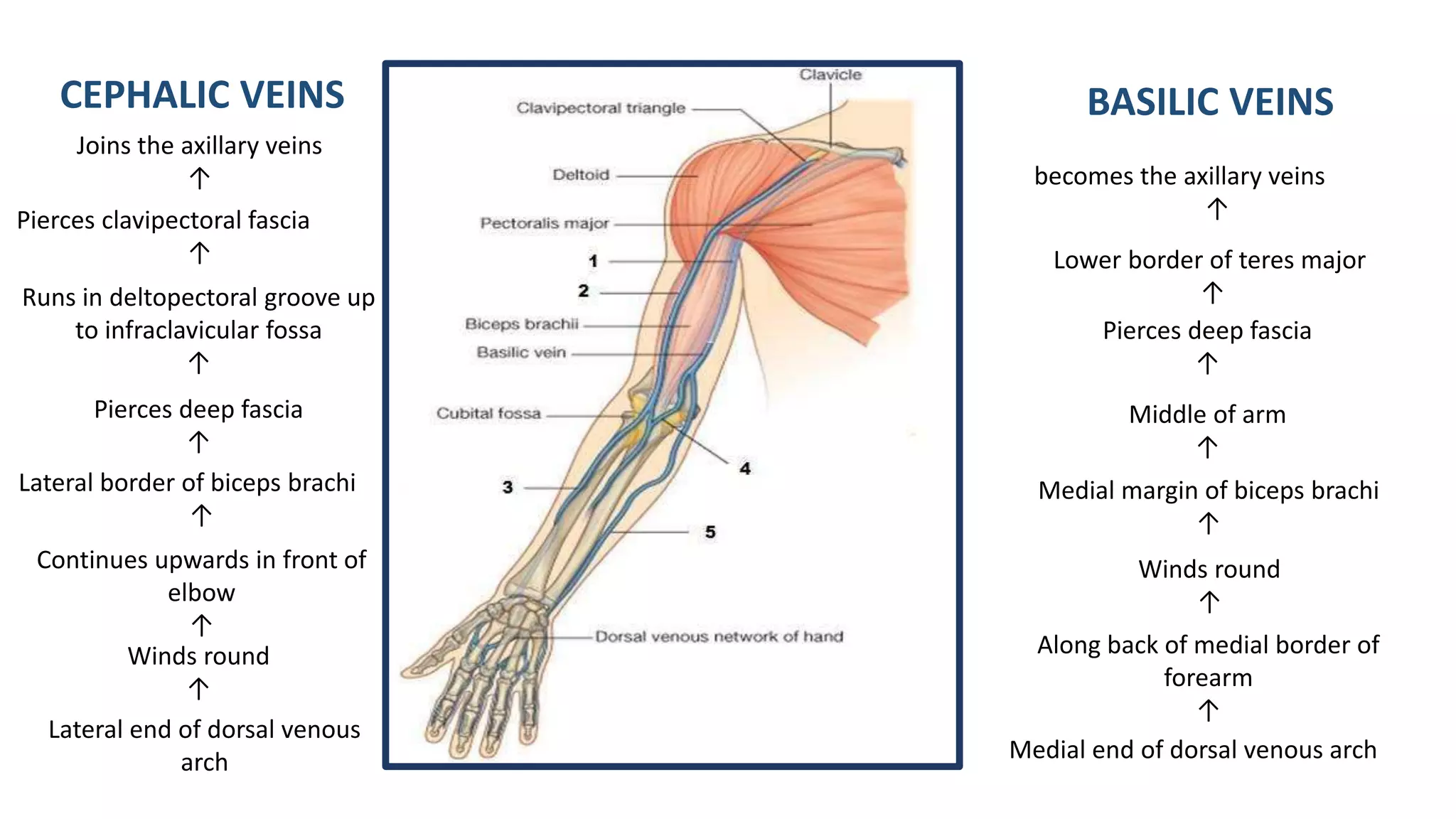
Lateral end of dorsal venous
arch
Winds round
↑
Continues upwards in front of
elbow
↑
Lateral border of biceps brachi
↑
Pierces deep fascia
↑
Runs in deltopectoral groove up
to infraclavicular fossa
↑
Pierces clavipectoral fascia
↑
Joins the axillary veins
↑
CEPHALIC VEINS
Medial end of dorsal venous arch
Along back of medial border of
forearm
↑
Winds round
↑
Medial margin of biceps brachi
↑
Pierces deep fascia
↑
Middle of arm
↑
Lower border of teres major
↑
becomes the axillary veins
↑
BASILIC VEINS
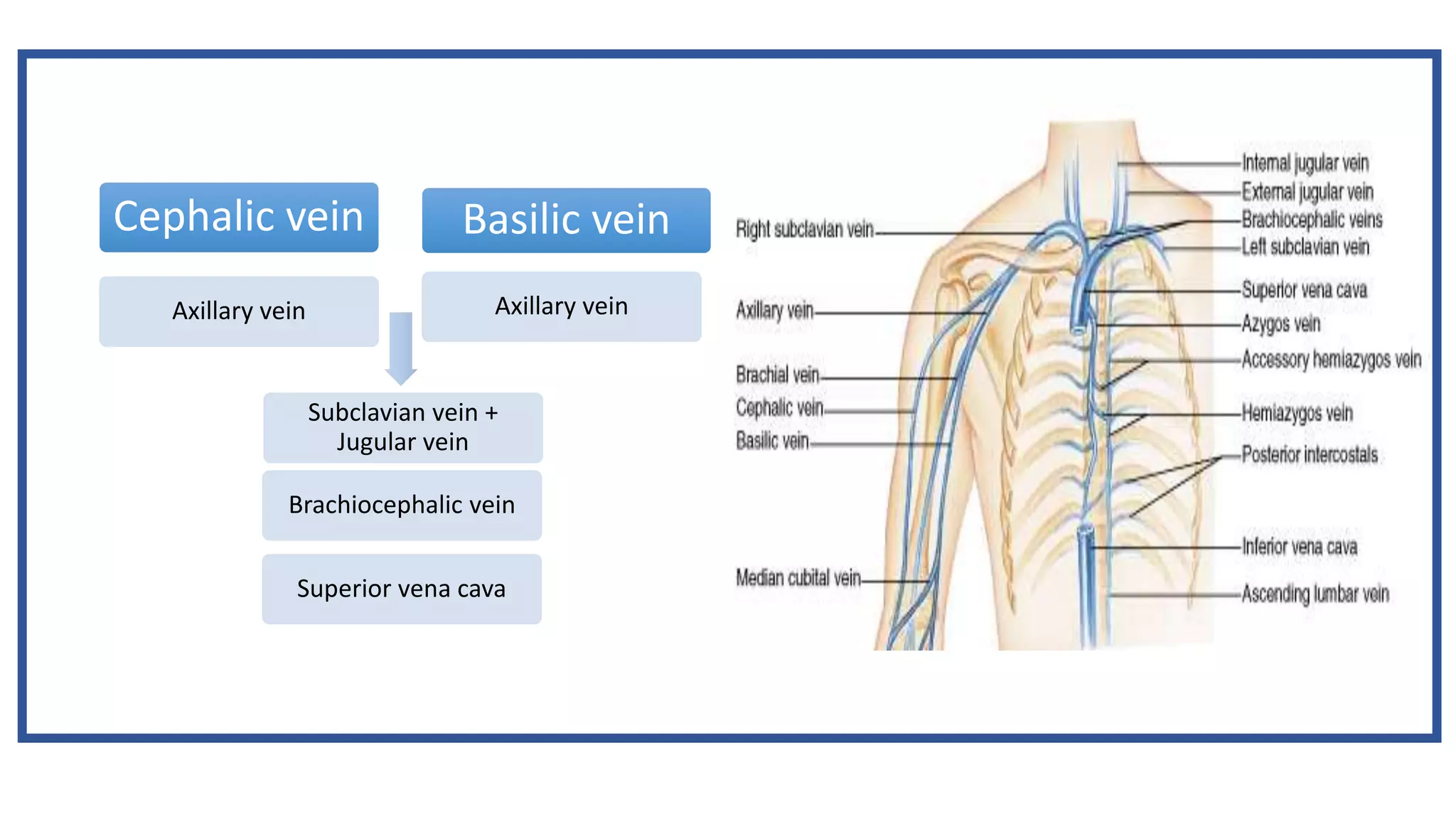
Cephalic vein
Axillary vein Axillary vein
Subclavian vein +
Jugular vein
Brachiocephalic vein
Superior vena cava
Basilic vein
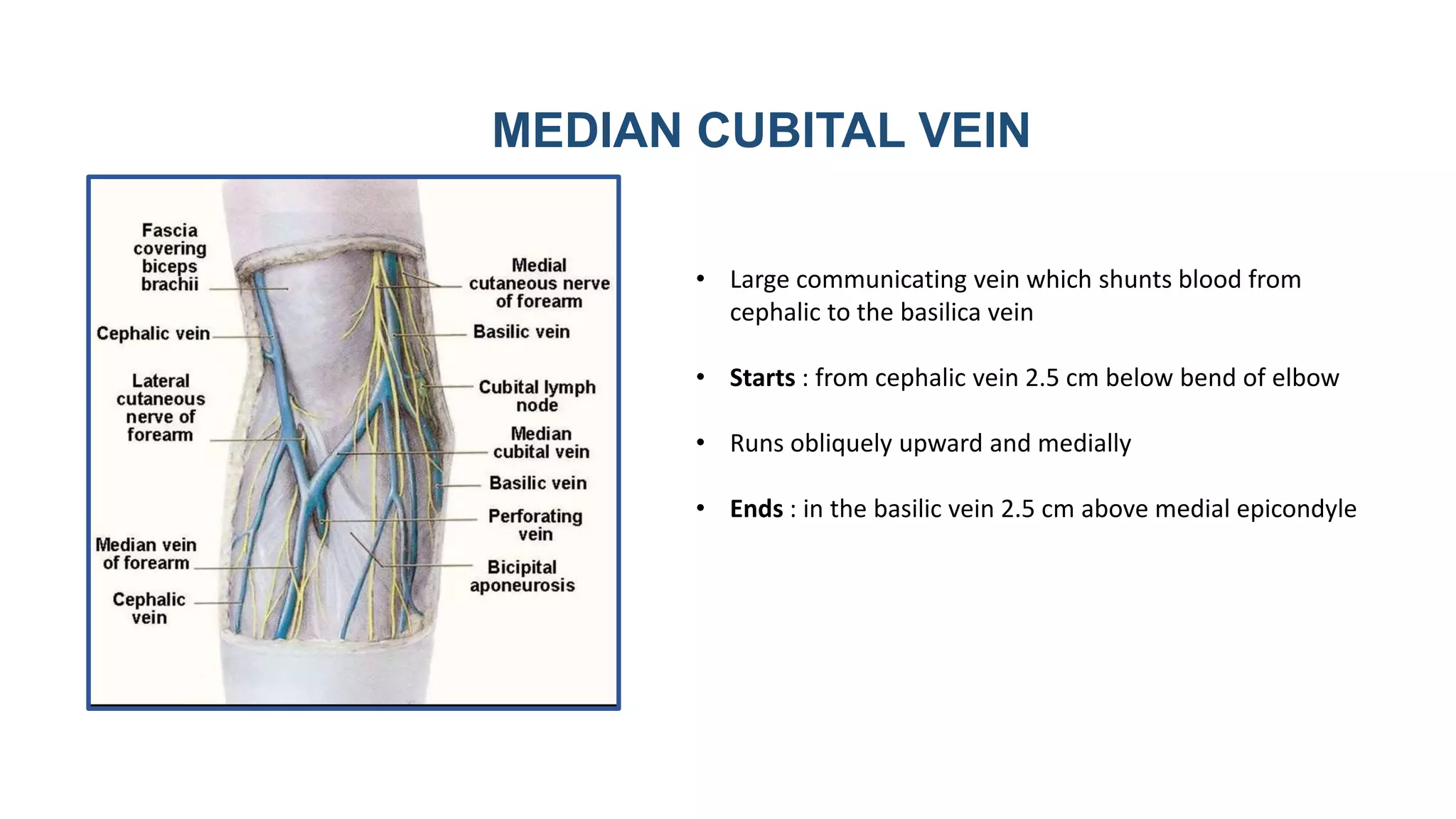
MEDIAN CUBITAL VEIN
• Large communicating vein which shunts blood from
cephalic to the basilica vein
• Starts : from cephalic vein 2.5 cm below bend of elbow
• Runs obliquely upward and medially
• Ends : in the basilic vein 2.5 cm above medial epicondyle
Clinical and surgical correlation
1. These superficial veins are commonly used for
intravenous injection and for withdrawing blood
for transfusion or for testing.
2. Cannulation via basilic vein is more liable
compared to cephalic because basilic vein
becomes the axillary vein without angulation (will
not prone to obstruction)
3. Axillary vein thrombosis may occur due to
prolonged abduction of the arm above the head,
as in painting ceiling.
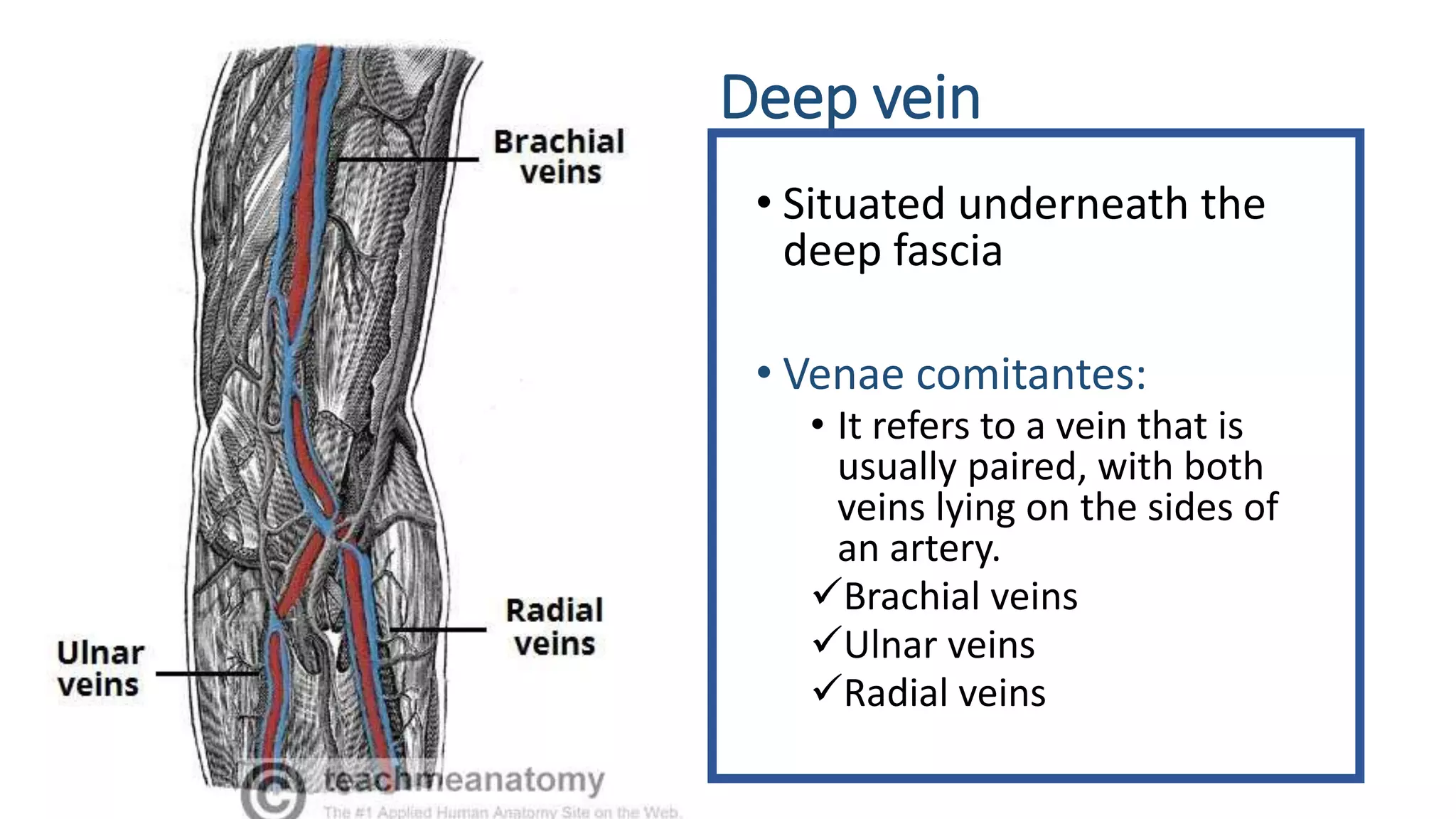
Deep vein
• Situated underneath the
deep fascia
• Venae comitantes:
• It refers to a vein that is
usually paired, with both
veins lying on the sides of
an artery.
Brachial veins
Ulnar veins
Radial veins
Venous system in lower limbs
• Superficial venous system
• Long ( Great ) Saphenous Veins (LSV/GSV)
• Short Saphenous Veins
• Deep venous system
• Iliac vein
• Femoral vein
• Popliteal vein
• Peroneal vein
• Tibial vein
• Soleal vein
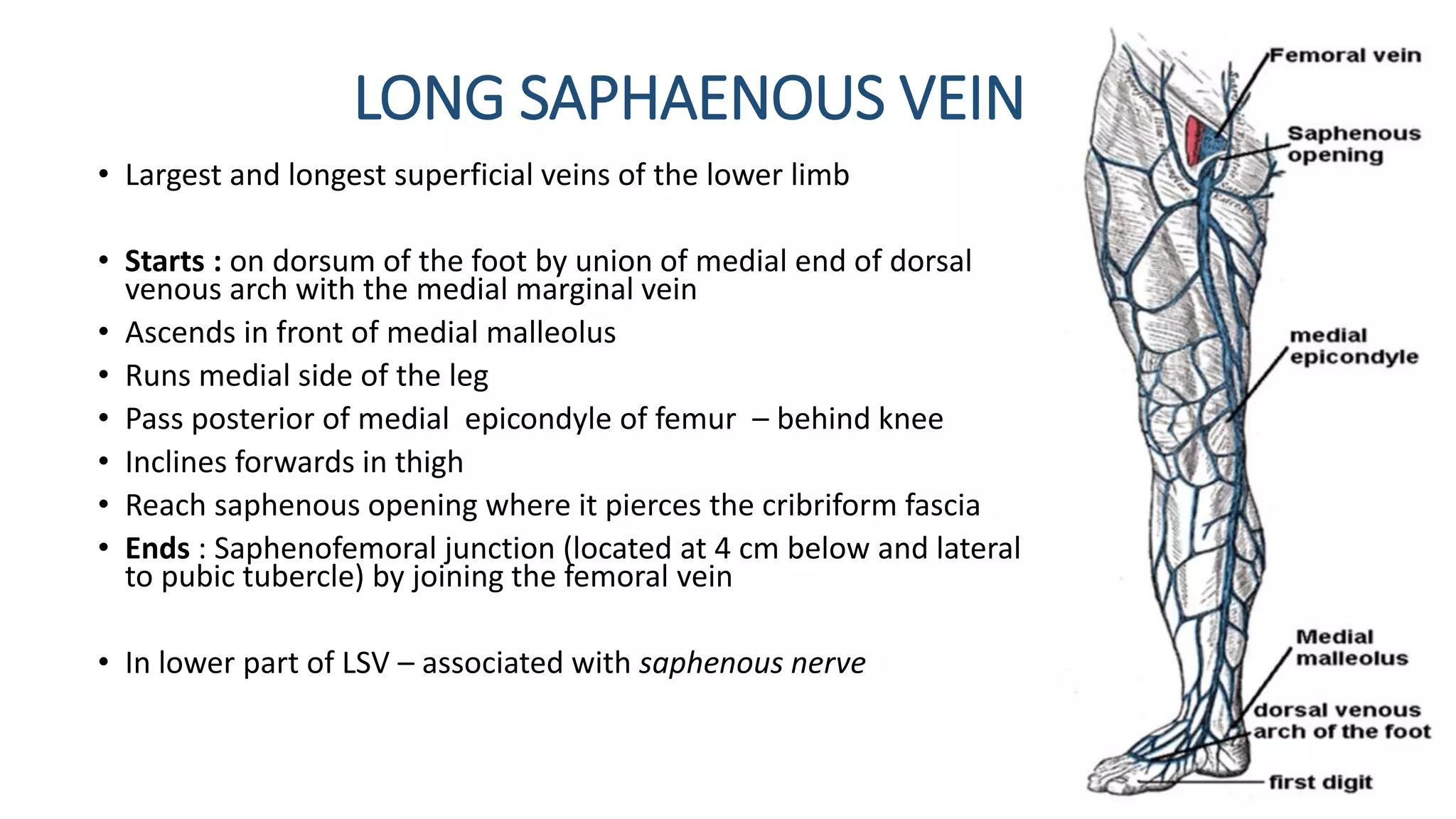
LONG SAPHAENOUS VEIN
• Largest and longest superficial veins of the lower limb
• Starts : on dorsum of the foot by union of medial end of dorsal
venous arch with the medial marginal vein
• Ascends in front of medial malleolus
• Runs medial side of the leg
• Pass posterior of medial epicondyle of femur – behind knee
• Inclines forwards in thigh
• Reach saphenous opening where it pierces the cribriform fascia
• Ends : Saphenofemoral junction (located at 4 cm below and lateral
to pubic tubercle) by joining the femoral vein
• In lower part of LSV – associated with saphenous nerve
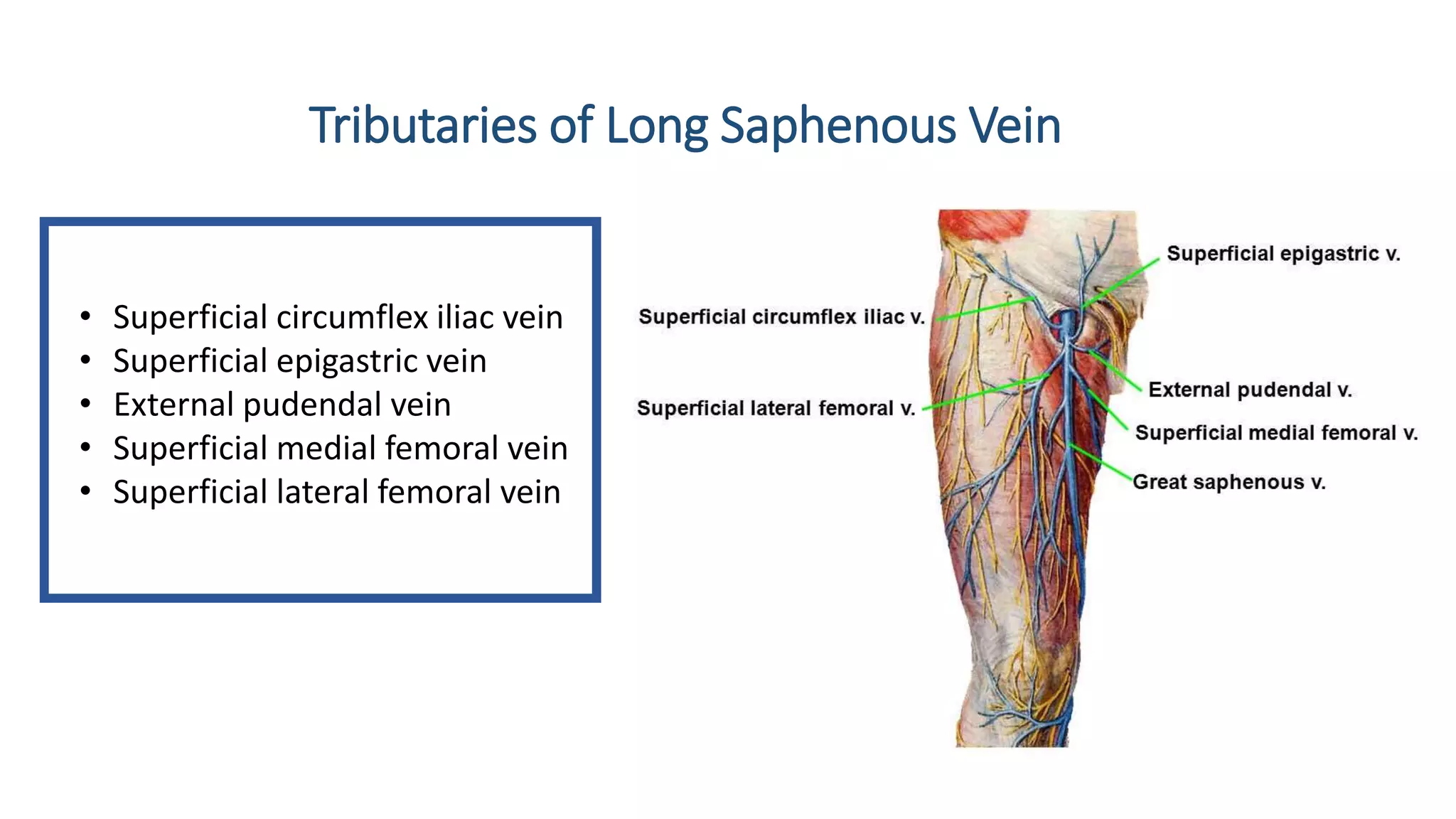
Tributaries of Long Saphenous Vein
• Superficial circumflex iliac vein
• Superficial epigastric vein
• External pudendal vein
• Superficial medial femoral vein
• Superficial lateral femoral vein
• Tributaries connect the long saphenous vein with short
saphenous veins
• Called as ‘Communicators’
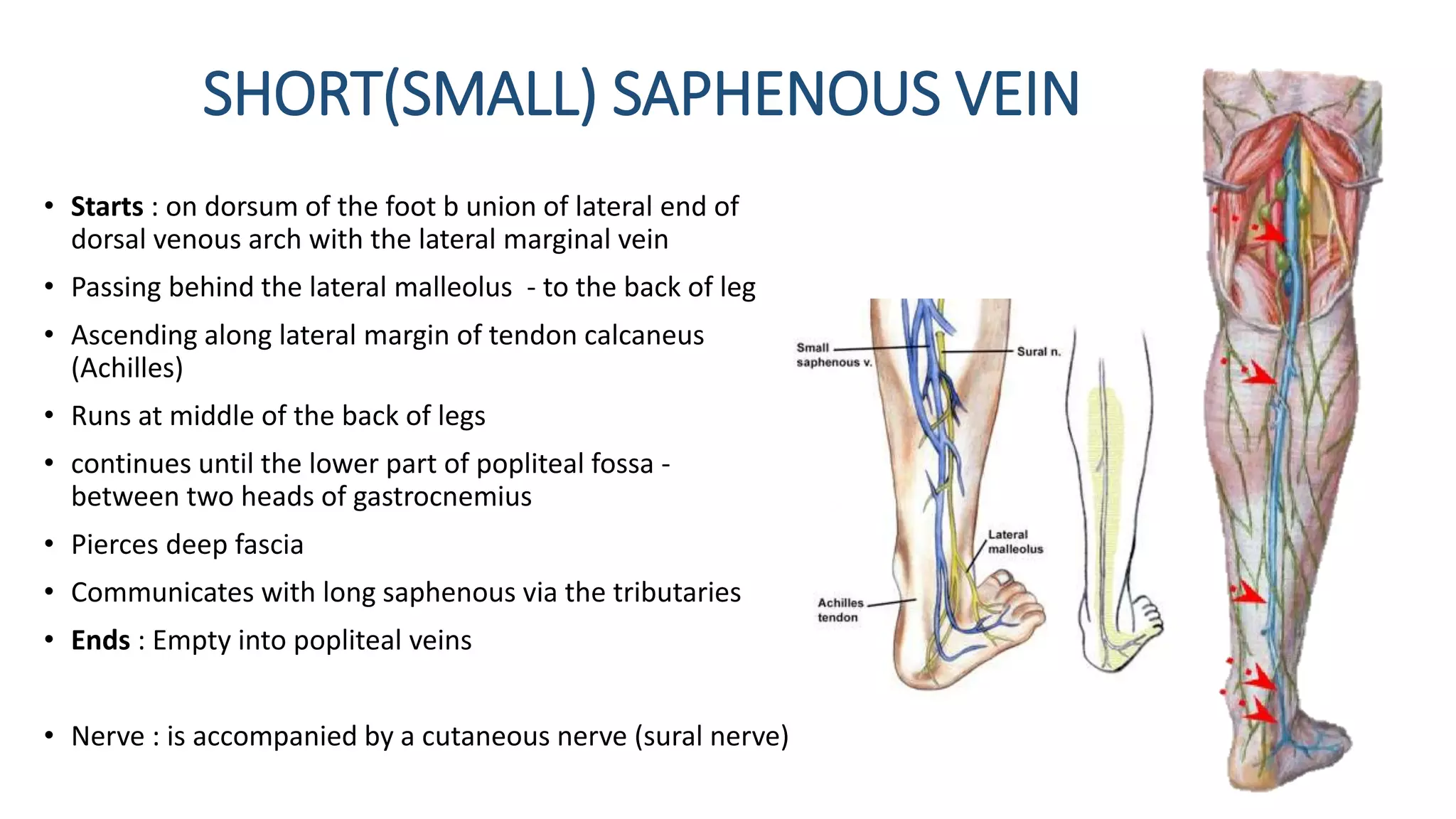
SHORT(SMALL) SAPHENOUS VEIN
• Starts : on dorsum of the foot b union of lateral end of
dorsal venous arch with the lateral marginal vein
• Passing behind the lateral malleolus - to the back of leg
• Ascending along lateral margin of tendon calcaneus
(Achilles)
• Runs at middle of the back of legs
• continues until the lower part of popliteal fossa -
between two heads of gastrocnemius
• Pierces deep fascia
• Communicates with long saphenous via the tributaries
• Ends : Empty into popliteal veins
• Nerve : is accompanied by a cutaneous nerve (sural nerve)
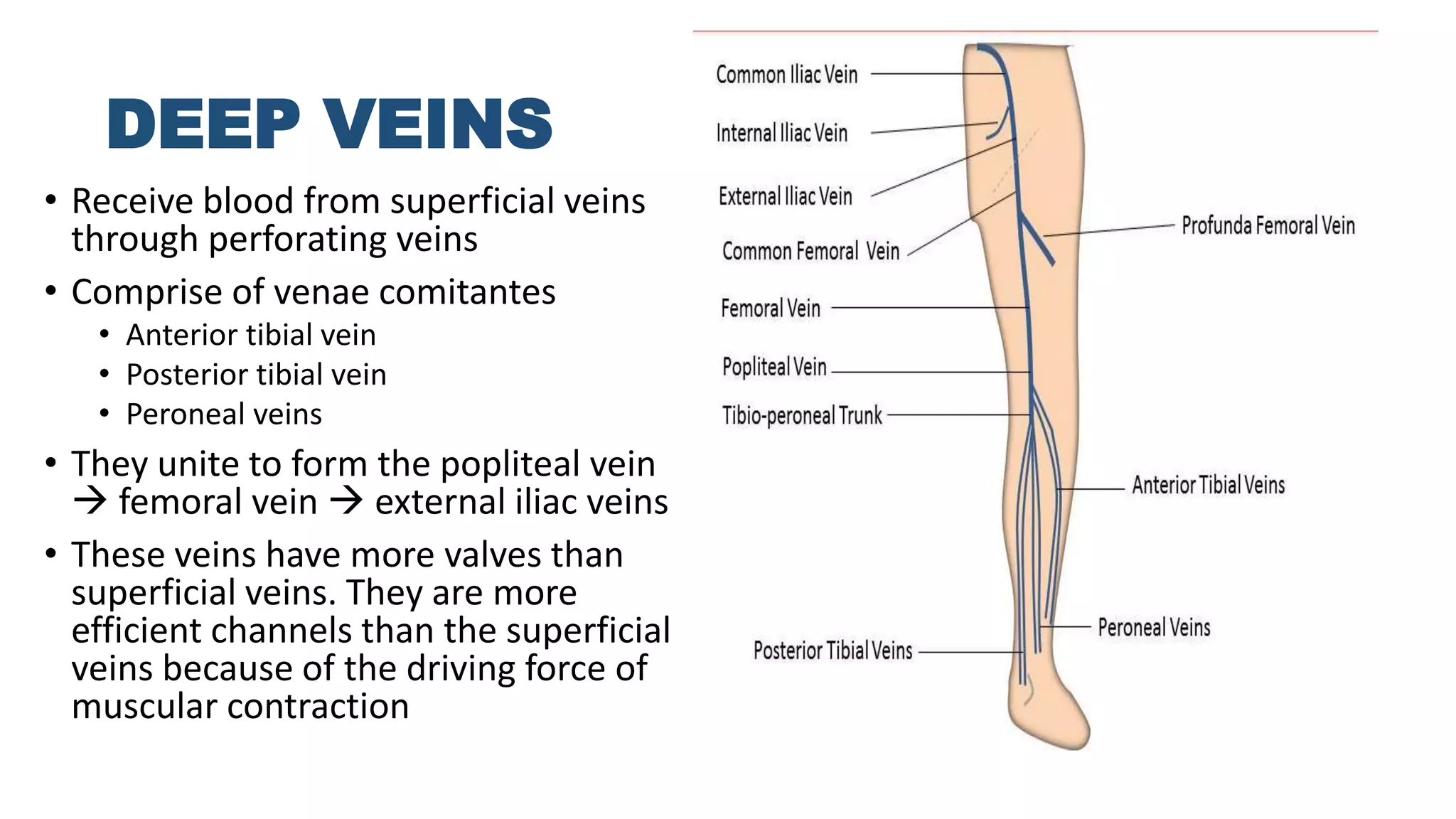
DEEP VEINS
• Receive blood from superficial veins
through perforating veins
• Comprise of venae comitantes
• Anterior tibial vein
• Posterior tibial vein
• Peroneal veins
• They unite to form the popliteal vein
 femoral vein  external iliac veins
• These veins have more valves than
superficial veins. They are more
efficient channels than the superficial
veins because of the driving force of
muscular contraction
Salient features of deep vein:
• High pressure system, well-supported by powerful
muscles
• Powerful calf muscle contraction returns the blood
to the heart
• Connected to superficial veins by perforators
• Deep veins are also provided with valves except
soleal vein
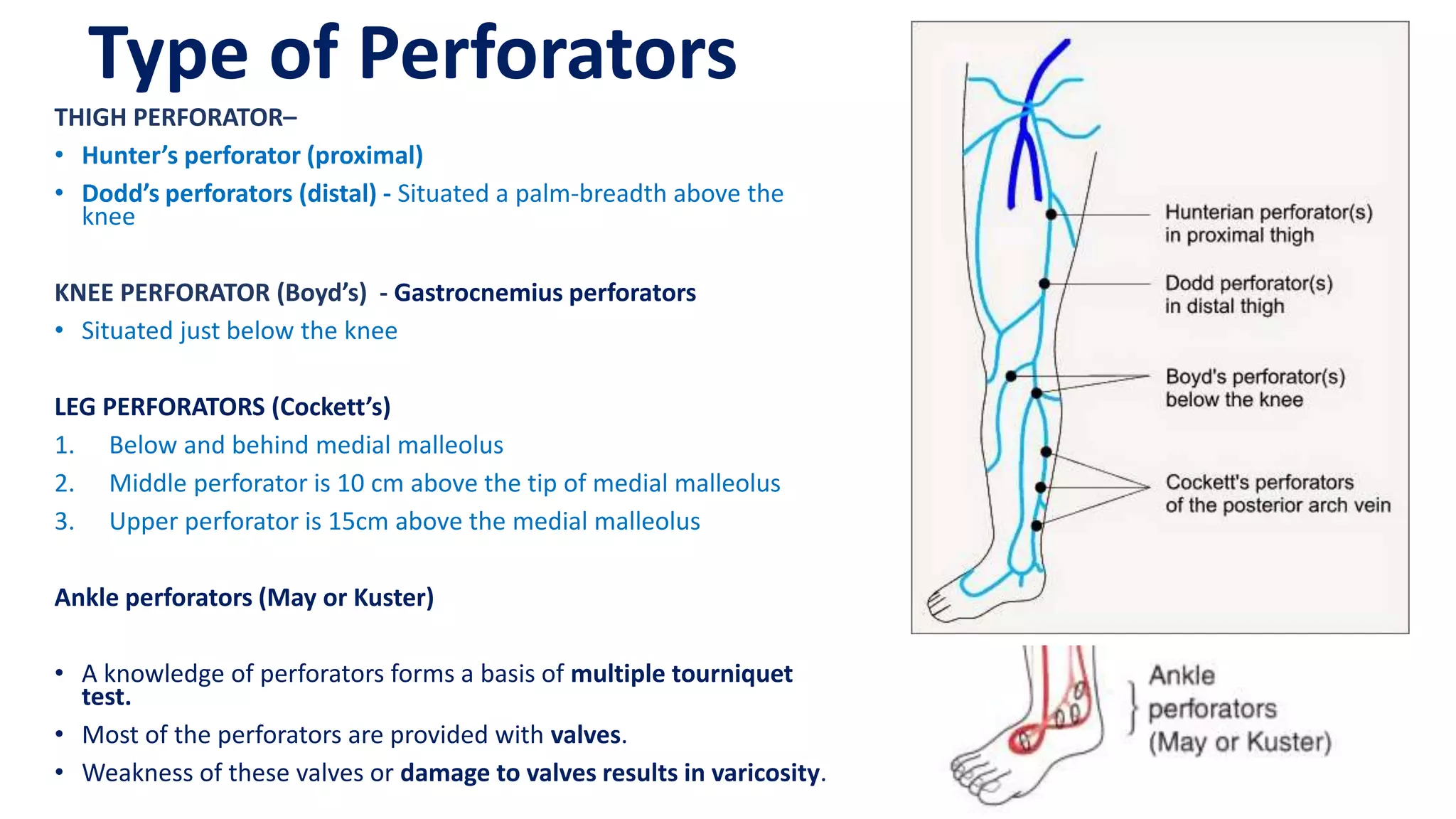
Type of Perforators
THIGH PERFORATOR–
• Hunter’s perforator (proximal)
• Dodd’s perforators (distal) - Situated a palm-breadth above the
knee
KNEE PERFORATOR (Boyd’s) - Gastrocnemius perforators
• Situated just below the knee
LEG PERFORATORS (Cockett’s)
1. Below and behind medial malleolus
2. Middle perforator is 10 cm above the tip of medial malleolus
3. Upper perforator is 15cm above the medial malleolus
Ankle perforators (May or Kuster)
• A knowledge of perforators forms a basis of multiple tourniquet
test.
• Most of the perforators are provided with valves.
• Weakness of these valves or damage to valves results in varicosity.
References
• SRB’s Manual of Surgery, Bhat M, S. (2016). 5th ed. Jaypee
Brothers Medical Publishers
• Manipal Manual of Surgery, 4th Edition, K.Rajgopal Shenoy
• B D Chaurasia Human anatomy, 5th edition

ANATOMY OF VENOUS SYSTEM.pptx

  • 1.
  • 2.
    Content 1) Venous systemin upper limb 2) Venous system in lower limb
  • 3.
    Venous System InUpper Limbs Superficial veins - Cephalic vein (preaxial) - Basilic vein (postaxial) - Median cubital veins  Deep veins - Brachial veins - Ulnar veins - Radial Veins
  • 4.
    Lateral end ofdorsal venous arch Winds round ↑ Continues upwards in front of elbow ↑ Lateral border of biceps brachi ↑ Pierces deep fascia ↑ Runs in deltopectoral groove up to infraclavicular fossa ↑ Pierces clavipectoral fascia ↑ Joins the axillary veins ↑ CEPHALIC VEINS Medial end of dorsal venous arch Along back of medial border of forearm ↑ Winds round ↑ Medial margin of biceps brachi ↑ Pierces deep fascia ↑ Middle of arm ↑ Lower border of teres major ↑ becomes the axillary veins ↑ BASILIC VEINS
  • 5.
    Cephalic vein Axillary veinAxillary vein Subclavian vein + Jugular vein Brachiocephalic vein Superior vena cava Basilic vein
  • 6.
    MEDIAN CUBITAL VEIN •Large communicating vein which shunts blood from cephalic to the basilica vein • Starts : from cephalic vein 2.5 cm below bend of elbow • Runs obliquely upward and medially • Ends : in the basilic vein 2.5 cm above medial epicondyle
  • 7.
    Clinical and surgicalcorrelation 1. These superficial veins are commonly used for intravenous injection and for withdrawing blood for transfusion or for testing. 2. Cannulation via basilic vein is more liable compared to cephalic because basilic vein becomes the axillary vein without angulation (will not prone to obstruction) 3. Axillary vein thrombosis may occur due to prolonged abduction of the arm above the head, as in painting ceiling.
  • 8.
    Deep vein • Situatedunderneath the deep fascia • Venae comitantes: • It refers to a vein that is usually paired, with both veins lying on the sides of an artery. Brachial veins Ulnar veins Radial veins
  • 9.
    Venous system inlower limbs • Superficial venous system • Long ( Great ) Saphenous Veins (LSV/GSV) • Short Saphenous Veins • Deep venous system • Iliac vein • Femoral vein • Popliteal vein • Peroneal vein • Tibial vein • Soleal vein
  • 10.
    LONG SAPHAENOUS VEIN •Largest and longest superficial veins of the lower limb • Starts : on dorsum of the foot by union of medial end of dorsal venous arch with the medial marginal vein • Ascends in front of medial malleolus • Runs medial side of the leg • Pass posterior of medial epicondyle of femur – behind knee • Inclines forwards in thigh • Reach saphenous opening where it pierces the cribriform fascia • Ends : Saphenofemoral junction (located at 4 cm below and lateral to pubic tubercle) by joining the femoral vein • In lower part of LSV – associated with saphenous nerve
  • 11.
    Tributaries of LongSaphenous Vein • Superficial circumflex iliac vein • Superficial epigastric vein • External pudendal vein • Superficial medial femoral vein • Superficial lateral femoral vein
  • 12.
    • Tributaries connectthe long saphenous vein with short saphenous veins • Called as ‘Communicators’
  • 13.
    SHORT(SMALL) SAPHENOUS VEIN •Starts : on dorsum of the foot b union of lateral end of dorsal venous arch with the lateral marginal vein • Passing behind the lateral malleolus - to the back of leg • Ascending along lateral margin of tendon calcaneus (Achilles) • Runs at middle of the back of legs • continues until the lower part of popliteal fossa - between two heads of gastrocnemius • Pierces deep fascia • Communicates with long saphenous via the tributaries • Ends : Empty into popliteal veins • Nerve : is accompanied by a cutaneous nerve (sural nerve)
  • 14.
    DEEP VEINS • Receiveblood from superficial veins through perforating veins • Comprise of venae comitantes • Anterior tibial vein • Posterior tibial vein • Peroneal veins • They unite to form the popliteal vein  femoral vein  external iliac veins • These veins have more valves than superficial veins. They are more efficient channels than the superficial veins because of the driving force of muscular contraction
  • 17.
    Salient features ofdeep vein: • High pressure system, well-supported by powerful muscles • Powerful calf muscle contraction returns the blood to the heart • Connected to superficial veins by perforators • Deep veins are also provided with valves except soleal vein
  • 18.
    Type of Perforators THIGHPERFORATOR– • Hunter’s perforator (proximal) • Dodd’s perforators (distal) - Situated a palm-breadth above the knee KNEE PERFORATOR (Boyd’s) - Gastrocnemius perforators • Situated just below the knee LEG PERFORATORS (Cockett’s) 1. Below and behind medial malleolus 2. Middle perforator is 10 cm above the tip of medial malleolus 3. Upper perforator is 15cm above the medial malleolus Ankle perforators (May or Kuster) • A knowledge of perforators forms a basis of multiple tourniquet test. • Most of the perforators are provided with valves. • Weakness of these valves or damage to valves results in varicosity.
  • 19.
    References • SRB’s Manualof Surgery, Bhat M, S. (2016). 5th ed. Jaypee Brothers Medical Publishers • Manipal Manual of Surgery, 4th Edition, K.Rajgopal Shenoy • B D Chaurasia Human anatomy, 5th edition