B.Tech (IT) Minor Project Presentation,2014 
Performance analysis of CSMA/CA and TDMA MAC 
protocols in Wireless Mesh Networks 
SAGAR GUPTA(BT/IT/1154) 
PRANJAL DAS(BT/IT/1146) 
DHRUBA JYOTI SAIKIA(BT/IT/1114) 
DARIHUNLANG SUCHIANG(BT/IT/1205(L)) 
Under the supervision of 
Md. Iftekhar Hussain 
Department Of Information Technology 
North-Eastern Hill University 
SHILLONG-22
CONTENTS 
 WIRELESS MESH NETWORKS 
• WMN vs MANET 
• WMN Architecture 
• WMN Characteristics 
• Application Scenarios 
 MAC PROTOCOLS FOR WMN 
• Background 
• CSMA/CA 
• TDMA 
 Performance Evaluation of CSMA/CA and TDMA in WMN 
• Performance Metric 
• Experimental Setup 
• Experimental Results 
 Conclusion And Future works 
 References
WIRELESS MESH NETWORKS 
• WMNs offer multiple redundant communications paths 
throughout the network. Whenever a link fails, the network 
automatically routes messages through alternate paths. 
• Even in adverse conditions devices in WMNs co-operate with 
each other in transmitting packets through the network. 
• WMNs are believed to be self-configuring and self-healing 
networks. 
• Dramatic increase in link quality just by shortening the 
distance between the nodes
Types of Nodes in WMN 
 Wireless Mesh Router 
• contains additional routing functions to support mesh networking. 
• usually equipped with multiple wireless interfaces built on either the same 
or different wireless access technologies. 
• improves the flexibility of mesh networking. 
 Mesh Clients 
• can also work as routers since they also have necessary functions for mesh 
networking. 
• gateway and bridge functions do not exist in these nodes. 
• usually have only one wireless interface as in Laptop/desktop PC, pocket 
PC etc.
WMN vs MANET 
There are various factors which can differentiate wireless mesh network from 
Ad-hoc Network. The major differences between these two types of network 
are the network topology and mobility of node 
• Network topology: Ad- hoc network are called as the infrastructure less 
network with a highly dynamic topology where as WMN have a relatively 
static network topology 
• Mobility of relay nodes: In Ad-hoc network the relay nodes have a higher 
degree of mobility i.e. relay nodes aren't fixed whereas in WMN's the 
degree of mobility of relay node is much lower than in Ad-hoc networks. 
• Infrastructure requirement: Ad-hoc network is infrastructure less whereas 
WMN has partial or fully fixed infrastructure. 
• Energy constraints: In Ad-hoc network energy constraints is high whereas 
it is low in the WMNs.
WMN Architecture 
• Based on the functionality of the nodes the 
architecture of WMNs can be classified into: 
• Infrastructure mesh Architecture 
• Client mesh Architecture 
• Hybrid mesh architecture
Infrastructure Mesh 
In infrastructure mesh architecture, the mesh routers 
collectively provide a wireless backbone infrastructure. 
Client node is passive in mesh infrastructure.
Client Mesh [1] 
Client meshing provides peer-to-peer networks among 
client devices. Here no such mesh router is required. Client will 
act like a mesh router by relaying the packets.
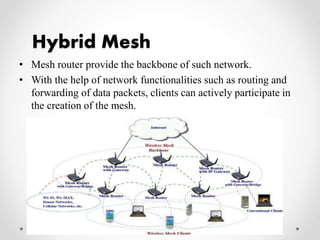
Hybrid Mesh 
• Mesh router provide the backbone of such network. 
• With the help of network functionalities such as routing and 
forwarding of data packets, clients can actively participate in 
the creation of the mesh.
WMN Characteristics 
• Dynamic self-configuration and self-organization 
• Adaptation 
• Fault tolerance and robustness 
• Low-Cost 
• Integration and interoperability
Application Scenarios 
• Broadband Home Networking 
• Community and neighborhood networking 
• Enterprise Networking 
• Building automation 
• Security Surveillance systems
Mac Protocols for WMN 
• Objectives 
o Maximize channel utilization. 
o Minimize channel access delay. 
• CSMA/CA : [4],[6],[8] 
o It is a Random Access Protocol. 
o It continuously senses the channel. 
o Collision avoidance technique – 
- Request to send/clear to send(RTS/CTS) 
- Transmission
Working of CSMA/CA 
CSMA/CA was invented for Wireless Networks . In Wireless 
Networks collisions are need to be avoided because they cannot 
be detected. Collisions are avoided by three strategies: 
• The Interframe space 
• The Contention Window 
• Acknowledgements
Working of CSMA/CA (contd.)
MAC protocols in WMN(cntd.) 
TDMA: [3],[4],[7],[10] 
• It is a channelization protocol. 
• Each channel is allocated with a unique time slot. 
• Three kinds of time slots-o 
Control slots 
o Contention slots 
o Data slots
TDMA frame structure
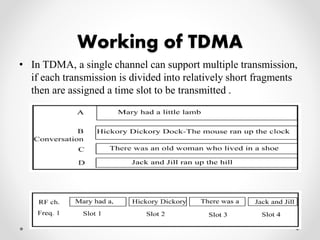
Working of TDMA 
• In TDMA, a single channel can support multiple transmission, 
if each transmission is divided into relatively short fragments 
then are assigned a time slot to be transmitted .
Performance evaluation of 
CSMA/CA and TDMA 
Performance metric 
• Throughput 
• Delay 
• Packet loss
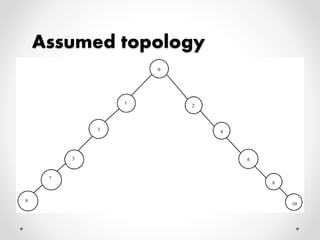
Assumed topology
Experimental Setup 
• Performance of the assumed network topology has been 
evaluated in terms of simulation in NS-2[5]. 
• The experiments were conducted to analyze the performance 
of the CSMA/CA and TDMA MAC protocol. 
• Table 1 specifies the various parameters considered along with 
their values during the simulation.
Table 1: Simulation 
Parameters 
Parameter Name Values 
• Traffic Types 
• Packet Size 
• Routing Protocol 
• Radio Propagation Model 
• Bandwidth 
• Antenna Type 
• Distance per hop 
• No. of Nodes 
• Simulation Time 
• CBR and FTP 
• 1000 bytes 
• AODV 
• Two Ray Ground Reflection 
Model 
• 11 Mbps 
• Omni Antenna 
• 20 Km 
• 11 
• 50 Secs
Experimental Results 
• With different number of Hops in TDMA MAC protocol
Experimental Results (cntd) 
• With different number of Hops in CSMA/CA.
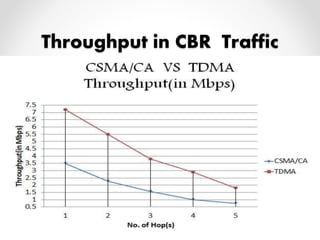
Throughput in CBR Traffic
Throughput in FTP Traffic
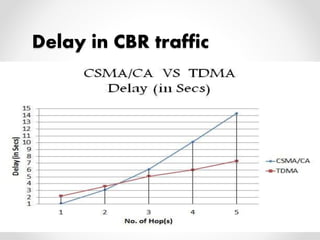
Delay in CBR traffic
Delay in FTP Traffic
Packet loss in CBR traffic
Packet loss in FTP Traffic
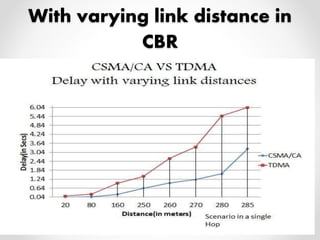
With varying link distance in 
CBR
With varying link distance in 
CBR
With varying link distance in 
CBR
Conclusion and Future works 
• In this Project we have studied and analysed the performance 
of CSMA/CA and TDMA MAC protocols in Wireless Mesh 
Network. 
• CSMA/CA is having different problems like hidden node, 
exposed node, information asymmetry. 
• TDMA provide good solutions to traffic correlation, heavy 
collision. 
• Comparingly in our performance analysis, we found that the 
performance of TDMA is far better than that of CSMA/CA. 
• Since CSMA/CA performance is not good using omni-directional 
antenna. So, in future we can work on these two 
protocols using directional antenna.
REFERENCES 
[1] Akyildiz, Ian F., XudongWang, and WeilinWang. "Wireless mesh networks: a survey." Computer networks 
47.4 (2005): 445-487. 
[2] Ian F. Akyildiz and Xudong Wang ,”Wireless Mesh Networks”:JohnWiley and Sons ,Ltd Publication 
[3] Mihail L. Sichitiu,”Wireless Mesh Networks: Opportunities and Challenges” 
[4] IEEE Standard for Wireless LAN Medium Access Control (MAC) and Physical Layer (PHY) Specifications, 
Nov. 1997,P802.11. 
[5] “Network Simulator- ns2.” http://www.isi.edu/nsnam/ns. 
[6] Manshaei, H., et al. "Performance analysis of the IEEE 802.11 MAC and physical layer protocol." World of 
Wireless Mobile and Multimedia Networks, 2005. WoWMoM 2005. Sixth IEEE International Symposium on a. 
IEEE, 2005. 
[7] Akyildiz, Ian F., et al. "Medium access control protocols for multimedia traffic in wireless 
networks." Network, IEEE 13.4 (1999): 39-47. 
[8] Bianchi, Giuseppe, Luigi Fratta, and Matteo Oliveri. "Performance evaluation and enhancement of the 
CSMA/CA MAC protocol for 802.11 wireless LANs."Personal, Indoor and Mobile Radio Communications, 
1996. PIMRC'96., Seventh IEEE International Symposium on. Vol. 2. IEEE, 1996. 
[9] Perkins, Charles E. Ad hoc networking. Addison-Wesley Professional, 2008. 
[10] Sen, Sayandeep, and Bhaskaran Raman. "Long distance wireless mesh network planning: problem 
formulation and solution." Proceedings of the 16th international conference on World Wide Web. ACM, 2007.
THANK YOU!!!!!

Performance analysis of CSMA/CA and TDMA MAC protocols in Wireless Mesh Networks

  • 1.
    B.Tech (IT) MinorProject Presentation,2014 Performance analysis of CSMA/CA and TDMA MAC protocols in Wireless Mesh Networks SAGAR GUPTA(BT/IT/1154) PRANJAL DAS(BT/IT/1146) DHRUBA JYOTI SAIKIA(BT/IT/1114) DARIHUNLANG SUCHIANG(BT/IT/1205(L)) Under the supervision of Md. Iftekhar Hussain Department Of Information Technology North-Eastern Hill University SHILLONG-22
  • 2.
    CONTENTS  WIRELESSMESH NETWORKS • WMN vs MANET • WMN Architecture • WMN Characteristics • Application Scenarios  MAC PROTOCOLS FOR WMN • Background • CSMA/CA • TDMA  Performance Evaluation of CSMA/CA and TDMA in WMN • Performance Metric • Experimental Setup • Experimental Results  Conclusion And Future works  References
  • 3.
    WIRELESS MESH NETWORKS • WMNs offer multiple redundant communications paths throughout the network. Whenever a link fails, the network automatically routes messages through alternate paths. • Even in adverse conditions devices in WMNs co-operate with each other in transmitting packets through the network. • WMNs are believed to be self-configuring and self-healing networks. • Dramatic increase in link quality just by shortening the distance between the nodes
  • 5.
    Types of Nodesin WMN  Wireless Mesh Router • contains additional routing functions to support mesh networking. • usually equipped with multiple wireless interfaces built on either the same or different wireless access technologies. • improves the flexibility of mesh networking.  Mesh Clients • can also work as routers since they also have necessary functions for mesh networking. • gateway and bridge functions do not exist in these nodes. • usually have only one wireless interface as in Laptop/desktop PC, pocket PC etc.
  • 6.
    WMN vs MANET There are various factors which can differentiate wireless mesh network from Ad-hoc Network. The major differences between these two types of network are the network topology and mobility of node • Network topology: Ad- hoc network are called as the infrastructure less network with a highly dynamic topology where as WMN have a relatively static network topology • Mobility of relay nodes: In Ad-hoc network the relay nodes have a higher degree of mobility i.e. relay nodes aren't fixed whereas in WMN's the degree of mobility of relay node is much lower than in Ad-hoc networks. • Infrastructure requirement: Ad-hoc network is infrastructure less whereas WMN has partial or fully fixed infrastructure. • Energy constraints: In Ad-hoc network energy constraints is high whereas it is low in the WMNs.
  • 7.
    WMN Architecture •Based on the functionality of the nodes the architecture of WMNs can be classified into: • Infrastructure mesh Architecture • Client mesh Architecture • Hybrid mesh architecture
  • 8.
    Infrastructure Mesh Ininfrastructure mesh architecture, the mesh routers collectively provide a wireless backbone infrastructure. Client node is passive in mesh infrastructure.
  • 9.
    Client Mesh [1] Client meshing provides peer-to-peer networks among client devices. Here no such mesh router is required. Client will act like a mesh router by relaying the packets.
  • 10.
    Hybrid Mesh •Mesh router provide the backbone of such network. • With the help of network functionalities such as routing and forwarding of data packets, clients can actively participate in the creation of the mesh.
  • 11.
    WMN Characteristics •Dynamic self-configuration and self-organization • Adaptation • Fault tolerance and robustness • Low-Cost • Integration and interoperability
  • 12.
    Application Scenarios •Broadband Home Networking • Community and neighborhood networking • Enterprise Networking • Building automation • Security Surveillance systems
  • 13.
    Mac Protocols forWMN • Objectives o Maximize channel utilization. o Minimize channel access delay. • CSMA/CA : [4],[6],[8] o It is a Random Access Protocol. o It continuously senses the channel. o Collision avoidance technique – - Request to send/clear to send(RTS/CTS) - Transmission
  • 14.
    Working of CSMA/CA CSMA/CA was invented for Wireless Networks . In Wireless Networks collisions are need to be avoided because they cannot be detected. Collisions are avoided by three strategies: • The Interframe space • The Contention Window • Acknowledgements
  • 15.
  • 16.
    MAC protocols inWMN(cntd.) TDMA: [3],[4],[7],[10] • It is a channelization protocol. • Each channel is allocated with a unique time slot. • Three kinds of time slots-o Control slots o Contention slots o Data slots
  • 17.
  • 18.
    Working of TDMA • In TDMA, a single channel can support multiple transmission, if each transmission is divided into relatively short fragments then are assigned a time slot to be transmitted .
  • 19.
    Performance evaluation of CSMA/CA and TDMA Performance metric • Throughput • Delay • Packet loss
  • 20.
  • 21.
    Experimental Setup •Performance of the assumed network topology has been evaluated in terms of simulation in NS-2[5]. • The experiments were conducted to analyze the performance of the CSMA/CA and TDMA MAC protocol. • Table 1 specifies the various parameters considered along with their values during the simulation.
  • 22.
    Table 1: Simulation Parameters Parameter Name Values • Traffic Types • Packet Size • Routing Protocol • Radio Propagation Model • Bandwidth • Antenna Type • Distance per hop • No. of Nodes • Simulation Time • CBR and FTP • 1000 bytes • AODV • Two Ray Ground Reflection Model • 11 Mbps • Omni Antenna • 20 Km • 11 • 50 Secs
  • 23.
    Experimental Results •With different number of Hops in TDMA MAC protocol
  • 24.
    Experimental Results (cntd) • With different number of Hops in CSMA/CA.
  • 25.
  • 26.
  • 27.
    Delay in CBRtraffic
  • 28.
    Delay in FTPTraffic
  • 29.
    Packet loss inCBR traffic
  • 30.
    Packet loss inFTP Traffic
  • 31.
    With varying linkdistance in CBR
  • 32.
    With varying linkdistance in CBR
  • 33.
    With varying linkdistance in CBR
  • 34.
    Conclusion and Futureworks • In this Project we have studied and analysed the performance of CSMA/CA and TDMA MAC protocols in Wireless Mesh Network. • CSMA/CA is having different problems like hidden node, exposed node, information asymmetry. • TDMA provide good solutions to traffic correlation, heavy collision. • Comparingly in our performance analysis, we found that the performance of TDMA is far better than that of CSMA/CA. • Since CSMA/CA performance is not good using omni-directional antenna. So, in future we can work on these two protocols using directional antenna.
  • 35.
    REFERENCES [1] Akyildiz,Ian F., XudongWang, and WeilinWang. "Wireless mesh networks: a survey." Computer networks 47.4 (2005): 445-487. [2] Ian F. Akyildiz and Xudong Wang ,”Wireless Mesh Networks”:JohnWiley and Sons ,Ltd Publication [3] Mihail L. Sichitiu,”Wireless Mesh Networks: Opportunities and Challenges” [4] IEEE Standard for Wireless LAN Medium Access Control (MAC) and Physical Layer (PHY) Specifications, Nov. 1997,P802.11. [5] “Network Simulator- ns2.” http://www.isi.edu/nsnam/ns. [6] Manshaei, H., et al. "Performance analysis of the IEEE 802.11 MAC and physical layer protocol." World of Wireless Mobile and Multimedia Networks, 2005. WoWMoM 2005. Sixth IEEE International Symposium on a. IEEE, 2005. [7] Akyildiz, Ian F., et al. "Medium access control protocols for multimedia traffic in wireless networks." Network, IEEE 13.4 (1999): 39-47. [8] Bianchi, Giuseppe, Luigi Fratta, and Matteo Oliveri. "Performance evaluation and enhancement of the CSMA/CA MAC protocol for 802.11 wireless LANs."Personal, Indoor and Mobile Radio Communications, 1996. PIMRC'96., Seventh IEEE International Symposium on. Vol. 2. IEEE, 1996. [9] Perkins, Charles E. Ad hoc networking. Addison-Wesley Professional, 2008. [10] Sen, Sayandeep, and Bhaskaran Raman. "Long distance wireless mesh network planning: problem formulation and solution." Proceedings of the 16th international conference on World Wide Web. ACM, 2007.
  • 36.