Film Theory
Sharondeep Bachra
Roland Barthes
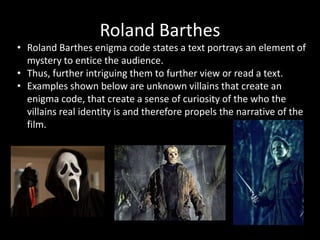
• Roland Barthes enigma code states a text portrays an element of
mystery to entice the audience.
• Thus, further intriguing them to further view or read a text.
• Examples shown below are unknown villains that create an
enigma code, that create a sense of curiosity of the who the
villains real identity is and therefore propels the narrative of the
film.
Claude Levi Strauss
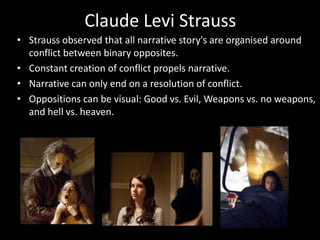
• Strauss observed that all narrative story's are organised around
conflict between binary opposites.
• Constant creation of conflict propels narrative.
• Narrative can only end on a resolution of conflict.
• Oppositions can be visual: Good vs. Evil, Weapons vs. no weapons,
and hell vs. heaven.
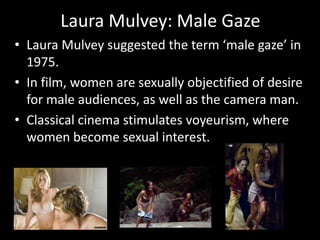
Laura Mulvey: Male Gaze
• Laura Mulvey suggested the term ‘male gaze’ in
1975.
• In film, women are sexually objectified of desire
for male audiences, as well as the camera man.
• Classical cinema stimulates voyeurism, where
women become sexual interest.
Tzvetean Todrov
• Todrov simplified the idea of narrative theory, whilst also
suggesting this theory of Equilibrium and Disequilibrium.
• This theory is:
• The fictional environment begins with a state of equilibrium
(everything is normal)
• It then suffers some disruption (Disequilibrium)
• New Equilibrium is produced at the end of the narrative.
Vladimir Propp
• Propp suggested that there are a number of limited characters
types that share a function.
• Characters types that share a function are;
• The hero – a character that seeks something
• The villain – who opposes the hero's request
• The Donor – who provides an object with magical properties.
• The Dispatcher – who sends the hero on his/her via message.
• The False Hero – who disrupts the hero’s success by making false
claims.
• The Helper – who aids the hero
• The Princess – acts as the reward for the hero and the object of the
villain’ plots.
• Her Father – who acts to reward the hero for his effort.

Film theory

  • 1.
  • 2.
    Roland Barthes • RolandBarthes enigma code states a text portrays an element of mystery to entice the audience. • Thus, further intriguing them to further view or read a text. • Examples shown below are unknown villains that create an enigma code, that create a sense of curiosity of the who the villains real identity is and therefore propels the narrative of the film.
  • 3.
    Claude Levi Strauss •Strauss observed that all narrative story's are organised around conflict between binary opposites. • Constant creation of conflict propels narrative. • Narrative can only end on a resolution of conflict. • Oppositions can be visual: Good vs. Evil, Weapons vs. no weapons, and hell vs. heaven.
  • 4.
    Laura Mulvey: MaleGaze • Laura Mulvey suggested the term ‘male gaze’ in 1975. • In film, women are sexually objectified of desire for male audiences, as well as the camera man. • Classical cinema stimulates voyeurism, where women become sexual interest.
  • 5.
    Tzvetean Todrov • Todrovsimplified the idea of narrative theory, whilst also suggesting this theory of Equilibrium and Disequilibrium. • This theory is: • The fictional environment begins with a state of equilibrium (everything is normal) • It then suffers some disruption (Disequilibrium) • New Equilibrium is produced at the end of the narrative.
  • 6.
    Vladimir Propp • Proppsuggested that there are a number of limited characters types that share a function. • Characters types that share a function are; • The hero – a character that seeks something • The villain – who opposes the hero's request • The Donor – who provides an object with magical properties. • The Dispatcher – who sends the hero on his/her via message. • The False Hero – who disrupts the hero’s success by making false claims. • The Helper – who aids the hero • The Princess – acts as the reward for the hero and the object of the villain’ plots. • Her Father – who acts to reward the hero for his effort.