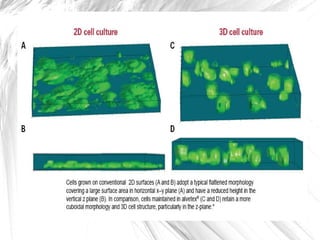
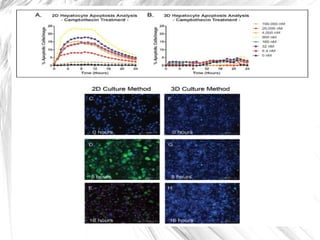
3D VS 2D● In 3D cell culture, cells attach to
one another and form natural cell-
to-cell attachments.
● These gap junctions are much
more prevalent in 3D cell culture
than 2D and these junctions
enable cells to communicate with
each other via exchange of ions,
small molecules and even
electrical currents.
● 3D culture have more tissue
differentiation, cell adherence
property.
● Cell grown in 3D culture could not
be killed by low doses of
chemotherapeutic drug or low
doses of radiation.
● In 2D culture cell does not
attached properly.
● Gap junction are not much
widespread in 2D culture.
● Less tissue differentiation
● cell could be easily killed by
low doses of drug.
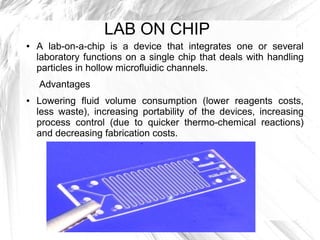
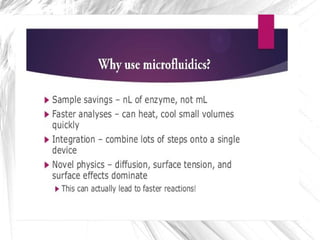
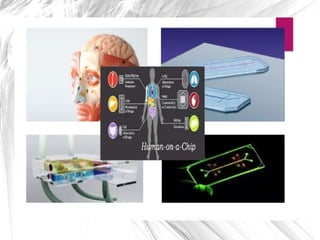
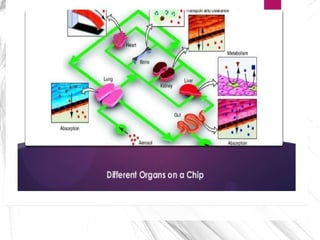
LAB ON CHIP
● A lab-on-a-chip is a device that integrates one or several
laboratory functions on a single chip that deals with handling
particles in hollow microfluidic channels.
Advantages
● Lowering fluid volume consumption (lower reagents costs,
less waste), increasing portability of the devices, increasing
process control (due to quicker thermo-chemical reactions)
and decreasing fabrication costs.
Ppt 3 d culture
Ppt 3 d culture
Ppt 3 d culture
Ppt 3 d culture
Ppt 3 d culture
Ppt 3 d culture
Ppt 3 d culture
Ppt 3 d culture

Ppt 3 d culture

  • 4.
    3D VS 2D●In 3D cell culture, cells attach to one another and form natural cell- to-cell attachments. ● These gap junctions are much more prevalent in 3D cell culture than 2D and these junctions enable cells to communicate with each other via exchange of ions, small molecules and even electrical currents. ● 3D culture have more tissue differentiation, cell adherence property. ● Cell grown in 3D culture could not be killed by low doses of chemotherapeutic drug or low doses of radiation. ● In 2D culture cell does not attached properly. ● Gap junction are not much widespread in 2D culture. ● Less tissue differentiation ● cell could be easily killed by low doses of drug.
  • 7.
    LAB ON CHIP ●A lab-on-a-chip is a device that integrates one or several laboratory functions on a single chip that deals with handling particles in hollow microfluidic channels. Advantages ● Lowering fluid volume consumption (lower reagents costs, less waste), increasing portability of the devices, increasing process control (due to quicker thermo-chemical reactions) and decreasing fabrication costs.