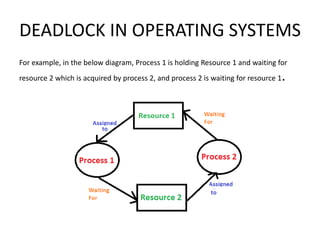
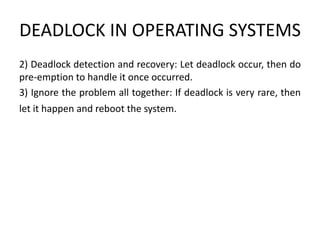
This document discusses deadlocks in operating systems. It defines a deadlock as when a set of processes are blocked because each process is holding a resource and waiting for another resource held by another process. Four conditions must be met simultaneously for a deadlock to occur: mutual exclusion, hold and wait, no preemption, and circular wait. An example of a deadlock between two processes, Process 1 and Process 2, is provided. Methods for handling deadlocks include prevention/avoidance, detection and recovery, and ignoring the problem. Prevention negates one of the necessary conditions, while avoidance uses strategies like Banker's algorithm to ensure deadlocks are avoided.