Figurative Language in
A Poem
By Wulan Affandi
For English Literature Class Grade XI
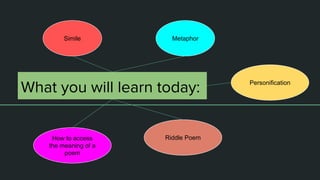
What you will learn today:
Simile Metaphor
Personification
Riddle PoemHow to access
the meaning of a
poem
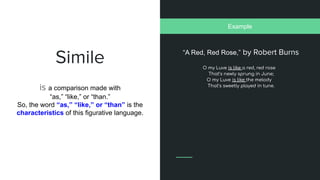
Simile
is a comparison made with
“as,” “like,” or “than.”
So, the word “as,” “like,” or “than” is the
characteristics of this figurative language.
“A Red, Red Rose,” by Robert Burns
Example
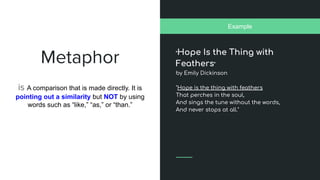
Metaphor
is A comparison that is made directly. It is
pointing out a similarity but NOT by using
words such as “like,” “as,” or “than.”
“Hope Is the Thing with
Feathers
Example
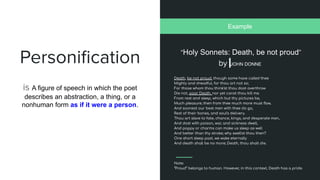
Personification
is A figure of speech in which the poet
describes an abstraction, a thing, or a
nonhuman form as if it were a person.
“Holy Sonnets: Death, be not proud”
by JOHN DONNE
Example
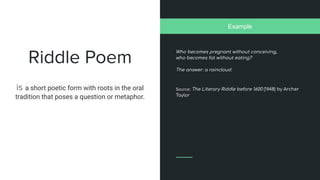
Riddle Poem
is a short poetic form with roots in the oral
tradition that poses a question or metaphor.
Source:
Example
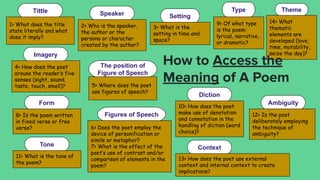
Theme
14> What
thematic
elements are
developed (love,
time, mutability,
seize the day)?
How to Access the
Meaning of A Poem
Tittle
1> What does the title
state literally and what
does it imply?
Speaker
2> Who is the speaker,
the author or the
persona or character
created by the author?
Setting
3> What is the
setting in time and
space?
Imagery
4> How does the poet
arouse the reader’s five
senses (sight, sound,
taste, touch, smell)?
The position of
Figure of Speech
5> Where does the poet
use figures of speech?
Figures of Speech
6> Does the poet employ the
device of personification or
simile or metaphor?
7> What is the effect of the
poet’s use of contrast and/or
comparison of elements in the
poem?
Form
8> Is the poem written
in fixed verse or free
verse?
Type
9> Of what type
is the poem:
lyrical, narrative,
or dramatic?
Diction
10> How does the poet
make use of denotation
and connotation in the
handling of diction (word
choice)?
Tone
11> What is the tone of
the poem?
Ambiguity
12> Is the poet
deliberately employing
the technique of
ambiguity?
Context
13> How does the poet use external
context and internal context to create
implications?
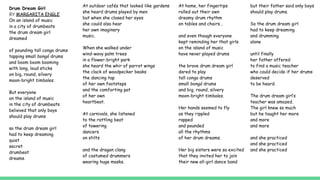
Drum Dream Girl
BY MARGARITA ENGLE
On an island of music
in a city of drumbeats
the drum dream girl
dreamed
of pounding tall conga drums
tapping small bongó drums
and boom boom booming
with long, loud sticks
on big, round, silvery
moon-bright timbales.
But everyone
on the island of music
in the city of drumbeats
believed that only boys
should play drums
so the drum dream girl
had to keep dreaming
quiet
secret
drumbeat
dreams.
At outdoor cafés that looked like gardens
she heard drums played by men
but when she closed her eyes
she could also hear
her own imaginary
music.
When she walked under
wind-wavy palm trees
in a flower-bright park
she heard the whir of parrot wings
the clack of woodpecker beaks
the dancing tap
of her own footsteps
and the comforting pat
of her own
heartbeat.
At carnivals, she listened
to the rattling beat
of towering
dancers
on stilts
and the dragon clang
of costumed drummers
wearing huge masks.
At home, her fingertips
rolled out their own
dreamy drum rhythm
on tables and chairs…
and even though everyone
kept reminding her that girls
on the island of music
have never played drums
the brave drum dream girl
dared to play
tall conga drums
small bongó drums
and big, round, silvery
moon-bright timbales.
Her hands seemed to fly
as they rippled
rapped
and pounded
all the rhythms
of her drum dreams.
Her big sisters were so excited
that they invited her to join
their new all-girl dance band
but their father said only boys
should play drums.
So the drum dream girl
had to keep dreaming
and drumming
alone
until finally
her father offered
to find a music teacher
who could decide if her drums
deserved
to be heard.
The drum dream girl’s
teacher was amazed.
The girl knew so much
but he taught her more
and more
and more
and she practiced
and she practiced
and she practiced
until the teacher agreed
that she was ready
to play her small bongó drums
outdoors at a starlit café
that looked like a garden
where everyone who heard
her dream-bright music
sang
and danced
and decided
that girls should always
be allowed to play
drums
and both girls and boys
should feel free
to dream.
What will I do next?
After you learn about some figures of
speech and how to access the
meaning of a poem, it’s time for you
to meter your comprehension about
the material.
1. Answer some questions in the
google form; and
2. Choose 1 poetry (write the source)
and access the meaning. Please
present your understanding in a
video.

Figurative Language in a Poem

  • 1.
    Figurative Language in APoem By Wulan Affandi For English Literature Class Grade XI
  • 2.
    What you willlearn today: Simile Metaphor Personification Riddle PoemHow to access the meaning of a poem
  • 3.
    Simile is a comparisonmade with “as,” “like,” or “than.” So, the word “as,” “like,” or “than” is the characteristics of this figurative language. “A Red, Red Rose,” by Robert Burns Example
  • 4.
    Metaphor is A comparisonthat is made directly. It is pointing out a similarity but NOT by using words such as “like,” “as,” or “than.” “Hope Is the Thing with Feathers Example
  • 5.
    Personification is A figureof speech in which the poet describes an abstraction, a thing, or a nonhuman form as if it were a person. “Holy Sonnets: Death, be not proud” by JOHN DONNE Example
  • 6.
    Riddle Poem is ashort poetic form with roots in the oral tradition that poses a question or metaphor. Source: Example
  • 7.
    Theme 14> What thematic elements are developed(love, time, mutability, seize the day)? How to Access the Meaning of A Poem Tittle 1> What does the title state literally and what does it imply? Speaker 2> Who is the speaker, the author or the persona or character created by the author? Setting 3> What is the setting in time and space? Imagery 4> How does the poet arouse the reader’s five senses (sight, sound, taste, touch, smell)? The position of Figure of Speech 5> Where does the poet use figures of speech? Figures of Speech 6> Does the poet employ the device of personification or simile or metaphor? 7> What is the effect of the poet’s use of contrast and/or comparison of elements in the poem? Form 8> Is the poem written in fixed verse or free verse? Type 9> Of what type is the poem: lyrical, narrative, or dramatic? Diction 10> How does the poet make use of denotation and connotation in the handling of diction (word choice)? Tone 11> What is the tone of the poem? Ambiguity 12> Is the poet deliberately employing the technique of ambiguity? Context 13> How does the poet use external context and internal context to create implications?
  • 8.
    Drum Dream Girl BYMARGARITA ENGLE On an island of music in a city of drumbeats the drum dream girl dreamed of pounding tall conga drums tapping small bongó drums and boom boom booming with long, loud sticks on big, round, silvery moon-bright timbales. But everyone on the island of music in the city of drumbeats believed that only boys should play drums so the drum dream girl had to keep dreaming quiet secret drumbeat dreams. At outdoor cafés that looked like gardens she heard drums played by men but when she closed her eyes she could also hear her own imaginary music. When she walked under wind-wavy palm trees in a flower-bright park she heard the whir of parrot wings the clack of woodpecker beaks the dancing tap of her own footsteps and the comforting pat of her own heartbeat. At carnivals, she listened to the rattling beat of towering dancers on stilts and the dragon clang of costumed drummers wearing huge masks. At home, her fingertips rolled out their own dreamy drum rhythm on tables and chairs… and even though everyone kept reminding her that girls on the island of music have never played drums the brave drum dream girl dared to play tall conga drums small bongó drums and big, round, silvery moon-bright timbales. Her hands seemed to fly as they rippled rapped and pounded all the rhythms of her drum dreams. Her big sisters were so excited that they invited her to join their new all-girl dance band but their father said only boys should play drums. So the drum dream girl had to keep dreaming and drumming alone until finally her father offered to find a music teacher who could decide if her drums deserved to be heard. The drum dream girl’s teacher was amazed. The girl knew so much but he taught her more and more and more and she practiced and she practiced and she practiced
  • 9.
    until the teacheragreed that she was ready to play her small bongó drums outdoors at a starlit café that looked like a garden where everyone who heard her dream-bright music sang and danced and decided that girls should always be allowed to play drums and both girls and boys should feel free to dream.
  • 10.
    What will Ido next? After you learn about some figures of speech and how to access the meaning of a poem, it’s time for you to meter your comprehension about the material. 1. Answer some questions in the google form; and 2. Choose 1 poetry (write the source) and access the meaning. Please present your understanding in a video.