Introduction to Poetry
Poetic Devices & Terms
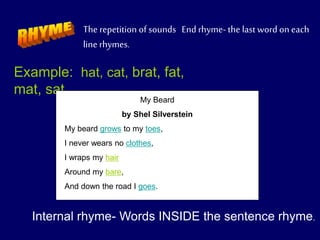
The repetition of sounds End rhyme- the last word on each
line rhymes.
Example: hat, cat, brat, fat,
mat, sat
My Beard
by Shel Silverstein
My beard grows to my toes,
I never wears no clothes,
I wraps my hair
Around my bare,
And down the road I goes.
Internal rhyme- Words INSIDE the sentence rhyme.
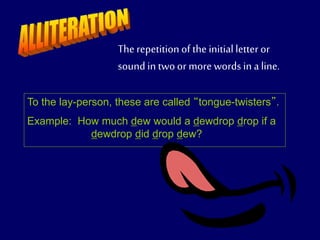
The repetitionof the initialletter or
sound in twoor more words in a line.
To the lay-person, these are called “tongue-twisters”.
Example: How much dew would a dewdrop drop if a
dewdrop did drop dew?
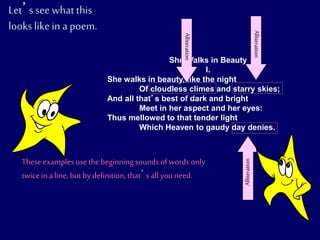
She Walks in Beauty
I.
She walks in beauty, like the night
Of cloudless climes and starry skies;
And all that’s best of dark and bright
Meet in her aspect and her eyes:
Thus mellowed to that tender light
Which Heaven to gaudy day denies.
Let’ssee what this
looks likein a poem.
Alliteration
Alliteration
Alliteration
These examplesuse the beginning sounds of words only
twice in a line, but by definition, that’s all you need.
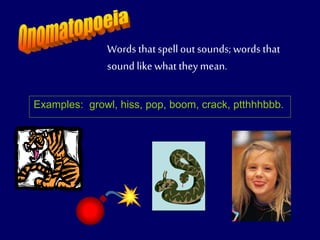
Words thatspell out sounds; words that
sound like what they mean.
Examples: growl, hiss, pop, boom, crack, ptthhhbbb.
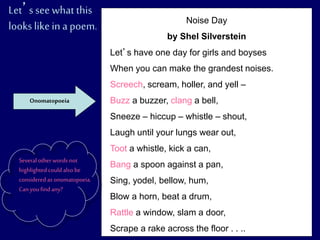
Let’ssee what this
looks likein a poem. Noise Day
by Shel Silverstein
Let’s have one day for girls and boyses
When you can make the grandest noises.
Screech, scream, holler, and yell –
Buzz a buzzer, clang a bell,
Sneeze – hiccup – whistle – shout,
Laugh until your lungs wear out,
Toot a whistle, kick a can,
Bang a spoon against a pan,
Sing, yodel, bellow, hum,
Blow a horn, beat a drum,
Rattle a window, slam a door,
Scrape a rake across the floor . . ..
Onomatopoeia
Several other words not
highlighted could also be
considered as onomatopoeia.
Canyoufind any?
A comparison between two
usually unrelated things using
the word “like” or “as”.
Examples:
Joe is as hungry as a bear.
In the morning, Rae is like an angry lion.
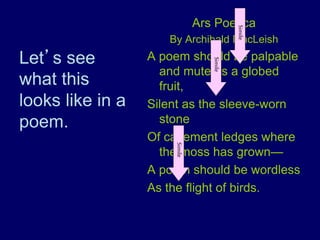
Ars Poetica
By Archibald MacLeish
A poem should be palpable
and mute as a globed
fruit,
Silent as the sleeve-worn
stone
Of casement ledges where
the moss has grown—
A poem should be wordless
As the flight of birds.
Let’s see
what this
looks like in a
poem.
Simile
Simile
Simile
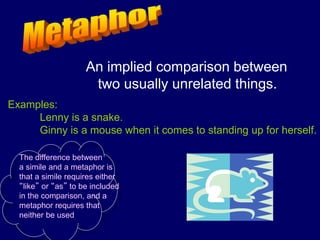
An implied comparison between
two usually unrelated things.
Examples:
Lenny is a snake.
Ginny is a mouse when it comes to standing up for herself.
The difference between
a simile and a metaphor is
that a simile requires either
“like” or “as” to be included
in the comparison, and a
metaphor requires that
neither be used.
When it comes to using a metaphor device in
poetry, a poet can either make the entire poem a
metaphor for something, or put little metaphors
throughout the poem.
• The following poem is one big metaphor.
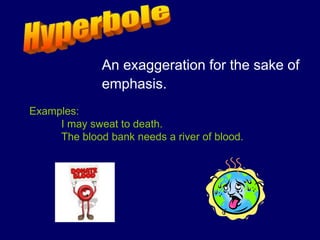
An exaggeration for the sake of
emphasis.
Examples:
I may sweat to death.
The blood bank needs a river of blood.
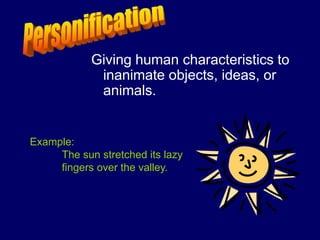
Giving human characteristics to
inanimate objects, ideas, or
animals.
Example:
The sun stretched its lazy
fingers over the valley.
What is Symbolism?
• A symbol is something that stands for itself,
but also something larger than itself.
–It may be a person, an animal, an inanimate
object, or an action
–. A writer often uses a concrete object to express an
abstract idea, a quality, or a belief.
– A symbol may appeal to a reader's emotions and can
provide a way to express an idea, communicate a
message, or clarify meaning
What is Symbolism?
–A writer often uses a concrete object
to express an abstract idea, a
quality, or a belief.
–A symbol may appeal to a reader's
emotions and can provide a way to
express an idea, communicate a
message, or clarify meaning.
Mother to Son by Langston Hughes
Well, son, I'll tell you:
Life for me ain't been no crystal stair.
It's had tacks in it,
And splinters,
And boards torn up,
And places with no carpet on the floor --
Bare.
But all the time
I'se been a-climbin' on,
And reachin' landin's,
And turnin' corners,
And sometimes goin' in the dark
Where there ain't been no light.
So boy, don't you turn back.
Don't you set down on the steps
'Cause you finds it's kinder hard.
Don't you fall now --
For I'se still goin', honey,
I'se still climbin',
And life for me ain't been no crystal stair.
Using words to create a picture
in the reader’s mind.
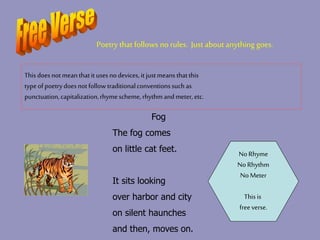
Poetry that follows norules. Just about anything goes.
This doesnotmean thatit usesnodevices, it justmeans thatthis
typeofpoetrydoesnotfollowtraditionalconventionssuch as
punctuation,capitalization,rhymescheme,rhythmandmeter,etc.
Fog
The fog comes
on little cat feet.
It sits looking
over harbor and city
on silent haunches
and then, moves on.
NoRhyme
NoRhythm
NoMeter
This is
freeverse.
A reference to another piece of literature orto history.
Example: “ShehathDian’swit” (fromRomeoandJuliet).
This isanallusiontoRomanmythologyandthe
goddess Diana.
The threemost commontypesofallusionreferto
mythology,the Bible,andShakespeare’swritings.
Rhythm is the flow of the
beat in a poem.
Gives poetry a musical feel.
Can be fast or slow,
depending on mood and
subject of poem.
You can measure rhythm in
meter, by counting the beats
in each line.
Rhythm
20
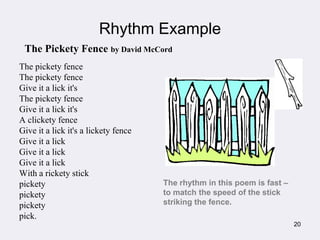
Rhythm Example
The pickety fence
The pickety fence
Give it a lick it's
The pickety fence
Give it a lick it's
A clickety fence
Give it a lick it's a lickety fence
Give it a lick
Give it a lick
Give it a lick
With a rickety stick
pickety
pickety
pickety
pick.
The Pickety Fence by David McCord
The rhythm in this poem is fast –
to match the speed of the stick
striking the fence.
21
Rhythm Example
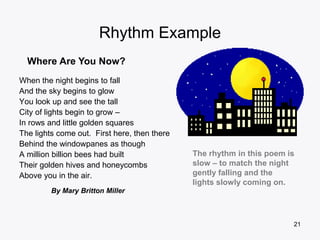
When the night begins to fall
And the sky begins to glow
You look up and see the tall
City of lights begin to grow –
In rows and little golden squares
The lights come out. First here, then there
Behind the windowpanes as though
A million billion bees had built
Their golden hives and honeycombs
Above you in the air.
By Mary Britton Miller
Where Are You Now?
The rhythm in this poem is
slow – to match the night
gently falling and the
lights slowly coming on.
22
Imagery
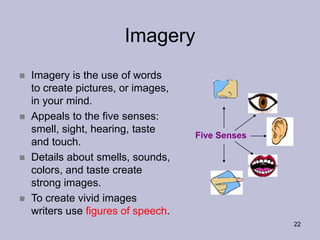
Five Senses
 Imagery is the use of words
to create pictures, or images,
in your mind.
 Appeals to the five senses:
smell, sight, hearing, taste
and touch.
 Details about smells, sounds,
colors, and taste create
strong images.
 To create vivid images
writers use figures of speech.
23
Lines and Stanzas
• Most poems are
written in lines.
• A group of lines in
a poem is called a
stanza.
• Stanzas separate
ideas in a poem.
They act like
paragraphs.
• This poem has two
stanzas.
March
A blue day
A blue jay
And a good beginning.
One crow,
Melting snow –
Spring’s winning!
By
Eleanor Farjeon
24
Free Verse
• A free verse poem
does not use rhyme or
patterns.
• Can vary freely in
length of lines,
stanzas, and subject.
Revenge
When I find out
who took
the last cooky
out of the jar
and left
me a bunch of
stale old messy
crumbs, I'm
going to take
me a handful
and crumb
up someone's bed.
By Myra Cohn Livingston
25
Mood
• Mood is the atmosphere, or
emotion, in the poem
created by the poet.
• Can be happy, angry, silly,
sad, excited, fearful or
thoughtful.
• Poet uses words and
images to create mood.
• Author’s purpose helps
determine mood.
• (See slides 65-72 for
examples.)
26
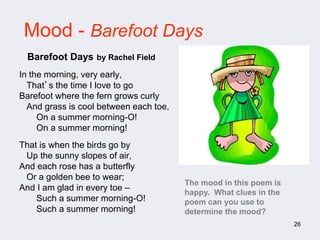
Mood - Barefoot Days
In the morning, very early,
That’s the time I love to go
Barefoot where the fern grows curly
And grass is cool between each toe,
On a summer morning-O!
On a summer morning!
That is when the birds go by
Up the sunny slopes of air,
And each rose has a butterfly
Or a golden bee to wear;
And I am glad in every toe –
Such a summer morning-O!
Such a summer morning!
Barefoot Days by Rachel Field
The mood in this poem is
happy. What clues in the
poem can you use to
determine the mood?
27
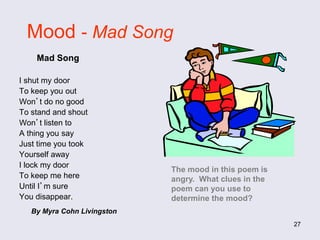
Mood - Mad Song
I shut my door
To keep you out
Won’t do no good
To stand and shout
Won’t listen to
A thing you say
Just time you took
Yourself away
I lock my door
To keep me here
Until I’m sure
You disappear.
By Myra Cohn Livingston
Mad Song
The mood in this poem is
angry. What clues in the
poem can you use to
determine the mood?
28
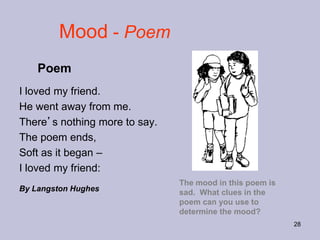
Mood - Poem
I loved my friend.
He went away from me.
There’s nothing more to say.
The poem ends,
Soft as it began –
I loved my friend:
By Langston Hughes
Poem
The mood in this poem is
sad. What clues in the
poem can you use to
determine the mood?
29
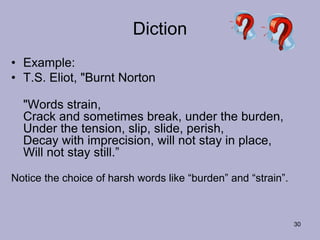
Diction
• Diction refers to the language of a poem, and how
each word is chosen to convey a precise meaning.
• Poets are very deliberate in choosing each word for
its particular effect,
• It's important to know the denotation and
connotations of the words in a poem, not to
mention their literal meaning, too.
30
Diction
• Example:
• T.S. Eliot, "Burnt Norton
"Words strain,
Crack and sometimes break, under the burden,
Under the tension, slip, slide, perish,
Decay with imprecision, will not stay in place,
Will not stay still.”
Notice the choice of harsh words like “burden” and “strain”.
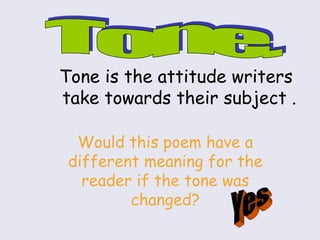
Tone is the attitude writers
take towards their subject .
Would this poem have a
different meaning for the
reader if the tone was
changed?
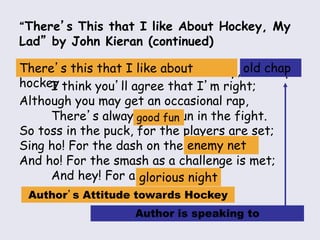
“There’s This that I like About Hockey, My
Lad” by John Kieran (continued)
There’s this that I like about hockey, old chap;
I think you’ll agree that I’m right;
Although you may get an occasional rap,
There’s always good fun in the fight.
So toss in the puck, for the players are set;
Sing ho! For the dash on the enemy net;
And ho! For the smash as a challenge is met;
And hey! For a glorious night!
There’s this that I like about
hockey
old chap
good fun
enemy net
glorious night
Author’s Attitude towards Hockey
Author is speaking to
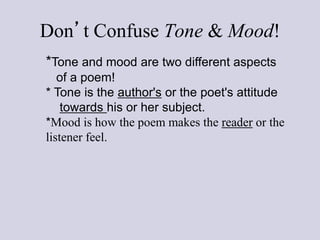
*Tone and mood are two different aspects
of a poem!
* Tone is the author's or the poet's attitude
towards his or her subject.
*Mood is how the poem makes the reader or the
listener feel.
Don’t Confuse Tone & Mood!
34
Reading for Meaning
• To find meaning in a poem, readers ask questions as they read. There
are many things to pay attention to when reading a poem:
Title – Provides clues about – topic, mood, speaker, author’s purpose?
Rhythm – Fast or slow? Why?
Sound Devices – What effects do they have?
Imagery – What pictures do we make in our minds?
Figures of Speech – What do they tell us about the subject?
Voice – Who is speaking - poet or character; one voice or more?
Author’s Purpose – Sending message, sharing feelings, telling story,
being funny, being descriptive?
Mood – Happy, sad, angry, thoughtful, silly, excited, frightened?
Plot – What is happening in the poem?
Remember, to make meaning, readers must make connections and tap
into their background knowledge and prior experiences as they read.

Poetry

  • 1.
  • 2.
    The repetition ofsounds End rhyme- the last word on each line rhymes. Example: hat, cat, brat, fat, mat, sat My Beard by Shel Silverstein My beard grows to my toes, I never wears no clothes, I wraps my hair Around my bare, And down the road I goes. Internal rhyme- Words INSIDE the sentence rhyme.
  • 3.
    The repetitionof theinitialletter or sound in twoor more words in a line. To the lay-person, these are called “tongue-twisters”. Example: How much dew would a dewdrop drop if a dewdrop did drop dew?
  • 4.
    She Walks inBeauty I. She walks in beauty, like the night Of cloudless climes and starry skies; And all that’s best of dark and bright Meet in her aspect and her eyes: Thus mellowed to that tender light Which Heaven to gaudy day denies. Let’ssee what this looks likein a poem. Alliteration Alliteration Alliteration These examplesuse the beginning sounds of words only twice in a line, but by definition, that’s all you need.
  • 5.
    Words thatspell outsounds; words that sound like what they mean. Examples: growl, hiss, pop, boom, crack, ptthhhbbb.
  • 6.
    Let’ssee what this lookslikein a poem. Noise Day by Shel Silverstein Let’s have one day for girls and boyses When you can make the grandest noises. Screech, scream, holler, and yell – Buzz a buzzer, clang a bell, Sneeze – hiccup – whistle – shout, Laugh until your lungs wear out, Toot a whistle, kick a can, Bang a spoon against a pan, Sing, yodel, bellow, hum, Blow a horn, beat a drum, Rattle a window, slam a door, Scrape a rake across the floor . . .. Onomatopoeia Several other words not highlighted could also be considered as onomatopoeia. Canyoufind any?
  • 7.
    A comparison betweentwo usually unrelated things using the word “like” or “as”. Examples: Joe is as hungry as a bear. In the morning, Rae is like an angry lion.
  • 8.
    Ars Poetica By ArchibaldMacLeish A poem should be palpable and mute as a globed fruit, Silent as the sleeve-worn stone Of casement ledges where the moss has grown— A poem should be wordless As the flight of birds. Let’s see what this looks like in a poem. Simile Simile Simile
  • 9.
    An implied comparisonbetween two usually unrelated things. Examples: Lenny is a snake. Ginny is a mouse when it comes to standing up for herself. The difference between a simile and a metaphor is that a simile requires either “like” or “as” to be included in the comparison, and a metaphor requires that neither be used.
  • 10.
    When it comesto using a metaphor device in poetry, a poet can either make the entire poem a metaphor for something, or put little metaphors throughout the poem. • The following poem is one big metaphor.
  • 11.
    An exaggeration forthe sake of emphasis. Examples: I may sweat to death. The blood bank needs a river of blood.
  • 12.
    Giving human characteristicsto inanimate objects, ideas, or animals. Example: The sun stretched its lazy fingers over the valley.
  • 13.
    What is Symbolism? •A symbol is something that stands for itself, but also something larger than itself. –It may be a person, an animal, an inanimate object, or an action –. A writer often uses a concrete object to express an abstract idea, a quality, or a belief. – A symbol may appeal to a reader's emotions and can provide a way to express an idea, communicate a message, or clarify meaning
  • 14.
    What is Symbolism? –Awriter often uses a concrete object to express an abstract idea, a quality, or a belief. –A symbol may appeal to a reader's emotions and can provide a way to express an idea, communicate a message, or clarify meaning.
  • 15.
    Mother to Sonby Langston Hughes Well, son, I'll tell you: Life for me ain't been no crystal stair. It's had tacks in it, And splinters, And boards torn up, And places with no carpet on the floor -- Bare. But all the time I'se been a-climbin' on, And reachin' landin's, And turnin' corners, And sometimes goin' in the dark Where there ain't been no light. So boy, don't you turn back. Don't you set down on the steps 'Cause you finds it's kinder hard. Don't you fall now -- For I'se still goin', honey, I'se still climbin', And life for me ain't been no crystal stair.
  • 16.
    Using words tocreate a picture in the reader’s mind.
  • 17.
    Poetry that followsnorules. Just about anything goes. This doesnotmean thatit usesnodevices, it justmeans thatthis typeofpoetrydoesnotfollowtraditionalconventionssuch as punctuation,capitalization,rhymescheme,rhythmandmeter,etc. Fog The fog comes on little cat feet. It sits looking over harbor and city on silent haunches and then, moves on. NoRhyme NoRhythm NoMeter This is freeverse.
  • 18.
    A reference toanother piece of literature orto history. Example: “ShehathDian’swit” (fromRomeoandJuliet). This isanallusiontoRomanmythologyandthe goddess Diana. The threemost commontypesofallusionreferto mythology,the Bible,andShakespeare’swritings.
  • 19.
    Rhythm is theflow of the beat in a poem. Gives poetry a musical feel. Can be fast or slow, depending on mood and subject of poem. You can measure rhythm in meter, by counting the beats in each line. Rhythm
  • 20.
    20 Rhythm Example The picketyfence The pickety fence Give it a lick it's The pickety fence Give it a lick it's A clickety fence Give it a lick it's a lickety fence Give it a lick Give it a lick Give it a lick With a rickety stick pickety pickety pickety pick. The Pickety Fence by David McCord The rhythm in this poem is fast – to match the speed of the stick striking the fence.
  • 21.
    21 Rhythm Example When thenight begins to fall And the sky begins to glow You look up and see the tall City of lights begin to grow – In rows and little golden squares The lights come out. First here, then there Behind the windowpanes as though A million billion bees had built Their golden hives and honeycombs Above you in the air. By Mary Britton Miller Where Are You Now? The rhythm in this poem is slow – to match the night gently falling and the lights slowly coming on.
  • 22.
    22 Imagery Five Senses  Imageryis the use of words to create pictures, or images, in your mind.  Appeals to the five senses: smell, sight, hearing, taste and touch.  Details about smells, sounds, colors, and taste create strong images.  To create vivid images writers use figures of speech.
  • 23.
    23 Lines and Stanzas •Most poems are written in lines. • A group of lines in a poem is called a stanza. • Stanzas separate ideas in a poem. They act like paragraphs. • This poem has two stanzas. March A blue day A blue jay And a good beginning. One crow, Melting snow – Spring’s winning! By Eleanor Farjeon
  • 24.
    24 Free Verse • Afree verse poem does not use rhyme or patterns. • Can vary freely in length of lines, stanzas, and subject. Revenge When I find out who took the last cooky out of the jar and left me a bunch of stale old messy crumbs, I'm going to take me a handful and crumb up someone's bed. By Myra Cohn Livingston
  • 25.
    25 Mood • Mood isthe atmosphere, or emotion, in the poem created by the poet. • Can be happy, angry, silly, sad, excited, fearful or thoughtful. • Poet uses words and images to create mood. • Author’s purpose helps determine mood. • (See slides 65-72 for examples.)
  • 26.
    26 Mood - BarefootDays In the morning, very early, That’s the time I love to go Barefoot where the fern grows curly And grass is cool between each toe, On a summer morning-O! On a summer morning! That is when the birds go by Up the sunny slopes of air, And each rose has a butterfly Or a golden bee to wear; And I am glad in every toe – Such a summer morning-O! Such a summer morning! Barefoot Days by Rachel Field The mood in this poem is happy. What clues in the poem can you use to determine the mood?
  • 27.
    27 Mood - MadSong I shut my door To keep you out Won’t do no good To stand and shout Won’t listen to A thing you say Just time you took Yourself away I lock my door To keep me here Until I’m sure You disappear. By Myra Cohn Livingston Mad Song The mood in this poem is angry. What clues in the poem can you use to determine the mood?
  • 28.
    28 Mood - Poem Iloved my friend. He went away from me. There’s nothing more to say. The poem ends, Soft as it began – I loved my friend: By Langston Hughes Poem The mood in this poem is sad. What clues in the poem can you use to determine the mood?
  • 29.
    29 Diction • Diction refersto the language of a poem, and how each word is chosen to convey a precise meaning. • Poets are very deliberate in choosing each word for its particular effect, • It's important to know the denotation and connotations of the words in a poem, not to mention their literal meaning, too.
  • 30.
    30 Diction • Example: • T.S.Eliot, "Burnt Norton "Words strain, Crack and sometimes break, under the burden, Under the tension, slip, slide, perish, Decay with imprecision, will not stay in place, Will not stay still.” Notice the choice of harsh words like “burden” and “strain”.
  • 31.
    Tone is theattitude writers take towards their subject . Would this poem have a different meaning for the reader if the tone was changed?
  • 32.
    “There’s This thatI like About Hockey, My Lad” by John Kieran (continued) There’s this that I like about hockey, old chap; I think you’ll agree that I’m right; Although you may get an occasional rap, There’s always good fun in the fight. So toss in the puck, for the players are set; Sing ho! For the dash on the enemy net; And ho! For the smash as a challenge is met; And hey! For a glorious night! There’s this that I like about hockey old chap good fun enemy net glorious night Author’s Attitude towards Hockey Author is speaking to
  • 33.
    *Tone and moodare two different aspects of a poem! * Tone is the author's or the poet's attitude towards his or her subject. *Mood is how the poem makes the reader or the listener feel. Don’t Confuse Tone & Mood!
  • 34.
    34 Reading for Meaning •To find meaning in a poem, readers ask questions as they read. There are many things to pay attention to when reading a poem: Title – Provides clues about – topic, mood, speaker, author’s purpose? Rhythm – Fast or slow? Why? Sound Devices – What effects do they have? Imagery – What pictures do we make in our minds? Figures of Speech – What do they tell us about the subject? Voice – Who is speaking - poet or character; one voice or more? Author’s Purpose – Sending message, sharing feelings, telling story, being funny, being descriptive? Mood – Happy, sad, angry, thoughtful, silly, excited, frightened? Plot – What is happening in the poem? Remember, to make meaning, readers must make connections and tap into their background knowledge and prior experiences as they read.