Presented by: Ehlie Rose G. Baguinaon
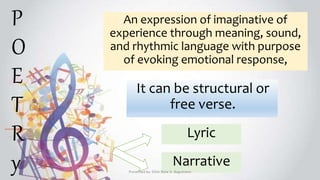
An expression of imaginative of
experience through meaning, sound,
and rhythmic language with purpose
of evoking emotional response,
P
O
E
T
R
y
It can be structural or
free verse.
It can be structural or
free verse.
Lyric
Narrative
Presented by: Ehlie Rose G. Baguinaon
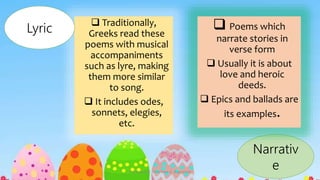
 Traditionally,
Greeks read these
poems with musical
accompaniments
such as lyre, making
them more similar
to song.
 It includes odes,
sonnets, elegies,
etc.
Lyric
Narrativ
e
 Poems which
narrate stories in
verse form
 Usually it is about
love and heroic
deeds.
 Epics and ballads are
its examples.
Presented by: Ehlie Rose G. Baguinaon
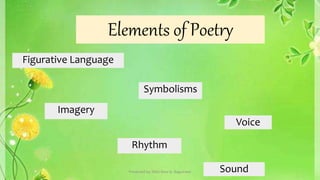
Elements of Poetry
Voice
Figurative Language
Imagery
Symbolisms
Sound
Rhythm
Presented by: Ehlie Rose G. Baguinaon
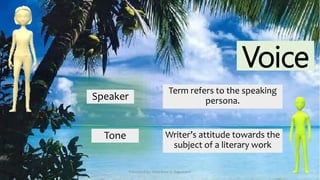
Voice
Speaker
Term refers to the speaking
persona.
Tone Writer’s attitude towards the
subject of a literary work
Presented by: Ehlie Rose G. Baguinaon
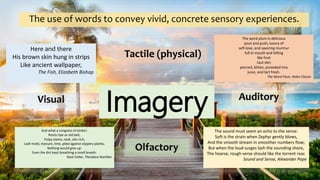
Imagery
The use of words to convey vivid, concrete sensory experiences.
Visual Auditory
Olfactory
Tactile (physical)
Here and there
His brown skin hung in strips
Like ancient wallpaper,
The Fish, Elizabeth Bishop
The sound must seem an echo to the sense:
Soft is the strain when Zephyr gently blows,
And the smooth stream in smoother numbers flow;
But when the loud surges lash the sounding shore,
The hoarse, rough verse should like the torrent roar.
Sound and Sense, Alexander Pope
And what a congress of stinks!-
Roots ripe as old bait,
Pulpy stems, rank, silo-rich,
Leaf-mold, manure, lime, piled against slippery planks.
Nothing would give up:
Even the dirt kept breathing a small breath.
Root Cellar, Theodore Roethke
The word plum is delicious
pout and push, luxury of
self-love, and savoring murmur
full in mouth and falling
like fruit
taut skin
pierced, bitten, provoked into
juice, and tart fresh.
The Word Plum, Helen Chasin
Presented by: Ehlie Rose G. Baguinaon
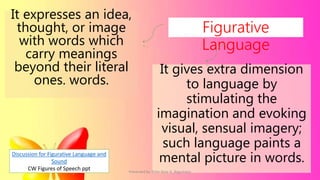
It gives extra dimension
to language by
stimulating the
imagination and evoking
visual, sensual imagery;
such language paints a
mental picture in words.
It expresses an idea,
thought, or image
with words which
carry meanings
beyond their literal
ones. words.
Figurative
Language
Discussion for Figurative Language and
Sound
CW Figures of Speech ppt Presented by: Ehlie Rose G. Baguinaon
Sound
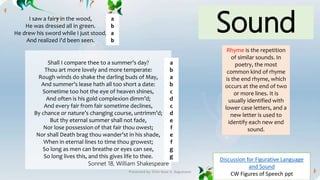
Rhyme is the repetition
of similar sounds. In
poetry, the most
common kind of rhyme
is the end rhyme, which
occurs at the end of two
or more lines. It is
usually identified with
lower case letters, and a
new letter is used to
identify each new end
sound.
I saw a fairy in the wood,
He was dressed all in green.
He drew his sword while I just stood,
And realized I'd been seen.
a
b
a
b
Shall I compare thee to a summer’s day?
Thou art more lovely and more temperate:
Rough winds do shake the darling buds of May,
And summer’s lease hath all too short a date:
Sometime too hot the eye of heaven shines,
And often is his gold complexion dimm’d;
And every fair from fair sometime declines,
By chance or nature’s changing course, untrimm’d;
But thy eternal summer shall not fade,
Nor lose possession of that fair thou owest;
Nor shall Death brag thou wander’st in his shade,
When in eternal lines to time thou growest;
So long as men can breathe or eyes can see,
So long lives this, and this gives life to thee.
Sonnet 18, William Shakespeare
a
b
a
b
c
d
c
d
e
f
e
f
g
g
Discussion for Figurative Language
and Sound
CW Figures of Speech pptPresented by: Ehlie Rose G. Baguinaon
R
h
y
t
h
m
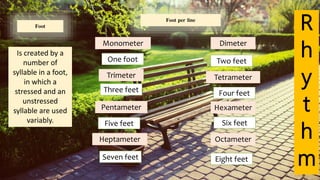
Monometer
Tetrameter
Hexameter
Heptameter
Trimeter
Octameter
Pentameter
Dimeter
One foot
Five feet
Two feet
Three feet Four feet
Eight feet
Six feet
Seven feet
Foot per line
Is created by a
number of
syllable in a foot,
in which a
stressed and an
unstressed
syllable are used
variably.
Foot
Presented by: Ehlie Rose G. Baguinaon
R
h
y
t
h
m
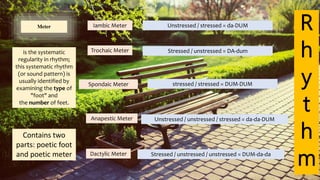
Iambic Meter
Spondaic Meter
Anapestic Meter
Dactylic Meter
Trochaic Meter
Unstressed / stressed = da-DUM
Stressed / unstressed = DA-dum
stressed / stressed = DUM-DUM
Unstressed / unstressed / stressed = da-da-DUM
Stressed / unstressed / unstressed = DUM-da-da
is the systematic
regularity in rhythm;
this systematic rhythm
(or sound pattern) is
usually identified by
examining the type of
"foot" and
the number of feet.
Meter
Contains two
parts: poetic foot
and poetic meter
Presented by: Ehlie Rose G. Baguinaon
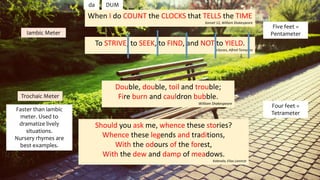
Iambic Meter
Trochaic Meter
When I do COUNT the CLOCKS that TELLS the TIME
Sonnet 12, William Shakespeare
To STRIVE, to SEEK, to FIND, and NOT to YIELD.
Ulysses, Alfred Tennyson
da DUM
Five feet =
Pentameter
Double, double, toil and trouble;
Fire burn and cauldron bubble.
William Shakespeare
Should you ask me, whence these stories?
Whence these legends and traditions,
With the odours of the forest,
With the dew and damp of meadows.
Kalevala, Elias Lonnrot
Four feet =
Tetrameter
Faster than iambic
meter. Used to
dramatize lively
situations.
Nursery rhymes are
best examples.
Presented by: Ehlie Rose G. Baguinaon
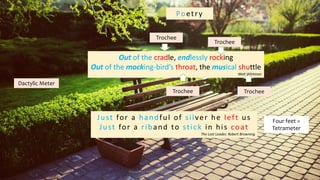
Dactylic Meter
Poetry
Out of the cradle, endlessly rocking
Out of the mocking-bird’s throat, the musical shuttle
Walt Whitman
Trochee
Trochee
TrocheeTrochee
Just for a handful of silver he left us
Just for a riband to stick in his coat
The Lost Leader, Robert Browning
Four feet =
Tetrameter
Presented by: Ehlie Rose G. Baguinaon
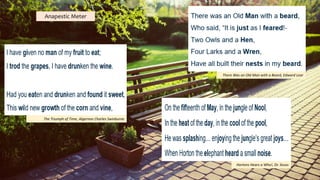
Anapestic Meter
Hortons Hears a Who!, Dr. Seuss
There Was an Old Man with a Beard, Edward Lear
The Triumph of Time, Algernon Charles Swinburne
Presented by: Ehlie Rose G. Baguinaon
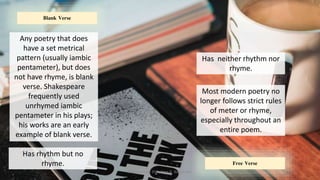
Free Verse
Blank Verse
Any poetry that does
have a set metrical
pattern (usually iambic
pentameter), but does
not have rhyme, is blank
verse. Shakespeare
frequently used
unrhymed iambic
pentameter in his plays;
his works are an early
example of blank verse.
Most modern poetry no
longer follows strict rules
of meter or rhyme,
especially throughout an
entire poem.
Has rhythm but no
rhyme.
Has neither rhythm nor
rhyme.
Presented by: Ehlie Rose G. Baguinaon
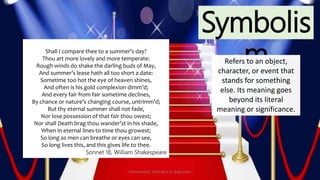
Symbolis
mRefers to an object,
character, or event that
stands for something
else. Its meaning goes
beyond its literal
meaning or significance.
Shall I compare thee to a summer’s day?
Thou art more lovely and more temperate:
Rough winds do shake the darling buds of May,
And summer’s lease hath all too short a date:
Sometime too hot the eye of heaven shines,
And often is his gold complexion dimm’d;
And every fair from fair sometime declines,
By chance or nature’s changing course, untrimm’d;
But thy eternal summer shall not fade,
Nor lose possession of that fair thou owest;
Nor shall Death brag thou wander’st in his shade,
When in eternal lines to time thou growest;
So long as men can breathe or eyes can see,
So long lives this, and this gives life to thee.
Sonnet 18, William Shakespeare
Presented by: Ehlie Rose G. Baguinaon
Forms of Conventional Poetry
Presented by: Ehlie Rose G. Baguinaon
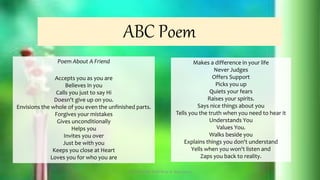
ABC Poem
Poem About A Friend
Accepts you as you are
Believes in you
Calls you just to say Hi
Doesn't give up on you.
Envisions the whole of you even the unfinished parts.
Forgives your mistakes
Gives unconditionally
Helps you
Invites you over
Just be with you
Keeps you close at Heart
Loves you for who you are
Makes a difference in your life
Never Judges
Offers Support
Picks you up
Quiets your fears
Raises your spirits.
Says nice things about you
Tells you the truth when you need to hear it
Understands You
Values You.
Walks beside you
Explains things you don't understand
Yells when you won't listen and
Zaps you back to reality.
Presented by: Ehlie Rose G. Baguinaon
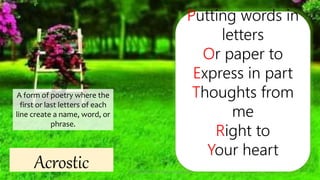
Acrostic
Putting words in
letters
Or paper to
Express in part
Thoughts from
me
Right to
Your heart
A form of poetry where the
first or last letters of each
line create a name, word, or
phrase.
Presented by: Ehlie Rose G. Baguinaon
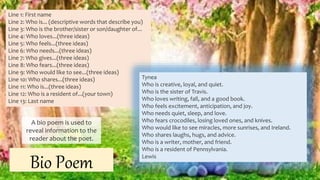
A bio poem is used to
reveal information to the
reader about the poet.
Bio Poem
Line 1: First name
Line 2: Who is... (descriptive words that describe you)
Line 3: Who is the brother/sister or son/daughter of...
Line 4: Who loves...(three ideas)
Line 5: Who feels...(three ideas)
Line 6: Who needs...(three ideas)
Line 7: Who gives...(three ideas)
Line 8: Who fears...(three ideas)
Line 9: Who would like to see...(three ideas)
Line 10: Who shares...(three ideas)
Line 11: Who is...(three ideas)
Line 12: Who is a resident of...(your town)
Line 13: Last name
Tynea
Who is creative, loyal, and quiet.
Who is the sister of Travis.
Who loves writing, fall, and a good book.
Who feels excitement, anticipation, and joy.
Who needs quiet, sleep, and love.
Who fears crocodiles, losing loved ones, and knives.
Who would like to see miracles, more sunrises, and Ireland.
Who shares laughs, hugs, and advice.
Who is a writer, mother, and friend.
Who is a resident of Pennsylvania.
Lewis
Presented by: Ehlie Rose G. Baguinaon
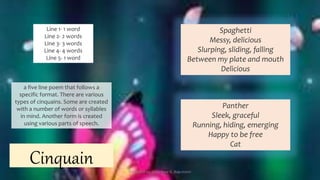
a five line poem that follows a
specific format. There are various
types of cinquains. Some are created
with a number of words or syllables
in mind. Another form is created
using various parts of speech.
Cinquain
Line 1- 1 word
Line 2- 2 words
Line 3- 3 words
Line 4- 4 words
Line 5- 1 word
Spaghetti
Messy, delicious
Slurping, sliding, falling
Between my plate and mouth
Delicious
Panther
Sleek, graceful
Running, hiding, emerging
Happy to be free
Cat
Presented by: Ehlie Rose G. Baguinaon
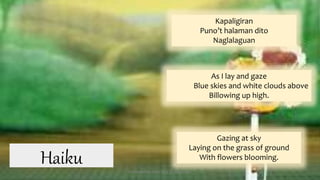
As I lay and gaze
Blue skies and white clouds above
Billowing up high.
Gazing at sky
Laying on the grass of ground
With flowers blooming.
Kapaligiran
Puno’t halaman dito
Naglalaguan
Haiku Presented by: Ehlie Rose G. Baguinaon
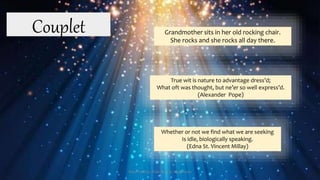
True wit is nature to advantage dress’d;
What oft was thought, but ne’er so well express’d.
(Alexander Pope)
Couplet Grandmother sits in her old rocking chair.
She rocks and she rocks all day there.
Whether or not we find what we are seeking
Is idle, biologically speaking.
(Edna St. Vincent Millay)
Presented by: Ehlie Rose G. Baguinaon
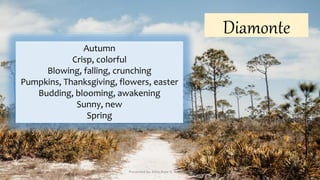
Diamonte
Autumn
Crisp, colorful
Blowing, falling, crunching
Pumpkins, Thanksgiving, flowers, easter
Budding, blooming, awakening
Sunny, new
Spring
Presented by: Ehlie Rose G. Baguinaon
Prepared by:
Ehlie Rose G. Baguinaon
All background pictures
and lessons are not mine.
Credits to all of the owners
and writers.
The quiz and activity for this lesson is file named as CW
Poetry Quiz and Activity. Check this out.
Presented by: Ehlie Rose G. Baguinaon

Poetry Types and Elements, Creative Writing Lesson

  • 1.
    Presented by: EhlieRose G. Baguinaon
  • 2.
    An expression ofimaginative of experience through meaning, sound, and rhythmic language with purpose of evoking emotional response, P O E T R y It can be structural or free verse. It can be structural or free verse. Lyric Narrative Presented by: Ehlie Rose G. Baguinaon
  • 3.
     Traditionally, Greeks readthese poems with musical accompaniments such as lyre, making them more similar to song.  It includes odes, sonnets, elegies, etc. Lyric Narrativ e  Poems which narrate stories in verse form  Usually it is about love and heroic deeds.  Epics and ballads are its examples. Presented by: Ehlie Rose G. Baguinaon
  • 4.
    Elements of Poetry Voice FigurativeLanguage Imagery Symbolisms Sound Rhythm Presented by: Ehlie Rose G. Baguinaon
  • 5.
    Voice Speaker Term refers tothe speaking persona. Tone Writer’s attitude towards the subject of a literary work Presented by: Ehlie Rose G. Baguinaon
  • 6.
    Imagery The use ofwords to convey vivid, concrete sensory experiences. Visual Auditory Olfactory Tactile (physical) Here and there His brown skin hung in strips Like ancient wallpaper, The Fish, Elizabeth Bishop The sound must seem an echo to the sense: Soft is the strain when Zephyr gently blows, And the smooth stream in smoother numbers flow; But when the loud surges lash the sounding shore, The hoarse, rough verse should like the torrent roar. Sound and Sense, Alexander Pope And what a congress of stinks!- Roots ripe as old bait, Pulpy stems, rank, silo-rich, Leaf-mold, manure, lime, piled against slippery planks. Nothing would give up: Even the dirt kept breathing a small breath. Root Cellar, Theodore Roethke The word plum is delicious pout and push, luxury of self-love, and savoring murmur full in mouth and falling like fruit taut skin pierced, bitten, provoked into juice, and tart fresh. The Word Plum, Helen Chasin Presented by: Ehlie Rose G. Baguinaon
  • 7.
    It gives extradimension to language by stimulating the imagination and evoking visual, sensual imagery; such language paints a mental picture in words. It expresses an idea, thought, or image with words which carry meanings beyond their literal ones. words. Figurative Language Discussion for Figurative Language and Sound CW Figures of Speech ppt Presented by: Ehlie Rose G. Baguinaon
  • 8.
    Sound Rhyme is therepetition of similar sounds. In poetry, the most common kind of rhyme is the end rhyme, which occurs at the end of two or more lines. It is usually identified with lower case letters, and a new letter is used to identify each new end sound. I saw a fairy in the wood, He was dressed all in green. He drew his sword while I just stood, And realized I'd been seen. a b a b Shall I compare thee to a summer’s day? Thou art more lovely and more temperate: Rough winds do shake the darling buds of May, And summer’s lease hath all too short a date: Sometime too hot the eye of heaven shines, And often is his gold complexion dimm’d; And every fair from fair sometime declines, By chance or nature’s changing course, untrimm’d; But thy eternal summer shall not fade, Nor lose possession of that fair thou owest; Nor shall Death brag thou wander’st in his shade, When in eternal lines to time thou growest; So long as men can breathe or eyes can see, So long lives this, and this gives life to thee. Sonnet 18, William Shakespeare a b a b c d c d e f e f g g Discussion for Figurative Language and Sound CW Figures of Speech pptPresented by: Ehlie Rose G. Baguinaon
  • 9.
    R h y t h m Monometer Tetrameter Hexameter Heptameter Trimeter Octameter Pentameter Dimeter One foot Five feet Twofeet Three feet Four feet Eight feet Six feet Seven feet Foot per line Is created by a number of syllable in a foot, in which a stressed and an unstressed syllable are used variably. Foot Presented by: Ehlie Rose G. Baguinaon
  • 10.
    R h y t h m Iambic Meter Spondaic Meter AnapesticMeter Dactylic Meter Trochaic Meter Unstressed / stressed = da-DUM Stressed / unstressed = DA-dum stressed / stressed = DUM-DUM Unstressed / unstressed / stressed = da-da-DUM Stressed / unstressed / unstressed = DUM-da-da is the systematic regularity in rhythm; this systematic rhythm (or sound pattern) is usually identified by examining the type of "foot" and the number of feet. Meter Contains two parts: poetic foot and poetic meter Presented by: Ehlie Rose G. Baguinaon
  • 11.
    Iambic Meter Trochaic Meter WhenI do COUNT the CLOCKS that TELLS the TIME Sonnet 12, William Shakespeare To STRIVE, to SEEK, to FIND, and NOT to YIELD. Ulysses, Alfred Tennyson da DUM Five feet = Pentameter Double, double, toil and trouble; Fire burn and cauldron bubble. William Shakespeare Should you ask me, whence these stories? Whence these legends and traditions, With the odours of the forest, With the dew and damp of meadows. Kalevala, Elias Lonnrot Four feet = Tetrameter Faster than iambic meter. Used to dramatize lively situations. Nursery rhymes are best examples. Presented by: Ehlie Rose G. Baguinaon
  • 12.
    Dactylic Meter Poetry Out ofthe cradle, endlessly rocking Out of the mocking-bird’s throat, the musical shuttle Walt Whitman Trochee Trochee TrocheeTrochee Just for a handful of silver he left us Just for a riband to stick in his coat The Lost Leader, Robert Browning Four feet = Tetrameter Presented by: Ehlie Rose G. Baguinaon
  • 13.
    Anapestic Meter Hortons Hearsa Who!, Dr. Seuss There Was an Old Man with a Beard, Edward Lear The Triumph of Time, Algernon Charles Swinburne Presented by: Ehlie Rose G. Baguinaon
  • 14.
    Free Verse Blank Verse Anypoetry that does have a set metrical pattern (usually iambic pentameter), but does not have rhyme, is blank verse. Shakespeare frequently used unrhymed iambic pentameter in his plays; his works are an early example of blank verse. Most modern poetry no longer follows strict rules of meter or rhyme, especially throughout an entire poem. Has rhythm but no rhyme. Has neither rhythm nor rhyme. Presented by: Ehlie Rose G. Baguinaon
  • 15.
    Symbolis mRefers to anobject, character, or event that stands for something else. Its meaning goes beyond its literal meaning or significance. Shall I compare thee to a summer’s day? Thou art more lovely and more temperate: Rough winds do shake the darling buds of May, And summer’s lease hath all too short a date: Sometime too hot the eye of heaven shines, And often is his gold complexion dimm’d; And every fair from fair sometime declines, By chance or nature’s changing course, untrimm’d; But thy eternal summer shall not fade, Nor lose possession of that fair thou owest; Nor shall Death brag thou wander’st in his shade, When in eternal lines to time thou growest; So long as men can breathe or eyes can see, So long lives this, and this gives life to thee. Sonnet 18, William Shakespeare Presented by: Ehlie Rose G. Baguinaon
  • 16.
    Forms of ConventionalPoetry Presented by: Ehlie Rose G. Baguinaon
  • 17.
    ABC Poem Poem AboutA Friend Accepts you as you are Believes in you Calls you just to say Hi Doesn't give up on you. Envisions the whole of you even the unfinished parts. Forgives your mistakes Gives unconditionally Helps you Invites you over Just be with you Keeps you close at Heart Loves you for who you are Makes a difference in your life Never Judges Offers Support Picks you up Quiets your fears Raises your spirits. Says nice things about you Tells you the truth when you need to hear it Understands You Values You. Walks beside you Explains things you don't understand Yells when you won't listen and Zaps you back to reality. Presented by: Ehlie Rose G. Baguinaon
  • 18.
    Acrostic Putting words in letters Orpaper to Express in part Thoughts from me Right to Your heart A form of poetry where the first or last letters of each line create a name, word, or phrase. Presented by: Ehlie Rose G. Baguinaon
  • 19.
    A bio poemis used to reveal information to the reader about the poet. Bio Poem Line 1: First name Line 2: Who is... (descriptive words that describe you) Line 3: Who is the brother/sister or son/daughter of... Line 4: Who loves...(three ideas) Line 5: Who feels...(three ideas) Line 6: Who needs...(three ideas) Line 7: Who gives...(three ideas) Line 8: Who fears...(three ideas) Line 9: Who would like to see...(three ideas) Line 10: Who shares...(three ideas) Line 11: Who is...(three ideas) Line 12: Who is a resident of...(your town) Line 13: Last name Tynea Who is creative, loyal, and quiet. Who is the sister of Travis. Who loves writing, fall, and a good book. Who feels excitement, anticipation, and joy. Who needs quiet, sleep, and love. Who fears crocodiles, losing loved ones, and knives. Who would like to see miracles, more sunrises, and Ireland. Who shares laughs, hugs, and advice. Who is a writer, mother, and friend. Who is a resident of Pennsylvania. Lewis Presented by: Ehlie Rose G. Baguinaon
  • 20.
    a five linepoem that follows a specific format. There are various types of cinquains. Some are created with a number of words or syllables in mind. Another form is created using various parts of speech. Cinquain Line 1- 1 word Line 2- 2 words Line 3- 3 words Line 4- 4 words Line 5- 1 word Spaghetti Messy, delicious Slurping, sliding, falling Between my plate and mouth Delicious Panther Sleek, graceful Running, hiding, emerging Happy to be free Cat Presented by: Ehlie Rose G. Baguinaon
  • 21.
    As I layand gaze Blue skies and white clouds above Billowing up high. Gazing at sky Laying on the grass of ground With flowers blooming. Kapaligiran Puno’t halaman dito Naglalaguan Haiku Presented by: Ehlie Rose G. Baguinaon
  • 22.
    True wit isnature to advantage dress’d; What oft was thought, but ne’er so well express’d. (Alexander Pope) Couplet Grandmother sits in her old rocking chair. She rocks and she rocks all day there. Whether or not we find what we are seeking Is idle, biologically speaking. (Edna St. Vincent Millay) Presented by: Ehlie Rose G. Baguinaon
  • 23.
    Diamonte Autumn Crisp, colorful Blowing, falling,crunching Pumpkins, Thanksgiving, flowers, easter Budding, blooming, awakening Sunny, new Spring Presented by: Ehlie Rose G. Baguinaon
  • 24.
    Prepared by: Ehlie RoseG. Baguinaon All background pictures and lessons are not mine. Credits to all of the owners and writers. The quiz and activity for this lesson is file named as CW Poetry Quiz and Activity. Check this out. Presented by: Ehlie Rose G. Baguinaon