Dielectric Properties Measurement
by ImpedanceAnalyzer.
Submitted by-
Jahid Hasan Kasem
Introduction
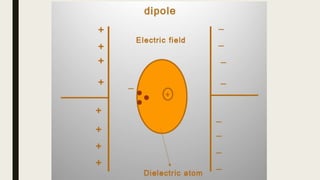
■ Dielectrics are the materials having electric dipole moment
permantly
■ Dipole: A dipole is an entity in which equal positive and negative
charges are separated by a small distance.
DIPOLE moment
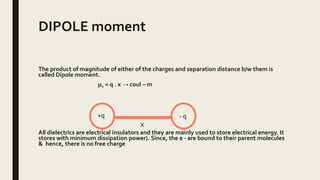
The product of magnitude of either of the charges and separation distance b/w them is
called Dipole moment.
μe = q . x → coul – m
All dielectrics are electrical insulators and they are mainly used to store electrical energy. It
stores with minimum dissipation power). Since, the e - are bound to their parent molecules
& hence, there is no free charge
+q - q
X
Dielectric parameter
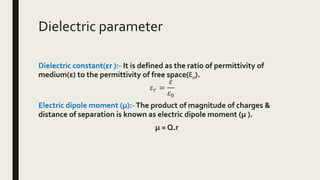
Dielectric constant(εr ):- It is defined as the ratio of permittivity of
medium(ε) to the permittivity of free space(Ɛ0).
𝜀 𝑟 =
𝜀
𝜀0
Electric dipole moment (μ):-The product of magnitude of charges &
distance of separation is known as electric dipole moment (μ ).
μ = Q.r
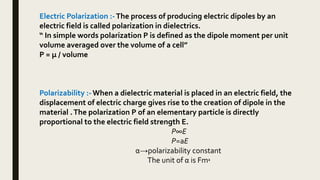
Electric Polarization :-The process of producing electric dipoles by an
electric field is called polarization in dielectrics.
“ In simple words polarization P is defined as the dipole moment per unit
volume averaged over the volume of a cell”
P = μ / volume
Polarizability :-When a dielectric material is placed in an electric field, the
displacement of electric charge gives rise to the creation of dipole in the
material .The polarization P of an elementary particle is directly
proportional to the electric field strength E.
P∞E
P=aE
α→polarizability constant
The unit of α is Fm2
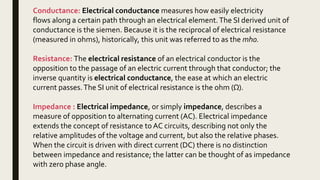
Conductance: Electrical conductance measures how easily electricity
flows along a certain path through an electrical element.The SI derived unit of
conductance is the siemen. Because it is the reciprocal of electrical resistance
(measured in ohms), historically, this unit was referred to as the mho.
Resistance: The electrical resistance of an electrical conductor is the
opposition to the passage of an electric current through that conductor; the
inverse quantity is electrical conductance, the ease at which an electric
current passes.The SI unit of electrical resistance is the ohm (Ω).
Impedance : Electrical impedance, or simply impedance, describes a
measure of opposition to alternating current (AC). Electrical impedance
extends the concept of resistance to AC circuits, describing not only the
relative amplitudes of the voltage and current, but also the relative phases.
When the circuit is driven with direct current (DC) there is no distinction
between impedance and resistance; the latter can be thought of as impedance
with zero phase angle.
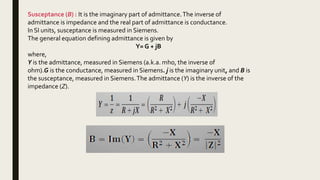
Susceptance (B) : It is the imaginary part of admittance.The inverse of
admittance is impedance and the real part of admittance is conductance.
In SI units, susceptance is measured in Siemens.
The general equation defining admittance is given by
Y= G + jB
where,
Y is the admittance, measured in Siemens (a.k.a. mho, the inverse of
ohm).G is the conductance, measured in Siemens. j is the imaginary unit, and B is
the susceptance, measured in Siemens.The admittance (Y) is the inverse of the
impedance (Z).
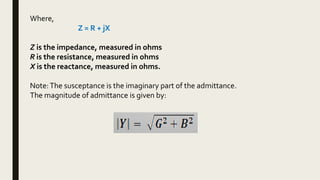
Where,
Z = R + jX
Z is the impedance, measured in ohms
R is the resistance, measured in ohms
X is the reactance, measured in ohms.
Note:The susceptance is the imaginary part of the admittance.
The magnitude of admittance is given by:
Properties of Good Dielectric Material
■ It should have high resistivity to reduce the leakage current.
■ It should have high dielectric strength.
■ It should have high mechanical strength.
■ It should have high fire resistance.
■ It should have low thermal expansion.
■ It should have high thermal conductivity.
■ It should have low dielectric loss.
■ It should have low water absorption quality.
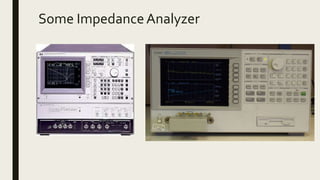
Some ImpedanceAnalyzer
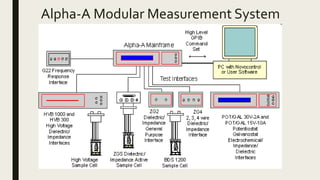
Alpha-A Modular Measurement System
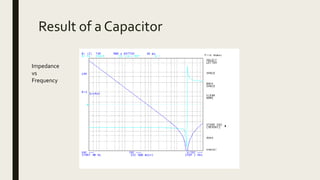
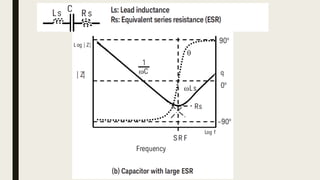
Result of a Capacitor
Impedance
vs
Frequency
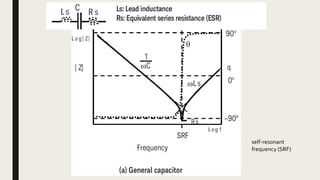
self-resonant
frequency (SRF)
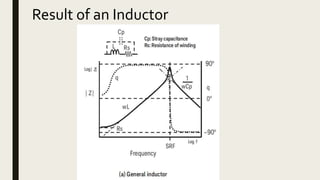
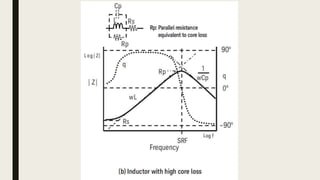
Result of an Inductor
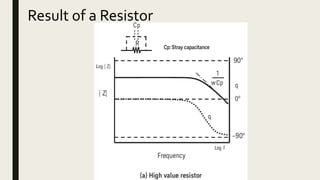
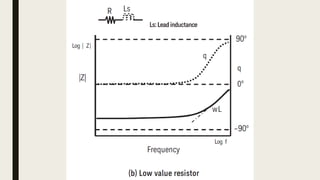
Result of a Resistor
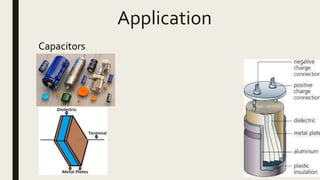
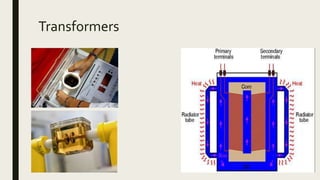
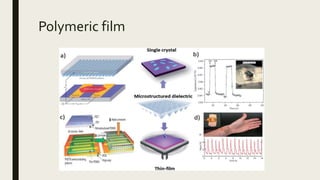
Application
Capacitors
Transformers
Polymeric film
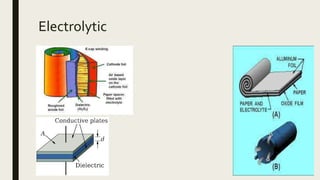
Electrolytic
ThankYou

Dielectric property measurement

  • 1.
    Dielectric Properties Measurement byImpedanceAnalyzer. Submitted by- Jahid Hasan Kasem
  • 2.
    Introduction ■ Dielectrics arethe materials having electric dipole moment permantly ■ Dipole: A dipole is an entity in which equal positive and negative charges are separated by a small distance.
  • 3.
    DIPOLE moment The productof magnitude of either of the charges and separation distance b/w them is called Dipole moment. μe = q . x → coul – m All dielectrics are electrical insulators and they are mainly used to store electrical energy. It stores with minimum dissipation power). Since, the e - are bound to their parent molecules & hence, there is no free charge +q - q X
  • 5.
    Dielectric parameter Dielectric constant(εr):- It is defined as the ratio of permittivity of medium(ε) to the permittivity of free space(Ɛ0). 𝜀 𝑟 = 𝜀 𝜀0 Electric dipole moment (μ):-The product of magnitude of charges & distance of separation is known as electric dipole moment (μ ). μ = Q.r
  • 6.
    Electric Polarization :-Theprocess of producing electric dipoles by an electric field is called polarization in dielectrics. “ In simple words polarization P is defined as the dipole moment per unit volume averaged over the volume of a cell” P = μ / volume Polarizability :-When a dielectric material is placed in an electric field, the displacement of electric charge gives rise to the creation of dipole in the material .The polarization P of an elementary particle is directly proportional to the electric field strength E. P∞E P=aE α→polarizability constant The unit of α is Fm2
  • 7.
    Conductance: Electrical conductancemeasures how easily electricity flows along a certain path through an electrical element.The SI derived unit of conductance is the siemen. Because it is the reciprocal of electrical resistance (measured in ohms), historically, this unit was referred to as the mho. Resistance: The electrical resistance of an electrical conductor is the opposition to the passage of an electric current through that conductor; the inverse quantity is electrical conductance, the ease at which an electric current passes.The SI unit of electrical resistance is the ohm (Ω). Impedance : Electrical impedance, or simply impedance, describes a measure of opposition to alternating current (AC). Electrical impedance extends the concept of resistance to AC circuits, describing not only the relative amplitudes of the voltage and current, but also the relative phases. When the circuit is driven with direct current (DC) there is no distinction between impedance and resistance; the latter can be thought of as impedance with zero phase angle.
  • 8.
    Susceptance (B) :It is the imaginary part of admittance.The inverse of admittance is impedance and the real part of admittance is conductance. In SI units, susceptance is measured in Siemens. The general equation defining admittance is given by Y= G + jB where, Y is the admittance, measured in Siemens (a.k.a. mho, the inverse of ohm).G is the conductance, measured in Siemens. j is the imaginary unit, and B is the susceptance, measured in Siemens.The admittance (Y) is the inverse of the impedance (Z).
  • 9.
    Where, Z = R+ jX Z is the impedance, measured in ohms R is the resistance, measured in ohms X is the reactance, measured in ohms. Note:The susceptance is the imaginary part of the admittance. The magnitude of admittance is given by:
  • 10.
    Properties of GoodDielectric Material ■ It should have high resistivity to reduce the leakage current. ■ It should have high dielectric strength. ■ It should have high mechanical strength. ■ It should have high fire resistance. ■ It should have low thermal expansion. ■ It should have high thermal conductivity. ■ It should have low dielectric loss. ■ It should have low water absorption quality.
  • 11.
  • 12.
  • 13.
    Result of aCapacitor Impedance vs Frequency
  • 14.
  • 16.
    Result of anInductor
  • 18.
    Result of aResistor
  • 20.
  • 21.
  • 22.
  • 23.
  • 24.