PART I
Coalinga is widely-known for it’s oil
fields, drills, and coal mining.
The valley is thought to have
originated below sea-level as an
offshore are depressed by
subduction. This could leave the
area open to many different
sediments, minerals, etc.
Later, the valley was later enclosed
by the uplift of the Coast Ranges.
Faulting moved the Coast Ranges.
Over the years, the valleys filled with
sediments from the faulting and the
filling eventually created a flatness
barely above sea level.
• Metamorphic comes from the Greek words meaning
  “form” and “change.”
• They form deep within the Earth where there is high
  temperature and pressure, along with chemical
  reactions that cause the previous rock to form into a
  new rock.
• Metamorphic rocks can be classified by types of
  foliation.
• There are 3 major types of foliation: Foliated, non
  foliated and weakly foliated.
• Foliated rocks are layered, and rocks that are non-
  foliated are not layered.
• I believe both of
  these rocks to be
  Gneiss.
• Gneiss is a
  metamorphic
  rock that has a
  banded
  appearance (
  bad quality
  camera) and is
  made up of
  granular mineral
  grains.
• The word igneous comes from the Latin word “fire.”
• Igneous rocks begin as hot, fluid material. This could be
  from lava that has erupted, or magma in deep bodies.
• Rock formed from lava is called extrusive (these cool
  quickly), while rock formed from magma is called
  intrusive (cool more slowly) and rock from deep magma
  is defined as plutonic (cool over millions of years.)
• Igneous rocks are usually found in the deep sea floor, or
  above the Earth’s larger subduction zones.
• Some types of Igneous rocks are basalt, granite and
  pumice.
• I believe that this is
  Andesite. Andesite is an
  extrusive igneous rock
  made up mainly of
  plagioclase and other
  minerals. Some minerals
  also associated with
  Andesite would be
  hornblend, pyroxene and
  biotite.
• Most sedimentary rocks form under
  water.
• They are composed of fragments of pre-
  existing rocks that have been
  concentrated, compacted and
  cemented without necessarily
  undergoing chemical change.
• The composition of sedimentary rocks
  depend on the types of rocks from which
  the rock fragments are derived.
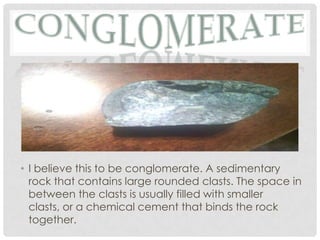
• I believe this to be conglomerate. A sedimentary
  rock that contains large rounded clasts. The space in
  between the clasts is usually filled with smaller
  clasts, or a chemical cement that binds the rock
  together.
• 1.) www.geology.com
• 2.) http://www.buzzle.com/
• 3.) http://www.buzzle.com/articles/earth-sciences/

Fieldlabpart1

  • 1.
  • 2.
    Coalinga is widely-knownfor it’s oil fields, drills, and coal mining. The valley is thought to have originated below sea-level as an offshore are depressed by subduction. This could leave the area open to many different sediments, minerals, etc. Later, the valley was later enclosed by the uplift of the Coast Ranges. Faulting moved the Coast Ranges. Over the years, the valleys filled with sediments from the faulting and the filling eventually created a flatness barely above sea level.
  • 3.
    • Metamorphic comesfrom the Greek words meaning “form” and “change.” • They form deep within the Earth where there is high temperature and pressure, along with chemical reactions that cause the previous rock to form into a new rock. • Metamorphic rocks can be classified by types of foliation. • There are 3 major types of foliation: Foliated, non foliated and weakly foliated. • Foliated rocks are layered, and rocks that are non- foliated are not layered.
  • 4.
    • I believeboth of these rocks to be Gneiss. • Gneiss is a metamorphic rock that has a banded appearance ( bad quality camera) and is made up of granular mineral grains.
  • 5.
    • The wordigneous comes from the Latin word “fire.” • Igneous rocks begin as hot, fluid material. This could be from lava that has erupted, or magma in deep bodies. • Rock formed from lava is called extrusive (these cool quickly), while rock formed from magma is called intrusive (cool more slowly) and rock from deep magma is defined as plutonic (cool over millions of years.) • Igneous rocks are usually found in the deep sea floor, or above the Earth’s larger subduction zones. • Some types of Igneous rocks are basalt, granite and pumice.
  • 6.
    • I believethat this is Andesite. Andesite is an extrusive igneous rock made up mainly of plagioclase and other minerals. Some minerals also associated with Andesite would be hornblend, pyroxene and biotite.
  • 7.
    • Most sedimentaryrocks form under water. • They are composed of fragments of pre- existing rocks that have been concentrated, compacted and cemented without necessarily undergoing chemical change. • The composition of sedimentary rocks depend on the types of rocks from which the rock fragments are derived.
  • 8.
    • I believethis to be conglomerate. A sedimentary rock that contains large rounded clasts. The space in between the clasts is usually filled with smaller clasts, or a chemical cement that binds the rock together.
  • 9.
    • 1.) www.geology.com •2.) http://www.buzzle.com/ • 3.) http://www.buzzle.com/articles/earth-sciences/