Tiffany Laulom(=
The Deadliest War
Chapter 5
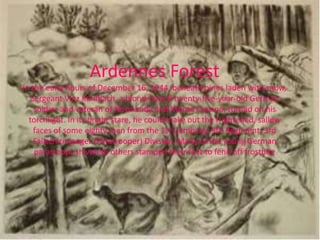
Ardennes Forest
In the early hours of December 16, 1944, beneath pines laden with snow,
   Sergeant Vinz Kuhlbach, a blond-haired twenty-five-year-old German
    soldier and veteran of Normandy and Monte Cassino, turned on his
  torchlight. In its bright stare, he could make out the frightened, sallow
    faces of some eighty men from the 1st Company, 9th Regiment, 3rd
    Fallschirmjaeger (Paratrooper) Division. Many of the young German
    paratroops shivered; others stamped their feet to fend off frostbite
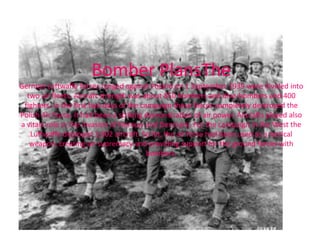
Bomber PlansThe
German Luftwaffe forces ranged against Poland on 1 September 1939 were divided into
  two air fleets. Aircraft strength was about 850 bombers and dive-bombers and 400
 fighters. In the first two days of the campaign these forces completely destroyed the
Polish Air Force. It had been a striking demonstration of air power. Aircrafts played also
a vitale role in the invasion of Norway and Denmark. For the campaign in the West the
   Luftwaffe deployed 3,902 aircraft. So far, the air force had been used as a tactical
   weapon, creating air supremacy and providing support for the ground forces with
                                          bombers.
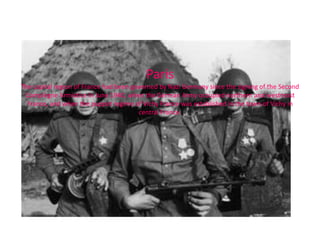
Paris
The capital region of France had been governed by Nazi Germany since the signing of the Second
 Compiègne Armistice in June 1940, when the German Army occupied northern and westmost
  France, and when the puppet regime of Vichy France was established in the town of Vichy in
                                        central France.
Kinder transport
   There were very large Jewish communities in Central Europe and indeed in Galicia
between 1867 and 1914. Poverty was extreme. In that area 5,000 Jews died each year
 through starvation (Gilbert M. 1981, p77). Many people emigrated to the US but also
 to Germany with whom they shared a common language and where Jews flourished.
  After WW1 Abraham left his native town for Berlin. It is possible that Abraham and
Erna had met before they emigrated to Germany since Abraham's older brother Simon
                       was already married to Erna's sister Rosa
Concentration camps
   The number of camps quadrupled between 1939 and 1942 to 300+,[1] as slave-
                       laborers from across Europe, Jews, political
      prisoners, criminals, homosexuals, gypsies, the mentally ill and others were
     incarcerated,[2] generally without judicial process. Holocaust scholars draw a
distinction between concentration camps (described in this article) and extermination
 camps, which were established by the Nazis for the industrial-scale mass murder of
        the predominantly Jewish ghetto and concentration camp populations.

Tiffany laulom(= chapter5

  • 1.
  • 2.
    Ardennes Forest In theearly hours of December 16, 1944, beneath pines laden with snow, Sergeant Vinz Kuhlbach, a blond-haired twenty-five-year-old German soldier and veteran of Normandy and Monte Cassino, turned on his torchlight. In its bright stare, he could make out the frightened, sallow faces of some eighty men from the 1st Company, 9th Regiment, 3rd Fallschirmjaeger (Paratrooper) Division. Many of the young German paratroops shivered; others stamped their feet to fend off frostbite
  • 3.
    Bomber PlansThe German Luftwaffeforces ranged against Poland on 1 September 1939 were divided into two air fleets. Aircraft strength was about 850 bombers and dive-bombers and 400 fighters. In the first two days of the campaign these forces completely destroyed the Polish Air Force. It had been a striking demonstration of air power. Aircrafts played also a vitale role in the invasion of Norway and Denmark. For the campaign in the West the Luftwaffe deployed 3,902 aircraft. So far, the air force had been used as a tactical weapon, creating air supremacy and providing support for the ground forces with bombers.
  • 4.
    Paris The capital regionof France had been governed by Nazi Germany since the signing of the Second Compiègne Armistice in June 1940, when the German Army occupied northern and westmost France, and when the puppet regime of Vichy France was established in the town of Vichy in central France.
  • 5.
    Kinder transport There were very large Jewish communities in Central Europe and indeed in Galicia between 1867 and 1914. Poverty was extreme. In that area 5,000 Jews died each year through starvation (Gilbert M. 1981, p77). Many people emigrated to the US but also to Germany with whom they shared a common language and where Jews flourished. After WW1 Abraham left his native town for Berlin. It is possible that Abraham and Erna had met before they emigrated to Germany since Abraham's older brother Simon was already married to Erna's sister Rosa
  • 6.
    Concentration camps The number of camps quadrupled between 1939 and 1942 to 300+,[1] as slave- laborers from across Europe, Jews, political prisoners, criminals, homosexuals, gypsies, the mentally ill and others were incarcerated,[2] generally without judicial process. Holocaust scholars draw a distinction between concentration camps (described in this article) and extermination camps, which were established by the Nazis for the industrial-scale mass murder of the predominantly Jewish ghetto and concentration camp populations.