Field Based Study
Paul J. Cuaresma
ED 489-01
Fall 2010
University of Guam
Dr. Kalingal
Are student teachers
committed to Formative
Assessment?
Research Question:
Definitions:
• Student Teachers
• Teachers in Training
• Accepted into SOE
• Graduating within three Semesters
• Formative Assessment
• Assessment for Learning
• Committed
• Cognitively, Affectively,
• Skills, Training, Application
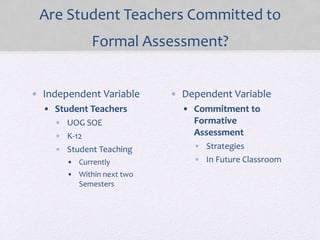
Are Student Teachers Committed to
Formal Assessment?
• Independent Variable
• Student Teachers
• UOG SOE
• K-12
• Student Teaching
• Currently
• Within next two
Semesters
• Dependent Variable
• Commitment to
Formative
Assessment
• Strategies
• In Future Classroom
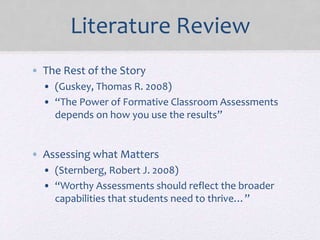
Literature Review
• The Rest of the Story
• (Guskey, Thomas R. 2008)
• “The Power of Formative Classroom Assessments
depends on how you use the results”
• Assessing what Matters
• (Sternberg, Robert J. 2008)
• “Worthy Assessments should reflect the broader
capabilities that students need to thrive…”
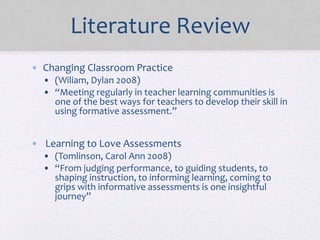
Literature Review
• Changing Classroom Practice
• (Wiliam, Dylan 2008)
• “Meeting regularly in teacher learning communities is
one of the best ways for teachers to develop their skill in
using formative assessment.”
• Learning to Love Assessments
• (Tomlinson, Carol Ann 2008)
• “From judging performance, to guiding students, to
shaping instruction, to informing learning, coming to
grips with informative assessments is one insightful
journey”
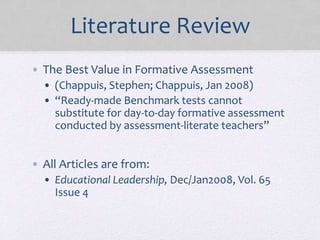
Literature Review
• The Best Value in Formative Assessment
• (Chappuis, Stephen; Chappuis, Jan 2008)
• “Ready-made Benchmark tests cannot
substitute for day-to-day formative assessment
conducted by assessment-literate teachers”
• All Articles are from:
• Educational Leadership, Dec/Jan2008, Vol. 65
Issue 4
Methodology
• Survey
• 15 Questions Total
• 3 - Independent Variable
• 3 - Cognitive
• 3 – Affective
• 2 – Skills/Training
• 4 – Application
• Hosted on www.surveymonkey.com
• Free Hosting/Data Collection
• Limit : 10 questions
• Separated into 2 Surveys
• Emailed to 1st and 2nd degree friends in SOE
• Posted on Facebook.com
Methodology
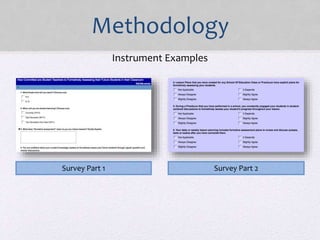
Instrument Examples
Survey Part 1 Survey Part 2
Data
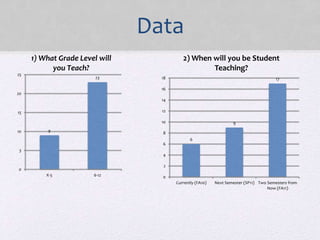
9
23
0
5
10
15
20
25
K-5 6-12
1) What Grade Level will
you Teach?
6
9
17
0
2
4
6
8
10
12
14
16
18
Currently (FA10) Next Semester (SP11) Two Semesters from
Now (FA11)
2) When will you be Student
Teaching?
Data
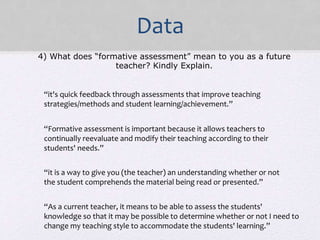
4) What does “formative assessment” mean to you as a future
teacher? Kindly Explain.
“it's quick feedback through assessments that improve teaching
strategies/methods and student learning/achievement.”
“Formative assessment is important because it allows teachers to
continually reevaluate and modify their teaching according to their
students' needs.”
“it is a way to give you (the teacher) an understanding whether or not
the student comprehends the material being read or presented.”
“As a current teacher, it means to be able to assess the students'
knowledge so that it may be possible to determine whether or not I need to
change my teaching style to accommodate the students' learning.”
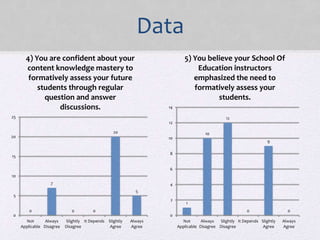
Data
0
7
0 0
20
5
0
5
10
15
20
25
Not
Applicable
Always
Disagree
Slightly
Disagree
It Depends Slightly
Agree
Always
Agree
4) You are confident about your
content knowledge mastery to
formatively assess your future
students through regular
question and answer
discussions.
1
10
12
0
9
0
0
2
4
6
8
10
12
14
Not
Applicable
Always
Disagree
Slightly
Disagree
It Depends Slightly
Agree
Always
Agree
5) You believe your School Of
Education instructors
emphasized the need to
formatively assess your
students.
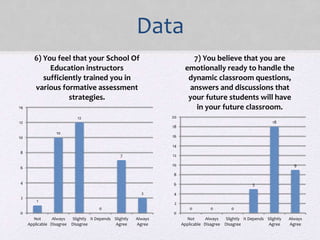
Data
1
10
12
0
7
2
0
2
4
6
8
10
12
14
Not
Applicable
Always
Disagree
Slightly
Disagree
It Depends Slightly
Agree
Always
Agree
6) You feel that your School Of
Education instructors
sufficiently trained you in
various formative assessment
strategies.
0 0 0
5
18
9
0
2
4
6
8
10
12
14
16
18
20
Not
Applicable
Always
Disagree
Slightly
Disagree
It Depends Slightly
Agree
Always
Agree
7) You believe that you are
emotionally ready to handle the
dynamic classroom questions,
answers and discussions that
your future students will have
in your future classroom.
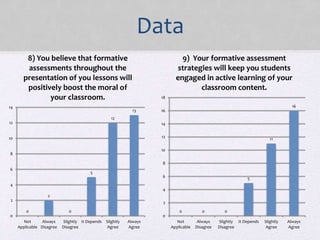
Data
0
2
0
5
12
13
0
2
4
6
8
10
12
14
Not
Applicable
Always
Disagree
Slightly
Disagree
It Depends Slightly
Agree
Always
Agree
8) You believe that formative
assessments throughout the
presentation of you lessons will
positively boost the moral of
your classroom.
0 0 0
5
11
16
0
2
4
6
8
10
12
14
16
18
Not
Applicable
Always
Disagree
Slightly
Disagree
It Depends Slightly
Agree
Always
Agree
9) Your formative assessment
strategies will keep you students
engaged in active learning of your
classroom content.
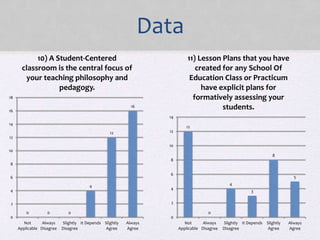
Data
0 0 0
4
12
16
0
2
4
6
8
10
12
14
16
18
Not
Applicable
Always
Disagree
Slightly
Disagree
It Depends Slightly
Agree
Always
Agree
10) A Student-Centered
classroom is the central focus of
your teaching philosophy and
pedagogy.
12
0
4
3
8
5
0
2
4
6
8
10
12
14
Not
Applicable
Always
Disagree
Slightly
Disagree
It Depends Slightly
Agree
Always
Agree
11) Lesson Plans that you have
created for any School Of
Education Class or Practicum
have explicit plans for
formatively assessing your
students.
Data
12
1
3
1
6
9
0
2
4
6
8
10
12
14
Not
Applicable
Always
Disagree
Slightly
Disagree
It Depends Slightly
Agree
Always
Agree
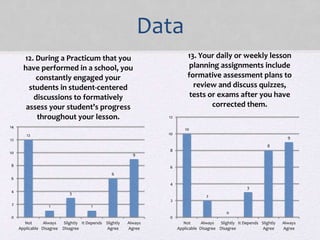
12. During a Practicum that you
have performed in a school, you
constantly engaged your
students in student-centered
discussions to formatively
assess your student’s progress
throughout your lesson.
10
2
0
3
8
9
0
2
4
6
8
10
12
Not
Applicable
Always
Disagree
Slightly
Disagree
It Depends Slightly
Agree
Always
Agree
13. Your daily or weekly lesson
planning assignments include
formative assessment plans to
review and discuss quizzes,
tests or exams after you have
corrected them.
Data
2 2
0
2
8
18
0
2
4
6
8
10
12
14
16
18
20
Not
Applicable
Always
Disagree
Slightly
Disagree
It
Depends
Slightly
Agree
Always
Agree
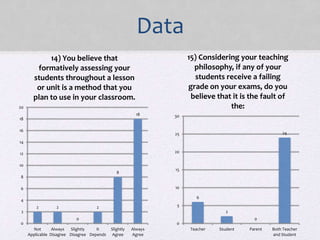
14) You believe that
formatively assessing your
students throughout a lesson
or unit is a method that you
plan to use in your classroom.
6
2
0
24
0
5
10
15
20
25
30
Teacher Student Parent Both Teacher
and Student
15) Considering your teaching
philosophy, if any of your
students receive a failing
grade on your exams, do you
believe that it is the fault of
the:
Analysis
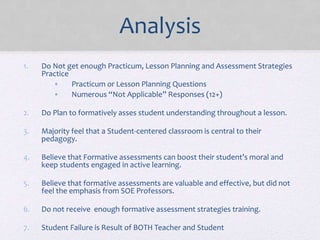
1. Do Not get enough Practicum, Lesson Planning and Assessment Strategies
Practice
• Practicum or Lesson Planning Questions
• Numerous “Not Applicable” Responses (12+)
2. Do Plan to formatively asses student understanding throughout a lesson.
3. Majority feel that a Student-centered classroom is central to their
pedagogy.
4. Believe that Formative assessments can boost their student’s moral and
keep students engaged in active learning.
5. Believe that formative assessments are valuable and effective, but did not
feel the emphasis from SOE Professors.
6. Do not receive enough formative assessment strategies training.
7. Student Failure is Result of BOTH Teacher and Student
Conclusion
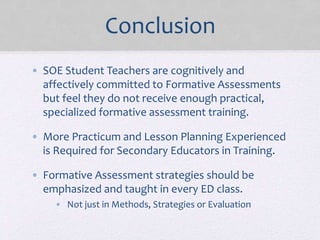
• SOE Student Teachers are cognitively and
affectively committed to Formative Assessments
but feel they do not receive enough practical,
specialized formative assessment training.
• More Practicum and Lesson Planning Experienced
is Required for Secondary Educators in Training.
• Formative Assessment strategies should be
emphasized and taught in every ED class.
• Not just in Methods, Strategies or Evaluation
Resources
• Chappuis, Stephen; Chappuis, Jan (2008). The Best value in Formative
Assessment. Educational Leadership, Dec/Jan2008, Vol. 65 Issue 4, p14-18, 5p.
• Guskey, Thomas R. (2008). The Rest of the Story. Educational Leadership,
Dec/Jan2008, Vol. 65 Issue 4, p28-35, 8p.
• Sternberg, Robert J. (2008). Assessing What Matters. Educational Leadership.
Dec/Jan2008, Vol. 65 Issue 4, p20-26, 7p.
• Tomlinson, Carol Ann (2008). Learning to Love Assessment. Educational
Leadership. Dec/Jan2008, Vol. 65 Issue 4, p8-13, 6p.
• Wiliam, Dylan (2008). Changing Classroom Practices. Educational
Leadership, Dec/Jan2008, Vol. 65 Issue 4, p36-42, 7p.
• www.surveymonkey.com
• www.facebook.com

Field based study ED489

  • 1.
    Field Based Study PaulJ. Cuaresma ED 489-01 Fall 2010 University of Guam Dr. Kalingal
  • 2.
    Are student teachers committedto Formative Assessment? Research Question:
  • 3.
    Definitions: • Student Teachers •Teachers in Training • Accepted into SOE • Graduating within three Semesters • Formative Assessment • Assessment for Learning • Committed • Cognitively, Affectively, • Skills, Training, Application
  • 4.
    Are Student TeachersCommitted to Formal Assessment? • Independent Variable • Student Teachers • UOG SOE • K-12 • Student Teaching • Currently • Within next two Semesters • Dependent Variable • Commitment to Formative Assessment • Strategies • In Future Classroom
  • 5.
    Literature Review • TheRest of the Story • (Guskey, Thomas R. 2008) • “The Power of Formative Classroom Assessments depends on how you use the results” • Assessing what Matters • (Sternberg, Robert J. 2008) • “Worthy Assessments should reflect the broader capabilities that students need to thrive…”
  • 6.
    Literature Review • ChangingClassroom Practice • (Wiliam, Dylan 2008) • “Meeting regularly in teacher learning communities is one of the best ways for teachers to develop their skill in using formative assessment.” • Learning to Love Assessments • (Tomlinson, Carol Ann 2008) • “From judging performance, to guiding students, to shaping instruction, to informing learning, coming to grips with informative assessments is one insightful journey”
  • 7.
    Literature Review • TheBest Value in Formative Assessment • (Chappuis, Stephen; Chappuis, Jan 2008) • “Ready-made Benchmark tests cannot substitute for day-to-day formative assessment conducted by assessment-literate teachers” • All Articles are from: • Educational Leadership, Dec/Jan2008, Vol. 65 Issue 4
  • 8.
    Methodology • Survey • 15Questions Total • 3 - Independent Variable • 3 - Cognitive • 3 – Affective • 2 – Skills/Training • 4 – Application • Hosted on www.surveymonkey.com • Free Hosting/Data Collection • Limit : 10 questions • Separated into 2 Surveys • Emailed to 1st and 2nd degree friends in SOE • Posted on Facebook.com
  • 9.
  • 10.
    Data 9 23 0 5 10 15 20 25 K-5 6-12 1) WhatGrade Level will you Teach? 6 9 17 0 2 4 6 8 10 12 14 16 18 Currently (FA10) Next Semester (SP11) Two Semesters from Now (FA11) 2) When will you be Student Teaching?
  • 11.
    Data 4) What does“formative assessment” mean to you as a future teacher? Kindly Explain. “it's quick feedback through assessments that improve teaching strategies/methods and student learning/achievement.” “Formative assessment is important because it allows teachers to continually reevaluate and modify their teaching according to their students' needs.” “it is a way to give you (the teacher) an understanding whether or not the student comprehends the material being read or presented.” “As a current teacher, it means to be able to assess the students' knowledge so that it may be possible to determine whether or not I need to change my teaching style to accommodate the students' learning.”
  • 12.
    Data 0 7 0 0 20 5 0 5 10 15 20 25 Not Applicable Always Disagree Slightly Disagree It DependsSlightly Agree Always Agree 4) You are confident about your content knowledge mastery to formatively assess your future students through regular question and answer discussions. 1 10 12 0 9 0 0 2 4 6 8 10 12 14 Not Applicable Always Disagree Slightly Disagree It Depends Slightly Agree Always Agree 5) You believe your School Of Education instructors emphasized the need to formatively assess your students.
  • 13.
    Data 1 10 12 0 7 2 0 2 4 6 8 10 12 14 Not Applicable Always Disagree Slightly Disagree It Depends Slightly Agree Always Agree 6)You feel that your School Of Education instructors sufficiently trained you in various formative assessment strategies. 0 0 0 5 18 9 0 2 4 6 8 10 12 14 16 18 20 Not Applicable Always Disagree Slightly Disagree It Depends Slightly Agree Always Agree 7) You believe that you are emotionally ready to handle the dynamic classroom questions, answers and discussions that your future students will have in your future classroom.
  • 14.
    Data 0 2 0 5 12 13 0 2 4 6 8 10 12 14 Not Applicable Always Disagree Slightly Disagree It Depends Slightly Agree Always Agree 8)You believe that formative assessments throughout the presentation of you lessons will positively boost the moral of your classroom. 0 0 0 5 11 16 0 2 4 6 8 10 12 14 16 18 Not Applicable Always Disagree Slightly Disagree It Depends Slightly Agree Always Agree 9) Your formative assessment strategies will keep you students engaged in active learning of your classroom content.
  • 15.
    Data 0 0 0 4 12 16 0 2 4 6 8 10 12 14 16 18 Not Applicable Always Disagree Slightly Disagree ItDepends Slightly Agree Always Agree 10) A Student-Centered classroom is the central focus of your teaching philosophy and pedagogy. 12 0 4 3 8 5 0 2 4 6 8 10 12 14 Not Applicable Always Disagree Slightly Disagree It Depends Slightly Agree Always Agree 11) Lesson Plans that you have created for any School Of Education Class or Practicum have explicit plans for formatively assessing your students.
  • 16.
    Data 12 1 3 1 6 9 0 2 4 6 8 10 12 14 Not Applicable Always Disagree Slightly Disagree It Depends Slightly Agree Always Agree 12.During a Practicum that you have performed in a school, you constantly engaged your students in student-centered discussions to formatively assess your student’s progress throughout your lesson. 10 2 0 3 8 9 0 2 4 6 8 10 12 Not Applicable Always Disagree Slightly Disagree It Depends Slightly Agree Always Agree 13. Your daily or weekly lesson planning assignments include formative assessment plans to review and discuss quizzes, tests or exams after you have corrected them.
  • 17.
    Data 2 2 0 2 8 18 0 2 4 6 8 10 12 14 16 18 20 Not Applicable Always Disagree Slightly Disagree It Depends Slightly Agree Always Agree 14) Youbelieve that formatively assessing your students throughout a lesson or unit is a method that you plan to use in your classroom. 6 2 0 24 0 5 10 15 20 25 30 Teacher Student Parent Both Teacher and Student 15) Considering your teaching philosophy, if any of your students receive a failing grade on your exams, do you believe that it is the fault of the:
  • 18.
    Analysis 1. Do Notget enough Practicum, Lesson Planning and Assessment Strategies Practice • Practicum or Lesson Planning Questions • Numerous “Not Applicable” Responses (12+) 2. Do Plan to formatively asses student understanding throughout a lesson. 3. Majority feel that a Student-centered classroom is central to their pedagogy. 4. Believe that Formative assessments can boost their student’s moral and keep students engaged in active learning. 5. Believe that formative assessments are valuable and effective, but did not feel the emphasis from SOE Professors. 6. Do not receive enough formative assessment strategies training. 7. Student Failure is Result of BOTH Teacher and Student
  • 19.
    Conclusion • SOE StudentTeachers are cognitively and affectively committed to Formative Assessments but feel they do not receive enough practical, specialized formative assessment training. • More Practicum and Lesson Planning Experienced is Required for Secondary Educators in Training. • Formative Assessment strategies should be emphasized and taught in every ED class. • Not just in Methods, Strategies or Evaluation
  • 20.
    Resources • Chappuis, Stephen;Chappuis, Jan (2008). The Best value in Formative Assessment. Educational Leadership, Dec/Jan2008, Vol. 65 Issue 4, p14-18, 5p. • Guskey, Thomas R. (2008). The Rest of the Story. Educational Leadership, Dec/Jan2008, Vol. 65 Issue 4, p28-35, 8p. • Sternberg, Robert J. (2008). Assessing What Matters. Educational Leadership. Dec/Jan2008, Vol. 65 Issue 4, p20-26, 7p. • Tomlinson, Carol Ann (2008). Learning to Love Assessment. Educational Leadership. Dec/Jan2008, Vol. 65 Issue 4, p8-13, 6p. • Wiliam, Dylan (2008). Changing Classroom Practices. Educational Leadership, Dec/Jan2008, Vol. 65 Issue 4, p36-42, 7p. • www.surveymonkey.com • www.facebook.com