


TEXTUAL
HARASSMENT
AND SEXTING
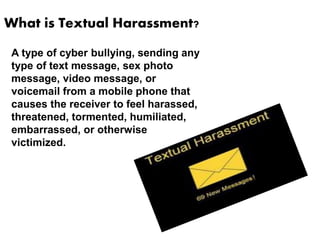
A type of cyber bullying, sending any
type of text message, sex photo
message, video message, or
voicemail from a mobile phone that
causes the receiver to feel harassed,
threatened, tormented, humiliated,
embarrassed, or otherwise
victimized.
What is Textual Harassment?
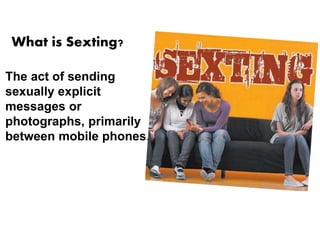
What is Sexting?
The act of sending
sexually explicit
messages or
photographs, primarily
between mobile phones.
Guam on Sexting and
Textual Harassment
• In 2010, at least 16
states and Guam
introduced or are
considering bills or
resolutions aimed at
sexting.
• The legislation
generally aims to
educate young people
about the risks of
sexting
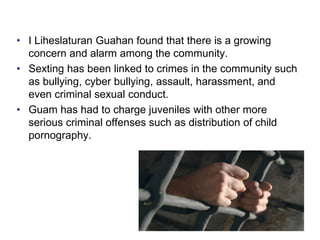
• I Liheslaturan Guahan found that there is a growing
concern and alarm among the community.
• Sexting has been linked to crimes in the community such
as bullying, cyber bullying, assault, harassment, and
even criminal sexual conduct.
• Guam has had to charge juveniles with other more
serious criminal offenses such as distribution of child
pornography.
• I Liheslaturan Guahan finds that there is a need to
create a program for first time offending juveniles,
charged for sexting or posting of sexual images.
• I Liheslaturan Guahan wishes to establish an
educational program that is intended to be an
alternative to prosecution for juveniles who are
charged with criminal offense.
Alarming Statistics
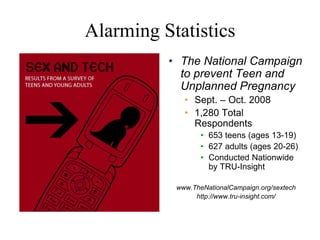
• The National Campaign
to prevent Teen and
Unplanned Pregnancy
• Sept. – Oct. 2008
• 1,280 Total
Respondents
• 653 teens (ages 13-19)
• 627 adults (ages 20-26)
• Conducted Nationwide
by TRU-Insight
www.TheNationalCampaign.org/sextech
http://www.tru-insight.com/
Alarming Statistics
Teens that have
electronically sent nude
or semi-nude pictures
or video of themselves.
• 20% of teens overall
• 22% of teen girls
• 18% of teen boys
• 11% of young teen girls
(ages 13-16)
How many teens are
sending sexually
suggestive
messages?
• 39% of all teens
• 37% of teen girls
• 40% of teen boys
• 48% of teens say they
have received such
messages
Alarming Statistics
• How do teens and young
adults feel about
sending/posting sexually
suggestive content?
• 75% of teens and 71% of young
adults say texting sexually
suggestive content “can have
serious negative
consequences.”
• Yet, 39% of teens and 59% of
young adults have sent or
posted
• Teens and young adults admit
that sending/posting sexually
suggestive content has an
impact on their behavior.
• 22% of teens and 28% of young
adults say they are more
aggressive using sexually
suggestive words and images
than they are in “real life.”
• 38% of teens and 40% of young
adults say exchanging sexually
suggestive content makes
dating or “hooking up” more
likely.
Analysis of Statistics
• ~ 20% of teens are sending Sexually
Suggestive/Explicit Images of Themselves
• ~ 40% of teens are Sending Sexually
Suggestive Text Messages
• ~ 70 – 75% Believe that there are “Serious
Negative Consequences
• ~ 25 - 30% Feel that it they are more
sexually aggressive when texting than in
real life.
http://www.youtube.com/watch?v=VLTj3WBmY1k
Video: Mother Loses Daughter Over Sexting
Preventions
•Contact the carrier and
ask that the text
message function be
disabled
•Turning off the
text messaging
function for a few
days may be
enough to
discourage the
harasser
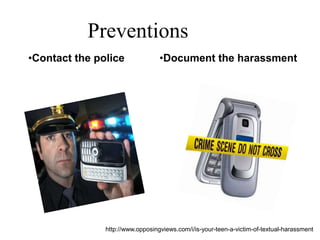
•Contact the police •Document the harassment
Preventions
http://www.opposingviews.com/i/is-your-teen-a-victim-of-textual-harassment
Preventions
•Services and software that makes it easier for parents
to monitor their child’s phone usage
http://www.cbsnews.com/stories/2010/06/22/earlyshow/living/parenting/main6606332.shtml
Conclusion

Textual harassment and sexting FINAL

  • 1.
  • 2.
    A type ofcyber bullying, sending any type of text message, sex photo message, video message, or voicemail from a mobile phone that causes the receiver to feel harassed, threatened, tormented, humiliated, embarrassed, or otherwise victimized. What is Textual Harassment?
  • 4.
    What is Sexting? Theact of sending sexually explicit messages or photographs, primarily between mobile phones.
  • 6.
    Guam on Sextingand Textual Harassment • In 2010, at least 16 states and Guam introduced or are considering bills or resolutions aimed at sexting. • The legislation generally aims to educate young people about the risks of sexting
  • 7.
    • I LiheslaturanGuahan found that there is a growing concern and alarm among the community. • Sexting has been linked to crimes in the community such as bullying, cyber bullying, assault, harassment, and even criminal sexual conduct. • Guam has had to charge juveniles with other more serious criminal offenses such as distribution of child pornography.
  • 8.
    • I LiheslaturanGuahan finds that there is a need to create a program for first time offending juveniles, charged for sexting or posting of sexual images. • I Liheslaturan Guahan wishes to establish an educational program that is intended to be an alternative to prosecution for juveniles who are charged with criminal offense.
  • 9.
    Alarming Statistics • TheNational Campaign to prevent Teen and Unplanned Pregnancy • Sept. – Oct. 2008 • 1,280 Total Respondents • 653 teens (ages 13-19) • 627 adults (ages 20-26) • Conducted Nationwide by TRU-Insight www.TheNationalCampaign.org/sextech http://www.tru-insight.com/
  • 10.
    Alarming Statistics Teens thathave electronically sent nude or semi-nude pictures or video of themselves. • 20% of teens overall • 22% of teen girls • 18% of teen boys • 11% of young teen girls (ages 13-16) How many teens are sending sexually suggestive messages? • 39% of all teens • 37% of teen girls • 40% of teen boys • 48% of teens say they have received such messages
  • 11.
    Alarming Statistics • Howdo teens and young adults feel about sending/posting sexually suggestive content? • 75% of teens and 71% of young adults say texting sexually suggestive content “can have serious negative consequences.” • Yet, 39% of teens and 59% of young adults have sent or posted • Teens and young adults admit that sending/posting sexually suggestive content has an impact on their behavior. • 22% of teens and 28% of young adults say they are more aggressive using sexually suggestive words and images than they are in “real life.” • 38% of teens and 40% of young adults say exchanging sexually suggestive content makes dating or “hooking up” more likely.
  • 12.
    Analysis of Statistics •~ 20% of teens are sending Sexually Suggestive/Explicit Images of Themselves • ~ 40% of teens are Sending Sexually Suggestive Text Messages • ~ 70 – 75% Believe that there are “Serious Negative Consequences • ~ 25 - 30% Feel that it they are more sexually aggressive when texting than in real life.
  • 13.
  • 14.
    Preventions •Contact the carrierand ask that the text message function be disabled •Turning off the text messaging function for a few days may be enough to discourage the harasser
  • 15.
    •Contact the police•Document the harassment Preventions http://www.opposingviews.com/i/is-your-teen-a-victim-of-textual-harassment
  • 16.
    Preventions •Services and softwarethat makes it easier for parents to monitor their child’s phone usage http://www.cbsnews.com/stories/2010/06/22/earlyshow/living/parenting/main6606332.shtml
  • 17.