FIBER EXAMINATION
Nandini Katare
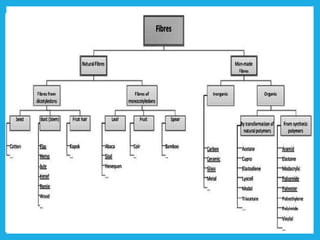
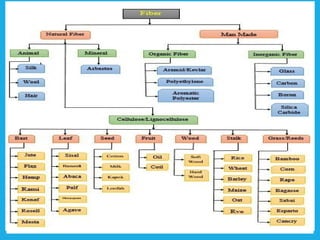
Fibre-Types and
Classification
Introduction
Natural Fibres
Fibres that are
obtained from natural
sources like plants
(cotton, linen, jute),
animals (wool, silk),
and minerals
(asbestos).
Man-made Fibres
Fibres that are
manufactured from
synthetic polymers or
modified natural
polymers through various
chemical processes like
polymerization, melt
spinning, and solution
spinning.
Textiles are made from a variety of
natural and man-made fibres, each with
their own unique properties and
production processes.
Natural Fibres
•Vegetable Fibres
Cellulose-based fibres obtained
from various plants, including
cotton, linen, jute, flax, ramie,
coir, sisal, and hemp. These
fibres are used for textiles,
paper, ropes, cords, coir mats,
and industrial fabrics.
•Animal Fibres
Protein-based fibres obtained
from animals such as sheep,
goats, rabbits, and silkworms.
Examples include wool and silk.
•Mineral Fibres
Naturally occurring mineral
fibres, with asbestos being the
only one used extensively,
though it is now being phased
out due to its suspected
carcinogenic effects.
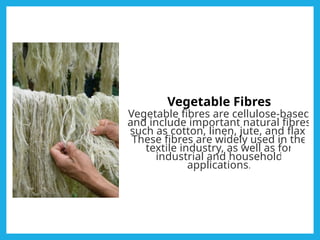
Vegetable Fibres
Vegetable fibres are cellulose-based
and include important natural fibres
such as cotton, linen, jute, and flax.
These fibres are widely used in the
textile industry, as well as for
industrial and household
applications.
Animal Fibres
Wool
Wool is a protein-based natural fibre
grown by animals like sheep, goats,
rabbits, and camels. Sheep provide
almost 90% of the total wool
produced globally. Wool grows at a
rate of about 1.25 cm per month and
is sheared after the full growth of the
thick coat.
Silk
Silk is another protein-based natural
fibre, produced by the silkworm. The
silkworm secretes a viscous fluid
from its glands and wraps itself with
the filament to form a cocoon. The
rate at which the silkworm produces
a 1 to 2 kilometer long filament is
close to 50 cm per hour.
Global Wool Production
In 1996, there were more than 12
crore sheep in the world, with India
having 4.5 crore sheep. However,
India's share of world wool
production was much lower.
Silk Production
The silkworm cocoon is subjected to
stoving (steaming), and the silkworm
dies inside the cocoon. The filament
is then collected for use in textile
production.
Man-Made Fibres
• Derived from
Natural
Feedstock
These fibres are
derived from natural
sources like cellulose
(viscose rayon, lyocell,
tencel) and rubber
latex. Viscose rayon
was the first truly
man-made fibre,
discovered over 100
years ago. More
recently, solvents for
cellulose have been
found, allowing for
the production of
cellulose fibres
directly from a
cellulose solution,
under the trade
names Lyocell and
• Derived from
Manufactured
Feedstock
These fibres are
produced from low
molecular weight
chemicals that are
converted into fibre-
forming polymers
through
polymerization.
Synthetic fibres like
polyamides (nylon 66,
nylon 6), polyesters,
acrylics, and
polypropylene are
obtained through this
route. Elastomeric
fibres like spandex
and lycra are also
similarly made.
• Miscellaneous
Fibres
This category includes
man-made fibres like
glass fibres and
metallic fibres (silver,
gold).
Derived from Natural Feedstock-Regenerated
Viscose Rayon
Previously made through a complex process
involving the conversion of cellulose to
cellulose xanthate, now using direct cellulose
dissolution methods.
Lyocell and Tencel
Direct cellulose dissolution methods have led
to the development of these advanced
cellulose-based fibres.
Chemically Modified Cellulose Fibres
Small quantities of cellulose diacetate and
cellulose triacetate are also produced as
chemically modified cellulose fibres.
Rubber Fibres
Rubber latex from rubber trees is used as a
natural feedstock to make rubber fibres for
textile and other industries.
Fibres derived from natural feedstock share similarities with natural cellulosic fibres,
offering comfort and suitability for apparel in tropical and hot climates, though they
may exhibit greater non-uniformity and complexity compared to man-made fibres.
Fiber examinations
•Fiber examinations involve a comparison of
samples from known and questioned sources to
determine whether they are originated from
the same source.
•Textile fibers can be exchanged between
individuals, between individuals and objects
and between objects.
•Fibers are associated with a specific source,
such as fabric from the victim, suspect or
scene.
•Whether a fiber is transferred and detected is
also dependent on the nature and duration of
the contact between the suspect and the
victim and/or scene and the persistence of the
fibers after they have been transferred.
Analysis
•There are three basic activities involved in an
analysis:
•1. Collection of a representative sample
•2. Preparation of the sample for analysis
•3. Analysis using appropriate methods
Physical Matches
• A physical match occurs when two or more pieces of fabric or
cordage can be reconstructed to prove they were previously one
continuous piece of fabric or cordage.
• This examination is conducted by describing and documenting any
cut, torn or damaged edges on questioned items and their
correlation to like areas on known items. Photography is the
recommended method for physical matching record.
Microscopic examination of Textile
Fibers
• Several types of light microscopes are used
including stereo binocular comparison microscope,
a compound light microscope equipped with
polarized light, fluorescence and interference.
• In certain instances, the scanning electron
microscope may yield additional information.
• They are mounted on glass microscope slides in a mounting
medium under a cover slip.
• The fibers are then examined microscopically with a combination
of various illumination sources, filters, and instrumentation
attached to a microscope to determine their polymer type and
record any microscopic characteristics.
• Known and questioned fibers are then compared to determine if
they exhibit the same microscopic characteristics and optical
properties.
Thin-Layer Chromatographic
examination of Nonreactive Dyes in
Textile Fibers
• TLC is an inexpensive, simple, well documented technique
that, under certain conditions, can be used to complement
the use of visible spectroscopy in comparisons of fiber
colorants.
Principle of tlc
•The principle of the method is that the
dye components are separated by their
differential migration caused by a
mobile phase flowing through a
porous, adsorptive medium.
• Forensic analysis of fiber colorants using TLC should be
considered for single fiber comparisons only when it is not
possible to discriminate between the fibers of interest using other
techniques, such as comparison microscopy (brightfield and
fluorescence) and microspectrophotometry in the visible range.
• The application of TLC may serve to discriminate between fibers,
or it may confirm their similarity.
Analytical
Techniques for Fibre
Examination
.
Microscopic Examination
Stereomicroscopy
Used to give a
general overview of
the fibre, helping
identify color,
texture, and possible
damages.
Polarized Light
Microscopy (PLM)
Used to determine
the optical properties
of fibres, including
birefringence,
refractive indices,
and pleochroism,
which can help
distinguish between
natural and synthetic
fibres.
Comparison
Microscopy
Used to compare
questioned fibres
with known
standards for side-
by-side analysis of
physical and optical
properties.
Microscopic examination is a fundamental technique in
fibre analysis, providing valuable insights into the
morphology, color, and surface features of fibres, which
are crucial for establishing links between suspects, victims,
and crime scenes.
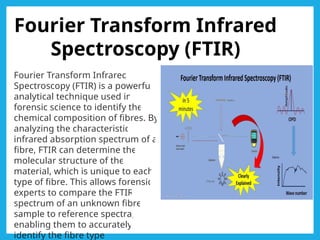
Fourier Transform Infrared
Spectroscopy (FTIR)
Fourier Transform Infrared
Spectroscopy (FTIR) is a powerful
analytical technique used in
forensic science to identify the
chemical composition of fibres. By
analyzing the characteristic
infrared absorption spectrum of a
fibre, FTIR can determine the
molecular structure of the
material, which is unique to each
type of fibre. This allows forensic
experts to compare the FTIR
spectrum of an unknown fibre
sample to reference spectra,
enabling them to accurately
identify the fibre type.
Raman Spectroscopy
Non-Destructive Analysis
Raman spectroscopy provides
detailed molecular information about
the fibre without damaging or
destroying the sample.
Comprehensive Fibre
Analysis
Raman spectroscopy can be used to
analyze both natural and synthetic
fibres, making it a versatile technique
for forensic investigations.
Differentiation of Dyes and
Additives
Raman spectroscopy can be used to
differentiate between different dyes
and additives present in the fibre,
providing valuable information for
comparison and identification.
Minimal Sample Required
Only a small amount of sample is
needed for Raman spectroscopic
analysis, making it an efficient and
non-destructive technique.
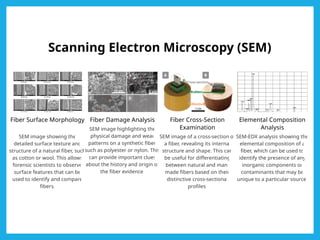
Scanning Electron Microscopy (SEM)
Fiber Surface Morphology
SEM image showing the
detailed surface texture and
structure of a natural fiber, such
as cotton or wool. This allows
forensic scientists to observe
surface features that can be
used to identify and compare
fibers.
Fiber Damage Analysis
SEM image highlighting the
physical damage and wear
patterns on a synthetic fiber,
such as polyester or nylon. This
can provide important clues
about the history and origin of
the fiber evidence.
Fiber Cross-Section
Examination
SEM image of a cross-section of
a fiber, revealing its internal
structure and shape. This can
be useful for differentiating
between natural and man-
made fibers based on their
distinctive cross-sectional
profiles.
Elemental Composition
Analysis
SEM-EDX analysis showing the
elemental composition of a
fiber, which can be used to
identify the presence of any
inorganic components or
contaminants that may be
unique to a particular source.
Ultraviolet-Visible (UV-Vis) Spectrophotometry
Fibre Dye Analysis
Dye Identification
Dye Differentiation
Colour Characterization
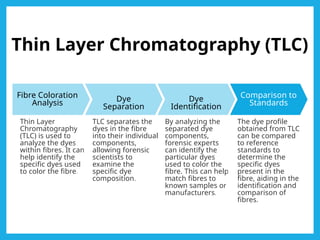
Thin Layer Chromatography (TLC)
Fibre Coloration
Analysis
Thin Layer
Chromatography
(TLC) is used to
analyze the dyes
within fibres. It can
help identify the
specific dyes used
to color the fibre.
Dye
Separation
TLC separates the
dyes in the fibre
into their individual
components,
allowing forensic
scientists to
examine the
specific dye
composition.
Dye
Identification
By analyzing the
separated dye
components,
forensic experts
can identify the
particular dyes
used to color the
fibre. This can help
match fibres to
known samples or
manufacturers.
Comparison to
Standards
The dye profile
obtained from TLC
can be compared
to reference
standards to
determine the
specific dyes
present in the
fibre, aiding in the
identification and
comparison of
fibres.
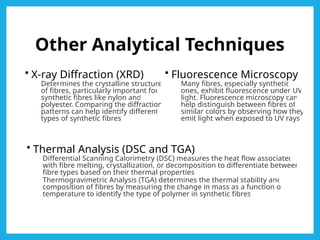
Other Analytical Techniques
• X-ray Diffraction (XRD)
Determines the crystalline structure
of fibres, particularly important for
synthetic fibres like nylon and
polyester. Comparing the diffraction
patterns can help identify different
types of synthetic fibres.
• Fluorescence Microscopy
Many fibres, especially synthetic
ones, exhibit fluorescence under UV
light. Fluorescence microscopy can
help distinguish between fibres of
similar colors by observing how they
emit light when exposed to UV rays.
• Thermal Analysis (DSC and TGA)
Differential Scanning Calorimetry (DSC) measures the heat flow associated
with fibre melting, crystallization, or decomposition to differentiate between
fibre types based on their thermal properties.
Thermogravimetric Analysis (TGA) determines the thermal stability and
composition of fibres by measuring the change in mass as a function of
temperature to identify the type of polymer in synthetic fibres.
Thank You

Fiber- Types, Collection and Examination.pptx

  • 1.
  • 2.
  • 5.
    Introduction Natural Fibres Fibres thatare obtained from natural sources like plants (cotton, linen, jute), animals (wool, silk), and minerals (asbestos). Man-made Fibres Fibres that are manufactured from synthetic polymers or modified natural polymers through various chemical processes like polymerization, melt spinning, and solution spinning. Textiles are made from a variety of natural and man-made fibres, each with their own unique properties and production processes.
  • 6.
    Natural Fibres •Vegetable Fibres Cellulose-basedfibres obtained from various plants, including cotton, linen, jute, flax, ramie, coir, sisal, and hemp. These fibres are used for textiles, paper, ropes, cords, coir mats, and industrial fabrics. •Animal Fibres Protein-based fibres obtained from animals such as sheep, goats, rabbits, and silkworms. Examples include wool and silk. •Mineral Fibres Naturally occurring mineral fibres, with asbestos being the only one used extensively, though it is now being phased out due to its suspected carcinogenic effects.
  • 7.
    Vegetable Fibres Vegetable fibresare cellulose-based and include important natural fibres such as cotton, linen, jute, and flax. These fibres are widely used in the textile industry, as well as for industrial and household applications.
  • 8.
    Animal Fibres Wool Wool isa protein-based natural fibre grown by animals like sheep, goats, rabbits, and camels. Sheep provide almost 90% of the total wool produced globally. Wool grows at a rate of about 1.25 cm per month and is sheared after the full growth of the thick coat. Silk Silk is another protein-based natural fibre, produced by the silkworm. The silkworm secretes a viscous fluid from its glands and wraps itself with the filament to form a cocoon. The rate at which the silkworm produces a 1 to 2 kilometer long filament is close to 50 cm per hour. Global Wool Production In 1996, there were more than 12 crore sheep in the world, with India having 4.5 crore sheep. However, India's share of world wool production was much lower. Silk Production The silkworm cocoon is subjected to stoving (steaming), and the silkworm dies inside the cocoon. The filament is then collected for use in textile production.
  • 9.
    Man-Made Fibres • Derivedfrom Natural Feedstock These fibres are derived from natural sources like cellulose (viscose rayon, lyocell, tencel) and rubber latex. Viscose rayon was the first truly man-made fibre, discovered over 100 years ago. More recently, solvents for cellulose have been found, allowing for the production of cellulose fibres directly from a cellulose solution, under the trade names Lyocell and • Derived from Manufactured Feedstock These fibres are produced from low molecular weight chemicals that are converted into fibre- forming polymers through polymerization. Synthetic fibres like polyamides (nylon 66, nylon 6), polyesters, acrylics, and polypropylene are obtained through this route. Elastomeric fibres like spandex and lycra are also similarly made. • Miscellaneous Fibres This category includes man-made fibres like glass fibres and metallic fibres (silver, gold).
  • 10.
    Derived from NaturalFeedstock-Regenerated Viscose Rayon Previously made through a complex process involving the conversion of cellulose to cellulose xanthate, now using direct cellulose dissolution methods. Lyocell and Tencel Direct cellulose dissolution methods have led to the development of these advanced cellulose-based fibres. Chemically Modified Cellulose Fibres Small quantities of cellulose diacetate and cellulose triacetate are also produced as chemically modified cellulose fibres. Rubber Fibres Rubber latex from rubber trees is used as a natural feedstock to make rubber fibres for textile and other industries. Fibres derived from natural feedstock share similarities with natural cellulosic fibres, offering comfort and suitability for apparel in tropical and hot climates, though they may exhibit greater non-uniformity and complexity compared to man-made fibres.
  • 11.
    Fiber examinations •Fiber examinationsinvolve a comparison of samples from known and questioned sources to determine whether they are originated from the same source. •Textile fibers can be exchanged between individuals, between individuals and objects and between objects.
  • 12.
    •Fibers are associatedwith a specific source, such as fabric from the victim, suspect or scene. •Whether a fiber is transferred and detected is also dependent on the nature and duration of the contact between the suspect and the victim and/or scene and the persistence of the fibers after they have been transferred.
  • 13.
    Analysis •There are threebasic activities involved in an analysis: •1. Collection of a representative sample •2. Preparation of the sample for analysis •3. Analysis using appropriate methods
  • 14.
    Physical Matches • Aphysical match occurs when two or more pieces of fabric or cordage can be reconstructed to prove they were previously one continuous piece of fabric or cordage. • This examination is conducted by describing and documenting any cut, torn or damaged edges on questioned items and their correlation to like areas on known items. Photography is the recommended method for physical matching record.
  • 15.
    Microscopic examination ofTextile Fibers • Several types of light microscopes are used including stereo binocular comparison microscope, a compound light microscope equipped with polarized light, fluorescence and interference. • In certain instances, the scanning electron microscope may yield additional information.
  • 16.
    • They aremounted on glass microscope slides in a mounting medium under a cover slip. • The fibers are then examined microscopically with a combination of various illumination sources, filters, and instrumentation attached to a microscope to determine their polymer type and record any microscopic characteristics. • Known and questioned fibers are then compared to determine if they exhibit the same microscopic characteristics and optical properties.
  • 17.
    Thin-Layer Chromatographic examination ofNonreactive Dyes in Textile Fibers • TLC is an inexpensive, simple, well documented technique that, under certain conditions, can be used to complement the use of visible spectroscopy in comparisons of fiber colorants.
  • 18.
    Principle of tlc •Theprinciple of the method is that the dye components are separated by their differential migration caused by a mobile phase flowing through a porous, adsorptive medium.
  • 19.
    • Forensic analysisof fiber colorants using TLC should be considered for single fiber comparisons only when it is not possible to discriminate between the fibers of interest using other techniques, such as comparison microscopy (brightfield and fluorescence) and microspectrophotometry in the visible range. • The application of TLC may serve to discriminate between fibers, or it may confirm their similarity.
  • 20.
  • 21.
    Microscopic Examination Stereomicroscopy Used togive a general overview of the fibre, helping identify color, texture, and possible damages. Polarized Light Microscopy (PLM) Used to determine the optical properties of fibres, including birefringence, refractive indices, and pleochroism, which can help distinguish between natural and synthetic fibres. Comparison Microscopy Used to compare questioned fibres with known standards for side- by-side analysis of physical and optical properties. Microscopic examination is a fundamental technique in fibre analysis, providing valuable insights into the morphology, color, and surface features of fibres, which are crucial for establishing links between suspects, victims, and crime scenes.
  • 22.
    Fourier Transform Infrared Spectroscopy(FTIR) Fourier Transform Infrared Spectroscopy (FTIR) is a powerful analytical technique used in forensic science to identify the chemical composition of fibres. By analyzing the characteristic infrared absorption spectrum of a fibre, FTIR can determine the molecular structure of the material, which is unique to each type of fibre. This allows forensic experts to compare the FTIR spectrum of an unknown fibre sample to reference spectra, enabling them to accurately identify the fibre type.
  • 23.
    Raman Spectroscopy Non-Destructive Analysis Ramanspectroscopy provides detailed molecular information about the fibre without damaging or destroying the sample. Comprehensive Fibre Analysis Raman spectroscopy can be used to analyze both natural and synthetic fibres, making it a versatile technique for forensic investigations. Differentiation of Dyes and Additives Raman spectroscopy can be used to differentiate between different dyes and additives present in the fibre, providing valuable information for comparison and identification. Minimal Sample Required Only a small amount of sample is needed for Raman spectroscopic analysis, making it an efficient and non-destructive technique.
  • 24.
    Scanning Electron Microscopy(SEM) Fiber Surface Morphology SEM image showing the detailed surface texture and structure of a natural fiber, such as cotton or wool. This allows forensic scientists to observe surface features that can be used to identify and compare fibers. Fiber Damage Analysis SEM image highlighting the physical damage and wear patterns on a synthetic fiber, such as polyester or nylon. This can provide important clues about the history and origin of the fiber evidence. Fiber Cross-Section Examination SEM image of a cross-section of a fiber, revealing its internal structure and shape. This can be useful for differentiating between natural and man- made fibers based on their distinctive cross-sectional profiles. Elemental Composition Analysis SEM-EDX analysis showing the elemental composition of a fiber, which can be used to identify the presence of any inorganic components or contaminants that may be unique to a particular source.
  • 25.
    Ultraviolet-Visible (UV-Vis) Spectrophotometry FibreDye Analysis Dye Identification Dye Differentiation Colour Characterization
  • 26.
    Thin Layer Chromatography(TLC) Fibre Coloration Analysis Thin Layer Chromatography (TLC) is used to analyze the dyes within fibres. It can help identify the specific dyes used to color the fibre. Dye Separation TLC separates the dyes in the fibre into their individual components, allowing forensic scientists to examine the specific dye composition. Dye Identification By analyzing the separated dye components, forensic experts can identify the particular dyes used to color the fibre. This can help match fibres to known samples or manufacturers. Comparison to Standards The dye profile obtained from TLC can be compared to reference standards to determine the specific dyes present in the fibre, aiding in the identification and comparison of fibres.
  • 27.
    Other Analytical Techniques •X-ray Diffraction (XRD) Determines the crystalline structure of fibres, particularly important for synthetic fibres like nylon and polyester. Comparing the diffraction patterns can help identify different types of synthetic fibres. • Fluorescence Microscopy Many fibres, especially synthetic ones, exhibit fluorescence under UV light. Fluorescence microscopy can help distinguish between fibres of similar colors by observing how they emit light when exposed to UV rays. • Thermal Analysis (DSC and TGA) Differential Scanning Calorimetry (DSC) measures the heat flow associated with fibre melting, crystallization, or decomposition to differentiate between fibre types based on their thermal properties. Thermogravimetric Analysis (TGA) determines the thermal stability and composition of fibres by measuring the change in mass as a function of temperature to identify the type of polymer in synthetic fibres.
  • 28.